Best Database That Connects to Data Platform in 2026: Prices, Free Plans and 6 Picks
Best database that connects to data platform in 2026: 6 contenders with entry costs and free tiers. Weaknesses are named for every tool. Read before you buy.
- Editor's choice
 MongoDB Atlas
Operational AI applications
Starts atSee websiteVisit mongodb.comFull review - Great alternative
 SingleStore
Live transactions and analytics
Starts atSee websiteVisit singlestore.comFull review - Also consider
 Amazon Redshift
Economical cloud data warehousing
Starts atSee websiteVisit aws.amazon.comFull review
Direct answer
If you need operational AI applications, MongoDB Atlas is the first tool to look at here. Listed starting prices: ClickHouse from $0.056 per unit per hour. Alternatives: SingleStore for live transactions and analytics, and Amazon Redshift for economical cloud data warehousing. Prices, free plans and limits for all 6 tools follow.
TL;DR:
- MongoDB Atlas is the opening pick, best for operational AI applications.
- Just one of the 6 tools, MongoDB Atlas, has a free plan.
- MongoDB Atlas, SingleStore, Amazon Redshift and others: pricing is by quote only, so plan time for a sales conversation.
- For live analytics at scale, ClickHouse is worth a look.
- Check the limits for MongoDB Atlas before you commit: not well suited to traditional warehousing.
Last checked November 2026. Prices and plan details were read from the vendors' own pages in November 2026; vendors change plans often, so confirm the current price on the vendor site before you buy.
Quick comparison
| Tool | Best for | Starts at | Free plan? | |
|---|---|---|---|---|
| MongoDB Atlas | Operational AI applications | See website | Yes | Visit |
| SingleStore | Live transactions and analytics | See website | Not stated | Visit |
| Amazon Redshift | Economical cloud data warehousing | See website | Not stated | Visit |
| Databricks Lakehouse Platform | Unified data, analytics, and AI | See website | Not stated | Visit |
 Google BigQuery | Completely managed AI data product | See website | Not stated | Visit |
| ClickHouse | Live analytics at scale | $0.056 per unit per hour | Free trial | Visit |
Database That Connects to Data Platform, one by one
This LinkVetted guide covers 6 options for database that connects to data platform. Each profile lists a starting price, free plan details, strengths and drawbacks, so you can drop poor fits quickly.
MongoDB Atlas works best for operational AI applications. As for the details, Atlas is not made for traditional SQL-based data warehousing or complicated analytical queries. It may lack the mature BI tooling of dedicated warehouses.
Also, MongoDB Atlas is a modern, run-anywhere data product that brings together live data, intelligent retrieval, and governed action for building AI applications and agents. It is well-suited for developers creating operational applications that need flexible schemas and live data access. For heavy analytics or reporting, an option like BigQuery or Redshift would be more appropriate. Check the vendor site for MongoDB Atlas pricing; none is listed in this comparison. MongoDB Atlas includes a free tier.
Points against: Not a strong match for traditional warehousing.
- Adaptable document model
- Run anywhere across clouds
- Restricted SQL support
SingleStore is aimed squarely at live transactions and analytics. SingleStore is a live database for AI, apps, and analytics, offering live reads and writes with one engine for transactions and analytics.
Limits to weigh: Potential for higher operational overhead.
It is aimed at applications that need both operational and analytical processing on the same data. No starting price is listed for SingleStore here; confirm pricing on the vendor site. Free access: Not stated.
- Live data ingestion
- Unified engine for transactions and analytics
- Smaller ecosystem
For economical cloud data warehousing, Amazon Redshift is a natural candidate. Amazon Redshift is a completely managed cloud data warehouse that simplifies the analysis of all your data, making it economical and quick. It is well-suited for organizations already using AWS services, as it integrates smoothly with the broader AWS ecosystem.
Downsides: Ramp-up time for tuning.
If you need a system that operates across several clouds or requires deep live analytics, consider options like ClickHouse or SingleStore that offer broader deployment adaptability. Worth adding: Redshift's performance tuning can need specialized knowledge, and its deep integration with AWS may be a drawback for multi-cloud strategies. Check the vendor site for Amazon Redshift pricing; none is listed in this comparison. On free options: Not stated.
- Integration with AWS ecosystem
- Completely managed and scalable
- Restricted to AWS environment
Databricks Lakehouse Platform
Best for: Unified data, analytics, and AI
Databricks Lakehouse Platform is built with unified data, analytics, and AI in mind. The product can be complicated to set up and handle, and costs may escalate with heavy usage.
Check the vendor site for Databricks Lakehouse Platform pricing; none is listed in this comparison. Free access: Not stated.
The main drawbacks: Potential for higher costs.
- Collaborative workspace
- Unified product for data and AI
- Complicated setup and management
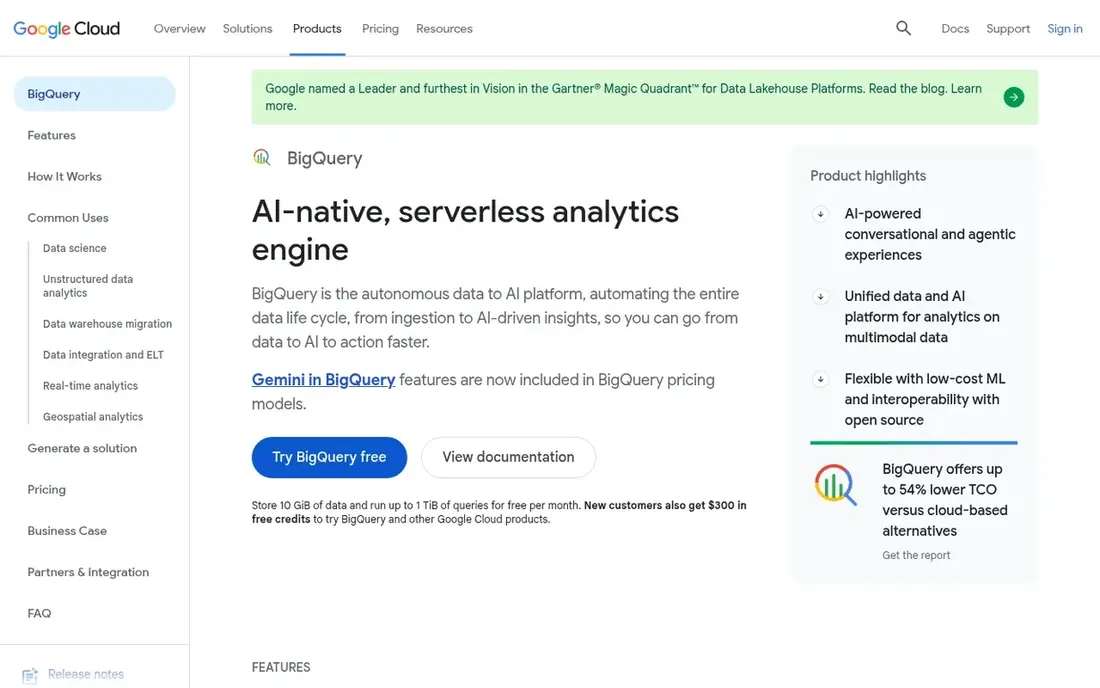
Google BigQuery is designed for completely managed AI data product. Google BigQuery is a completely managed, serverless data warehouse that automates the whole data life cycle, from ingestion to AI-driven action.
Honest limits: Potential for unexpected costs.
It is designed for organizations that want to minimize infrastructure management whereas using advanced analytics and machine learning. For everyday use, organizations with strict data residency requirements or existing investments in other cloud ecosystems might prefer alternative options that offer more customization or hybrid deployment choices. Pricing for Google BigQuery is not stated here, so ask the vendor for current figures. Free options: Not stated.
- Serverless architecture
- Integrated AI and machine learning
- Restricted control over infrastructure
ClickHouse
Best for: Live analytics at scale
ClickHouse is aimed squarely at live analytics at scale. ClickHouse is an open, composable system made for data-intensive workloads, from live analytics and transactions to observability, security, and AI engineering. It excels in scenarios requiring high-throughput, low-latency queries on large datasets.
As for the details, ClickHouse is well suited to organizations needing live insights, for example log analysis, clickstream analytics, and monitoring. It also demands tuning and expertise to achieve optimal performance. Entry price for ClickHouse: $0.056 per unit per hour. Free access: Free trial.
Honest limits: Restricted transaction support.
- High-performance for live queries
- Open and composable architecture
- Needs tuning for optimal performance
How we chose
Selection started from tools commonly considered for database that connects to data platform, then narrowed to 6 that have clear pricing information or a clear quote process. Plan names, prices and limits change often. Treat the figures here as a starting point and verify them with the vendor. Order on the page follows fit for the typical buyer first, then price transparency and free access. Your own requirements should decide the final pick.
Things to verify first
- Confirm the entry price on the vendor page. For MongoDB Atlas, SingleStore, Amazon Redshift and others that means a quote rather than a fixed price.
- Test the free plan from MongoDB Atlas against your real workload before relying on it.
- Use real work to test the free trial from ClickHouse, rather than a demo project.
- Read the limits listed for MongoDB Atlas first: not a strong match for traditional warehousing.
- Ask Amazon Redshift whether prices are locked for the first term and what happens at renewal.
- Confirm you can export your data from SingleStore, so leaving later does not mean losing records.
FAQ
Can I try these tools before paying?
Often, yes. MongoDB Atlas has a free plan and ClickHouse offers a free trial. Use your own data and a real task during the test, and check what the free tier or trial limits before you rely on it.
Are there open source choices among these databases?
ClickHouse is open source, and Databricks supports open source technologies like Apache Spark. On top of that, open source can offer flexibility and cost benefits but may need more management effort.
Is MongoDB Atlas the right pick for everyone comparing database that connects to data platform?
No single tool suits every team. MongoDB Atlas comes first because it fits operational AI applications, while SingleStore suits real-time transactions and analytics and Amazon Redshift suits cost-effective cloud data warehousing. Match the tool to your own size, budget and workflow before deciding.
Which options for database that connects to data platform have a free plan?
MongoDB Atlas is the only tool in this list with a free plan. Free plans usually cap users, projects or features, so check the limits on the vendor page. One other tool offers a trial instead.
What should I look for in a database that connects to my data system?
Consider compatibility with your data sources, performance for your workloads, scalability, and total cost. Also check security features and ease of integration with your existing tools.
Do these tools publish their prices?
Not all of them. MongoDB Atlas, SingleStore, Amazon Redshift and others publish no starting price, so expect a quote request for those. The rest, ClickHouse included, show a starting price, though seats and billing terms still change the final cost.
Sources
- https://www.mongodb.com/atlas
- https://www.singlestore.com
- https://aws.amazon.com/redshift
- https://www.databricks.com
- https://cloud.google.com/bigquery
- https://clickhouse.com