Best Azure Data Factory Alternatives in 2026: 9 Tools Compared
Looking for Azure Data Factory alternatives? We compare 9 ETL, ELT and pipeline tools for data teams moving data to warehouses in 2026 for your team today.
- Editor's choice
 Fivetran
Managed data ingestion
Starts atSee websiteVisit fivetran.comFull review - Great alternative
 dbt Cloud
SQL transformations
Starts atSee websiteVisit getdbt.comFull review - Also consider
 AWS Glue
Serverless ETL in AWS
Starts atSee websiteVisit aws.amazon.comFull review
TL;DR:
- There is no single like-for-like swap for Azure Data Factory, because teams use it for ingestion, transformation and orchestration, and different tools lead in each area.
- Fivetran, Airbyte and Hevo-style ingestion tools suit teams that want managed connectors with little pipeline code.
- dbt Cloud and Matillion suit teams that want transformations in SQL or in a visual flow close to the warehouse.
- Apache Airflow and AWS Glue suit teams that need code-driven orchestration or a cloud-native service inside AWS.
- Our pick for most teams is to pair a managed ingestion tool with dbt for transformation, rather than forcing one tool to do every job.
Quick comparison
| Tool | Best for | Starts at | Free plan? | |
|---|---|---|---|---|
| Fivetran | Managed data ingestion | See website | Free trial | Visit |
| dbt Cloud | SQL transformations | See website | Yes | Visit |
| AWS Glue | Serverless ETL in AWS | See website | No | Visit |
 Apache Airflow | Code-driven orchestration | Free | Yes | Visit |
 SnapLogic | Low-code integration | See website | Free trial | Visit |
 Talend | Enterprise data integration | See website | Free trial | Visit |
 Matillion | Warehouse-native ELT | See website | Free trial | Visit |
 Airbyte | Open source ingestion | Free | Yes | Visit |
 Google Cloud Data Fusion | Visual pipelines in Google Cloud | See website | Free trial | Visit |
The best Azure Data Factory alternatives
Azure Data Factory, often shortened to ADF, moves data between sources, transforms it and schedules the whole flow. The tools below cover that same ground from different angles, so match the tool to the part of the pipeline that hurts most in your setup.
Fivetran is the simplest replacement for the ingestion half of ADF. You connect a source, pick a warehouse destination, and Fivetran keeps the data in sync, handling schema changes and retries without a hand-built pipeline for each source. That managed approach saves a lot of maintenance time for small data teams.
The catch is cost and scope. Pricing is usage-based, so high-volume sources need careful monitoring, and Fivetran is not a full transformation or orchestration platform by itself. Most teams pair it with dbt or a warehouse-native tool for the transformation step, which is a common and well supported pattern.
- Large connector library
- Automated schema handling
- Managed scaling and monitoring
- Usage-based pricing can grow fast
- Transformation features are limited on their own
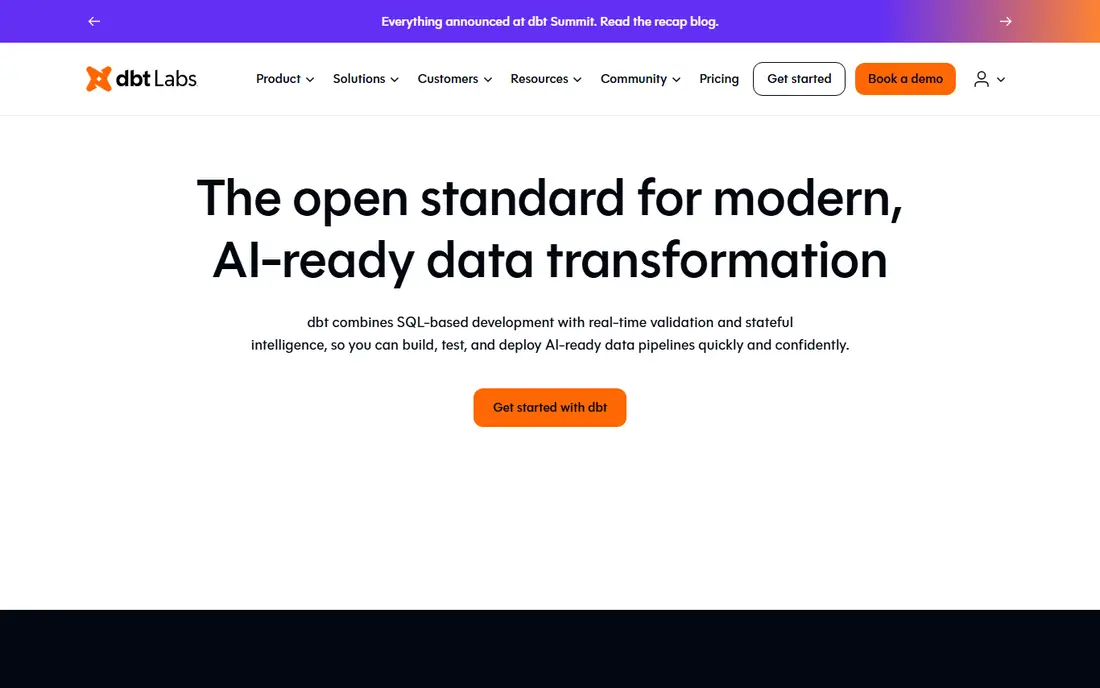
dbt Cloud, built around the open source dbt project, turns warehouse data into clean, tested models using SQL. Analysts write models, add tests, document sources and schedule runs, all tracked in Git. That workflow fits analytics teams that already think in SQL and want transformations they can review like code.
dbt does not ingest data from apps and APIs on its own, so you still need Fivetran, Airbyte or a similar tool to load raw data first. It also assumes you have a warehouse such as Snowflake, BigQuery or Databricks. If your team is comfortable with SQL, dbt is often the clearest upgrade from ADF data flows for the transformation layer.
- Transformations in SQL with tests and docs
- Version control with Git
- Strong warehouse support
- Not an ingestion tool
- Needs a warehouse and some SQL skill
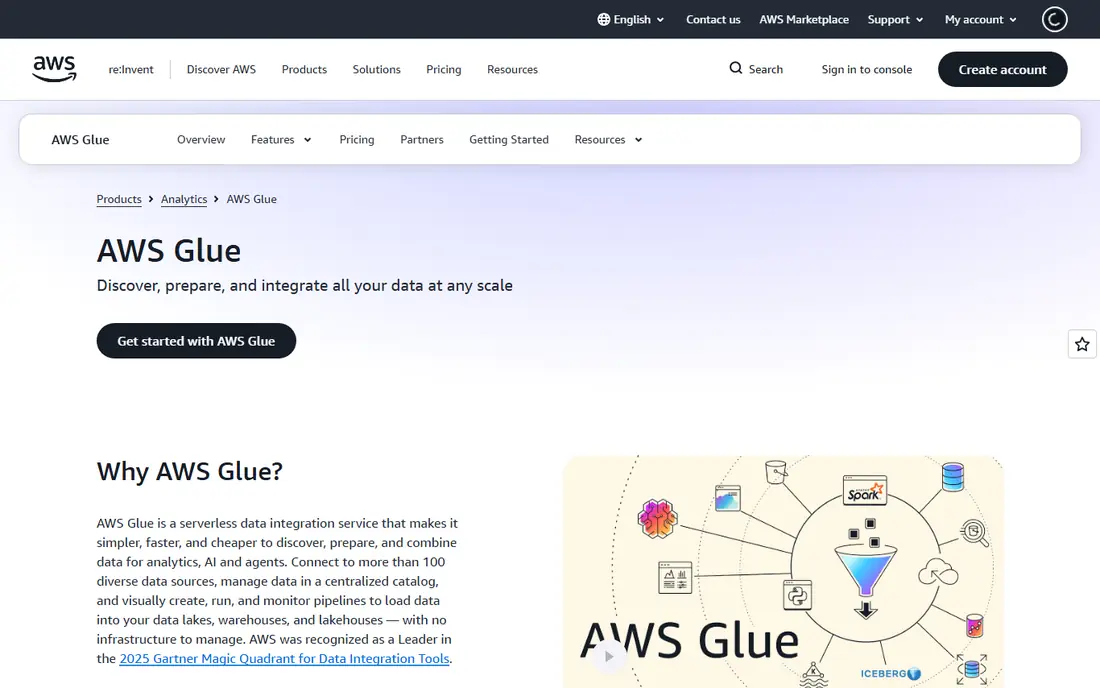
AWS Glue is the closest cloud-native match to ADF inside AWS. It offers serverless ETL jobs, a data catalog that discovers schemas, and crawlers that keep table definitions up to date. Glue jobs run on Spark or Python, and the service fits naturally with S3, Redshift, Athena and other AWS data services.
Glue is not a good pick outside AWS, and job costs depend on worker type and run time, so test with real data volumes before you scale. Teams already on AWS who want a managed ETL service without running servers will find Glue the most direct ADF equivalent in that cloud.
- Serverless Spark ETL
- Data catalog and crawlers
- Deep AWS integration
- AWS only
- Pricing and job tuning can surprise newcomers
Apache Airflow schedules and monitors data pipelines written as directed acyclic graphs in Python. Each task can call another tool, run SQL, trigger a Spark job or check a file, and the web interface shows run history, logs and retries. That flexibility is why many larger data teams standardise on Airflow for orchestration, even when they use other tools for ingestion and transformation.
Self-hosting is the trade. Airflow itself is free and open source, but you need to run, upgrade and monitor it, or pay for a managed service such as Astronomer. Small teams without Python or operations capacity should prefer a managed ingestion plus dbt setup instead of taking on Airflow alone.
- Open source orchestration in Python
- Huge provider library
- Full control over scheduling
- You host and maintain it
- Needs Python and operations skill
SnapLogic offers a visual, low-code way to build integration pipelines, with prebuilt connectors for apps, databases and cloud services. Business and data teams can drag steps together, map fields and schedule flows without writing a full ETL program for each source. It also covers application integration, not only warehouse loading.
Pricing is aimed at mid-size and enterprise teams, so smaller teams should ask for a quote early and compare it with Fivetran plus dbt. Visual pipelines also need discipline as they grow, with naming, testing and documentation, or they become hard to debug. For teams that want low-code breadth across apps and data, SnapLogic is a strong ADF alternative.
- Visual low-code pipelines
- Large connector library
- Application and data integration in one place
- Enterprise pricing
- Visual flows can get complex at scale
Talend is a long-running enterprise integration platform, now part of Qlik, that covers ETL, data quality and application integration. It offers a large set of components for transforming, cleansing and joining data, plus deployment options for cloud and on-premises environments. That breadth suits organisations with mixed systems and strict data quality needs.
Setup is heavier than a managed ingestion tool, and licensing terms need careful review. Talend fits best where data teams already have integration skills and need one platform for many source types. Smaller cloud-only teams will usually move faster with Fivetran or Airbyte plus dbt.
- Broad connector and transformation library
- Data quality tools
- On-premises and cloud options
- Heavier setup
- Licensing can be complex
Matillion builds ELT pipelines that run inside your cloud warehouse, using its compute rather than a separate engine. You design jobs visually, load data with built-in connectors, and transform it with SQL and visual components close to where the data lives. That design keeps data movement simple and uses warehouse performance well.
Matillion depends on your warehouse choice, so it is not a neutral tool if you plan to switch warehouses soon. Pricing also varies by edition and usage, so run a trial on your real warehouse and data volumes. Teams centred on Snowflake, BigQuery or Databricks who like visual design often find Matillion a natural ADF replacement.
- Visual ELT inside the warehouse
- Good Snowflake, BigQuery and Databricks support
- Built-in connectors
- Warehouse dependent
- Pricing tied to usage and edition
Airbyte is an open source data ingestion platform with a large connector catalogue. You can self-host it for free, build custom connectors, and keep control of where data runs. A managed cloud version is also available for teams that do not want to run the infrastructure themselves.
Self-hosting brings maintenance, upgrades and monitoring, which offsets the free licence for small teams. Connector quality also varies, so test your key sources during a trial. Airbyte suits teams that value open source control, want to avoid vendor lock-in, or need connectors that managed tools do not cover well.
- Open source connectors
- Self-hosting option
- Managed cloud also available
- Self-hosting needs operations work
- Some connectors need more tuning than managed rivals
Google Cloud Data Fusion is a fully managed, visual data integration service in Google Cloud. It lets teams build pipelines with a drag-and-drop interface, run them on managed compute, and connect to Google services such as BigQuery and Cloud Storage alongside other sources. It is built on the open source CDAP project, which gives it a broad transformation library.
Data Fusion is a Google Cloud service, so it is not the right pick for Azure or AWS centred teams. It can also feel heavy for a simple one-source load, where Fivetran or Airbyte would be faster. For Google Cloud teams that want a managed visual alternative to ADF, Data Fusion is the most direct option in that ecosystem.
- Fully managed visual pipelines
- Built on open source CDAP
- Strong Google Cloud integration
- Google Cloud only
- Can feel heavy for simple loads
How we picked these
We compared official product pages, documentation and pricing pages for tools that cover ingestion, transformation or orchestration, the three jobs ADF combines. We favoured tools that exist and work in October 2026, that publish clear connector lists and trial terms, and that serve a range of team sizes. We excluded narrow point tools that only sync one app, since they do not replace a general data pipeline platform.
How to choose between ETL and ELT
The old ETL pattern transforms data before loading it, while ELT loads raw data first and transforms it inside the warehouse. ELT now suits most cloud warehouse teams, because warehouse compute is fast and raw data stays available for rework. ETL still suits cases where data must be cleansed or reduced before it lands, or where compliance rules limit raw storage.
Start by listing your sources, destinations and transformation needs. If ingestion is the pain, start with Fivetran or Airbyte. If transformation is the pain, start with dbt or Matillion. If scheduling and dependencies across many jobs are the pain, start with Airflow or a cloud-native orchestrator. Many teams end up with two tools rather than one, and that is normal.
Questions to ask on a trial
Test your hardest source, not your easiest one, and measure run time, cost and failure handling. Check how schema changes are handled, how retries work, and how easy it is to see logs when a job fails. Ask how pricing scales with volume, and get that answer in writing before you migrate a production pipeline.
FAQ
What is the best alternative to Azure Data Factory?
There is no single best answer for every team. Fivetran plus dbt is a strong pairing for cloud warehouse teams, AWS Glue is the closest match inside AWS, and Google Cloud Data Fusion is the closest match inside Google Cloud. Apache Airflow suits teams that need code-driven orchestration across many tools.
Is dbt a full replacement for Azure Data Factory?
No, dbt on its own is a transformation tool, not an ingestion or orchestration platform. It works best paired with an ingestion tool such as Fivetran or Airbyte, and optionally with Airflow for scheduling. That pairing covers most of what ADF does, with clearer SQL-based transformations.
Are Azure Data Factory alternatives cheaper?
It depends on volume and team skill. Managed tools can cost more per run than self-hosted Airflow or Airbyte, but they save engineering time on maintenance. Always test with real volumes, since usage-based pricing grows with data size and run frequency.
Can I run Azure Data Factory alternatives on premises?
Yes, in some cases. Talend offers on-premises options, and Airflow and Airbyte can be self-hosted. Fully managed cloud services such as AWS Glue and Google Cloud Data Fusion run in their own clouds, so they do not fit an on-premises-only setup.
Do these tools work with Snowflake and BigQuery?
Most of the tools on this list support Snowflake, BigQuery and other major warehouses, either as destinations or as transformation targets. Check the current connector list on the vendor site for your exact warehouse version before you commit.
What should small teams pick first?
Small teams usually move fastest with a managed ingestion tool plus dbt Cloud, because there is little infrastructure to run. Add Airflow or a managed orchestrator only when scheduling across many jobs becomes hard to manage by hand.