Best Cloud Data Integration Platforms in 2026: 9 Platforms Compared
Compare the best cloud data integration platform in 2026, with managed connectors, pricing models, sync speed, and free tiers for data teams of all sizes.
- Editor's choice
 Fivetran
Managed connectors at scale
Starts atFreeVisit fivetran.comFull review - Great alternative
 Airbyte
Open source and cloud choice
Starts at$20 per monthVisit airbyte.comFull review - Also consider
 Stitch
Simple SaaS to warehouse sync
Starts at$100 per monthVisit stitchdata.comFull review
TL;DR:
- Fivetran is our pick for teams that want managed connectors and reliable syncs without building pipelines by hand.
- Airbyte is best for teams that want open source control, a large connector catalog, and published cloud pricing.
- Stitch and Hevo suit smaller teams with simpler sources, while Talend and Informatica fit large enterprises with complex transforms.
- Pricing models differ sharply, so compare monthly active rows, credits, and capacity, not just the headline plan price.
- Always test sync speed, schema changes, and failure alerts on your own sources before you commit.
Quick comparison
| Tool | Best for | Starts at | Free plan? | |
|---|---|---|---|---|
| Fivetran | Managed connectors at scale | Free | Yes | Visit |
| Airbyte | Open source and cloud choice | $20 per month | Yes | Visit |
| Stitch | Simple SaaS to warehouse sync | $100 per month | Free trial | Visit |
 Talend | Enterprise data jobs | See website | No | Visit |
 Informatica | Enterprise integration and governance | See website | No | Visit |
 Matillion | Cloud warehouse pipelines | See website | Free trial | Visit |
 Hevo Data | Small teams, fast setup | $239 per month | Yes | Visit |
 Integrate.io | Low-code pipelines | See website | Free trial | Visit |
 Azure Data Factory | Microsoft cloud teams | See website | No | Visit |
The best cloud data integration platforms
Cloud data integration moves data from apps, databases, and files into a warehouse or lake where analysts can query it. The best platform for you depends on how many sources you have, how often data changes, and how much engineering time you can spend on pipelines. Managed tools save time, while open and cloud-native tools give more control.
Fivetran is the default managed choice for a data team that wants to connect a SaaS app or database and trust the sync to keep working. Connectors handle schema changes, incremental loads, and retries, so analysts spend less time fixing pipelines. The free plan covers small volumes, which makes it easy to test a source before paying.
The pricing model is the main thing to model carefully. Fivetran bills by monthly active rows per connection, and deletes and history changes now count toward paid rows. At high volume, that can be costly, and paid contracts carry a sizable annual minimum. For a team with many sources and a need for reliability, the managed service is still worth the premium.
- 700 plus managed connectors
- Automatic schema handling
- Free plan up to 500,000 monthly active rows
- Usage billing can climb fast
- $12,000 annual contract minimum on paid plans
- Per-connection minimums apply
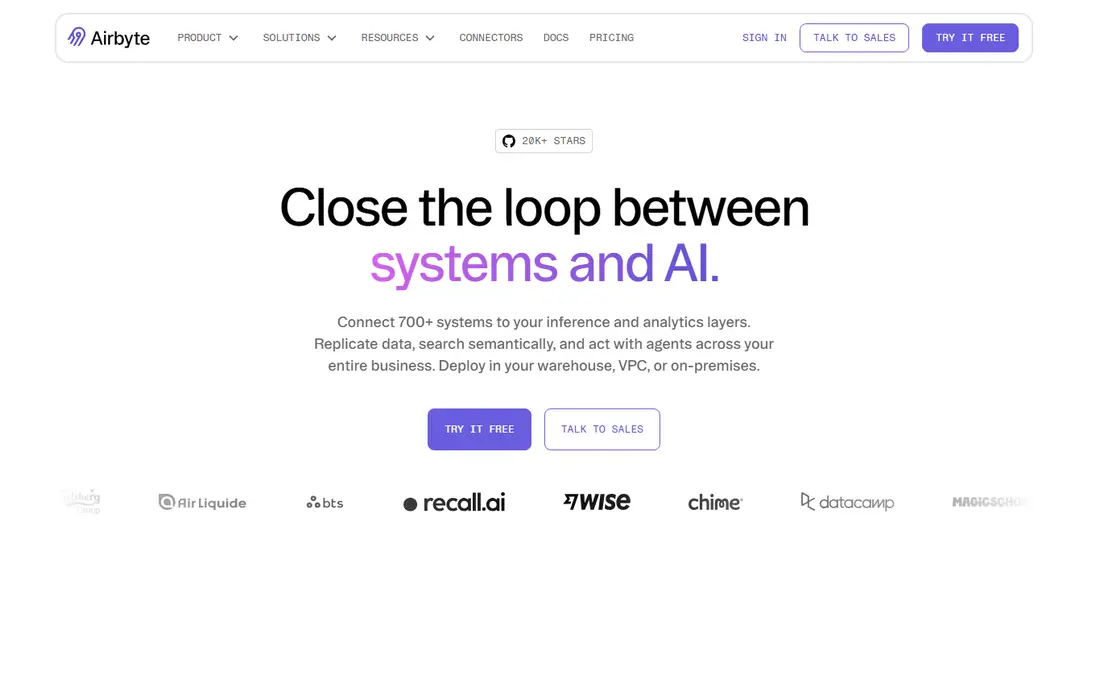
Airbyte gives a team a choice that Fivetran does not. You can self-host the open source core for free, use managed cloud on volume pricing, or run capacity-based plans for larger workloads. The connector catalog is large, and the builder helps a team create a custom connector from API docs without writing a full pipeline from scratch.
Cloud Standard starts at $20 per month, with Plus at $189 per month for larger credit bundles, based on published comparisons. Self-hosting saves license cost but adds server, upgrade, and monitoring work. Airbyte suits teams that value open code, published pricing, and the freedom to move between cloud and self-hosted deployment.
- 700 plus connectors with open source core
- Cloud starts at $20 per month
- No-code connector builder with AI help
- Self-hosting needs operations skill
- Capacity pricing can confuse
- Some connectors need community support
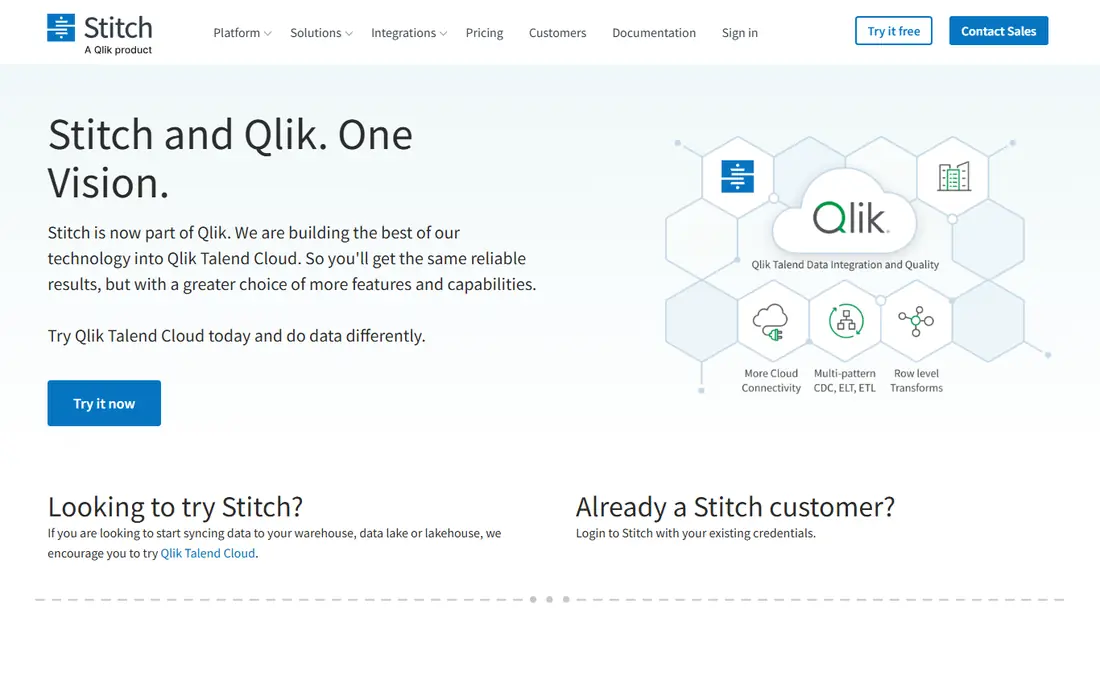
Stitch is a straightforward extract and load tool for a small team that needs to move data from a handful of SaaS apps into a warehouse. Setup is quick, pricing is based on replicated rows, and the Standard tier starts near $100 per month for 5 million rows in published comparisons. That simplicity suits analysts who do not want to manage a complex pipeline platform.
The limits are range and future direction. Stitch has fewer maintained connectors than its larger rivals, and it is being absorbed into Qlik Talend Cloud, so long-term plans should be checked. For a simple, stable set of sources, Stitch remains a practical, low-friction pick.
- Simple setup for common SaaS sources
- Row-based tiers are easy to grasp
- Free trial for testing
- Connector range is narrower than Fivetran or Airbyte
- Product is being folded into Qlik Talend Cloud
- Limited transform depth
Talend, now part of Qlik Talend Cloud, is an enterprise platform for data integration, quality, and governance. Teams build jobs in a visual studio, add data quality checks, and run pipelines across cloud and on-prem sources. That depth suits large organizations with complex transforms, master data, and compliance needs.
Pricing is quote-only across editions, and third-party reports place starter annual costs in the five-figure range. For a team that only needs to sync a few SaaS apps to a warehouse, Talend is heavier than Fivetran, Airbyte, or Hevo. For a large enterprise with varied sources and strict quality rules, Talend is a credible, mature choice.
- Broad data quality and transform tools
- Visual job design in Studio
- Now part of Qlik Talend Cloud
- Quote-only pricing
- Java job model feels heavy for simple syncs
- Learning curve for new users
Informatica is a long-running enterprise data platform with tools for integration, quality, governance, and master data. Large firms use it to move and clean data across many systems while keeping lineage and access controls visible. The cloud suite brings those capabilities together for teams that already run a complex data estate.
Cost and complexity are the barriers. Pricing is by quote, projects often need consultants, and a small team will use only a small part of the suite. If your company needs enterprise governance alongside integration, Informatica fits. Smaller teams should start with a managed ELT tool and add governance later.
- Deep enterprise governance and data quality
- Wide source and target support
- Strong cloud data management suite
- Quote-only pricing
- Implementation needs specialists
- Overkill for small teams
Matillion is designed for teams whose warehouse is the center of their data work. Pipelines are built visually, transforms run inside the warehouse, and common cloud warehouses are first-class targets. That design keeps data movement close to where analysts query it, which can improve speed and simplicity for warehouse-centric teams.
The trade-off is focus. Matillion is less general than Fivetran or Airbyte for moving data to many different targets, and pricing requires a conversation. A team already committed to Snowflake, BigQuery, or a similar warehouse will get the most from Matillion. A team with varied targets should compare it with a broader ELT tool first.
- Built for cloud warehouses such as Snowflake and BigQuery
- Visual pipeline design
- Strong transform options
- Pricing is not fully published
- Warehouse-specific focus limits other targets
- Needs warehouse skill
Hevo Data suits a small or mid-size team that wants to start syncing in hours, not weeks. The interface guides source and warehouse setup, and the free plan covers up to 1 million events for testing. Starter paid plans start near $239 per month in published comparisons, which is a clear entry point for a growing team.
Event pricing needs care. Every record write can count, so high-frequency updates can raise the bill faster than a row-based model. Connector depth is also thinner than Fivetran or Airbyte for rare sources. For common SaaS and database sources with moderate change rates, Hevo is a fast, friendly pick.
- Fast setup for common sources
- Free plan with 1 million events
- Real-time and batch sync options
- Event-based pricing can multiply with frequent updates
- Connector depth is thinner than leaders
- Advanced features need higher plans
Integrate.io offers a low-code way to build pipelines, with connectors, transforms, and data quality checks in one platform. Teams that want more control than a simple ELT tool, but do not want to write code for every pipeline, will find the visual builder useful. API and reverse ETL options help move cleaned data back into business tools.
Pricing is not fully published, so budgeting needs a quote, and the interface can feel busy for a first-time user. The platform suits mid-size teams that need a mix of integration, transform, and quality work without a full engineering team. Test a real pipeline, including error handling, during the trial.
- Low-code pipeline builder
- Wide connector set
- Data quality and API options
- Pricing is quote-based
- Interface can feel busy
- Enterprise features need higher tiers
Azure Data Factory is the natural integration choice for a team already running on Microsoft Azure. It connects Azure SQL, Blob Storage, Synapse, and many SaaS sources, with visual pipelines and data flows for transforms. Pay-as-you-go pricing means you pay for pipeline runs and compute rather than a flat license, which suits variable workloads.
The limits appear outside Azure. A team with a mixed cloud estate may find a neutral ELT tool simpler, and Data Factory pricing can be hard to forecast without modeling runs. For a Microsoft-centric team that already uses Azure data services, Data Factory is a strong, well-integrated pick.
- Native fit for Azure data services
- Visual pipeline and data flow tools
- Pay-as-you-go pricing
- Best inside Azure, weaker outside it
- Pricing depends on runs and compute
- Needs Azure skill
How we picked these
We compared official pricing pages, connector catalogs, documentation, and public pricing comparisons for cloud data integration tools still sold in October 2026. We favored tools with managed connectors, clear sync and error handling, and a free plan or trial where available. We included enterprise and cloud-native options because pricing models and deployment needs differ so much across team sizes.
How to compare cloud data integration pricing
Do not compare headline prices alone, since vendors bill by different units. Fivetran bills by monthly active rows per connection, Airbyte bills by credits or capacity, Hevo bills by events, and Azure Data Factory bills by runs and compute. Model your own volume first, then ask each vendor for a quote at that volume.
Test on your real sources
Run a trial with your largest and messiest sources, not just a demo dataset. Check how schema changes are handled, how deletes are treated, how failures are alerted, and how long a full historical load takes. A tool that syncs a clean demo quickly may struggle with a source that changes schema often or sends frequent updates.
Plan for transforms and ownership
Decide where transforms will live. Managed ELT tools load raw data into a warehouse, and transforms usually run in dbt or a similar tool. Enterprise suites and Matillion offer more built-in transform options. Also decide who owns pipelines, who gets failure alerts, and how you will document sources, so a tool does not become a single-person dependency.
FAQ
What is the best cloud data integration platform?
For most teams, Fivetran is the best managed pick because its connectors are reliable and need little upkeep. Airbyte is best if you want open source control and published cloud pricing. Smaller teams with simple sources should also look at Hevo and Stitch before committing to an enterprise suite.
What are the best cloud data integration tools for a small team?
Hevo Data, Stitch, and Airbyte Cloud are strong small-team picks. Hevo offers fast setup and a free plan, Stitch offers simple row-based tiers, and Airbyte Cloud starts at $20 per month with a large connector catalog. Start with the tool that covers your must-have sources at a price you can forecast.
How is cloud data integration pricing calculated?
It depends on the vendor. Fivetran uses monthly active rows per connection, Airbyte uses credits or capacity, Hevo uses events, and cloud-native tools such as Azure Data Factory use runs and compute. Always model your own source volume, update frequency, and historical load size before comparing quotes.
Do I need coding skill to use these platforms?
No, not for managed ELT tools such as Fivetran, Hevo, and Stitch, which are designed for analysts and data teams without heavy coding. Airbyte self-hosting, Talend, Informatica, and Azure Data Factory need more technical skill for setup, custom connectors, or complex transforms. Choose based on your team, not just the feature list.
What is the difference between ETL and ELT?
ETL transforms data before loading it into a warehouse, while ELT loads raw data first and transforms it inside the warehouse. Most cloud tools on this list follow ELT, which suits cloud warehouses and tools such as dbt. ETL suits cases where data must be cleaned or masked before it reaches the warehouse.
Can I move data in real time with these tools?
Some tools support frequent syncs, including near real-time options for databases with change data capture, but many SaaS syncs run on intervals such as every 15 minutes. Check sync frequency for each source, since it varies by connector and plan. For true streaming needs, pair an ELT tool with a streaming platform or a database replication tool.