8 Best Big Data Integration Platforms for 2026
We compared the best big data integration platforms on connectors, change data capture, governance and price to help data teams move data they can trust.
- Editor's choice
 Fivetran
Managed ELT into cloud warehouses
Starts atSee websiteVisit fivetran.comFull review - Great alternative
 Airbyte
Open source and custom connectors
Starts atSee websiteVisit airbyte.comFull review - Also consider
 Informatica
Large, governance-heavy enterprises
Starts atSee websiteVisit informatica.comFull review
TL;DR:
- Managed ELT tools like Fivetran and Hevo suit teams that want connectors maintained for them.
- Airbyte suits engineering-led teams that want open source connectors and self-hosting control.
- Informatica and Qlik Talend suit large firms where governance, quality and compliance matter most.
- Change data capture matters more than connector counts when source data changes often.
- Price by volume, not by seat alone, since a cheap plan can grow fast once data volumes rise.
Quick comparison
| Tool | Best for | Starts at | Free plan? | |
|---|---|---|---|---|
| Fivetran | Managed ELT into cloud warehouses | See website | Yes | Visit |
| Airbyte | Open source and custom connectors | See website | Yes | Visit |
| Informatica | Large, governance-heavy enterprises | See website | No | Visit |
 Qlik Talend Cloud | Movement, quality and governance together | See website | No | Visit |
 Matillion | Warehouse-native transformation | See website | No | Visit |
 Hevo Data | No-code ELT for smaller teams | See website | Yes | Visit |
 Stitch | Simple warehouse-first ELT | $100/month | No | Visit |
 AWS Glue | AWS-native Spark ETL | See website | No | Visit |
The best big data integration platforms for 2026
Fivetran is the default pick for teams that want data pipelines to run without babysitting. Its managed connectors handle schema changes, retries and incremental syncs, so analysts spend less time fixing broken loads. Change data capture keeps warehouse data fresh from databases that update constantly. The price model is the thing to watch. Usage-based billing means costs track data volume, which is fair but can surprise a team after a busy quarter. Transformation work usually happens in the warehouse or a separate tool, so Fivetran fits best as the movement layer of a wider stack.
- Fully managed connectors, automatic schema handling, change data capture
- Usage-based pricing can grow fast, and transformation options are lighter than code-first tools
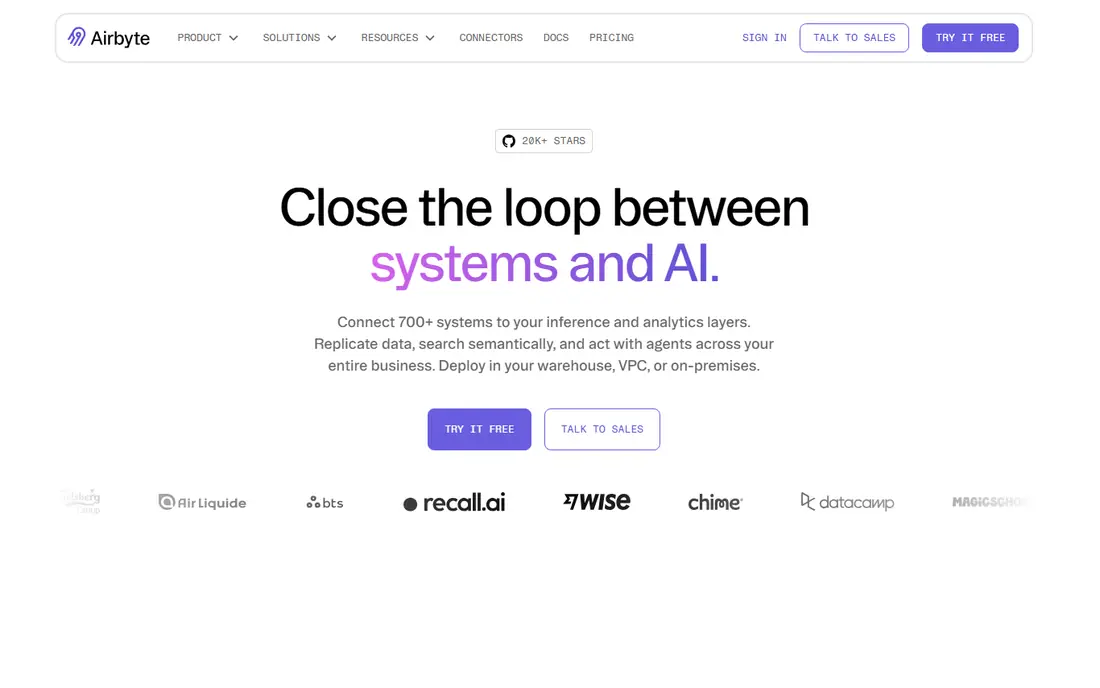
Airbyte gives engineering teams control that managed tools do not. Its open source core can run in your own cloud, connectors can be built with its developer kit, and the code stays portable if you move infrastructure later. The cloud service removes the hosting burden for teams that prefer a managed option. Control brings responsibility. A self-hosted setup needs monitoring, upgrades and someone on call when a pipeline fails. Teams without data engineering capacity may get more value from a fully managed tool, but for teams that build custom connectors, Airbyte is the most flexible platform here.
- Open source core, 700 plus connectors, cloud or self-hosted deployment
- Self-hosting needs engineering time, and some enterprise features sit behind paid tiers

Informatica suits organizations where data movement is only half the job. Its cloud platform pairs integration with a data catalog, quality checks, lineage and master data tools, which helps regulated firms answer who touched data and where it came from. Connector breadth covers both cloud apps and older on-premises systems. That breadth comes with weight. Pricing is quote-based, implementation is a project rather than an afternoon, and small teams will find simpler tools faster. For a large firm consolidating many systems under one governance model, Informatica's depth justifies the effort.
- Broad governance, catalog and quality tools, many enterprise connectors
- Enterprise pricing and setup effort, and the platform is heavier than SMB tools
Qlik Talend Cloud pairs data movement with quality controls in one platform. Pipelines can run in batch, stream changes as they happen, or move data in near real time, while quality rules catch bad records before they reach dashboards. Hybrid connectivity helps firms that still run some systems on premises. The buying experience is less simple than a self-serve tool, since pricing is quote-based and the wider Qlik product family overlaps in places. Ask for a scoped quote tied to your connector list and data volumes. For mid-size and large teams that need quality and movement together, it is a strong combined pick.
- Batch, change data capture and streaming, built-in data quality, hybrid connectivity
- Quote-based pricing, and the product range can confuse first-time buyers
Matillion builds pipelines that run inside your cloud data platform rather than on a separate engine. That pushdown approach keeps heavy transformation work where the data already lives, which suits Snowflake, BigQuery and Redshift shops. Visual design plus Git workflows gives data teams a balance of speed and version control. The trade-off is focus. Matillion is at its best for warehouse-centered teams, and firms with heavy application-to-application integration may need a second tool. Pricing is quote-based, so model it against your warehouse spend before deciding.
- Pushdown ELT on cloud platforms, visual pipeline design, Git workflows
- Tied closely to cloud warehouses, and pricing is quote-based
Hevo Data is built for teams that want pipelines without writing code. Sources connect through a guided setup, schema changes are handled by the platform, and monitoring shows sync health at a glance. The free plan covers small volumes, which makes it easy to prove value before paying. Depth is the limit. Complex transformation logic and streaming ingestion sit behind higher tiers or need a warehouse tool alongside Hevo. For a growing team moving SaaS data into a warehouse for reporting, Hevo's simplicity is a genuine advantage over heavier enterprise platforms.
- No-code setup, managed schema updates, free plan for small volumes
- Fewer advanced transformation features, and streaming sits on higher tiers
Stitch is the plain option on this list, and that plainness is the appeal. It moves data from common sources into a warehouse with little setup, and its tiered pricing from 100 dollars per month for 5 million rows is easy to understand. Teams that need a handful of reliable pipelines can be running the same day. The connector catalog is smaller than Fivetran or Airbyte, and transformation happens in the warehouse, not in Stitch. Firms with unusual sources or heavy in-pipeline logic will outgrow it. For straightforward reporting pipelines, Stitch remains a dependable, low-fuss choice.
- Fast setup, simple pricing tiers, minimal configuration
- Smaller connector range than leaders, and limited transformation depth
AWS Glue fits teams already committed to Amazon Web Services. It runs serverless Spark ETL jobs, catalogs data automatically, and connects naturally to S3, Redshift and other AWS services. Pay-as-you-go pricing means you pay for job runs rather than a flat platform fee. The limits are clear. Glue is an AWS tool first, so multi-cloud teams get less value, and building jobs well needs Spark and AWS knowledge. For an AWS-native data team that wants ETL close to its storage and compute, Glue is a practical, well-integrated pick.
- Serverless Spark jobs, deep AWS integration, pay-as-you-go pricing
- AWS-only focus, and the learning curve is steep for non-engineers
How we picked these
We compared official feature pages, pricing pages, documentation, app store listings, privacy policies and public reviews for platforms operating in October 2026. We looked for connector breadth, change data capture, schema handling, monitoring, governance features and deployment options. We favored tools with a clear data integration role, and we left out pure transformation or visualization tools that do not move data between systems.
Buying a big data integration platform
Start with your sources, not the feature list
List every source you must connect in the next year, including databases, SaaS apps and files. A platform with 700 connectors still fails if it lacks your one critical source. Check whether each connector is fully managed, community-built or custom, since support quality varies by type.
Decide how fresh the data must be
Daily batch loads suit reporting, while change data capture suits operational dashboards and fraud checks. Streaming adds cost and complexity, so only pay for it where freshness changes a decision. Ask vendors how they handle late-arriving data and schema changes, since those edge cases cause most pipeline failures.
Price for your real volume
Compare billing units carefully: rows, events, compute hours and credits all behave differently as data grows. Run a trial on your largest source and watch the bill, not just the dashboard. A platform that looks cheap at demo volume can become the most expensive line in your data budget within a year.
Check governance before you scale
Access controls, lineage, audit logs and data quality rules matter more as pipelines multiply. A tool that moves data fast but cannot show where a number came from will fail an audit or a board question. Confirm that monitoring and alerting cover failed jobs, so a broken pipeline is found by the platform, not by a manager asking why a report is empty.
FAQ
What are the best big data integration tools? Fivetran leads for managed ELT, Airbyte leads for open source flexibility, and Informatica and Qlik Talend lead for enterprise governance. Hevo and Stitch suit smaller teams with simpler needs. The best pick follows your sources, volume and engineering capacity. What is the difference between ETL and ELT? ETL transforms data before loading it into a warehouse, while ELT loads raw data first and transforms it inside the warehouse. ELT suits cloud warehouses with cheap compute, while ETL suits cases where data must be cleaned before storage. Many platforms now support both patterns. Is Airbyte really free? The open source core is free to self-host, but you pay for your own infrastructure and engineering time. Airbyte Cloud is a paid managed service with its own pricing. Small teams should weigh hosting effort against the managed price. How much does Fivetran cost? Fivetran uses usage-based, quote-led pricing tied to data volume, so there is no single public starting price. Request a quote based on your monthly volume and connector list. Track usage after launch, since costs rise with data growth. Do I need a data integration platform if I already have a warehouse? A warehouse stores data, but it does not move it from your apps and databases on its own. An integration platform automates that movement, handles schema changes and keeps data fresh. Without one, teams usually end up maintaining fragile scripts for each source.
Sources
https://www.designrush.com/agency/it-services/trends/data-integration-tools https://airbyte.com/data-engineering-resources/big-data-integration https://www.unite.ai/data-integration-tools/ https://fivetran.com https://airbyte.com https://www.informatica.com https://www.qlik.com https://www.matillion.com https://hevodata.com https://www.stitchdata.com https://aws.amazon.com/glue/