Best Data Integration Platforms Comparison in 2026: 8 Platforms Compared
Read our best data integration platforms comparison for 2026, covering connectors, pricing models, sync speed, and which teams each platform fits best.
- Editor's choice
 Fivetran
Teams that want managed connectors without pipeline code
Starts atSee websiteVisit fivetran.comFull review - Great alternative
 Airbyte
Teams that want open source flexibility at lower entry cost
Starts at$20 per monthVisit airbyte.comFull review - Also consider
 Stitch
Simple, predictable SaaS to warehouse replication
Starts at$100 per monthVisit stitchdata.comFull review
TL;DR:
- Fivetran suits teams that want managed connectors with little pipeline code, while Airbyte suits teams that want open source control and lower entry cost.
- Pricing models differ more than features do: Fivetran charges by monthly active rows, Airbyte by credits, and Stitch and Hevo by simpler tiered plans.
- Sync frequency, transformation approach, and destination support matter more than connector counts alone, so test with your real sources.
- Budget for warehouse and compute costs on top of the integration tool, since those bills are separate.
Quick comparison
| Tool | Best for | Starts at | Free plan? | |
|---|---|---|---|---|
| Fivetran | Teams that want managed connectors without pipeline code | See website | Yes | Visit |
| Airbyte | Teams that want open source flexibility at lower entry cost | $20 per month | Yes | Visit |
| Stitch | Simple, predictable SaaS to warehouse replication | $100 per month | No | Visit |
 Talend | Enterprises that need integration plus data quality and governance | See website | No | Visit |
 Informatica | Large enterprises with complex, governed data platforms | See website | No | Visit |
 Workato | Teams that want data integration plus business workflow automation | See website | No | Visit |
 Boomi | Enterprises integrating many apps, APIs, and data sources | See website | No | Visit |
 Hevo Data | Small and mid sized teams that want simple, reliable pipelines | $239 per month | Yes | Visit |
The best data integration platforms comparison
Data integration platforms move data from apps, databases, and files into a warehouse or lake, where teams can report on it. The platforms below differ in how much code they need, how they charge, and how they handle transformations, so the right pick depends on team size and data volume.
Fivetran charges by monthly active rows, with a $5 base charge per standard connection for up to one million rows, and a free plan up to 500,000 monthly active rows. Standard pricing examples list about $500 per million rows for some connections, and annual contracts carry a published minimum, so small teams should model their row counts before committing.
Fivetran strength is hands off operation: connectors handle schema changes, retries, and incremental syncs, and transformations run through bundled dbt tools. That reliability is why many mid sized and large teams pay a premium. The catch is cost control. Row counts rise with source changes, so monitor monthly active rows by connector and use selective sync to keep bills predictable.
- Over 700 managed connectors
- Automatic schema handling
- Strong reliability and support
- Usage based pricing can surprise at scale
- Annual contract minimums apply on many plans
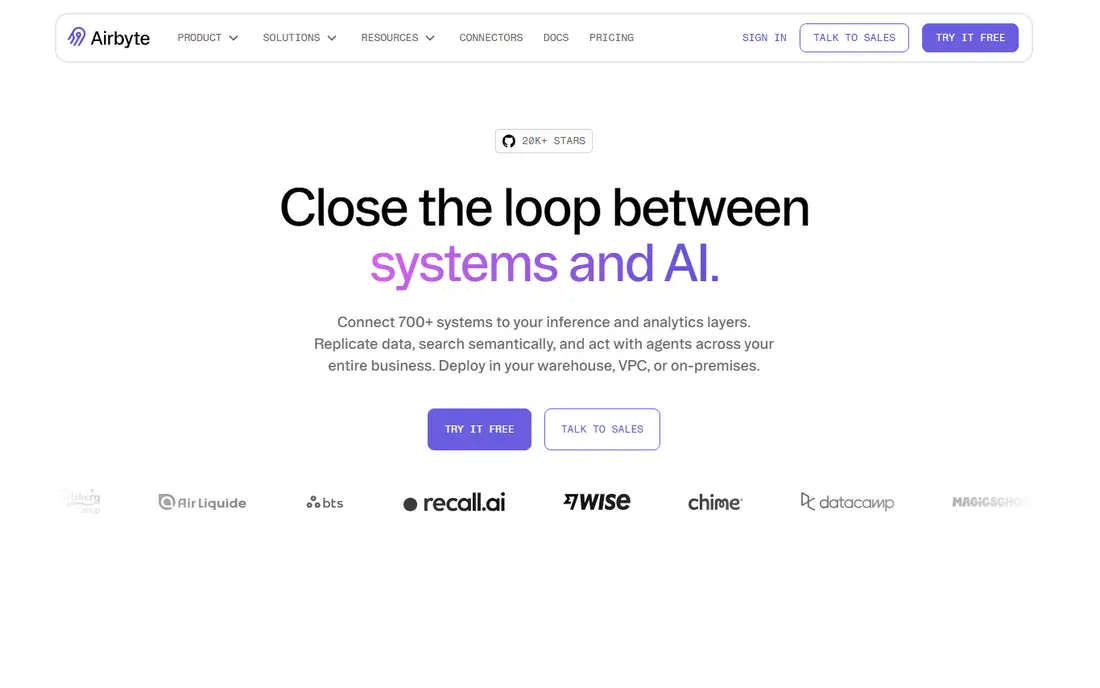
Airbyte offers Core, a free open source edition for self hosting, and Cloud Standard from $20 per month with five credits, plus Plus from $189 per month for 40 credits, with extra credits at $5 each. Cloud pricing is credit based, with database sources metered by volume and API sources by rows, so the same data can cost different amounts depending on source type.
Airbyte suits teams that want connector code they can inspect and customise, plus a managed cloud option when self hosting is too much work. Its Connector Builder helps teams create custom sources quickly. The trade off is operational effort on self hosted setups, and careful credit modelling on Cloud for high volume database syncs.
- Open source core you can self host
- Over 700 connectors
- Credit pricing with a low entry tier
- Credit math varies by source type
- Self hosting needs engineering time
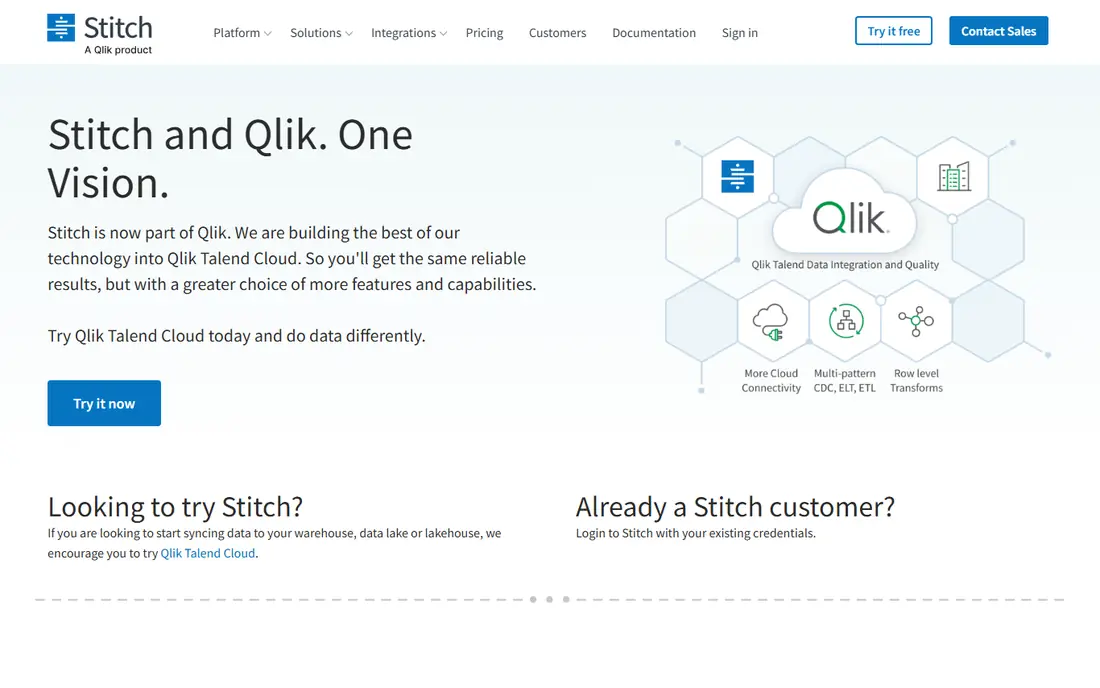
Stitch, from Talend, lists plans from about $100 per month with five million monthly replicated rows included on some tiers, and higher tiers for larger volumes. A free trial is offered. Pricing is simpler to forecast than row per connector models, which appeals to small data teams.
Stitch strength is simplicity: connect a SaaS source, pick a warehouse destination, and schedule replication without building pipelines. It handles standard sources well, though teams that need heavy transformations or real time streaming should look at Fivetran, Airbyte, or a full enterprise platform. Stitch fits best when the job is reliable replication, not complex data engineering.
- Simple setup and flat tier pricing
- Good for standard SaaS sources
- Reliable scheduled replication
- Fewer advanced transformation features
- Less suited to complex enterprise pipelines
Talend
Best for: Enterprises that need integration plus data quality and governance
Talend sells by quote, with products covering data integration, data quality, and governance in one platform. It suits large organisations that need to clean, profile, and govern data as it moves, not just copy it into a warehouse. Talend also owns Stitch, which serves simpler replication needs.
The benefit is control across the data lifecycle, with visual pipeline design and governance features that regulated teams need. The cost is complexity and implementation time. Talend fits enterprises with data engineering staff and governance requirements, while smaller teams will move faster with Fivetran, Airbyte, or Hevo.
- Broad integration, quality, and governance tools
- Strong for complex enterprise data estates
- Quote based pricing
- Heavier setup than SaaS replication tools
Informatica Intelligent Data Management Cloud is sold by quote and serves large enterprises that integrate data across cloud, on premises, and SaaS systems. It covers ingestion, integration, quality, governance, and master data management, which makes it a platform choice rather than a single pipeline tool.
Informatica strength is breadth and governance at scale, with controls that large regulated organisations require. The trade off is cost, setup time, and the need for skilled data teams. Small and mid sized teams should only consider Informatica when governance, master data, or multi cloud complexity genuinely demands it.
- Deep enterprise integration and governance
- Strong for cloud data management at scale
- Broad connector library
- Enterprise pricing and implementation
- Overkill for small teams
Workato
Best for: Teams that want data integration plus business workflow automation
Workato is sold by quote and combines application integration with workflow automation. Teams build recipes that move data between apps, trigger actions, and automate business processes, which suits operations, finance, and revenue teams as well as data teams.
Workato fits when integration work is tied to business workflows, such as syncing CRM and billing data while triggering approvals or alerts. Pure data teams that need high volume warehouse replication may prefer Fivetran or Airbyte, while Workato wins when the same platform must also automate the process around the data.
- Low code recipes for apps and data
- Strong business workflow automation
- Good for operations teams
- Quote based pricing
- Data pipeline depth differs from pure ELT tools
Boomi is sold by quote as an integration platform as a service, covering application integration, API management, and data integration. It suits enterprises with many systems, including on premises apps, cloud apps, and partner APIs, that need one platform to manage connections and flows.
Boomi strength is breadth across integration patterns, with monitoring and management tools for large estates. The limit is that pricing and licensing need a sales conversation, and smaller teams may find the platform heavier than a focused ELT tool. Choose Boomi when application integration and data integration must live on one enterprise platform.
- Broad integration platform with API management
- Strong for hybrid and enterprise estates
- Good monitoring
- Quote based pricing
- Setup and licensing complexity
Hevo Data
Best for: Small and mid sized teams that want simple, reliable pipelines
Hevo Data lists starting paid plans from about $239 per month, with a free tier for limited use. Plans are tiered by events and features, which makes budgeting simpler than pure usage models for teams with steady volumes.
Hevo suits teams that want Fivetran style managed pipelines without enterprise complexity or pricing. Setup is quick, transformations are handled in a straightforward way, and support is geared to small data teams. Larger enterprises with governance, master data, or very high volumes should compare Talend or Informatica, but Hevo is a strong mid market default.
- Simple pipeline setup
- Good SaaS and database connector coverage
- Clear tiered pricing
- Entry paid price is higher than Airbyte Cloud
- Less suited to very large enterprise estates
How we picked these
We compared official pricing pages, connector lists, and pricing models in October 2026, focusing on how each platform charges, how it handles transformations, and what team size it truly fits. We kept platforms that are live today and widely used for production data work, and we listed See website where pricing is quote based rather than inventing a starting price. Warehouse, compute, and destination costs are separate from these tools and should be budgeted alongside them.
How to compare data integration platforms fairly
Start by listing your sources, destinations, and sync needs. Note which sources change often, which need near real time sync, and which need transformations before reporting. A platform with many connectors still fails if your key source needs custom handling or if sync frequency does not match your reporting needs.
Next, model cost on your real volumes. Run the vendor pricing calculator with your row counts, sync frequency, and connector list, and compare at least two platforms on the same data. Include warehouse costs, since a cheap integration bill can hide an expensive warehouse bill. Finally, trial with a real pipeline for two weeks, checking schema changes, failed sync alerts, and how easy it is to fix a broken connector without engineering help.
FAQ
Which data integration platform is best for a small team?
Airbyte Cloud and Hevo Data are strong small team starts, with Airbyte offering the lowest entry price and Hevo offering simpler tiered pricing. Stitch also suits simple SaaS to warehouse replication. Pick by your source list and volume, not by connector count alone.
Is Fivetran or Airbyte cheaper?
It depends on volume and source type. Airbyte Cloud often costs less at low to mid API volume, while Fivetran can be more predictable for database tables where the same rows change often, since Fivetran counts a changed row once per month. Model both on your real tables before choosing.
What is the difference between ETL and ELT?
ETL transforms data before loading it into a warehouse, while ELT loads raw data first and transforms it inside the warehouse. Most tools on this list follow ELT, using dbt or warehouse native transformations, which suits modern cloud warehouses and keeps raw data available for new analyses.
Do I need a data integration platform if I use one app?
Probably not. A single app with built in reporting may be enough until you need to join data from several sources, such as CRM, billing, ads, and product usage. When reporting across sources becomes manual and error prone, an integration platform earns its cost.
How often should data sync?
It depends on the decision. Daily sync suits most reporting, hourly suits operations dashboards, and near real time suits fraud, inventory, or live customer support. Faster sync costs more in rows, credits, and warehouse compute, so match frequency to the decision, not to the fastest option available.
What hidden costs should I check?
Check warehouse compute, storage, transformation runs, API call limits on sources, and overage charges on your integration plan. Also check whether failed sync retries, schema changes, or historical backfills count toward billed rows or credits. Ask vendors to model a backfill before you sign.