6 Best Database Solutions for Data Warehousing for 2026, Vetted and Compared
Best database solutions for data warehousing: 6 tools compared on price, free plans and fit. Plain-spoken summaries throughout. Current for November 2026.
- Editor's choice
 Google BigQuery
Serverless, autonomous data and AI
Starts atPricing on requestVisit cloud.google.comFull review - Great alternativeIBM Db2 Warehouse
In-memory processing at massive scale
Starts atPricing on requestVisit ibm.comFull review - Also considerTeradata Vantage
Enterprise-scale autonomous product
Starts atPricing on requestVisit teradata.comFull review
Direct answer
Google BigQuery leads the list, best for serverless, autonomous data and AI. IBM Db2 Warehouse is better for in-memory processing at massive scale, and Teradata Vantage is better for enterprise-scale autonomous system. All 6 tools are compared below on fit, free plan and limits. None of these vendors publish plan prices, so pricing is on request for every option.
TL;DR:
- The list opens with Google BigQuery, aimed at serverless, autonomous data and AI.
- Before buying Amazon Redshift, weigh this: tied to AWS ecosystem.
- For unified data, analytics, and AI, Databricks Lakehouse Platform is worth a look.
- A permanent free plan is missing from all 6 tools, Google BigQuery and Databricks Lakehouse Platform included; plan for a trial or a premium start.
Last checked November 2026. Pricing on request: vendors did not publish plan prices when this guide was last checked (November 2026), so ask each vendor for a written quote.
Quick comparison
| Tool | Best for | Starts at | Free plan? | |
|---|---|---|---|---|
| Google BigQuery | Serverless, autonomous data and AI | Pricing on request | Not stated | Visit |
| IBM Db2 Warehouse | In-memory processing at massive scale | Pricing on request | Not stated | Visit |
| Teradata Vantage | Enterprise-scale autonomous product | Pricing on request | Not stated | Visit |
 Amazon Redshift | Completely managed cloud data warehousing | Pricing on request | Not stated | Visit |
| Vertica | AI-driven analytics at petabyte scale | Pricing on request | Not stated | Visit |
| Databricks Lakehouse Platform | Unified data, analytics, and AI | Pricing on request | Not stated | Visit |
Database Solutions for Data Warehousing compared in detail
If you are comparing database solutions for data warehousing, this page covers 6 tools in one place: what each is best for, what it costs to start, whether it has a free plan, and the main limit to know about.
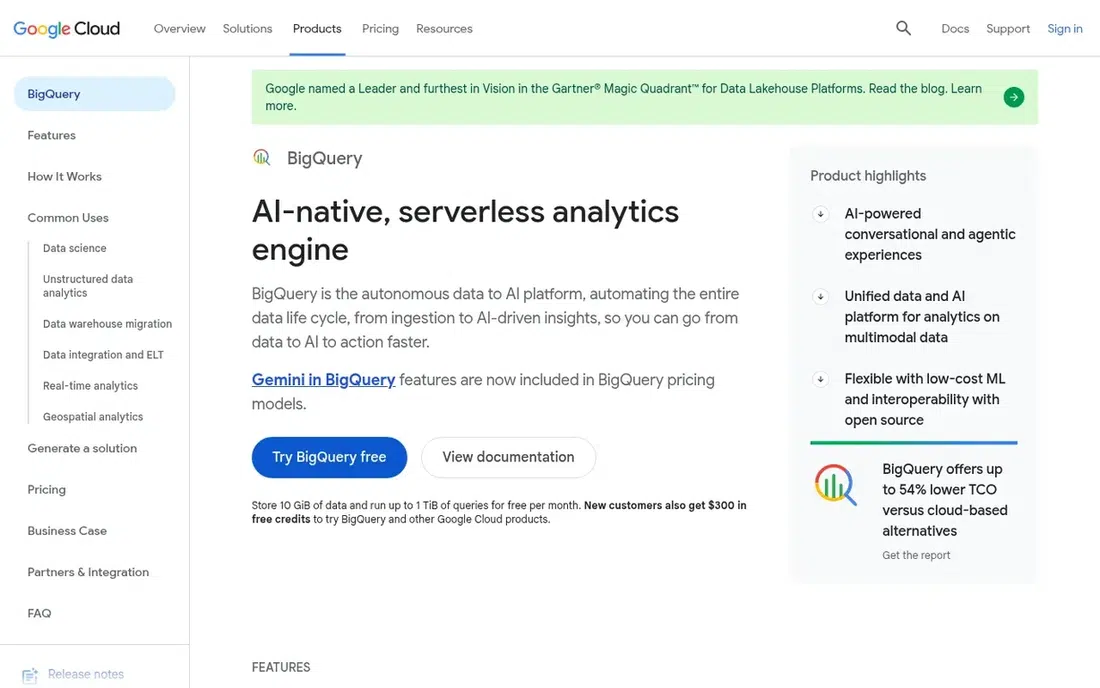
Google BigQuery is a good fit for serverless, autonomous data and AI. Google BigQuery is an autonomous data and AI system that automates the whole data life cycle so you can go from data to AI to action quicker. It is a serverless enterprise data warehouse that scales automatically, making it right for teams that want to avoid infrastructure management.
Trade-offs to know: Google Cloud dependency.
On top of that, if you need on-premises deployment or fine-grained infrastructure control, consider Vertica or IBM Db2 Warehouse instead. BigQuery runs only on Google Cloud, which may limit multi-cloud strategies. Its serverless nature means less control over performance tuning than self-managed systems. Check the vendor site for Google BigQuery pricing; none is listed in this comparison. Free access: Not stated.
- Quick path from data to AI
- Automates data life cycle
- Less control over tuning
IBM Db2 Warehouse
Best for: In-memory processing at massive scale
IBM Db2 Warehouse is built with in-memory processing at massive scale in mind. IBM Db2 Warehouse is built on the SQL engine of IBM and queries data from several sources for advanced in-memory processing at a massive scale. Db2 Warehouse is closely tied to IBM technologies, which may limit appeal for teams standardized on other stacks.
The main drawbacks: May need tuning.
In daily use, the product supports both cloud and on-premises deployments, offering adaptability for hybrid environments. Achieving optimal in-memory performance may need tuning. Beyond that, if you want a completely managed cloud service with minimal tuning, consider Amazon Redshift or Google BigQuery. IBM Db2 Warehouse shows no starting price here, so confirm the cost on the vendor site. Trial and free access: Not stated.
- Advanced in-memory processing
- Queries several sources
- IBM ecosystem dependency
Teradata Vantage
Best for: Enterprise-scale autonomous product
Teradata Vantage is a good fit for enterprise-scale autonomous system. Teradata Vantage is described as the AI system for the autonomous era, connecting and scaling across any environment. It is built for large enterprises that need a solid, scalable data warehouse with advanced analytics capabilities.
Points against: Less suited for small teams.
More specifically, Vantage supports deployment adaptability, making it right for organizations with complicated, mission-critical data environments. Beyond that, Teradata Vantage is aimed at enterprise-scale deployments, which can be overkill for smaller teams. Teradata Vantage shows no starting price here, so confirm the cost on the vendor site. As for free access: Not stated.
- AI system for autonomous era
- Links and scales broadly
- Enterprise complexity
Amazon Redshift works best for completely managed cloud data warehousing. Amazon Redshift is a quick, completely managed cloud data warehouse that makes it straightforward and economical to analyze all your data. It is built for organizations that want a turnkey warehouse on AWS without managing infrastructure.
Downsides: Restricted customization.
As for the details, if you need a portable or on-premises warehouse, consider alternatives like Teradata Vantage or IBM Db2 Warehouse. For everyday use, the service takes care of provisioning, scaling, and maintenance, letting teams focus on querying and reporting. Pricing for Amazon Redshift is not stated here, so ask the vendor for current figures. On free options: Not stated.
- Examines all your data
- Straightforward and economical analysis
- Tied to AWS ecosystem
Vertica
Best for: AI-driven analytics at petabyte scale
Vertica is designed for AI-driven analytics at petabyte scale. Vertica needs more practical deployment and management than completely managed serverless choices.
The main drawbacks: Less automatic than serverless.
From a buyer's view, if you prefer a completely managed service with minimal operational overhead, consider Amazon Redshift or Google BigQuery. Check the vendor site for Vertica pricing; none is listed in this comparison. Free access: Not stated.
- Quick query performance
- Examines petabytes of data
- Needs deployment management
Databricks Lakehouse Platform
Best for: Unified data, analytics, and AI
Databricks Lakehouse Platform works best for unified data, analytics, and AI. The lakehouse approach supports diverse workloads without separating data silos. From a buyer's view, whereas it supports several clouds, setup and governance can be complicated.
Downsides: Multi-cloud but complicated.
On top of that, Databricks Lakehouse Platform gives you a unified system for data, analytics, and AI. It eases ETL, data warehousing, governance, and AI on the Data + AI Platform, making it a fit for organizations that want to combine data engineering and machine learning in one place. Check the vendor site for Databricks Lakehouse Platform pricing; none is listed in this comparison. On free options: Not stated.
- Unified product for data and AI
- Eases ETL and warehousing
- Needs lakehouse expertise
How these tools were picked
For each of the 6 tools we noted price, free plan or trial, fit for database solutions for data warehousing and the main limit, using vendor pages and documentation. Where a vendor does not publish a price, the entry says quote. Where a price depends on seats or billing term, the entry says so. The order reflects how well each tool fits the most common buying scenario for database solutions for data warehousing, then price clarity, then free plan access. It is a starting point, not a verdict.
A buyer's checklist
- Request quotes from Google BigQuery, Databricks Lakehouse Platform and the others; the list shows no fixed prices.
- Before choosing Google BigQuery, weigh its main limit: Google Cloud dependency.
- Test how quickly IBM Db2 Warehouse answers a pre-sales question; it hints at how support will feel later.
- Ask the daily users to test Amazon Redshift on a live task before you roll it out to everyone.
- Look at the renewal terms for Teradata Vantage: auto-renewal, notice periods and price changes can matter more than the first-year price.
FAQ
Which data warehouse is a good match for AI and machine learning?
Google BigQuery comes first here and is built for serverless, autonomous data and AI. Buyers with other needs may prefer IBM Db2 Warehouse (for in-memory processing at massive scale) or Teradata Vantage (for enterprise-scale autonomous product). Compare costs and limits first.
Can I try these tools before paying?
Not by default. None of the tools, from Google BigQuery to Databricks Lakehouse Platform, lists a free plan or a free trial here, so ask each vendor for a demo before committing.
Does any tool for database solutions for data warehousing here have a free plan?
A permanent free plan is not offered by Google BigQuery, Databricks Lakehouse Platform or the other tools here. Plan a short evaluation period instead.
How are the tools for database solutions for data warehousing ordered?
The order follows typical fit for database solutions for data warehousing, with Google BigQuery first and Databricks Lakehouse Platform last, then price clarity and free access. It is editorial judgement, not a score, so another team could rank the tools differently.
What is the best database for data warehousing in 2026?
For most readers this guide would start with Google BigQuery, built for serverless, autonomous data and AI. IBM Db2 Warehouse is the alternative for in-memory processing at massive scale, and Teradata Vantage for enterprise-scale autonomous platform. The right answer depends on budget and workflow.
Can I use these databases for live analytics?
Vertica is aimed at quick querying over large datasets, and Amazon Redshift takes care of concurrent queries well. Check each vendor's documentation for streaming and latency guarantees.
Sources
- https://cloud.google.com/bigquery
- https://www.ibm.com/products/db2-warehouse
- https://www.teradata.com
- https://aws.amazon.com/redshift
- https://www.vertica.com
- https://www.databricks.com