Best Object-Oriented Databases for Startups in 2026: 5 Tools Compared
Weighing the best Object-Oriented databases for startups? We lined up 5 products by cost, free access and fit. Real limits included. Current for November 2026.
- Editor's choice
 Redis
Live data for quick applications
Starts at$5 a monthVisit redis.ioFull review - Great alternativeActian NoSQL Database
Direct C++ and Java object storage
Starts at$499 per monthVisit actian.comFull review - Also considerCouchbase Capella
Managed operational data system
Starts atSee websiteVisit couchbase.comFull review
Direct answer
If you need live data for quick applications, Redis is the first tool to look at here. Listed starting prices: Redis from $5 a month, Actian NoSQL Database from $499 per month and Neo4j from $0.09 per GB per hour. Actian NoSQL Database fits direct C++ and Java object storage; Couchbase Capella fits managed operational data product. Details, prices and limits for the rest of the 5 tools are below.
TL;DR:
- Redis is the opening pick, best for live data for quick applications.
- Check the limits for InterSystems IRIS before you commit: system breadth may overwhelm small teams.
- 2 of 5 tools offer a free plan: Redis, Neo4j.
- Starting prices begin at $5 per month with Redis.
- Neo4j is the one to check for connected data and graph queries.
Last checked November 2026. Prices and plan details were read from the vendors' own pages in November 2026; vendors change plans often, so confirm the current price on the vendor site before you buy.
Quick comparison
| Tool | Best for | Starts at | Free plan? | |
|---|---|---|---|---|
| Redis | Live data for quick applications | $5 a month | Yes | Visit |
| Actian NoSQL Database | Direct C++ and Java object storage | $499 per month | Free trial | Visit |
| Couchbase Capella | Managed operational data system | See website | Not stated | Visit |
| InterSystems IRIS | Unified data product with machine learning | See website | Not stated | Visit |
 Neo4j | Connected data and graph queries | $0.09 per GB per hour | Yes | Visit |
5 Object-Oriented databases for startups in detail
Short on time? The summary and table above give the quick view of 5 Object-Oriented databases for startups, and the profiles that follow give the detail behind each entry.
Redis is a good fit for live data for quick applications. Redis presents itself as real-time data infrastructure for agents and applications, with a developer-focused message around building quick apps. Beyond that, Redis is not designed as a general object database, so it seldom replaces a primary store for complicated object models.
Startups often reach for it when responsiveness matters, for example caching, session data or other time-sensitive workloads that sit alongside a central system of record. Teams should treat it as a complement and choose a separate database for durable, richly structured data. On cost, Redis starts like this: $5 per month. Redis includes a free tier.
Trade-offs to know: Best used alongside a primary database.
- Developer-oriented positioning
- Aimed at live data needs
- Not a full object persistence layer
Actian NoSQL Database
Best for: Direct C++ and Java object storage
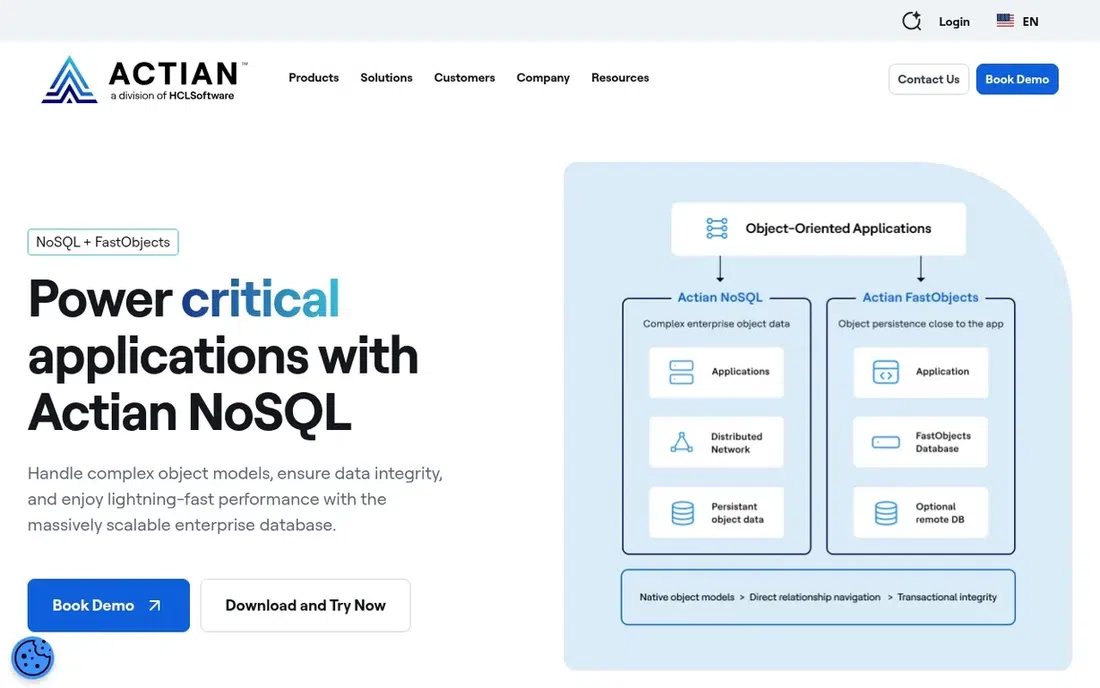
Where Actian NoSQL Database fits: direct C++ and Java object storage. Actian NoSQL Database, also presented as FastObjects, keeps C++ and Java objects straight without mapping code. That makes it a natural fit for startups building object-oriented applications in those languages, where preserving the object model in the database cuts translation work.
In daily use, the vendor also lists disaster recovery, Kubernetes support and MCP access as current capabilities. The tool is oriented toward C++ and Java, so teams working primarily in other languages may find it a weaker match. What you pay to start with Actian NoSQL Database: $499 per month. Free access: Free trial.
Downsides: Centred on C++ and Java environments.
- Keeps objects with no mapping code
- Kubernetes support and MCP access
- Less suited to teams outside those languages
Couchbase Capella
Best for: Managed operational data system
Think of Couchbase Capella for managed operational data product. Startups wanting a minimal footprint or a self-managed object store may prefer a narrower tool.
Pricing for Couchbase Capella is not stated here, so ask the vendor for current figures. As for free access: Not stated.
What to check first: Managed model ties you to the service.
- Mobile sync included
- Key-value
- Wide feature set needs evaluation
InterSystems IRIS
Best for: Unified data product with machine learning
In short, InterSystems IRIS is for unified data product with machine learning. InterSystems IRIS is a data management system positioned as a platform for building machine learning enabled applications that link data and application silos. The platform's breadth is also its central caution: a very small team may not need all of that capability at once.
Honest limits: Product breadth may overwhelm small teams.
In practice, startups that expect to grow into complicated, multi-source data needs may find the combined approach handy, since it aims to cut the number of separate systems a team must stitch together as applications mature. Teams wanting a narrowly focused object store, or a more straightforward document database, may prefer to start smaller and revisit a product approach later. Check the vendor site for InterSystems IRIS pricing; none is listed in this comparison. As for free access: Not stated.
- Supports machine learning enabled applications
- Links data and application silos
- Needs deliberate setup planning
Neo4j is a good fit for connected data and graph queries. Startups whose products revolve around relationships, like recommendations, networks or dependency mapping, may find the graph approach a closer fit than a table or document model. Neo4j is a graph intelligence product built around connecting data as it is stored, supporting capable, complicated queries at scale and speed.
Where it is weaker: Not pitched at plain object persistence.
Graph modeling asks teams to think in nodes and relationships, which is a ramp-up time for developers used to objects or documents. In practice, startups without relationship-heavy data may get more value from a more straightforward object or document store. What you pay to start with Neo4j: $0.09 per GB per hour. A free plan is available with Neo4j.
- Connects data as it is stored
- Graph model matches relationship-heavy domains
- Graph modeling needs a different mindset
Our selection method
We compared the tools on published pricing, free plan or trial availability, feature coverage for Object-Oriented databases for startups, and the limits each vendor documents. Where a vendor does not publish a price, the entry says quote. Where a price depends on seats or billing term, the entry says so. We ordered the tools by general fit, then by how clearly pricing is shown, then by free access. A buyer with unusual needs may reorder them.
What to confirm before you sign up
- Ask Couchbase Capella and InterSystems IRIS for a written quote, since no starting price is shown.
- Look at free plan limits closely: Redis and Neo4j have one, and the caps decide whether it is usable for real work.
- Run a trial of Actian NoSQL Database with real work before paying for a year; your own workflow is the best test.
- Before choosing Redis, weigh its main limit: not a full object persistence layer.
- Check whether Neo4j bills monthly or annually, and what cancelling early costs.
- A short pilot of Couchbase Capella with your real workflow tells you more than a feature table.
FAQ
Do these tools publish their prices?
Not all of them. Couchbase Capella and InterSystems IRIS publish no starting price, so expect a quote request for those. The rest, Redis included, show a starting price, though seats and billing terms still change the final cost.
Can a startup combine multiple of these databases?
A typical pattern pairs a primary store for durable data with a live layer such as Redis for latency-sensitive work. On top of that, keep the number of systems small early on to limit operational overhead, and add specialized keeps as needs become clear.
How are the tools for Object-Oriented databases for startups ordered?
The order follows typical fit for Object-Oriented databases for startups, with Redis first and Neo4j last, then price clarity and free access. It is editorial judgement, not a score, so another team could rank the tools differently.
Is Redis the right pick for everyone comparing Object-Oriented databases for startups?
No single tool suits every team. Redis comes first because it fits real-time data for fast applications, while Actian NoSQL Database suits direct C++ and Java object storage and Couchbase Capella suits managed operational data platform. Match the tool to your own size, budget and workflow before deciding.
How do graph databases differ from object databases?
Object databases focus on persisting application objects straight. Choose based on whether your product's value depends more on relationships or on faithful object storage.
Which options for Object-Oriented databases for startups have a free plan?
On this list, Redis and Neo4j include a free plan. Caps on seats, usage or features are common, so test the free plan against your real workload. One other tool offers a trial instead.
Sources
- https://redis.io
- https://www.actian.com/databases/nosql
- https://www.couchbase.com/products/capella
- https://www.intersystems.com/products/intersystems-iris
- https://neo4j.com