6 Link Building Services for Nonprofits Worth Shortlisting in 2026
A practical 2026 guide to the best link building services for nonprofits, with real vendors, fit notes, limits and a buying checklist from Shihab Mia.
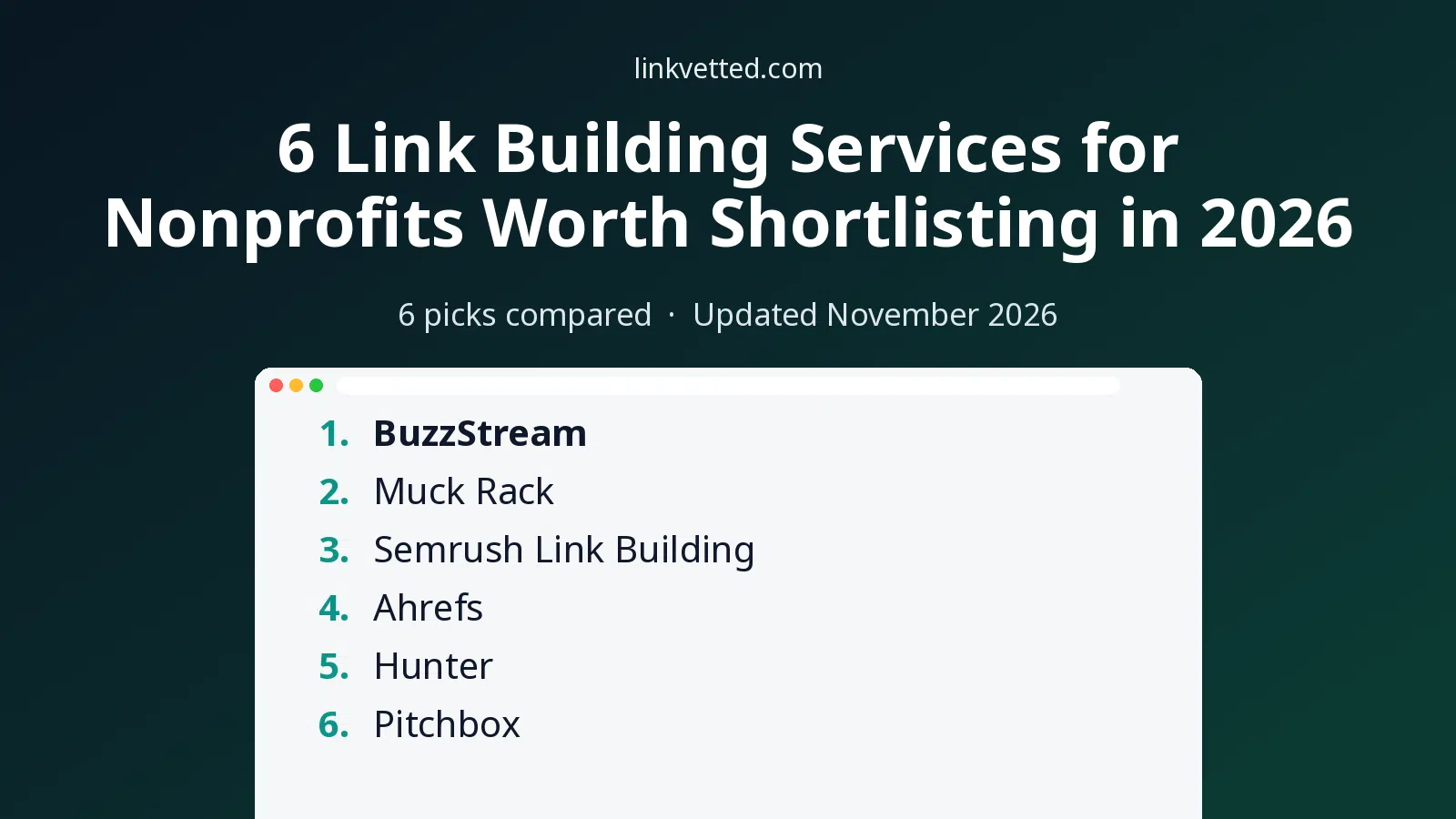
- Editor's choice
 BuzzStream
Outreach contact management for small teams
Starts atSee websiteVisit buzzstream.comFull review - Great alternative
 Muck Rack
Earned media and journalist outreach
Starts atSee websiteVisit muckrack.comFull review - Also considerSemrush Link Building
Done-for-you link acquisition with reporting
Starts atSee websiteVisit semrush.comFull review
Direct answer
My first pick for most nonprofits is BuzzStream, because its outreach workflow fits small teams that need to manage donor, partner and media contacts in one place. For earned media and cause-related coverage, I point people to Muck Rack. For agencies that want done-for-you link building with nonprofit-friendly outreach, Semrush's link building service is a practical third option. I based this on vendor documentation and public sources, not hands-on tests.
TL;DR:
- Nonprofits usually need relationship-led outreach more than volume, so contact management and media databases matter as much as link metrics.
- Free or low-cost tiers help small teams start without a large budget commitment, but check limits before you rely on them.
- A nonprofit's existing partners, sponsors, volunteers and local press are often the strongest link sources, so tools that organize those contacts win.
- Done-for-you services can save time, but you should confirm their outreach standards and ask how they avoid low-quality or paid-link schemes.
- Always verify pricing, plan limits and current features on the vendor's own site before you commit.
Last checked November 2026. Plan prices are not quoted in this guide because they change often; see each vendor's own pricing page for current figures before you buy.
Quick comparison
| Tool | Best for | Starts at | Free plan? | |
|---|---|---|---|---|
| BuzzStream | Outreach contact management for small teams | See website | Free trial | Visit |
| Muck Rack | Earned media and journalist outreach | See website | No free plan | Visit |
| Semrush Link Building | Done-for-you link acquisition with reporting | See website | No free plan | Visit |
 Ahrefs | Backlink research and prospect discovery | See website | No free plan | Visit |
 Hunter | Finding contact emails for outreach | See website | Free plan | Visit |
 Pitchbox | Agencies running repeatable outreach campaigns | See website | No free plan | Visit |
The best link building services for nonprofits compared
I compared these tools from vendor documentation and public sources, including each vendor's own product pages and help docs. I did not run hands-on tests, and I am not claiming client results or measured outcomes. My aim is to help you shortlist options that fit a nonprofit's budget, team size and outreach style, then check the details yourself.
BuzzStream is an outreach and relationship management tool built around prospecting, contact records and email follow-ups. For a nonprofit, that maps well to the way you already work: you have partners, sponsors, local journalists and volunteers to stay in touch with. It suits a small communications or marketing team that wants one place to track who was contacted, when and why.
For link building, the useful part is the pipeline. You can build prospect lists, record the relationship history and run follow-ups without losing track of who replied. That matters for nonprofits because a single local news mention or partner page link often comes from a relationship you already have, not from a cold blast. The tool helps you keep those conversations organized.
The limits are practical. It is not a full SEO platform, so you still need separate tools for backlink research and site audits. Very small teams may find the setup work heavier than expected, and anyone wanting a fully managed service should skip it.
- Built for link and PR outreach
- contact and relationship tracking
- team-friendly workflow
- Takes time to learn
- not a full SEO suite
Muck Rack is a media database and PR platform used to find journalists, track coverage and manage press relationships. Nonprofits often earn their best links through cause-related stories, local news and sector publications, and this is the kind of tool built for that work. It fits communications teams that already pitch stories and want a more organized way to do it.
The link building value is indirect but real. When a journalist covers your program, the article usually links to your site. Muck Rack helps you find the right reporters, see what they cover and monitor when coverage appears. That makes it easier to build a repeatable media routine instead of sending one-off pitches.
The main limit is cost and focus. It is a PR tool, not a link metrics platform, so you will still need backlink research elsewhere. Very small nonprofits with no press program may find it more than they need right now.
- Large media database
- journalist profiles and coverage tracking
- media monitoring
- Cost can be high for tiny teams
- focused on PR rather than pure SEO
Semrush Link Building
Best for: Done-for-you link acquisition with reporting
Semrush is a well-known SEO platform, and its link building service is a managed offering where the vendor handles outreach and link acquisition on your behalf. For a nonprofit with a small team and limited time, that can be appealing: you describe your site and goals, and the work is handled for you. It fits organizations that want a documented process and reporting rather than building an in-house outreach machine.
For nonprofit link building, the benefit is time. Staff time is often the scarcest resource, and a managed service removes the prospecting and follow-up load. You should still ask how targets are selected, what outreach standards are used and how the vendor avoids low-quality or paid-link schemes that could create risk later.
The trade-off is control. You will not hand-pick every target, and the service sits inside a broader platform you may or may not need. Nonprofits that want to own every relationship should skip it and use an outreach tool instead.
- Managed outreach option
- reporting inside a known SEO platform
- clear deliverables
- Less control over individual targets
- requires trust in the vendor's process
Ahrefs is an SEO toolset with a large backlink index and research features. For link building, it is where many teams start: you look at who links to similar organizations, find unlinked mentions and check your own backlink profile. It fits nonprofits that want to do the research themselves and hand the outreach to a communications person.
The nonprofit angle is competitor and peer analysis. You can study which foundations, sector publications and local outlets link to organizations like yours, then build a target list. That list can feed into an outreach tool or a simple spreadsheet. It is research, not outreach, so it works best as the first step in a process you already run.
The limits are clear. There is no built-in contact management or email sequencing, and the cost may be hard to justify for a very small organization. If you only need a handful of links a year, a lighter approach may be enough.
- Strong backlink index
- competitor link analysis
- useful site audit tools
- No outreach CRM
- can be costly for small budgets
Hunter is an email discovery tool. You enter a domain and it suggests likely email addresses and patterns for people at that organization. For nonprofit link building, it fills a specific gap: once you have a target list of partner sites, sector publications or local newsrooms, you need a way to reach the right person.
It fits small teams that already have a prospect list and want a quick way to find contacts. It is not a link building platform, and it will not manage your outreach or track replies. Think of it as a supporting tool in a workflow that includes research and a CRM or spreadsheet.
The limits are the narrow scope and variable data. Some domains return good results, others less so, and you should always verify before sending. Nonprofits that want an all-in-one outreach system should look elsewhere.
- Simple email discovery
- works alongside other tools
- easy to start
- Narrow use case
- data accuracy varies by domain
Pitchbox is an outreach platform used by agencies and in-house teams to run link building and blogger outreach campaigns. It combines prospecting, contact management and email follow-up in a workflow. It fits nonprofits that work with an agency, or larger organizations with a dedicated digital team running ongoing campaigns.
For nonprofit link building, the value is repeatability. If you run seasonal campaigns around events, appeals or reports, a structured workflow helps you keep track of who was contacted and what happened. That is useful when several people share outreach duties and you need a shared record.
The limits are setup effort and fit. It is built with agencies in mind, so a one-person communications team may find it heavy. Nonprofits without a repeatable campaign process should start with a simpler tool and revisit later.
- Campaign workflow
- prospect management
- built for outreach teams
- Setup takes time
- aimed more at agencies than small in-house teams
How I chose
I built this list from vendor documentation and public sources. I read each vendor's product pages, help documentation and public descriptions of what the tool does, then matched those capabilities to the way nonprofits actually earn links: through partners, local press, sector publications and long-term relationships. I did not run hands-on tests, and I am not claiming measured results or client outcomes. Where a vendor's public materials were unclear on a detail, I left it out rather than guess.
I also weighed limits as much as features. A tool that is too heavy for a small team, or priced for agencies, is a poor fit even if it is well made. I looked at whether each option supports relationship-led outreach, whether it helps with research or contact finding, and whether it leaves room for a nonprofit to keep control of who it approaches. Pricing, plan limits and current features change, so I have pointed you to each official site to confirm the details before you buy.
What to check before you buy
- Confirm the current plan limits and pricing on the vendor's own site, since these change and are not listed here.
- Ask whether the tool or service supports relationship-led outreach, which matters more for nonprofits than raw link volume.
- Check how the vendor selects link targets and whether it avoids paid-link schemes and low-quality sites.
- Make sure the workflow fits your team size, including whether more than one person needs access.
- See whether the tool exports your prospect and contact data, so you are not locked in if you switch later.
- Ask about nonprofit discounts or eligibility directly with the vendor, and get any terms in writing.
FAQ
Do nonprofits need paid link building services?
Not always. Many nonprofits earn good links through partners, local press and sector publications without a paid service. A paid tool helps when you have more targets than time, or when outreach is spread across several people. Start with the relationships you already have, then decide whether a tool or managed service saves enough staff time to justify the cost.
Is it safe to use a done-for-you link building service?
It can be, if you check how the vendor works. Ask how targets are selected, what outreach standards apply and whether the vendor uses paid links or low-quality sites. Get the answers in writing. A service that is vague about its process is a risk, and no vendor should promise specific rankings or placements.
Can we start with free tools?
Yes, for early outreach. Hunter offers a free plan, and BuzzStream offers a free trial, which lets you test a workflow before committing. Free tiers usually have limits, so check them against your target list size. A spreadsheet plus a free email finder can carry a small nonprofit through its first few campaigns.
How is nonprofit link building different from regular SEO?
The sources are often different. Nonprofits tend to earn links from foundations, sponsors, local news, volunteers and sector publications rather than product review sites. That makes relationship management and media outreach more important than high-volume campaigns. The goal is usually credibility and visibility for programs, not commercial rankings.
What should a small nonprofit do first?
List the organizations, sponsors, local outlets and sector publications you already work with, then check which ones link to you. Fix the easy gaps first, such as partner pages and event listings. After that, decide whether you need a research tool, an outreach tool or a managed service, and confirm current pricing on each vendor's site.
Sources
- https://www.buzzstream.com
- https://muckrack.com
- https://www.semrush.com
- https://ahrefs.com
- https://hunter.io
- https://www.pitchbox.com
Related guides
- Best Capital Campaign Software for Nonprofits (2026): 5 Picks Checked on Vendor Pages
- Choosing Client Portal Software for Nonprofits in 2026: 5 Options Compared
- 6 Best Collaborative Document Editing Software for Nonprofits for 2026, Vetted and Compared
- Best Donation Button Software for Small Nonprofits (2026): 6 Picks Checked on Vendor Pages