6 Link Building Services for Australian Businesses Worth Shortlisting in 2026
A practical guide to the best link building services for Australian businesses in 2026, compared from vendor documentation and public sources.
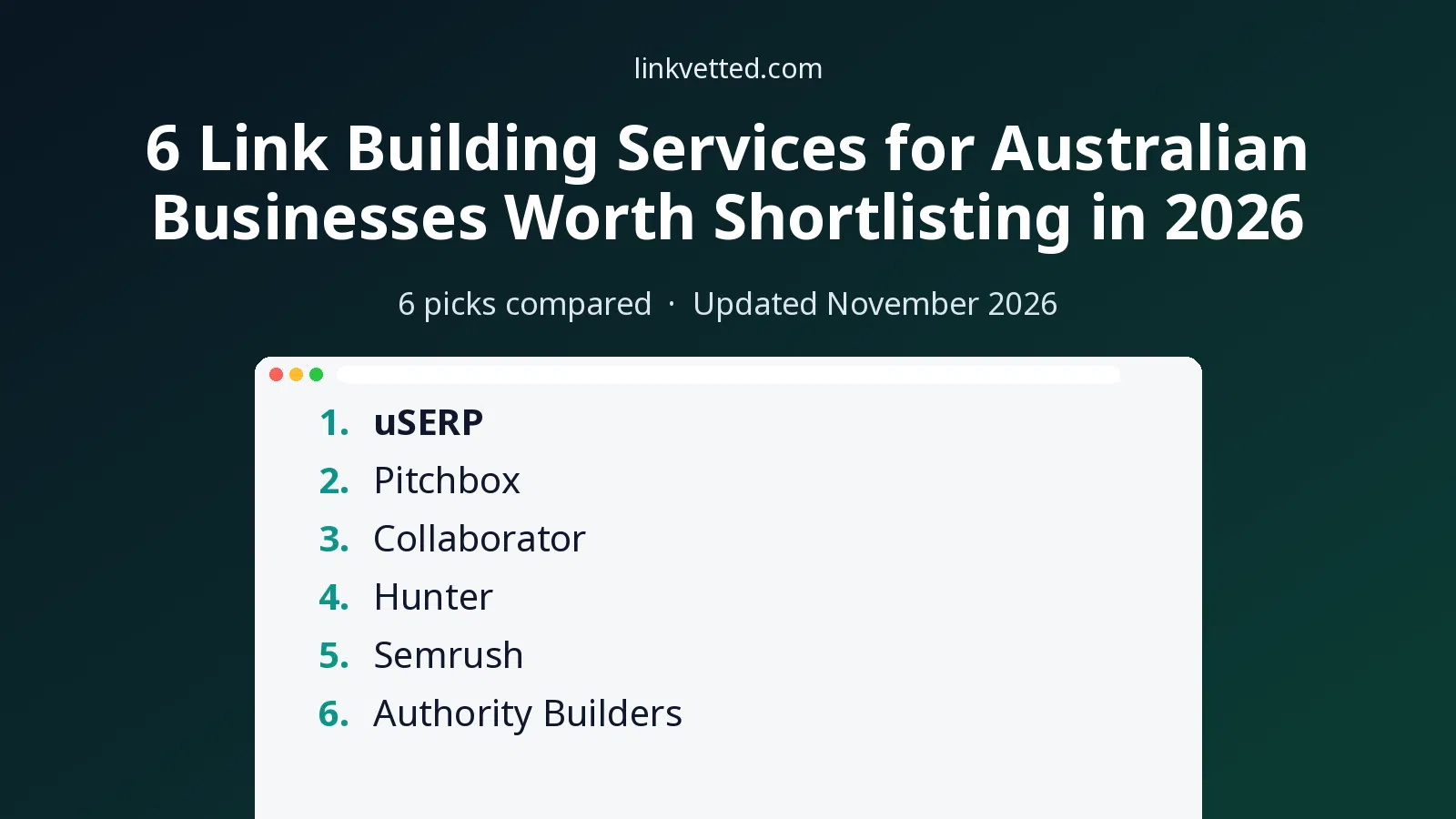
- Editor's choice
 uSERP
Full-service outreach and digital PR
Starts atSee websiteVisit userp.ioFull review - Great alternative
 Pitchbox
Running your own outreach campaigns
Starts atSee websiteVisit pitchbox.comFull review - Also considerCollaborator
Buying individual vetted placements
Starts atSee websiteVisit collaborator.proFull review
Direct answer
My first pick is uSERP, because its documented process covers outreach, editorial placements and digital PR in one place, which suits Australian agencies and in-house teams that want a managed service. For teams that prefer to run outreach themselves with software support, Pitchbox is the practical second choice. For businesses that want to buy vetted links on a marketplace with less management overhead, Collaborator is the third option.
TL;DR:
- uSERP is the strongest fit when you want one vendor to handle prospecting, outreach and placement across several link types.
- Pitchbox suits teams that want to keep control of outreach and use software for prospecting, sequences and reporting.
- Collaborator works well for buyers who want to select individual placements from a marketplace rather than commission a managed campaign.
- Australian relevance depends on where a vendor sources publishers, so always ask for examples of Australian or region-specific placements.
- No service guarantees rankings, and any vendor that promises specific positions should be treated with caution.
Last checked November 2026. Plan prices are not quoted in this guide because they change often; see each vendor's own pricing page for current figures before you buy.
Quick comparison
| Tool | Best for | Starts at | Free plan? | |
|---|---|---|---|---|
| uSERP | Full-service outreach and digital PR | See website | Not stated | Visit |
| Pitchbox | Running your own outreach campaigns | See website | Not stated | Visit |
| Collaborator | Buying individual vetted placements | See website | Not stated | Visit |
 Hunter | Finding outreach contacts | See website | Free plan | Visit |
 Semrush | Link research and competitor analysis | See website | Free plan | Visit |
 Authority Builders | Simple done-for-you link orders | See website | Not stated | Visit |
The best link building services for Australian businesses compared
I compared these services from vendor documentation and public sources, including each vendor's own product pages and help content. I did not run hands-on tests, so treat this as a starting point for your own evaluation. The focus is on what each service documents about its process, its publisher network and how it fits an Australian business or agency.
uSERP is a managed link building and digital PR service. You brief the team on your niche and targets, and they handle prospecting, outreach and placement. It fits agencies and in-house marketing teams that want a partner rather than another tool to learn, especially when they need a mix of editorial links and PR coverage.
For Australian businesses, the practical question is publisher geography. Ask the team which Australian outlets and niche sites they can reach, and whether they can mix local placements with international ones. The workflow usually starts with a strategy call, then a proposed list of targets, then placement reports as links go live.
The main limit is control. If you want to approve every prospect and send every email yourself, a software tool will suit you better. Skip uSERP if your budget is tight or you only need a handful of links.
- Managed outreach and placements
- covers editorial links and digital PR
- documented vetting process
- Less hands-on control
- pricing needs a quote
Pitchbox is outreach software for link building and digital PR campaigns. You build prospect lists, run email sequences and track replies and placements. It fits in-house teams and agencies that want to own the outreach process instead of outsourcing it, and it scales better than managing everything from a spreadsheet.
For Australian campaigns, the tool lets you target local publishers and journalists directly, which matters if you want coverage in Australian media. You can segment by state or city, run separate sequences for local and national outlets, and report on what was placed. The software supports the work but does not do the relationship building for you.
The limit is that Pitchbox is a tool, not a service. You need someone who can write pitches, manage replies and keep the pipeline moving. Skip it if you have no outreach capacity.
- Prospecting and outreach sequences in one tool
- campaign reporting
- works with your own publisher list
- You supply the strategy and effort
- needs a trained operator
Collaborator
Best for: Buying individual vetted placements
Collaborator is a marketplace where you can browse publishers and buy placements directly. It fits businesses that want to pick individual links rather than commission a managed campaign, and it gives you visibility of the sites before you commit.
For an Australian business, the useful part is filtering. You can look for publishers in your niche and check whether Australian or region-specific sites are available. The workflow is straightforward: search, review the site, order the placement, then track the live link. It suits teams that already know what a good link looks like.
The drawback is that vetting is your job. Marketplace quality varies, so check traffic, relevance and whether the site publishes real editorial content. Skip it if you want a vendor to take responsibility for selection.
- Marketplace of publishers
- you choose each placement
- filtering by niche and metrics
- Quality varies by publisher
- you still need to vet each site
Hunter is an email finding tool. You enter a domain and it returns likely email addresses and patterns for people at that company. It fits the early stage of link building, when you have a list of target sites and need contact details for editors or owners.
For Australian campaigns, Hunter helps you build a local prospect list faster. You can find contacts at Australian publications, niche blogs and industry sites, then move those contacts into your outreach tool. It is a supporting tool rather than a link building service on its own.
The limit is scope. Hunter does not send emails, track replies or place links, and some addresses will be wrong or generic. Skip it if you already have a contact source or you are buying managed placements.
- Finds email addresses from domains
- simple interface
- useful for building prospect lists
- No outreach or placement features
- data accuracy varies
Semrush is an SEO platform with a backlink analysis section. It fits teams that want to research competitor links, find gaps and build a target list before they approach publishers or hire a service. The link data helps you see which sites link to competitors in your niche.
For Australian businesses, you can filter competitor backlinks by country and look for local publishers that already link to similar sites. That gives you a realistic target list for outreach or for briefing a managed service. The workflow is research first, then outreach or procurement.
The limit is that Semrush does not build links for you. It is a research and monitoring tool, and the backlink data is an estimate. Skip it if you only want placements and have no interest in analysis.
- Backlink data for competitors
- link gap analysis
- broad SEO toolkit
- Not a placement service
- data needs interpretation
Authority Builders is a done-for-you link building service where you order placements and the team handles sourcing and publishing. It fits businesses that want a simple process without managing outreach or marketplace browsing, and it works for smaller campaigns where speed matters more than bespoke strategy.
For Australian businesses, ask about publisher geography and niche relevance before ordering. The process is usually a brief, a proposed set of sites, then placement and reporting. It is less flexible than a full-service agency but simpler than running your own campaign.
The limit is control over which sites you get. If you need specific Australian outlets or a PR angle, this model may not fit. Skip it if you want to approve every publisher in advance.
- Order-based process
- curated site list
- straightforward reporting
- Limited control over specific sites
- less suited to complex PR campaigns
How I chose
I built this list from vendor documentation and public sources, including each service's own product pages, help content and published process descriptions. I looked at what each vendor says it does, how the workflow runs, and where the limits are. I did not run hands-on tests, so I am not claiming first-hand results from any of these services.
The selection favours services that document a clear process and fit different buying styles: managed service, software, marketplace, research and simple orders. I also considered how each one could support Australian campaigns, mainly whether publisher geography and local outreach are part of the documented offer. Where a vendor does not state something clearly, such as a free plan or pricing, I have said so rather than guess.
What to check before you buy
- Ask for examples of Australian publishers or region-specific placements the vendor has secured.
- Confirm whether the service is managed, self-serve software or a marketplace, and match that to your team's capacity.
- Check how publishers are vetted: relevance, editorial standards and whether paid placements are disclosed.
- Ask what reporting you get and whether you can see live links and placement dates.
- Clarify what happens if a link is removed, and whether there is any replacement policy.
- Avoid any vendor that promises specific rankings or a set number of positions.
FAQ
Are link building services worth it for small Australian businesses?
It depends on your competition and budget. A small local business may get more from local citations and genuine community relationships than from bought links. If you do use a service, start small, check the publishers and focus on relevance to your niche and location rather than volume.
Can these services get links from Australian websites specifically?
Some can, but you need to ask. Managed services and marketplaces vary in how many Australian publishers they can reach. Before buying, request examples of Australian sites in your niche and confirm whether local placements are part of the standard offer or a custom request.
Is buying links against Google's guidelines?
Google's spam policies treat links bought primarily to manipulate rankings as link spam. Paid placements that are disclosed and genuinely editorial are a different matter, but the line is not always clear. Treat any vendor promising guaranteed rankings or undisclosed paid links with caution, and focus on relevance and editorial quality.
How long before link building shows results?
Link building is usually a slow channel. Placements need time to be indexed and to have any effect, and results depend on your overall SEO, content and competition. Any vendor promising fast ranking changes is overpromising. Plan for months, not weeks, and track referrals and rankings together.
Should I use a service or build links myself?
If you have time and writing skills, doing outreach yourself with a tool like Pitchbox or Hunter keeps costs down and gives you control. A managed service suits teams without outreach capacity. Many businesses mix both: research and contact finding in-house, then a service for larger campaigns.
Sources
- https://userp.io
- https://pitchbox.com
- https://collaborator.pro
- https://hunter.io
- https://semrush.com
- https://authority.builders