6 Best AI Link Building Tools for 2026, Vetted and Compared
A practical comparison of the best AI link building tools in 2026, covering prospecting, outreach and digital PR, based on vendor documentation.
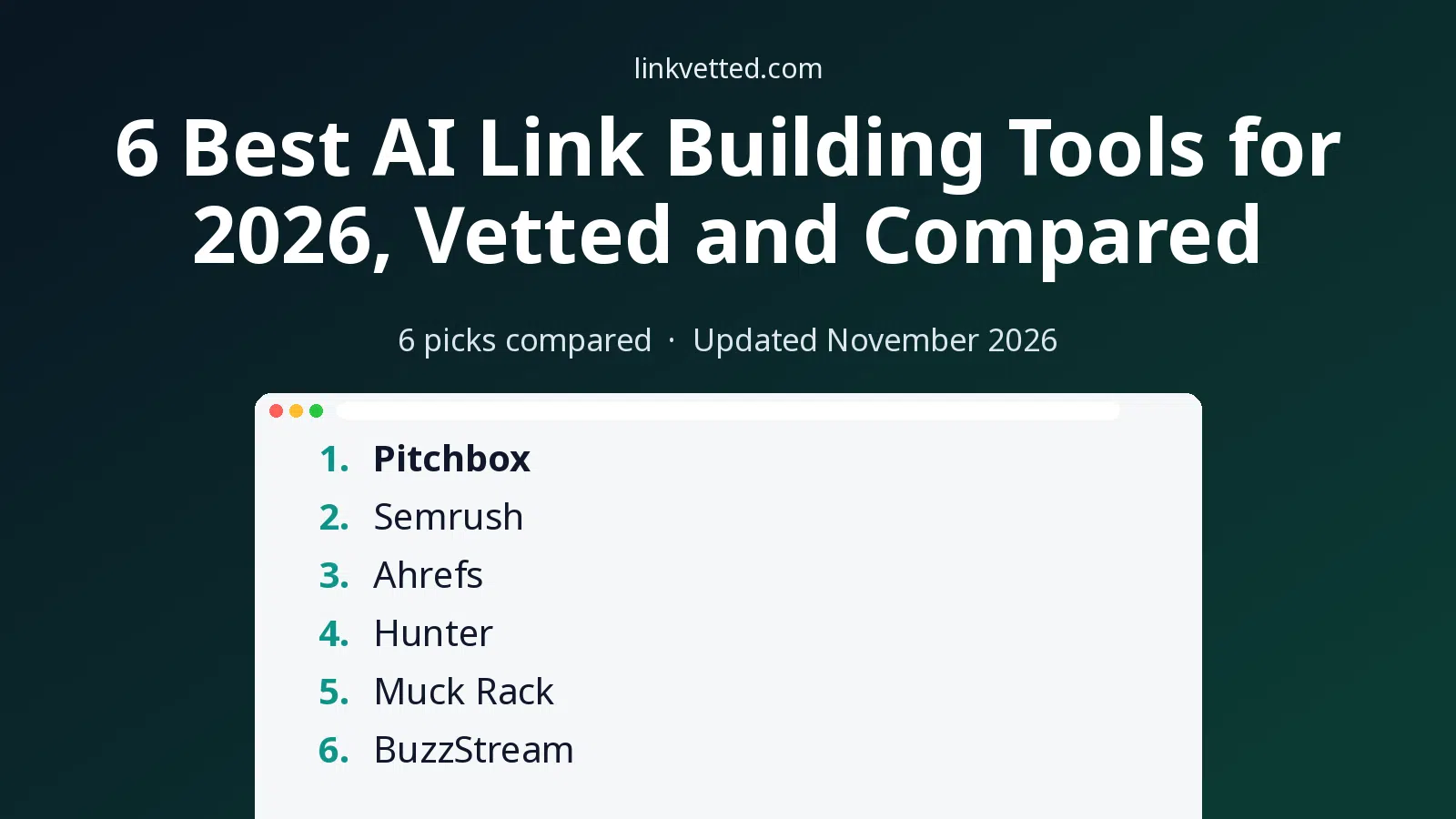
- Editor's choice
 Pitchbox
Agency outreach at scale
Starts atSee websiteVisit pitchbox.comFull review - Great alternative
 Semrush
Link prospects from search data
Starts atSee websiteVisit semrush.comFull review - Also consider
 Ahrefs
Backlink research and prospecting
Starts atSee websiteVisit ahrefs.comFull review
Direct answer
My top pick is Pitchbox, because it puts AI-assisted prospecting and outreach sequencing in one place and fits agencies running many campaigns. If your focus is finding link opportunities from search data, Semrush is the stronger fit. If you mainly need media and journalist contacts for digital PR, Muck Rack covers that side better. Each tool below suits a different part of the link building workflow, so the right choice depends on where your process is slowest.
TL;DR:
- AI link building tools mostly speed up prospecting, contact finding and outreach writing, not the decision to build a link.
- Pick a tool based on your bottleneck: finding prospects, finding emails, sending sequences or managing PR contacts.
- Most of these products are sold on annual or seat-based plans, so check the pricing page before you commit.
- Vendor documentation is the best source for feature limits, because AI features change between plans and releases.
- No tool replaces editorial judgement; you still need to check relevance and avoid low-quality link sources.
Last checked November 2026. Plan prices are not quoted in this guide because they change often; see each vendor's own pricing page for current figures before you buy.
Quick comparison
| Tool | Best for | Starts at | Free plan? | |
|---|---|---|---|---|
| Pitchbox | Agency outreach at scale | See website | Not stated | Visit |
| Semrush | Link prospects from search data | See website | Free plan | Visit |
| Ahrefs | Backlink research and prospecting | See website | Not stated | Visit |
 Hunter | Finding contact emails | See website | Free plan | Visit |
 Muck Rack | Digital PR and media contacts | See website | Not stated | Visit |
 BuzzStream | Small teams running outreach | See website | Free trial | Visit |
The best AI link building tools compared
I compared these tools from vendor documentation, pricing pages and public sources. I did not run hands-on tests, so treat this as a starting point for your own trial. I looked at where each tool sits in the link building workflow, what its AI features are documented to do, and where the limits are. The aim is to help you shortlist two or three tools rather than read every feature page yourself.
Pitchbox is an outreach platform built around campaigns. You add prospects, find contacts, send sequences and track replies in one place. It fits agencies and in-house teams that run many link building or digital PR campaigns at once and need a repeatable process. Solo site owners will likely find it heavier than they need.
For link building, the useful part is the combination of prospect search and outreach automation. Vendor documentation describes AI help with finding prospects and drafting messages, which cuts the time spent on repetitive email work. You still review the list and the copy before sending, so the quality of your targeting remains the main factor.
The limit is cost and complexity. If you send a handful of outreach emails a month, a spreadsheet and a cheaper email finder will do the same job. Skip Pitchbox if you do not have a repeatable outreach process yet.
- Prospect discovery and outreach in one workflow
- AI-assisted email drafting
- campaign reporting for clients
- Priced for teams rather than solo users
- setup takes time
Semrush is a broad SEO platform, and its backlink and link building tools are one part of it. That makes it a sensible choice if you already use it for keyword research and want prospect ideas in the same place. You can look at competitor backlinks, find sites that link to several competitors, and build outreach lists from that data.
The AI angle is mostly in the wider platform: documented features help with content and research tasks, while the link tools give you the raw prospect data. The workflow is to export a prospect list, qualify it, then move it into an outreach tool or your own email process.
The drawback is that you pay for a full suite when you may only need the link module. If your only job is sending outreach, a dedicated outreach tool is a better fit. Check which plan includes the link features you need.
- Large backlink and keyword dataset
- link building tools sit beside SEO research
- AI features across the suite
- Link building is one module among many
- plans are priced for regular use
Ahrefs is known for backlink data, and its tools support the research side of link building well. You can review a competitor's links, find sites that link to rivals but not to you, and export lists for outreach. It suits SEOs who want reliable link data and are comfortable running outreach elsewhere.
The AI features are spread across the platform rather than focused on link building alone. In practice, you use Ahrefs to build and qualify the prospect list, then use a separate tool to find emails and send messages. That split is normal and often works better than forcing one tool to do everything.
The main limit is that Ahrefs does not send outreach for you. If you want one tool that finds prospects and runs sequences, look at Pitchbox or BuzzStream instead. Credit limits on some features are also worth checking before you rely on heavy exports.
- Well-documented backlink index
- useful competitor link gap analysis
- clean prospect exports
- No built-in outreach sending
- credit limits apply to some features
Hunter is an email finding tool. You give it a domain or a name, and it returns likely email addresses and patterns. In a link building process it sits between prospecting and outreach: you have a list of sites, and Hunter helps you find who to contact.
The AI element is in search and verification features that the vendor documents on its site. For link building, the practical value is speed: you can turn a list of domains into contacts without checking each site by hand. It pairs well with Ahrefs or Semrush for prospecting and with an outreach tool for sending.
The limit is scope. Hunter does not manage campaigns, track replies or report on links. If you need an all-in-one workflow, use it as a supporting tool rather than the main platform. Always verify addresses before a large send.
- Simple email finding workflow
- domain search for bulk contact discovery
- works alongside other outreach tools
- No outreach sequencing
- email accuracy still needs checking
Muck Rack is a media relations platform. It helps you find journalists, build media lists, send pitches and track coverage. For link building, it fits the digital PR side: earning links through stories, data and expert comment rather than cold outreach to bloggers.
The AI features documented by the vendor focus on media monitoring, search and pitch support. That is useful when your link strategy depends on press coverage. It is less useful if you mostly build links through resource pages, guest posts or niche edits.
The limit is fit. Muck Rack does not report on backlinks or domain metrics, so you need a separate SEO tool to measure results. Skip it if your link building is purely SEO-driven and does not involve media outreach.
- Large media contact database
- monitoring and reporting for PR coverage
- useful for journalist outreach
- Not built around SEO link metrics
- priced for PR teams
BuzzStream is an outreach and relationship management tool for link building and content promotion. You build prospect lists, store contact details, send emails and track conversations. It suits small teams and consultants who want a structured process without the cost and complexity of an enterprise platform.
The vendor documents research and workflow features that help you qualify prospects and personalise outreach. AI assistance is present but lighter than in larger suites, so expect to do more of the writing and filtering yourself. That can be an advantage if you want close control over every message.
The limit is scale. For very large campaigns with many team members, a bigger platform may fit better. If you send a few hundred pitches a month and want to keep things simple, BuzzStream is worth a trial.
- Contact and outreach management in one place
- research sidebar for prospect context
- simpler than large suites
- Smaller AI feature set
- less suited to very large campaigns
How I chose
I built this list from vendor documentation, pricing pages and public sources. I did not run hands-on tests, so I cannot tell you how each tool feels day to day. Instead, I mapped each product to a stage of the link building workflow: prospecting, contact finding, outreach and digital PR. Then I checked what the vendor says the AI features do and which plans include them. That gives a fair picture of fit without overstating what any tool can do.
I also looked at limits. A tool that is strong at prospecting may not send email, and a PR platform may not report on backlinks. Those gaps matter more than feature counts when you are choosing. My advice is to shortlist based on your bottleneck, then use free plans or trials where they exist to check the workflow yourself. Vendor documentation is the best source for current feature and plan details, because these products change often.
What to check before you buy
- Confirm which plan includes the AI features you want, because they are often limited to higher tiers.
- Check whether the tool finds contacts, sends outreach or both, so you do not pay twice for the same step.
- Ask how prospect data is sourced and how often it is refreshed.
- Look at export limits and credit rules if you plan to build large lists.
- Check whether reporting covers links built or only emails sent.
- Read the vendor's documentation on data use and email compliance before a large campaign.
FAQ
What are AI link building tools used for?
They speed up the parts of link building that involve lists and email: finding prospect sites, locating contact addresses, drafting outreach messages and tracking replies. The AI features are documented as assistance, not automation of the whole process. You still decide which prospects are relevant and whether a link is worth pursuing, and you still review messages before they go out.
Do I need a separate email finder if I use an outreach tool?
Not always. Some outreach platforms include contact finding, while others expect you to bring a list. Check the vendor documentation for your plan, because contact credits and email finding are often limited. If your main tool does not include it, a dedicated finder like Hunter can fill the gap without replacing your outreach workflow.
Can these tools guarantee links or rankings?
No. They help you find prospects and run outreach, but the decision to link sits with the publisher. No tool can promise a link, and none should be bought on that basis. Use them to make your process faster and more organised, then judge results by the quality of sites that respond, not by a promised number of links.
Is a free plan enough to start?
It depends on the tool. Some offer a free plan with limits, and others offer a trial or no free option at all. Free tiers are usually enough to test the workflow and see whether the data fits your niche. For regular campaigns you will likely need a paid plan, so check the pricing page before you build a process around a free tier.
How do I choose between an SEO suite and a dedicated outreach tool?
Start with your bottleneck. If you struggle to find prospect sites, an SEO suite with backlink data is the better first buy. If you already have lists and struggle to send and track outreach, a dedicated tool fits better. Many teams end up using one of each, with the suite for research and the outreach tool for campaigns.
Sources
- https://www.pitchbox.com
- https://www.semrush.com
- https://ahrefs.com
- https://hunter.io
- https://muckrack.com
- https://www.buzzstream.com