Best RDF Databases in 2026: Prices, Free Plans and 5 Picks
Need the best RDF databases? We compare 5 tools on cost, free access and who each suits. The weak spots sit next to the strengths. Checked this month.
- Editor's choiceMarkLogic
Multi-model enterprise data management
Starts atSee websiteVisit progress.comFull review - Great alternative
 Neo4j
Property graph queries at scale
Starts at$0.09 per GB per hourVisit neo4j.comFull review - Also considerGraphDB
Semantic graph analytics and linking
Starts atSee websiteVisit ontotext.comFull review
Direct answer
For multi-model enterprise data management, MarkLogic is where this list starts. Listed starting prices: Neo4j from $0.09 per GB per hour. For a different need, Neo4j covers property graph queries at scale and GraphDB covers semantic graph analytics and linking. The other 2 tools in the list cover narrower or pricier cases.
TL;DR:
- The list opens with MarkLogic, aimed at multi-model enterprise data management.
- Expect to ask for a quote from MarkLogic, GraphDB, Amazon Neptune and AllegroGraph; the other tools show a starting price.
- 2 of 5 tools offer a free plan: Neo4j, Amazon Neptune.
- AllegroGraph is the one to check for knowledge graphs with neuro-symbolic AI.
- Before buying Amazon Neptune, weigh this: tied to the AWS ecosystem.
Last checked November 2026. Prices and plan details were read from the vendors' own pages in November 2026; vendors change plans often, so confirm the current price on the vendor site before you buy.
Quick comparison
| Tool | Best for | Starts at | Free plan? | |
|---|---|---|---|---|
| MarkLogic | Multi-model enterprise data management | See website | Free trial | Visit |
| Neo4j | Property graph queries at scale | $0.09 per GB per hour | Yes | Visit |
| GraphDB | Semantic graph analytics and linking | See website | Not stated | Visit |
| Amazon Neptune | Managed graph database on AWS | See website | Yes | Visit |
| AllegroGraph | Knowledge graphs with neuro-symbolic AI | See website | Not stated | Visit |
5 RDF databases in detail
LinkVetted put together this guide to RDF databases for readers who want a clear shortlist without reading every vendor page. It compares 5 tools on starting price, free plans, who each one suits and where each one falls short.
MarkLogic
Best for: Multi-model enterprise data management
Where MarkLogic fits: multi-model enterprise data management. Teams wanting a narrow semantic store may prefer a dedicated triple store.
Drawbacks to consider: Enterprise scope can be heavy for small projects.
MarkLogic does not show a starting price in this comparison, so check the vendor site for current pricing. Trial and free access: Free trial.
- Aimed at complicated data challenges
- Adaptable multi-model system
- Multi-model design needs architectural planning
Neo4j targets property graph queries at scale. Neo4j is oriented toward property graphs, so teams with strict RDF and SPARQL requirements may need adaptation or a different engine.
From a buyer's view, organizations concentrated on relationship-heavy queries and graph applications are a natural audience. More specifically, choose it when connected data queries and graph application development matter more than native RDF semantics. Neo4j pricing: $0.09 per GB per hour. You can start on Neo4j without paying.
Where it is weaker: RDF users may need additional adaptation.
- Complicated queries at scale and speed
- Graph intelligence product focus
- Property graph orientation differs from RDF modeling
GraphDB
Best for: Semantic graph analytics and linking
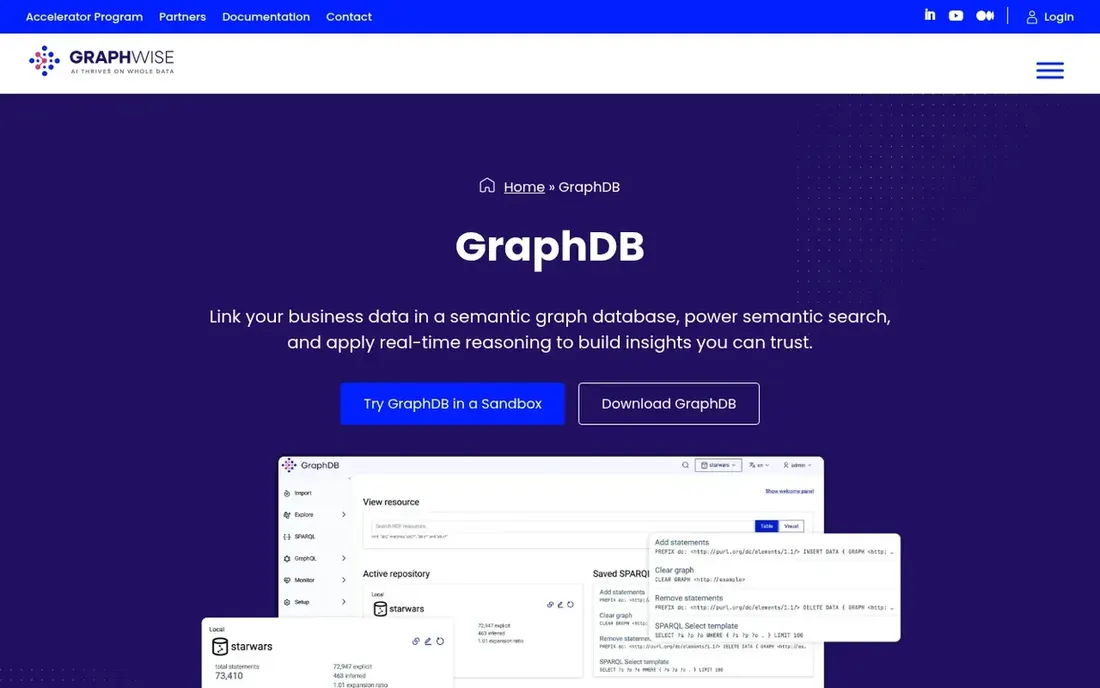
GraphDB is aimed squarely at semantic graph analytics and linking. It suits teams working with RDF and ontologies that require a purpose-built semantic engine.
Drawbacks to consider: Semantic focus may not suit pure property graph needs.
This comparison lists no price for GraphDB; ask the vendor. Free plan details: Not stated.
- Quick query performance for semantic graphs
- Semantic linking of unstructured data
- Needs RDF modeling knowledge
Amazon Neptune
Best for: Managed graph database on AWS
Amazon Neptune works best for managed graph database on AWS. It fits teams already on AWS that want to avoid operating graph infrastructure themselves.
Also, choose Neptune when managed graph operations on AWS are the priority. Check the vendor site for Amazon Neptune pricing; none is listed in this comparison. Amazon Neptune offers a free plan.
Honest limits: Tied to the AWS ecosystem.
- Completely managed service
- Supports knowledge graph use cases
- Managed model limits infrastructure control
AllegroGraph
Best for: Knowledge graphs with neuro-symbolic AI
AllegroGraph is a good fit for knowledge graphs with neuro-symbolic AI. AllegroGraph is presented as a knowledge graph system integrating neuro-symbolic AI for advanced data analytics and intelligent decision-making.
Watch-outs: Needs understanding of semantic AI approaches.
AllegroGraph does not show a starting price in this comparison, so check the vendor site for current pricing. Trial and free access: Not stated.
- Aimed at advanced analytics
- Knowledge graph system focus
- Specialized positioning may narrow fit
How the list was put together
The comparison looks at four things: starting price, free access, how well the feature set matches RDF databases, and the main limit of each tool. Treat prices as a snapshot: vendors change plans often, so check the vendor site for the figure that applies today. We ordered the tools by general fit, then by how clearly pricing is shown, then by free access. A buyer with unusual needs may reorder them.
What to confirm before you sign up
- Confirm the entry price on the vendor page. For MarkLogic, GraphDB, Amazon Neptune and AllegroGraph that means a quote rather than a fixed price.
- Read the fine print on the free plans from Neo4j and Amazon Neptune; seat, project and feature caps differ.
- Use real work to test the free trial from MarkLogic, rather than a demo project.
- Read the limits listed for MarkLogic first: enterprise scope can be heavy for small projects.
- Ask Neo4j whether prices are locked for the first term and what happens at renewal.
- Check the support hours and onboarding help Amazon Neptune offers; smaller vendors vary a lot here.
FAQ
Which options for RDF databases have a free plan?
On this list, Neo4j and Amazon Neptune include a free plan. Caps on seats, usage or features are common, so test the free plan against your real workload. One other tool offers a trial instead. Prices, free plan details and limits for all 5 tools in this RDF databases roundup sit on the individual cards above.
What should I look for in a RDF database?
Focus on native RDF and SPARQL support, the deployment model you can operate, and how well the engine deals with your query patterns. Also check governance and access control features.
How are the tools for RDF databases ordered?
The order follows typical fit for RDF databases, with MarkLogic first and AllegroGraph last, then price clarity and free access. It is editorial judgement, not a score, so another team could rank the tools differently.
Is a managed graph database worth considering?
Managed services like Amazon Neptune cut operational overhead by handling infrastructure for you. That fits teams that want to focus on applications instead of database operations.
How do RDF databases differ from property graph databases?
RDF databases store triples and are queried with SPARQL, which fits semantic and ontology-driven work. Some systems support both, so confirm which model suits your data.
Can I try these tools before paying?
Often, yes. Neo4j and Amazon Neptune have a free plan and MarkLogic offers a free trial. Use your own data and a real task during the test, and check what the free tier or trial limits before you rely on it. Each of the 5 options in this RDF databases guide has its own card above with the price, free plan and limits.
Sources
- https://www.progress.com/marklogic
- https://neo4j.com
- https://www.ontotext.com/products/graphdb
- https://aws.amazon.com/neptune
- https://allegrograph.com