Best Web Framework for Rust (2026): 5 Picks Checked on Vendor Pages
Best web framework for rust in 2026: 5 contenders with entry costs and free tiers. Axum is the first pick for modular Tokio-based applications. Quick to scan.
- Editor's choiceAxum
Modular Tokio-based applications
Starts at$4 per user a monthVisit github.comFull review - Great alternativeTide
Friendly async Rust development
Starts at$4 per user per monthVisit github.comFull review - Also considerNickel
Express.js-inspired simplicity
Starts at$4 per user a monthVisit github.comFull review
Direct answer
Our first pick is Axum, best for modular Tokio-based applications. Listed starting prices: Axum from $4 per user a month, Tide from $4 per user per month and Nickel from $4 per user a month. If your case is different, Tide suits friendly async Rust development and Nickel suits express.js-inspired simplicity. All 5 tools are compared below on price, free plan and limits.
TL;DR:
- Axum takes the first slot, best suited to modular Tokio-based applications.
- Free plans exist at 4 of 5 tools (Axum, Tide, Nickel, Warp).
- Actix Web fits high-performance production APIs.
- The cheapest monthly starting price in the list is $4 per user per month, offered by Axum.
Last checked November 2026. Prices and plan details were read from the vendors' own pages in November 2026; vendors change plans often, so confirm the current price on the vendor site before you buy.
Quick comparison
| Tool | Best for | Starts at | Free plan? | |
|---|---|---|---|---|
| Axum | Modular Tokio-based applications | $4 per user a month | Yes | Visit |
| Tide | Friendly async Rust development | $4 per user per month | Yes | Visit |
| Nickel | Express.js-inspired simplicity | $4 per user a month | Yes | Visit |
 Warp | Composable filter-based routing | $4 per user a month | Yes | Visit |
| Actix Web | High-performance production APIs | See website | Not stated | Visit |
5 options for web framework for rust in detail
LinkVetted put together this guide to web framework for rust for readers who want a clear shortlist without reading every vendor page. It compares 5 tools on starting price, free plans, who each one suits and where each one falls short.
Axum
Best for: Modular Tokio-based applications
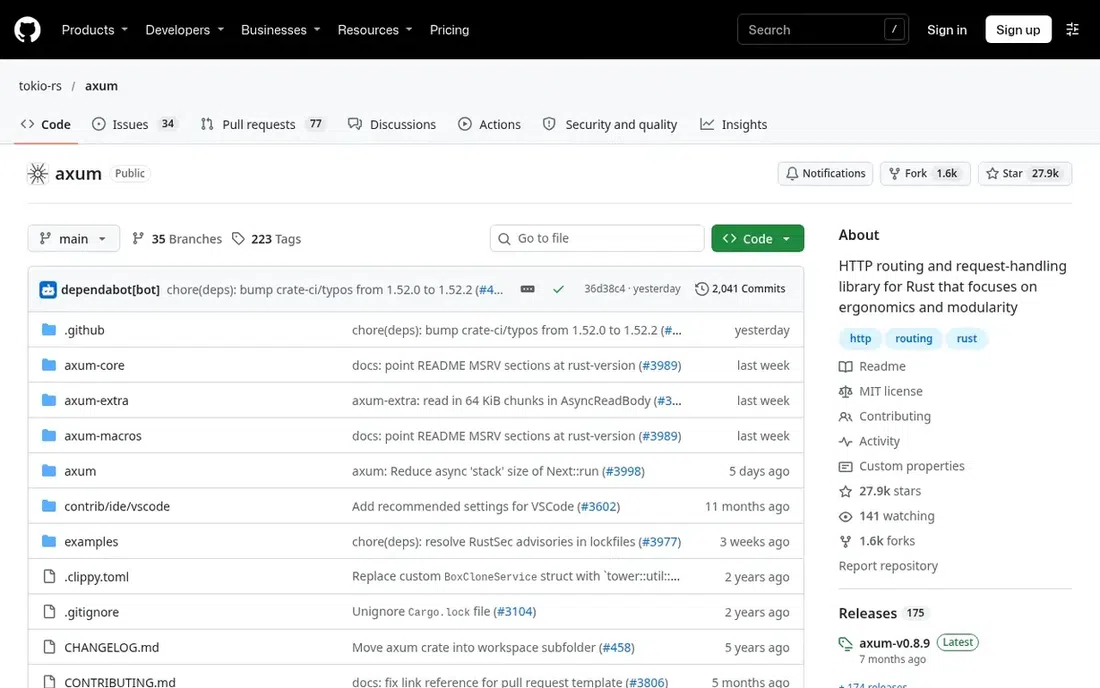
Axum makes the most sense for modular Tokio-based applications. As a relatively newer framework, Axum has a smaller ecosystem of extensions compared with more established choices. From a buyer's view, built on Tokio, it integrates smoothly with the async ecosystem and supplies a clean, composable API.
Where Axum stands out: Tokio integration.
It is a strong match for developers who want fine-grained control and prefer to assemble components when needed. Axum is an HTTP routing and request-handling library for Rust that concentrates on ergonomics and modularity. The starting price for Axum: $4 per user per month. Axum includes a free tier. Honest limits: Fewer built-in features.
- Modular architecture
- Ergonomic design
- Younger ecosystem
Tide
Best for: Friendly async Rust development
Tide is designed for friendly async Rust development. Tide is a quick and friendly HTTP server framework for async Rust. It aims to provide a straightforward and approachable API for building web applications, with a focus on async programming.
Drawbacks to consider: Smaller ecosystem.
Tide has a smaller community and fewer resources compared with more established frameworks, which may impact support and available plugins. If you need a bigger ecosystem or more built-in features, consider Actix Web or Axum. Entry price for Tide: $4 per user per month. Tide includes a free tier.
- Friendly API
- Light
- Less documentation
Nickel
Best for: Express.js-inspired simplicity
For express.js-inspired simplicity, Nickel is a natural candidate. Nickel is an Express.js-inspired web framework for Rust. It gives you a familiar and straightforward API for developers coming from Node.js backgrounds, making it simple to build web applications rapidly.
Watch-outs: Restricted features.
What users get: Light.
It is well suited to small to medium-sized projects that value simplicity. On top of that, Nickel has seen less active development and has a smaller feature set compared with other frameworks. If you need a more actively maintained framework with a richer ecosystem, Actix Web or Axum are better choices. Price to start with Nickel: $4 per user per month. Nickel includes a free tier.
- Familiar syntax
- Straightforward routing
- Less active development
Choose Warp for Composable filter-based routing. Warp is a super-easy, composable web server framework for warp accelerates.
This approach appeals to those who enjoy functional programming and fine-grained control over request handling. What you pay to start with Warp: $4 per user per month. You can start on Warp without paying.
Honest limits: Unconventional routing.
- Light
- Flexible
- Steeper ramp-up time
Actix Web
Best for: High-performance production APIs
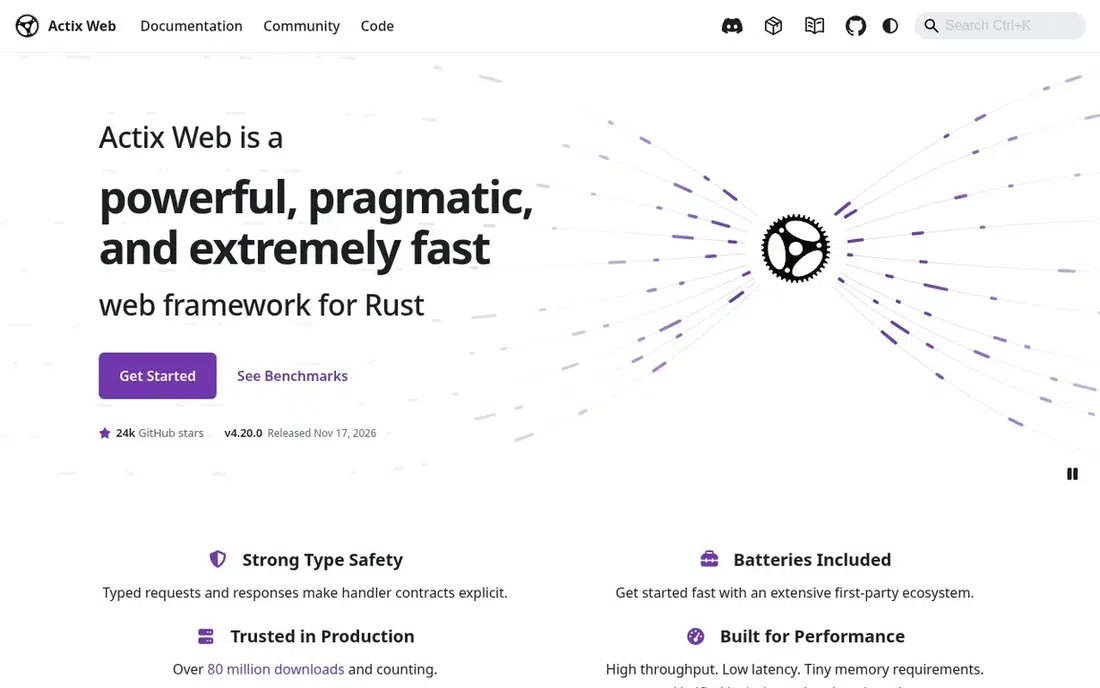
Actix Web is built with high-performance production APIs in mind. Actix Web is a capable, pragmatic, and very quick web framework for Rust. It is well-suited for building high-performance web services and APIs, offering a rich set of features and a mature ecosystem.
Limits to weigh: Steep ramp-up time.
Developers who require to deal with high throughput and low latency commonly consider Actix Web a solid candidate. Its advanced features and actor-based design can introduce complexity, making it less approachable for newcomers. No starting price is listed for Actix Web here; confirm pricing on the vendor site. Trial and free access: Not stated.
- Capable features
- Very quick
- Complicated for beginners
Our selection method
For each of the 5 tools we noted price, free plan or trial, fit for web framework for rust and the main limit, using vendor pages and documentation. Where a price is missing, the vendor does not list one publicly or ties it to a quote. Always confirm before budgeting. The ranking is editorial: typical fit first, then clear pricing, then free access. If your needs are unusual, read the profiles rather than relying on position.
What to confirm before you sign up
- Confirm the entry price on the vendor page. For Actix Web that means a quote rather than a fixed price.
- Check what the free option really includes: Axum, Tide, Nickel and Warp offer a free plan, and usage caps differ.
- Before choosing Axum, weigh its main limit: younger ecosystem.
- Check whether Actix Web bills monthly or annually, and what cancelling early costs.
- Verify that exporting from Warp is possible on your plan and covers all your records.
FAQ
Do these tools publish their prices?
Not all of them. Actix Web publishes no starting price, so expect a quote request for it. The rest, Axum included, show a starting price, though seats and billing terms still change the final cost.
Which options for web framework for rust have a free plan?
Axum, Tide, Nickel and Warp offer a free plan in this list. Free plans usually cap users, projects or features, so check the limits on the vendor page.
What is the cheapest option for web framework for rust in this list?
On published monthly entry prices, Axum is the lowest here at $4 per user per month. Entry price is only part of the cost, because seats, add-ons and billing terms can change the total.
Is Axum the right pick for everyone comparing web framework for rust?
No single tool suits every team. Axum comes first because it fits modular Tokio-based applications, while Tide suits friendly async Rust development and Nickel suits express.js-inspired simplicity. Match the tool to your own size, budget and workflow before deciding.
Sources
- https://github.com/tokio-rs/axum
- https://github.com/http-rs/tide
- https://github.com/nickel-org/nickel.rs
- https://github.com/seanmonstar/warp
- https://actix.rs