Best Node Js Framework (2026): 5 Picks Checked on Vendor Pages
Best node js framework: 5 contenders ranked by fit, with entry costs and free tiers. Clear notes on pricing gaps and limits. A comparison table is included.
- Editor's choiceKoa
Light middleware-style applications
Starts atSee websiteVisit koajs.comFull review - Great alternativeNestJS
Large TypeScript backends and teams
Starts atSee websiteVisit nestjs.comFull review - Also considerExpress
Minimal, adaptable web apps and APIs
Starts atSee websiteVisit expressjs.comFull review
Direct answer
Our first pick is Koa, best for light middleware-style applications. Listed starting prices: Sails.js from $600 a month. Look at NestJS for large TypeScript backends and teams, and at Express for minimal, adaptable web apps and APIs. The remaining 2 options are covered below with prices and limits.
TL;DR:
- The list opens with Koa, aimed at light middleware-style applications.
- Before buying NestJS, weigh this: more concepts to learn.
- Koa, Sails.js and the 3 others all need a premium plan or a trial, since no free plan is listed.
- Sails.js is the lowest-priced starter here at $600 per month.
- Sails.js suits Realtime MVC applications.
Last checked November 2026. Prices and plan details were read from the vendors' own pages in November 2026; vendors change plans often, so confirm the current price on the vendor site before you buy.
Quick comparison
| Tool | Best for | Starts at | Free plan? | |
|---|---|---|---|---|
| Koa | Light middleware-style applications | See website | Not stated | Visit |
| NestJS | Large TypeScript backends and teams | See website | Not stated | Visit |
| Express | Minimal, adaptable web apps and APIs | See website | Not stated | Visit |
| AdonisJS | Batteries-included TypeScript applications | See website | Not stated | Visit |
| Sails.js | Realtime MVC applications | $600 a month | Not stated | Visit |
The 5 tools in detail
If you are comparing node js framework, this page covers 5 tools in one place: what each is best for, what it costs to start, whether it has a free plan, and the main limit to know about.
Koa
Best for: Light middleware-style applications
Koa is a good fit for light middleware-style applications. Koa is described as a next generation web framework for Node.js.
Limits to weigh: Few built-in features.
It is recognised for a small core built around middleware and modern asynchronous patterns, giving developers fine control over request and response handling. Pick a batteries-included or more structured framework when you want conventions and built-in tooling. This comparison lists no price for Koa; ask the vendor. Free plan details: Not stated.
- Middleware-centric design
- Expressive core
- Smaller ecosystem than Express
NestJS
Best for: Large TypeScript backends and teams
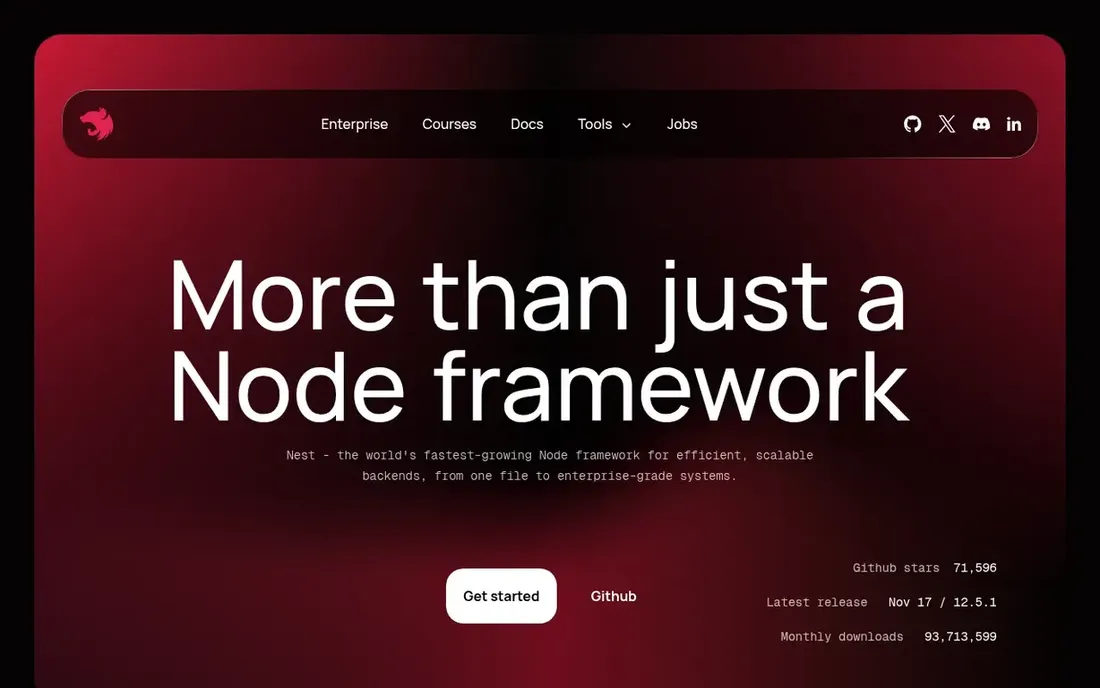
Where NestJS fits: large TypeScript backends and teams. NestJS is a progressive Node.js framework built around TypeScript for efficient, scalable backends. It is built to grow from a small API in a single file to enterprise-grade systems with many teams, offering an organized architecture that supports shared conventions.
Downsides: Heavier structure for small APIs.
For everyday use, teams without TypeScript experience face a ramp-up time. The structured approach means more concepts and boilerplate than a minimalist framework, which can slow very small projects. Also, choose a lighter framework when the service is small, short-lived or maintained by a single developer. This comparison lists no price for NestJS; ask the vendor. On free options: Not stated.
Upsides: TypeScript-first design.
- Structured architecture
- Scales from one file to enterprise
- More concepts to learn
Express
Best for: Minimal, adaptable web apps and APIs

Express serves minimal, adaptable web apps and APIs. Pick a more structured framework when you need solid conventions across plenty of contributors or a TypeScript-first architecture. Worth adding: since Express stays minimal, bigger applications can drift into inconsistent patterns except when the team sets conventions.
It supplies little built-in guidance for authentication, data access or validation. Its small core and middleware approach let developers assemble only the pieces they need, which fits small services, prototypes and teams that prefer to define their own project structure. Express does not show a starting price in this comparison, so check the vendor site for current pricing. Free plan details: Not stated.
Trade-offs to know: Little built-in structure.
- Minimalist core
- Unopinionated structure
- Plenty of choices left to you
AdonisJS
Best for: Batteries-included TypeScript applications
In short, AdonisJS is for Batteries-included TypeScript applications. Teams with existing tooling may find the framework opinionated. The included conventions mean less freedom to swap in preferred libraries, and the full stack can be more than a small microservice needs.
From a buyer's view, consider a minimalist framework when you want to choose each component yourself. AdonisJS is described as the batteries-included TypeScript framework, with authentication, ORM, validation, mail, file uploads and testing all working together. It is aimed at teams who want to ship without stitching together numerous separate packages. AdonisJS does not show a starting price in this comparison, so check the vendor site for current pricing. On free options: Not stated.
Where it falls short: Less suited to tiny microservices.
- TypeScript-first
- Validation and mail included
- Opinionated conventions
Sails.js
Best for: Realtime MVC applications
Sails.js is built with Realtime MVC applications in mind. Sails.js is a realtime MVC framework for Node.js that makes it simple to build custom, enterprise-grade apps. In practice, the MVC conventions and realtime focus may be more than a straightforward API needs, and developers who prefer minimal cores may find it heavy.
Where it falls short: Less minimal than micro frameworks.
It rewards teams already comfortable with Rails-style patterns. Also, pick a lighter framework when realtime features and MVC structure are not needed. Price to start with Sails.js: $600 per month. Free plan details: Not stated.
- Data-oriented style
- Realtime MVC design
- MVC conventions to adopt
How we built this list
For each of the 5 tools we noted price, free plan or trial, fit for node js framework and the main limit, using vendor pages and documentation. Prices and plan limits come from vendor pages and can change, so confirm them on the vendor site before you buy. We ordered the tools by general fit, then by how clearly pricing is shown, then by free access. A buyer with unusual needs may reorder them.
What to check before you buy
- Confirm the entry price on the vendor page. For Koa, NestJS, Express and AdonisJS that means a quote rather than a fixed price.
- Before choosing Koa, weigh its main limit: few built-in features.
- Ask NestJS which support channels and response times come with the plan you would buy.
- Check the integration list for AdonisJS against the tools you run today, and note which ones need a higher plan.
- Involve the people who will use Express daily; a short pilot beats a long feature checklist.
FAQ
Which frameworks contain realtime or MVC features?
Sails.js is a realtime MVC framework meant to resemble Rails-style architecture. AdonisJS bundles plenty of application features, though its focus is a batteries-included TypeScript stack instead of realtime MVC specifically.
What is the cheapest option for node js framework in this list?
On published monthly entry prices, Sails.js is the lowest here at $600 per month. Entry price is only part of the cost, because seats, add-ons and billing terms can change the total.
Does any tool for node js framework here have a free plan?
A permanent free plan is not offered by Koa, Sails.js or the other tools here. Plan a short evaluation period instead.
When should I choose NestJS over Express?
NestJS suits projects expected to grow into large TypeScript backends with plenty of teams, since it gives you a structured architecture. Express fits smaller services or teams that prefer to define their own conventions with a minimal core.
How are the tools for node js framework ordered?
The order follows typical fit for node js framework, with Koa first and Sails.js last, then price clarity and free access. It is editorial judgement, not a score, so another team could rank the tools differently.
Can I try these tools before paying?
Not by default. None of the tools, from Koa to Sails.js, lists a free plan or a free trial here, so ask each vendor for a demo before committing.