Best Web Ecommerce Software (2026): 6 Picks Checked on Vendor Pages
Best web ecommerce software in 2026: 6 tools with starting prices, free plans and limits. Compare costs and catches in one place. Updated November 2026.
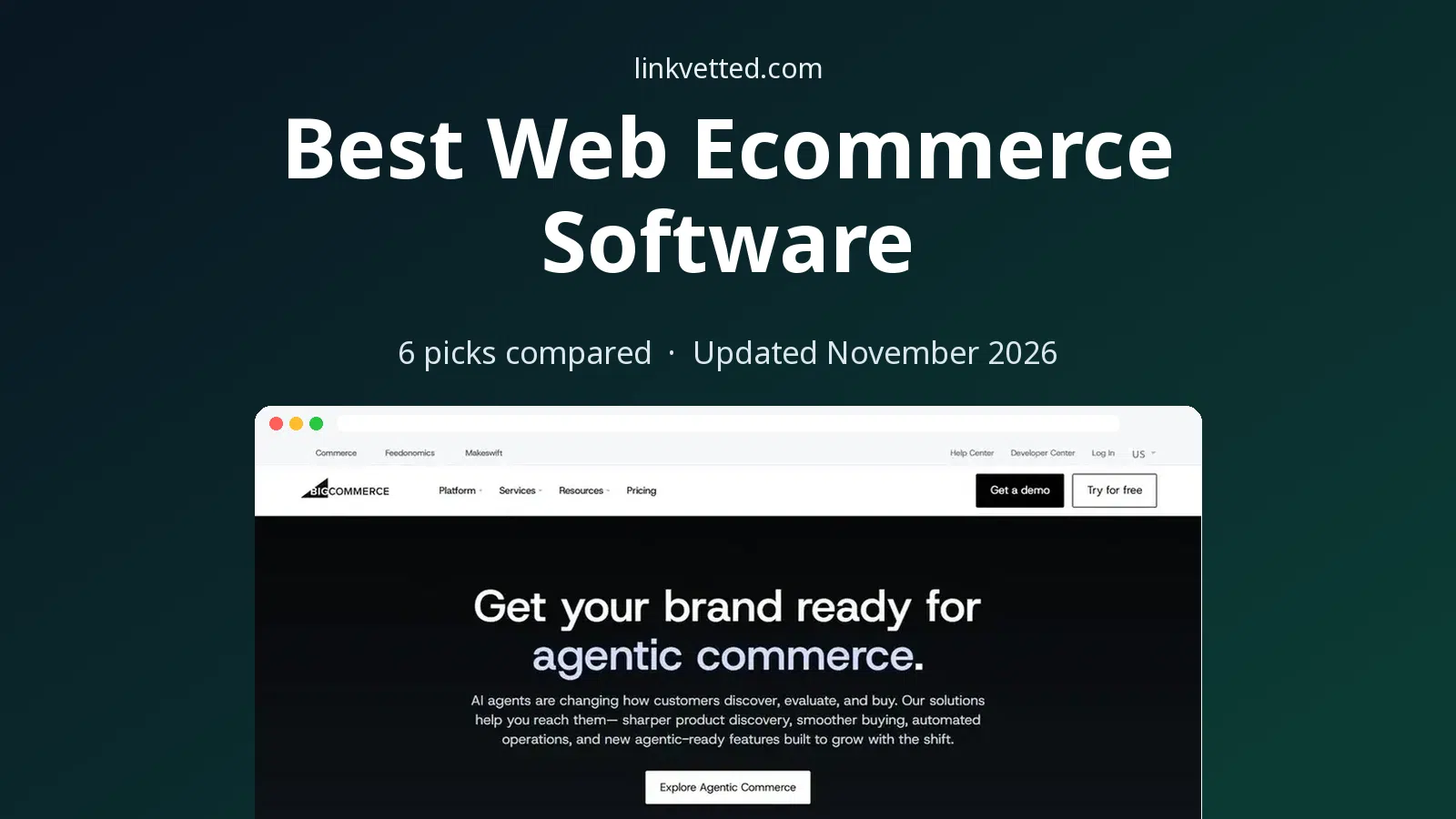
- Editor's choice
 BigCommerce
Scalable multi-channel commerce operations
Starts atSee websiteVisit bigcommerce.comFull review - Great alternative
 Adobe Commerce
Enterprise B2B and B2C personalization
Starts atSee websiteVisit business.adobe.comFull review - Also consider
 WooCommerce
Open-source adaptability for developers
Starts at$29 a monthVisit woocommerce.comFull review
Direct answer
This list puts BigCommerce first for scalable multi-channel commerce operations. Listed starting prices: WooCommerce from $29 a month and Shopify from $19 a month. For a different need, Adobe Commerce covers enterprise B2B and B2C personalization and WooCommerce covers open-source flexibility for developers. The full list of 6 tools follows, with prices and free plan facts.
TL;DR:
- The list opens with BigCommerce, aimed at scalable multi-channel commerce operations.
- Before buying WooCommerce, weigh this: needs WordPress hosting and upkeep.
- For large-scale commerce within Salesforce, Salesforce Commerce Cloud is worth a look.
- Neither BigCommerce nor Salesforce Commerce Cloud, nor any of the other 4 tools, has a permanent free plan; trials and quotes are the norm.
- The lowest published monthly entry price here is $19 per month, from Shopify.
Last checked November 2026. Prices and plan details were read from the vendors' own pages in November 2026; vendors change plans often, so confirm the current price on the vendor site before you buy.
Quick comparison
| Tool | Best for | Starts at | Free plan? | |
|---|---|---|---|---|
| BigCommerce | Scalable multi-channel commerce operations | See website | Not stated | Visit |
| Adobe Commerce | Enterprise B2B and B2C personalization | See website | Not stated | Visit |
| WooCommerce | Open-source adaptability for developers | $29 a month | Not stated | Visit |
 Wix eCommerce | Configurable all-in-one site building | See website | Not stated | Visit |
 Shopify | All-in-one commerce for most firms | $19 a month | Free trial | Visit |
 Salesforce Commerce Cloud | Large-scale commerce within Salesforce | See website | Not stated | Visit |
6 options for web ecommerce software in detail
This LinkVetted guide covers 6 options for web ecommerce software. Each profile lists a starting price, free plan details, strengths and drawbacks, so you can drop poor fits quickly.

BigCommerce targets scalable multi-channel commerce operations. BigCommerce describes itself as commerce aimed at momentum, offering a single scalable foundation to power buying experiences across brands, regions, and channels. This positions it well for expanding firms that expect to expand into new markets or sales channels and want a product that can keep pace.
Where it is weaker: Customization can need technical help.
The system's breadth can feel heavy for a straightforward store with restricted catalog and no multi-channel plans. In daily use, some customizations may need developer involvement. No starting price is listed for BigCommerce here; confirm pricing on the vendor site. Free plan details: Not stated.
- Supports several brands and regions
- Scalable foundation
- May be complicated for very small keeps
For enterprise B2B and B2C personalization, Adobe Commerce is a natural candidate. Adobe Commerce usually demands substantial development and operational resources, which can be excessive for small or mid-size firms. For everyday use, Adobe Commerce, formerly Magento, is described as an AI-powered composable ecommerce product for B2B and B2C that gives personalized experiences at global scale.
What to check first: Needs significant technical resources.
It is targeted at enterprises with complicated requirements, including multi-brand operations and international expansion. More specifically, implementation and maintenance are complicated. Check the vendor site for Adobe Commerce pricing; none is listed in this comparison. As for free access: Not stated.
- B2B and B2C capabilities
- AI-powered composable product
- Complicated for smaller companies
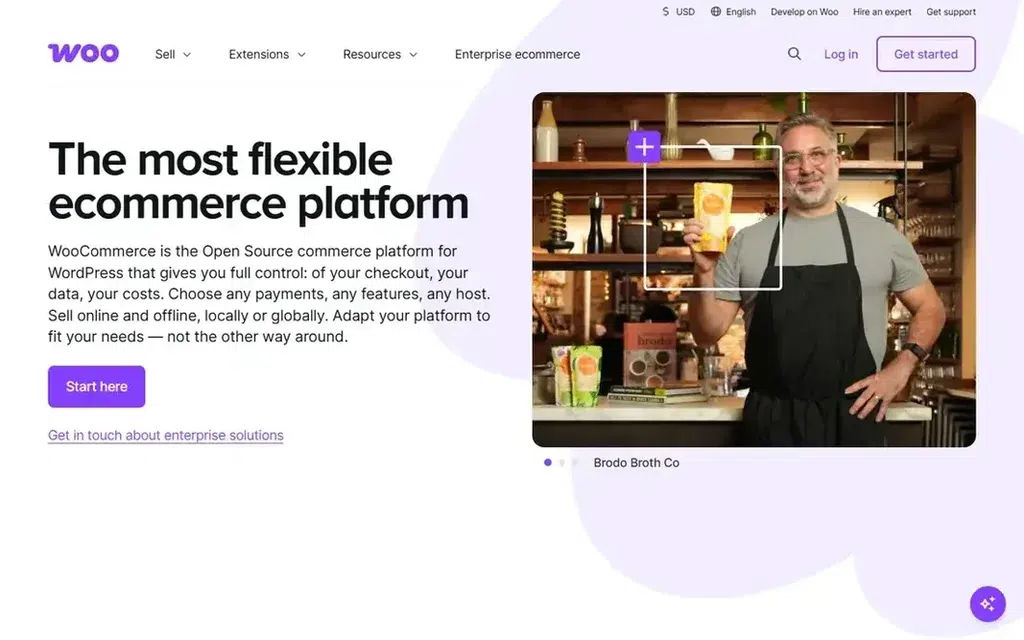
In short, WooCommerce is for open-source adaptability for developers. WooCommerce is the open-source ecommerce product that helps merchants and developers build successful companies for the long term.
Since it is open source, it gives you deep adaptability for those comfortable managing a WordPress environment and who want to tailor the store to specific requirements. It may not suit firms without technical support. WooCommerce pricing: $29 per month. Trial and free access: Not stated.
The main drawbacks: Needs WordPress hosting and upkeep.
- Solid developer community
- Long-term build adaptability
- More technical setup than hosted choices
Wix eCommerce targets configurable all-in-one site building. Wix eCommerce is presented as an all-in-one ecommerce system for creating a completely configurable website and selling across channels. Its strength lies in design adaptability, letting merchants shape the look and feel of their store without deep coding.
Trade-offs to know: Less suited to very large catalogs.
In practice, the emphasis on customization can introduce complexity as a store grows. The product is usually less oriented toward very large or highly complicated catalogs. Check the vendor site for Wix eCommerce pricing; none is listed in this comparison. As for free access: Not stated.
- Highly configurable design
- All-in-one ecommerce system
- Design freedom can add complexity

Shopify targets all-in-one commerce for most firms. Shopify presents itself as an all-in-one commerce system meant to help companies build and grow rapidly. Its homepage flags AI capabilities and tools that extend beyond entry-level ecommerce to run plenty of parts of a business.
Honest limits: Can need app extras for advanced needs.
This makes it a good fit for merchants who want a unified system without stitching together separate services, particularly those prioritizing speed and simplicity over deep customization. If you need full architectural freedom or already have a development team committed to an open-source stack, consider WooCommerce or Adobe Commerce instead. From a buyer's view, advanced or highly specialized requirements may call for external apps or custom work. Shopify cost at the entry level: $19 per month. Trial and free access: Free trial.
- Wide business management features
- All-in-one system
- Less control over core code
Salesforce Commerce Cloud is built with large-scale commerce within Salesforce in mind. Commerce Cloud is generally complicated to implement and run, requiring specialized expertise and significant investment.
Honest limits: Overkill for small companies.
- Part of the Salesforce ecosystem
- Suited to large-scale operations
- Complicated and resource-intensive
How we compared the tools
Pricing pages, product documentation and feature lists were the main sources, and every entry carries at least one honest drawback. Seat minimums, billing terms and add-ons can move the real cost, so the starting prices here are a guide and not a quote. The order reflects how well each tool fits the most common buying scenario for web ecommerce software, then price clarity, then free plan access. It is a starting point, not a verdict.
Before you commit
- Get a written quote from BigCommerce, Adobe Commerce, Wix eCommerce and Salesforce Commerce Cloud; the list shows no starting price for them.
- Use real work to test the free trial from Shopify, rather than a demo project.
- Read the limits listed for BigCommerce first: may be complicated for very small keeps.
- Check whether the features you need in Adobe Commerce sit on the entry plan or only on higher tiers.
- Look at the help docs and support options for WooCommerce before you commit.
FAQ
What is the cheapest option for web ecommerce software in this list?
On published monthly entry prices, Shopify is the lowest here at $19 per month. Entry price is only part of the cost, because seats, add-ons and billing terms can change the total. For the full picture, the cards above cover all 6 entries of this web ecommerce software list, including price, free plan and limits.
Does any tool for web ecommerce software here have a free plan?
No tool in this list, BigCommerce and Salesforce Commerce Cloud included, has a permanent free plan. Shopify offer a trial. Trials and quotes are the usual route, so plan a short evaluation period. Prices, free plan details and limits for all 6 tools in this web ecommerce software roundup sit on the individual cards above.
Can I try these options before paying?
Often, yes. Shopify offers a free trial. Use your own data and a real task during the test, and check what the free tier or trial limits before you rely on it. Each of the 6 options in this web ecommerce software guide has its own card above with the price, free plan and limits.
How are the tools for web ecommerce software ordered?
The order follows typical fit for web ecommerce software, with BigCommerce first and Salesforce Commerce Cloud last, then price clarity and free access. It is editorial judgement, not a score, so another team could rank the tools differently.
What distinguishes enterprise ecommerce products like Adobe Commerce and Salesforce Commerce Cloud?
These systems are aimed at complicated, large-scale operations, offering broad customization, B2B and B2C capabilities, and integration with broader enterprise systems. They usually need dedicated technical teams and significant resources. Smaller firms frequently find hosted systems more practical.
Sources
- https://www.bigcommerce.com
- https://business.adobe.com/products/magento/magento-commerce.html
- https://woocommerce.com
- https://www.wix.com/ecommerce
- https://www.shopify.com
- https://www.salesforce.com/commerce