Best Web Development for Ecommerce for 2026: Our 6 Vetted Picks
Best web development for ecommerce in 2026: 6 contenders with entry costs and free tiers. Strengths and weak spots are spelled out. Updated November 2026.
- Editor's choice
 Adobe Commerce
Enterprise B2B and B2C personalization
Starts atSee websiteVisit business.adobe.comFull review - Great alternative
 Shopware
Configurable responsive storefronts
Starts atSee websiteVisit shopware.comFull review - Also consider
 commercetools
Composable enterprise commerce infrastructure
Starts atSee websiteVisit commercetools.comFull review
Direct answer
For enterprise B2B and B2C personalization, Adobe Commerce is where this list starts. Listed starting prices: Shopify from $19 a month and WooCommerce from $29 per month. Look at Shopware for configurable responsive storefronts, and at commercetools for Composable enterprise commerce infrastructure. The remaining 3 options are covered below with prices and limits.
TL;DR:
- This list starts with Adobe Commerce, which is built for enterprise B2B and B2C personalization.
- Before buying Adobe Commerce, weigh this: enterprise focus layers on implementation complexity.
- BigCommerce is the one to check for scalable multi-channel commerce experiences.
- Just one of the 6 tools, Shopware, has a free plan.
- For the cheapest start, look at Shopify: $19 per month.
Last checked November 2026. Prices and plan details were read from the vendors' own pages in November 2026; vendors change plans often, so confirm the current price on the vendor site before you buy.
Quick comparison
| Tool | Best for | Starts at | Free plan? | |
|---|---|---|---|---|
| Adobe Commerce | Enterprise B2B and B2C personalization | See website | Not stated | Visit |
| Shopware | Configurable responsive storefronts | See website | Yes | Visit |
| commercetools | Composable enterprise commerce infrastructure | See website | Free trial | Visit |
 Shopify | All-in-one commerce with built-in business tools | $19 a month | Free trial | Visit |
 WooCommerce | Open-source keeps on WordPress | $29 per month | Not stated | Visit |
 BigCommerce | Scalable multi-channel commerce experiences | See website | Not stated | Visit |
The full web development for ecommerce list
Short on time? The summary and table above give the quick view of 6 tools for web development for ecommerce, and the profiles that follow give the detail behind each entry.
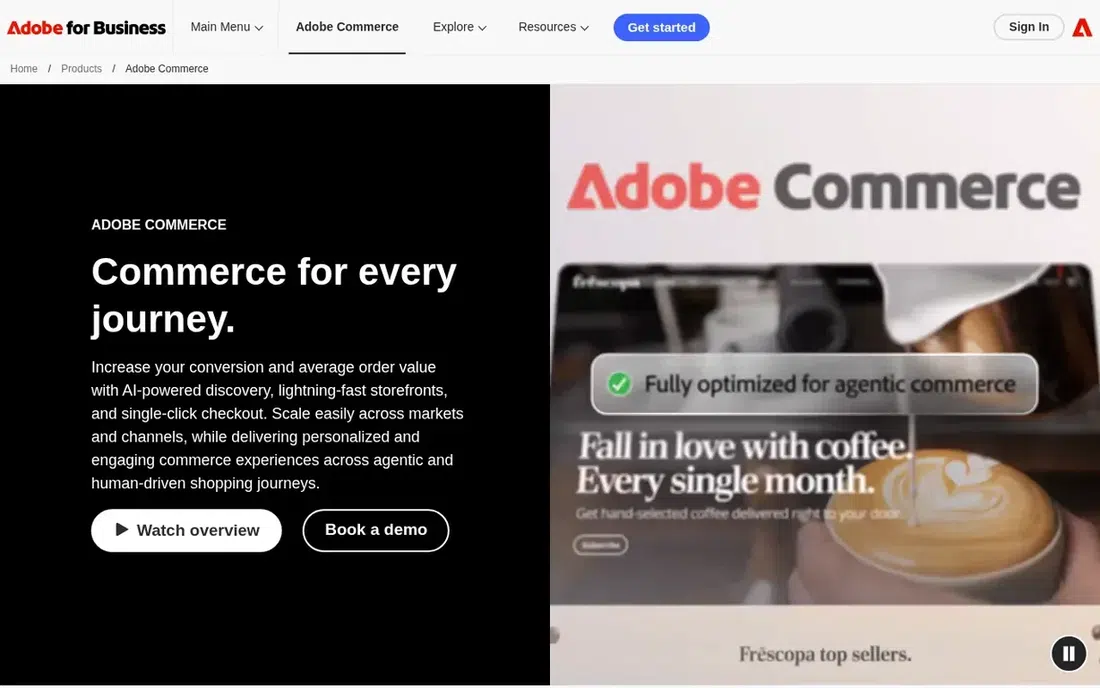
Pick Adobe Commerce if this describes you: enterprise B2B and B2C personalization. Adobe Commerce, formerly known as Magento, is presented as an AI-powered composable ecommerce system for B2B and B2C that gives personalized experiences at global scale. Also, the composable approach lets teams assemble services around the commerce core instead of accept a fixed stack.
Points against: Needs capable development resources.
That adaptability includes real implementation and maintenance demands, so it is a poor fit for small teams without technical depth. From a buyer's view, if you want a hosted system that deals with infrastructure for you, look at Shopify or BigCommerce before choosing an enterprise composable build. Check the vendor site for Adobe Commerce pricing; none is listed in this comparison. Free options: Not stated.
- AI-powered personalization features
- Composable architecture for enterprise builds
- Enterprise focus layers on implementation complexity
Shopware works best for configurable responsive storefronts. Shopware presents itself as an ecommerce product for building and customizing a completely responsive online store with a blend of design and functionality.
Downsides: Smaller ecosystem in some regions.
Pricing for Shopware is not stated here, so ask the vendor for current figures. Free access exists with Shopware.
- Balances design with functionality
- Completely responsive storefront building
- Custom builds need developer involvement
commercetools is built with Composable enterprise commerce infrastructure in mind. This is infrastructure, not a turnkey store, so teams must build and maintain much of the experience themselves.
No starting price is listed for commercetools here; confirm pricing on the vendor site. Trial and free access: Free trial.
Honest limits: Overkill for small storefronts.
- In-store and chat channels
- API-first composable approach
- Needs engineering resources to assemble

Shopify is aimed squarely at all-in-one commerce with built-in business tools. If your project relies on a completely open stack or heavy custom architecture, compare WooCommerce or commercetools instead before committing. Since Shopify is a hosted, opinionated system, teams needing deep control over the codebase or unusual backend integrations may find it constraining.
Limits to weigh: Less control over the underlying stack.
In daily use, Shopify presents itself as an all-in-one commerce system for firms, pairing storefront building with tools to handle numerous parts of a business. Its homepage flags AI assistance and a quick path to build or grow. Shopify pricing: $19 per month. As for free access: Free trial.
- Combines ecommerce software with broader business management tools
- AI-assisted building and growth features
- Deep customization can need platform-specific approaches
Pick WooCommerce if this describes you: open-source keeps on WordPress. WooCommerce describes itself as the open-source ecommerce system that helps merchants and developers build successful firms for the long term.
Downsides: You handle hosting and maintenance.
In practice, open source means you own hosting, security and updates, and reliability relies on the extensions you choose. On top of that, if you would rather not run infrastructure or vet plugins, a hosted system like Shopify removes that burden at the cost of some control. Starting cost for WooCommerce: $29 per month. Free access: Not stated.
- Open-source and extensible
- Suits the WordPress content ecosystem
- Extension quality varies across the ecosystem

BigCommerce serves scalable multi-channel commerce experiences. BigCommerce describes itself as commerce made for momentum, powering buying experiences across brands, regions and channels from a single, scalable foundation.
Downsides: Less suited to very straightforward single-product keeps.
Strengths: regions and channels. Development teams get a product meant to absorb that growth without rebuilding the commerce core each time. In practice, the system's breadth means configuration and extension decisions carry weight, and smaller keeps may not need its multi-channel depth. Check the vendor site for BigCommerce pricing; none is listed in this comparison. On free options: Not stated.
- Scales with catalog and channel growth
- Positioned for modern buying experiences
- Advanced setups can get complicated
Selection criteria
Before you commit
- Get a written quote from Adobe Commerce, Shopware, commercetools and BigCommerce; the list shows no starting price for them.
- Look at the free plan from Shopware closely: its caps decide whether it is usable for real work.
- Take the trial from commercetools and Shopify and push a live task through it before you pay.
- Before choosing Adobe Commerce, weigh its main limit: enterprise focus layers on implementation complexity.
- Pick one real project and run it in Adobe Commerce first; a small pilot shows fit faster than a checklist.
- Make sure Shopware lets you export your data in a format another tool can read.
FAQ
Which options for web development for ecommerce have a free plan?
Shopware is the only tool in this list with a free plan. Free plans usually cap users, projects or features, so check the limits on the vendor page. Several others offer a trial instead. Each of the 6 options in this web development for ecommerce guide has its own card above with the price, free plan and limits.
Which product is a good match for a first ecommerce build?
Start with Adobe Commerce if you need enterprise B2B and B2C personalization. Shopware is the better match for configurable responsive storefronts, and commercetools for Composable enterprise commerce infrastructure. The best choice depends on budget, team size and workflow.
What is the cheapest option for web development for ecommerce in this list?
On published monthly entry prices, Shopify is the lowest here at $19 per month. Entry price is only part of the cost, because seats, add-ons and billing terms can change the total. All 6 picks in this web development for ecommerce comparison list a starting price, free plan details and the main limits on their cards above.
Can I try these tools before paying?
Often, yes. Shopware has a free plan and commercetools and Shopify offer a free trial. Use your own data and a real task during the test, and check what the free tier or trial limits before you rely on it.
Is Adobe Commerce the right pick for everyone comparing web development for ecommerce?
No single tool suits every team. Adobe Commerce comes first because it fits enterprise B2B and B2C personalization, while Shopware suits customizable responsive storefronts and commercetools suits Composable enterprise commerce infrastructure. Match the tool to your own size, budget and workflow before deciding.
Sources
- https://business.adobe.com/products/magento/magento-commerce.html
- https://www.shopware.com
- https://commercetools.com
- https://www.shopify.com
- https://woocommerce.com
- https://www.bigcommerce.com