Best 3PL Companies for Ecommerce in 2026: 9 Companies Compared
We compared the best 3pl companies for ecommerce on fulfillment, pricing, and fit, so your online store can ship faster without losing margin every day.

- Editor's choice
 ShipBob
Growing direct-to-consumer brands
Starts atSee websiteVisit shipbob.comFull review - Great alternative
 ShipMonk
Subscription boxes and kitting
Starts at$250 per monthVisit shipmonk.comFull review - Also consider
 Red Stag Fulfillment
Heavy and high-value goods
Starts atSee websiteVisit redstagfulfillment.comFull review
TL;DR:
- ShipBob suits fast-growing direct-to-consumer brands that need distributed warehouses and strong Shopify links.
- ShipMonk leads for subscription boxes and kitting, while Red Stag Fulfillment leads for heavy, bulky, and high-value goods.
- Shipfusion, ShipNetwork, and Flowspace give mid-sized brands strong inventory visibility across sales channels.
- Most 3PL pricing is quoted per brand, so compare storage, pick and pack, shipping, and returns together, never just one fee.
- Send a test batch with bundles, gift notes, and returns before you move full volume to any provider.
Quick comparison
| Tool | Best for | Starts at | Free plan? | |
|---|---|---|---|---|
| ShipBob | Growing direct-to-consumer brands | See website | No | Visit |
| ShipMonk | Subscription boxes and kitting | $250 per month | No | Visit |
| Red Stag Fulfillment | Heavy and high-value goods | See website | No | Visit |
 Shipfusion | High-volume accuracy | See website | No | Visit |
 ShipNetwork | Distributed marketplace fulfillment | See website | No | Visit |
 Flowspace | Omnichannel brands | See website | No | Visit |
 Flexport | International ecommerce fulfillment | See website | No | Visit |
 eFulfillment Service | Small brands starting out | See website | No | Visit |
 GoBolt | Fast US and Canada fulfillment | See website | No | Visit |
The best 3PL companies for ecommerce
A third-party logistics provider, or 3PL, stores your products, picks and packs orders, ships them, and often handles returns. We compared providers on warehouse coverage, integrations, minimums, and fit by product type and order volume.

ShipBob is the default shortlist pick for many growing Shopify brands, and for good reason. Its distributed fulfillment centers let you store stock near customers, which cuts shipping zones and delivery times, and its dashboard tracks inventory, orders, and shipping performance in one place. Integrations with major store platforms keep orders syncing without manual uploads.
The catch is total cost. ShipBob quotes per brand, and onboarding, receiving, and plan fees sit on top of per-order fulfillment and postage, so a headline rate never tells the full story. Ask for a quote built from your real order mix, including weight, dimensions, and return rate, before you compare it with a rival.
- Large warehouse network
- Strong Shopify integration
- Real-time inventory visibility
- Custom quotes
- Receiving and plan fees can add up for small brands

ShipMonk shines for brands built around boxes, bundles, and recurring shipments. Its kitting and subscription logic handles repeat orders, custom packaging, and batch releases better than a generic warehouse, and its platform is free for clients to use. Crowdfunding brands also benefit, since ShipMonk can handle large batch surges tied to campaign fulfillment.
Pricing needs care. ShipMonk lists a $250 per month minimum pick and pack fee, with first-item picks around $3 and extra picks around $0.75 in published guides, plus packaging costs. That structure suits steady volume but can feel steep for very small brands, so model your average items per order before signing.
- Strong subscription and kitting tools
- Crowdfunding batch support
- Free platform use for clients
- Pick fees can run higher than rivals
- Packaging materials billed separately
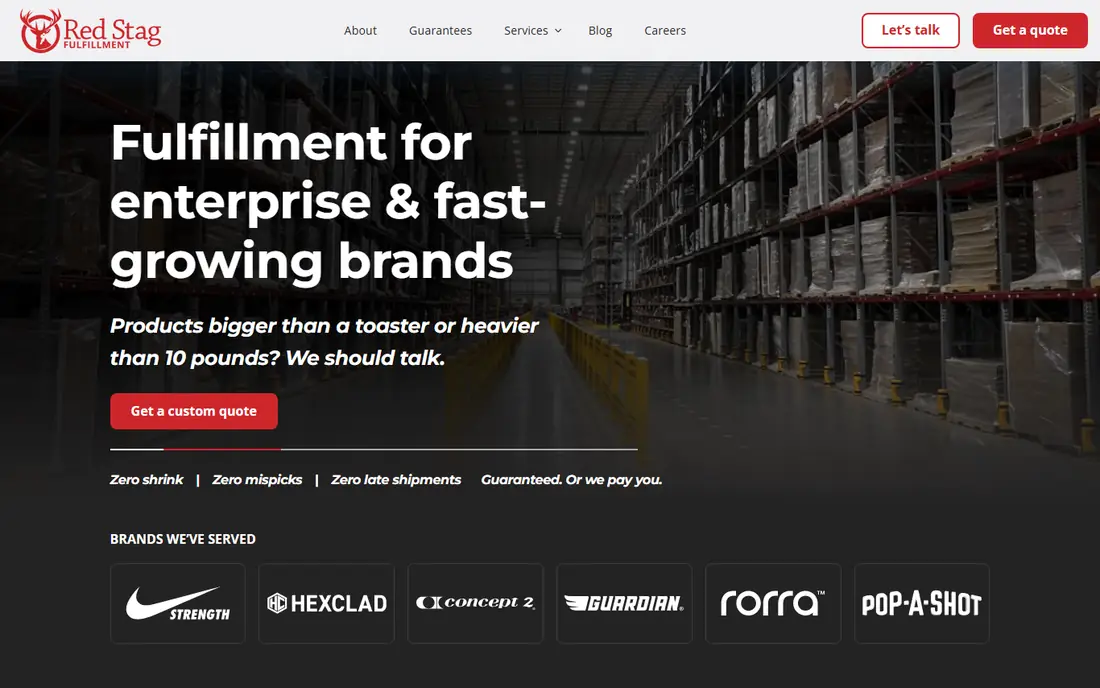
Red Stag Fulfillment is our pick when your products are heavy, bulky, fragile, or expensive. Its Knoxville and Salt Lake City warehouses are built for oversized goods, and it backs order accuracy with a financial guarantee, which matters when a single mistake costs far more than a small parcel. Brands selling fitness equipment, furniture, and premium goods often fit here.
The trade-off is reach and minimums. Two warehouses cannot match ShipBob on two-day coverage everywhere, and Red Stag targets brands with steady monthly volume rather than a handful of orders. If your catalog is light and small, a distributed small-parcel 3PL will usually ship faster for less.
- No weight cap in practice for oversized goods
- Accuracy guarantees
- High-value handling
- Higher minimums than small-brand 3PLs
- Only two US warehouse locations
Shipfusion suits high-volume direct-to-consumer and consumer packaged goods brands that prize accuracy above all else. Its published accuracy figures are among the strongest in this list, and its warehouses in the US and Canada support both direct and wholesale channels. Subscription brands also get solid bundling and repeat-order handling.
Smaller brands may find the entry bar high, since Shipfusion targets brands with hundreds of orders per month and prices on a custom basis. If you are below that level, start with eFulfillment Service or ShipBob and revisit Shipfusion once volume grows.
- Strong accuracy record
- US and Canada coverage
- Subscription and wholesale support
- Higher order minimums
- Custom pricing only
ShipNetwork, formerly Rakuten Super Logistics, fits mid-volume US brands that sell across marketplaces and their own stores. Its distributed network helps with two-day delivery coverage, and its marketplace experience helps Walmart and Amazon sellers meet channel requirements. Inventory visibility across channels is a core strength.
The limit is product size. ShipNetwork suits small parcels better than heavy goods, with published weight guidance around 30 pounds in comparison guides. Heavy brands should shortlist Red Stag instead, and all brands should confirm receiving, storage, and returns fees in the quote.
- Former Rakuten Super Logistics network
- Marketplace seller strength
- Distributed inventory
- Custom pricing
- Weight limits suit small parcels best
Flowspace suits brands selling direct, wholesale, and through retail at the same time. Its platform combines fulfillment with inventory and transportation management, so one system can cover several channels instead of a patchwork of vendors. Its flexible network model also lets brands add capacity without building their own warehouses.
Because Flowspace works with network partners, service can vary by location, so ask which warehouses will actually hold your stock and who manages them. Request service-level terms for accuracy, ship times, and support response, and test a peak-season scenario before committing.
- Omnichannel fulfillment
- Inventory and transport tools
- Flexible network model
- Custom pricing
- Network partners vary by location
Flexport, which absorbed Deliverr fulfillment, suits brands with international ambitions. Its freight forwarding, customs, and fulfillment combination helps a brand move goods across borders and then ship locally, without juggling separate freight and warehouse vendors. That end-to-end view also improves tracking and landed-cost clarity.
Flexport is heavier than a pure small-brand 3PL, and its sales process suits larger or faster-growing brands. If you only ship domestically at low volume, ShipBob or ShipMonk will be simpler and cheaper. International sellers, by contrast, may save real time with Flexport.
- Freight forwarding plus fulfillment
- Customs help
- Global logistics strength
- Enterprise-leaning complexity
- Fulfillment pricing is quoted
eFulfillment Service is a good first 3PL for small brands that want to hand off packing without a monthly minimum. Its Traverse City warehouse handles order fulfillment, kitting, and returns, and its simple model suits founders moving from a garage or spare room to outsourced shipping. Published accuracy figures are solid for a small provider.
One warehouse means longer transit to distant customers, and heavier goods may not fit. As volume grows, compare the delivered cost against a distributed network, because postage savings from a second warehouse can outweigh a slightly higher pick fee.
- No order minimum in published guides
- Simple setup
- Returns handling
- Single US warehouse
- Weight limits around 50 pounds
GoBolt suits brands that sell across the US and Canada and want fast delivery on both sides of the border. Its fulfillment network, returns handling, and delivery options help cross-border brands avoid the usual customs and returns headaches. Sustainability-focused delivery choices also appeal to brands whose customers care about that story.
The network is smaller than ShipBob or Amazon, so confirm coverage for your main customer regions and your peak volumes. Ask how GoBolt handles US to Canada duties and returns, since those details decide whether cross-border shipping stays profitable.
- North American coverage
- Returns management
- Sustainability-focused delivery options
- Custom pricing
- Smaller US footprint than the largest networks
How we picked these
We compared official service pages, published pricing guides, and 2026 3PL shortlists that rank providers by catalog fit and order profile. We favored providers with current operations, a verifiable homepage, and a distinct strength, rather than generic warehouses with no ecommerce focus. Where pricing was quoted per brand, we wrote See website, and where a published minimum existed, we stated it and noted that postage and storage sit separately.
What to compare in every 3PL quote
A 3PL quote has many lines, and the cheapest headline fee rarely wins. Use the same request for every finalist so the quotes line up.
Ask for total landed cost per order
Request storage, receiving, pick and pack, packaging, postage, returns, and special-project fees for your real order mix. Include your average weight, items per order, and return rate, and ask for a sample invoice at your current monthly volume.
Test accuracy and support
Send sample orders with bundles, coupons, gift notes, and out-of-stock items, and time the support replies. Check how the provider handles damaged goods, wrong picks, and holiday peaks, and get accuracy and ship-time promises in writing where offered.
FAQ
What does a 3PL do for an ecommerce store?
A 3PL stores your inventory, picks and packs each order, ships it to the customer, and usually handles returns and restocking. You keep control of your store, marketing, and product, while the 3PL runs the warehouse work.
How much does a 3PL cost?
Most 3PLs quote per brand, covering storage, pick and pack, packaging, postage, and returns. ShipMonk lists a $250 per month minimum pick and pack fee, while other providers on this list quote custom rates, so request a full sample invoice.
When should a store switch to a 3PL?
Switch when packing eats time you need for marketing and product, when shipping errors rise, or when postage zones hurt margins. Many brands switch around a few hundred orders per month, but the right moment depends on your margins and growth rate.
Can a 3PL handle Amazon and Shopify at once?
Yes. Most providers on this list integrate with Shopify, WooCommerce, Amazon, and other channels, and sync inventory across them. Confirm each channel you sell on before signing, and test the sync with real orders.
What happens to my inventory if I leave a 3PL?
You can usually move stock to a new provider or back in-house, but exit fees, notice periods, and transfer timing vary. Ask for the exit process in writing, including who pays freight and how long the transfer takes.
Is Amazon Multi-Channel Fulfillment a 3PL?
Amazon Multi-Channel Fulfillment lets Amazon sellers use Amazon warehouses for non-Amazon orders, which works like a 3PL for many brands. It suits Amazon-first sellers best, while independent brands often prefer a neutral provider such as ShipBob or ShipMonk.