Best Traffic Simulation Software for Cities in 2026: Prices, Free Plans and 5 Picks
Best traffic simulation software for cities in 2026: 5 tools with starting prices, free plans and limits. Short verdicts, no fluff. Built for quick decisions.
- Editor's choice
 Simul8
Discrete event simulation for process improvement
Starts atPricing on requestVisit simul8.comFull review - Great alternative
 MATLAB
Custom traffic algorithms and data analysis
Starts atPricing on requestVisit mathworks.comFull review - Also considerSIDRA Intersection
Lane-based intersection and network analysis
Starts atPricing on requestVisit sidrasolutions.comFull review
Direct answer
For discrete event simulation for process improvement, Simul8 is where this list starts. If your case is different, MATLAB suits custom traffic algorithms and data analysis and SIDRA Intersection suits Lane-based intersection and network analysis. All 5 tools are compared below on fit, free plan and limits. None of these vendors publish plan prices, so pricing is on request for every option.
TL;DR:
- The list opens with Simul8, aimed at discrete event simulation for process improvement.
- A fair warning about MATLAB: not a dedicated traffic simulator.
- Neither Simul8 nor Legion, nor any of the other 3 tools, has a permanent free plan; trials and quotes are the norm.
- For pedestrian and crowd simulation, Legion is worth a look.
- Every tool from Simul8 to Legion works by quote, with no list price shown.
Last checked November 2026. Pricing on request: vendors did not publish plan prices when this guide was last checked (November 2026), so ask each vendor for a written quote.
Quick comparison
| Tool | Best for | Starts at | Free plan? | |
|---|---|---|---|---|
| Simul8 | Discrete event simulation for process improvement | Pricing on request | Not stated | Visit |
| MATLAB | Custom traffic algorithms and data analysis | Pricing on request | Not stated | Visit |
| SIDRA Intersection | Lane-based intersection and network analysis | Pricing on request | No | Visit |
| SUMO | Open-source multi-modal traffic simulation | Pricing on request | Not stated | Visit |
 Legion | Pedestrian and crowd simulation | Pricing on request | Not stated | Visit |
Our 5 traffic simulation software for cities
LinkVetted put together this guide to traffic simulation software for cities for readers who want a clear shortlist without reading every vendor page. It compares 5 tools on starting price, free plans, who each one suits and where each one falls short.
Simul8 works best for discrete event simulation for process improvement. Simul8 is discrete event simulation software used to test scenarios and boost decision-making in manufacturing, healthcare, and other sectors. Pick Simul8 when your focus is on process efficiency and you can adapt the model to transport-related workflows.
Simul8 lacks built-in traffic-specific features like car-following models or signal control. Beyond that, in a traffic context, it can model processes for example toll booths or logistics hubs. But it is not designed specifically for urban traffic flow. Simul8 does not show a starting price in this comparison, so check the vendor site for current pricing. Free plan details: Not stated.
The main drawbacks: May need customization for transport.
- Simple to test what-if scenarios
- Applicable across industries
- General-purpose, not traffic-specific
MATLAB works best for custom traffic algorithms and data analysis. MATLAB is not a turnkey traffic simulation tool; you would have to build or integrate models yourself, frequently with extra toolboxes.
Where it is weaker: Needs add-on products for traffic modeling.
In traffic simulation, it frequently serves as a system for building custom models or analyzing simulation outputs. More specifically, for standard traffic analysis, dedicated software like SUMO or SIDRA Intersection is more direct. MATLAB shows no starting price here, so confirm the cost on the vendor site. Free options: Not stated.
- Capable computational environment
- Widely used in engineering
- Not a dedicated traffic simulator
SIDRA Intersection
Best for: Lane-based intersection and network analysis
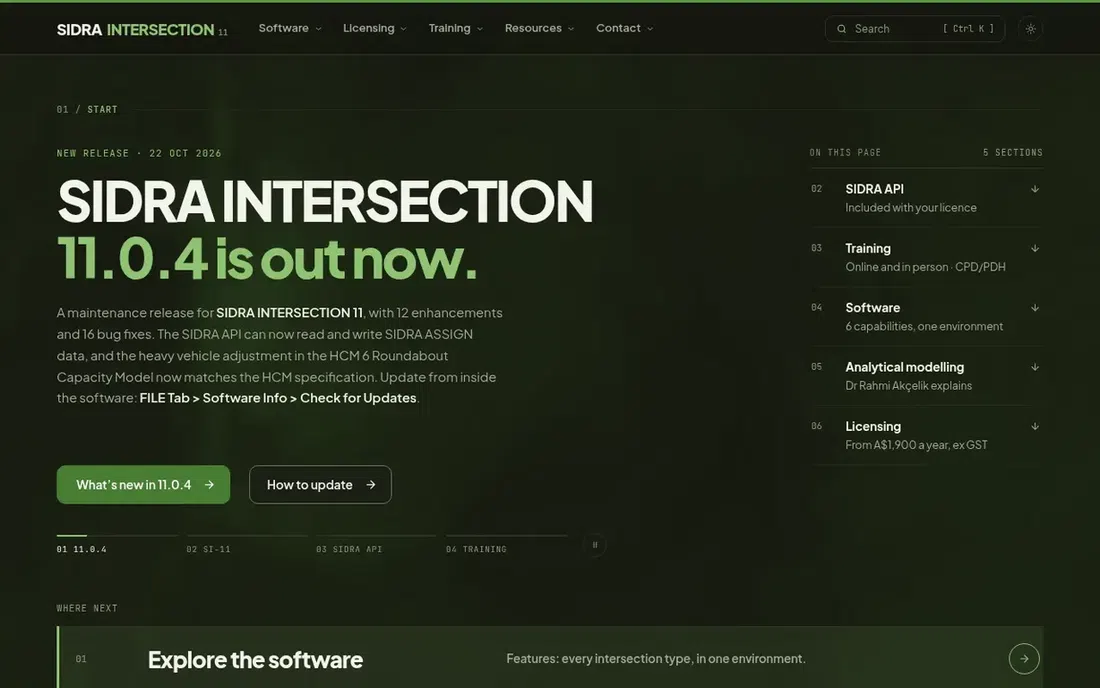
SIDRA Intersection is aimed squarely at Lane-based intersection and network analysis. If your project needs modeling whole corridors or public transit interactions, a broader tool like SUMO or Legion may be better. It excels in in-depth intersection analysis but is not a general-purpose city simulator.
Where it is weaker: May need training for advanced features.
For everyday use, SIDRA INTERSECTION is lane-based micro-analytical software for modeling intersections, roundabouts, and small networks. It is used in plenty of countries for operational analysis and design. Beyond that, SIDRA Intersection is less suited for large-scale, multi-modal urban simulation or pedestrian flows. The tool is a solid fit for traffic engineers who require in-depth performance metrics at specific junctions and want a focused, instead of city-wide, simulation approach. Pricing for SIDRA Intersection is not stated here, so ask the vendor for current figures. SIDRA Intersection has no free tier.
- Supports roundabouts and networks
- Used internationally
- Centred on intersection performance
SUMO
Best for: Open-source multi-modal traffic simulation
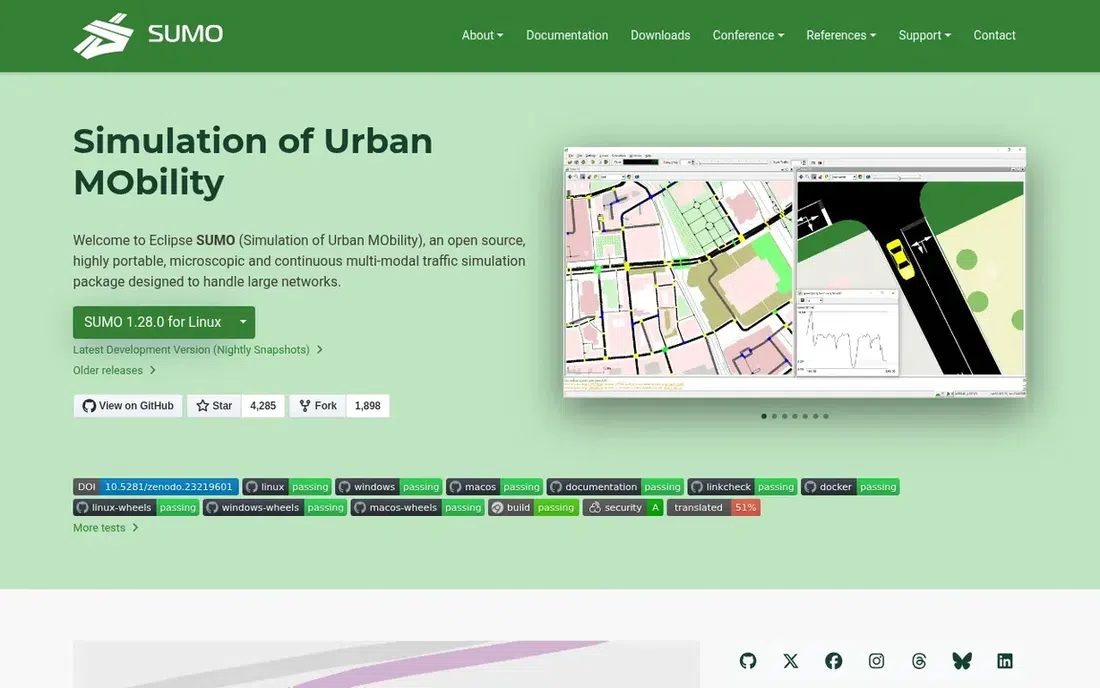
Pick SUMO if this describes you: open-source multi-modal traffic simulation. Eclipse SUMO is an open-source, microscopic traffic simulation package that models urban mobility with a focus on multi-modal transport. It is well suited for researchers, city planners, and developers who require an adaptable, scriptable product for large-scale scenarios.
Its continuous simulation approach and active community make it a capable choice for custom projects where budget and adaptability matter. Beyond that, SUMO can be complicated to set up and demands programming skills for advanced use. Its visualization tools are entry-level compared with commercial alternatives. No starting price is listed for SUMO here; confirm pricing on the vendor site. Free plan details: Not stated.
Limits to weigh: Needs technical expertise.
- Open source and freely available
- Supports microscopic and continuous simulation
- Restricted built-in visualization
Legion is aimed squarely at pedestrian and crowd simulation. Legion, from Bentley Systems, is software for modeling pedestrian and crowd dynamics in urban spaces. It lets planners to simulate how people interact with infrastructure like stations, streets, and event venues.
It is well suited to projects where foot traffic and safety are primary concerns, offering precise analysis of crowd flow and space utilization. It also demands accurate spatial and behavioral data to produce dependable results. On top of that, choose Legion when pedestrian movement is the focus, and complement it with a traffic simulator like SUMO for vehicles. This comparison lists no price for Legion; ask the vendor. Free options: Not stated.
Limits to weigh: Needs in-depth spatial data.
- Models crowd interactions
- Handy for space planning
- Not for vehicle traffic simulation
What went into this list
Each tool was reviewed on what its vendor publishes: price, plan limits, core features and stated drawbacks. We did not run hands-on tests. Seat minimums, billing terms and add-ons can move the real cost, so the starting prices here are a guide and not a quote. The order reflects how well each tool fits the most common buying scenario for traffic simulation software for cities, then price clarity, then free plan access. It is a starting point, not a verdict.
Things to verify first
- Confirm the entry price with every vendor: no tool from Simul8 to Legion shows a fixed starting price.
- Before choosing Simul8, weigh its main limit: general-purpose, not traffic-specific.
- Look at the renewal terms for SUMO: auto-renewal, notice periods and price changes can matter more than the first-year price.
- Price Legion for your actual team size; headline prices rarely include add-ons or overage.
- Confirm the exact SIDRA Intersection plan that includes your must-have features.
FAQ
What is the best free traffic simulation software for cities?
This list starts with Simul8, which fits discrete event simulation for process improvement. For other needs, MATLAB is aimed at custom traffic algorithms and data analysis, and SIDRA Intersection at Lane-based intersection and network analysis. Check each tool's price and main limit first.
Is Simul8 the right pick for everyone comparing traffic simulation software for cities?
No single tool suits every team. Simul8 comes first because it fits discrete event simulation for process improvement, while MATLAB suits custom traffic algorithms and data analysis and SIDRA Intersection suits Lane-based intersection and network analysis. Match the tool to your own size, budget and workflow before deciding.
How are the tools for traffic simulation software for cities ordered?
The order follows typical fit for traffic simulation software for cities, with Simul8 first and Legion last, then price clarity and free access. It is editorial judgement, not a score, so another team could rank the tools differently.
Do these tools publish their prices?
No. None of the tools, from Simul8 to Legion, shows a fixed starting price here, so budget time for quotes.
Can I try these tools before paying?
Not by default. None of the tools, from Simul8 to Legion, lists a free plan or a free trial here, so ask each vendor for a demo before committing.
Sources
- https://www.simul8.com
- https://www.mathworks.com/products/matlab.html
- https://www.sidrasolutions.com/software/sidra-intersection
- https://www.eclipse.org/sumo
- https://www.bentley.com/software/legion