Best Unified API Platforms in 2026: 9 Tools Compared
Best unified API platforms compared, with one API for CRM, HR, accounting and more, plus pricing, sync speed and developer control for SaaS teams today.

- Editor's choice
 Merge
Broad enterprise integrations
Starts at$650 per monthVisit merge.devFull review - Great alternative
 Apideck
Broad unified APIs for B2B SaaS
Starts at$599 per monthVisit apideck.comFull review - Also consider
 Nango
Developer-led open-source integrations
Starts atFreeVisit nango.devFull review
TL;DR:
- A unified API lets a SaaS product connect to many customer systems, such as CRMs or HR tools, through one normalized API instead of building each integration alone.
- Merge and Apideck suit broad, managed integrations, while Nango suits developer-led teams that want open-source control.
- Unified.to and Kombo suit real-time or HR-focused needs, while Finch and Codat suit narrow, deep categories such as employment or accounting data.
- Check sync speed, write support, field mapping and passthrough access before choosing, since those details decide whether a unified API fits your product.
Quick comparison
| Tool | Best for | Starts at | Free plan? | |
|---|---|---|---|---|
| Merge | Broad enterprise integrations | $650 per month | No | Visit |
| Apideck | Broad unified APIs for B2B SaaS | $599 per month | No | Visit |
| Nango | Developer-led open-source integrations | Free | Yes | Visit |
 Unified.to | Real-time unified data | $750 per month | No | Visit |
 Paragon | Embedded integrations with workflows | See website | No | Visit |
 Kombo | HR and ATS integrations | See website | No | Visit |
 StackOne | Enterprise HR and AI integrations | See website | No | Visit |
 Finch | Employment and payroll data | See website | No | Visit |
 Codat | Small business financial data | See website | No | Visit |
The best unified API platforms
We compared categories covered, connector counts, sync models, field mapping, authentication, developer tools and pricing, with a focus on B2B SaaS teams shipping customer-facing integrations.
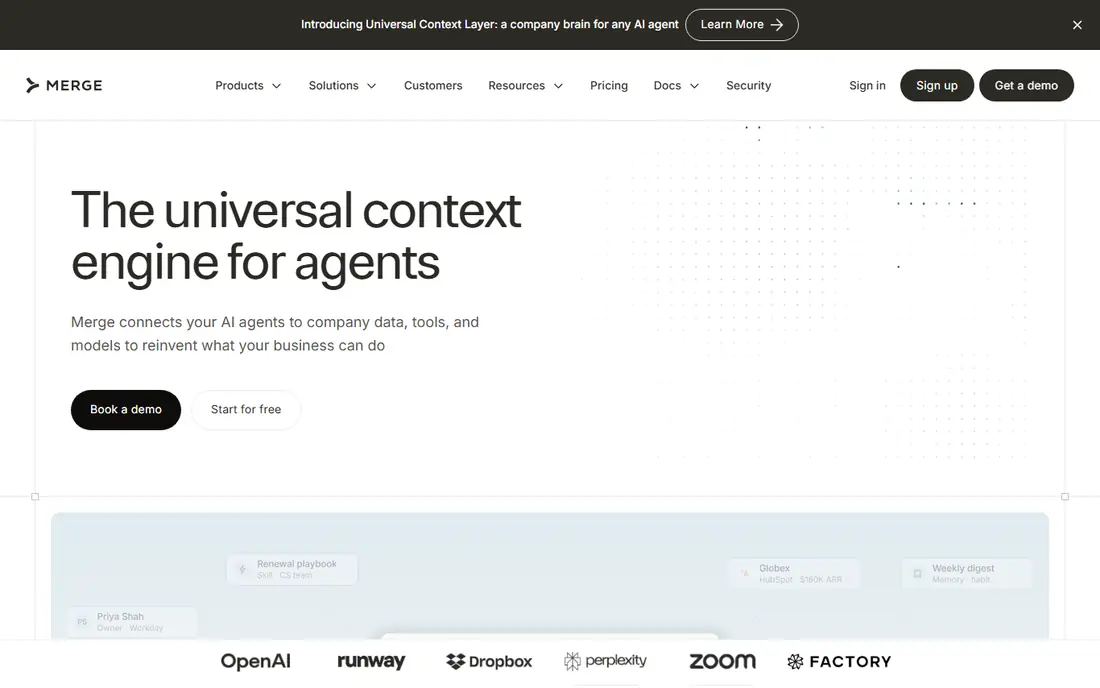
Merge is one of the best-known unified API platforms, offering one API across HR, applicant tracking, CRM, accounting, ticketing and other categories. It normalizes data from many providers into common models, handles authentication and maintains connectors when providers change their APIs. That managed approach saves product teams from building and fixing dozens of integrations themselves.
The trade-offs are price and sync style. Merge entry pricing is higher than some rivals, and data is often synced to Merge before you query it, which suits many products but not every real-time use case. For an enterprise SaaS team that needs broad, reliable integrations with strong security, Merge is a leading choice.
- Broad category coverage including HR, ATS, CRM and accounting
- Managed connectors and normalized models
- Strong enterprise security
- Higher entry price
- Sync is often cached rather than fully real-time

Apideck offers unified APIs across CRM, accounting, HR, ecommerce and other categories, plus a vault for credentials and a marketplace where customers can discover integrations. Its real-time approach suits products that need fresh data on demand, rather than only synced snapshots. Consumer-based pricing also makes costs easier to model as you add customers.
Custom field mapping appears on higher tiers, so check that detail if your customers use custom fields heavily. Pricing also rises with consumers and categories, so model growth carefully. For a B2B SaaS team that wants a broad, real-time unified API with a customer-facing marketplace, Apideck is a strong option.
- Unified APIs plus vault and integration marketplace
- Real-time access in many categories
- Consumer-based pricing
- Custom field mapping sits on higher tiers
- Pricing rises with consumers and categories

Nango is an open-source product integration platform that suits engineer-heavy teams who want control. It supports hundreds of APIs across CRM, accounting, HR, ecommerce and other categories, with syncs that can run frequently and models defined in code. Self-hosting gives teams control over data and deployment, which matters for security-sensitive products.
That control comes with work. Unlike Merge or Apideck, Nango leaves much of the mapping and maintenance to your team, so you need engineers who can own integrations. A free tier and pay-as-you-go options help teams start small. For a developer-led SaaS team that values open source and control, Nango is a compelling pick.
- Open-source and self-hostable
- Very large connector range
- Code-first control over models and sync
- Teams build and maintain mappings themselves
- Needs engineering time and expertise
Unified.to focuses on real-time unified APIs across more than 15 categories, with virtual webhooks that notify your product when data changes. Passthrough access lets developers reach the raw provider API when the normalized model lacks a field, which helps with edge cases. That real-time focus suits products that need fresh CRM, HR or accounting data on demand.
Entry pricing is higher than some rivals, and Unified.to is less widely known than Merge, though it is growing fast among developer teams. For a product where stale data would hurt, such as live dashboards or automation, Unified.to is worth a close look.
- Real-time data across many categories
- Virtual webhooks
- Passthrough access to raw provider APIs
- Higher entry price
- Narrower brand recognition than Merge in some markets
Paragon is an embedded integration platform that lets SaaS customers connect their tools through a white-labeled experience, with workflows to automate steps between systems. That customer-facing polish matters when integrations are a selling point for your product, since users can set them up without leaving your app. Managed authentication and a visual workflow builder help product teams ship integrations faster.
Paragon pricing is contract based, and its strength leans toward embedded workflows rather than pure normalized data models in every category. Teams that need deep unified models for HR or accounting may prefer Merge or Apideck. For a B2B SaaS team that wants a polished, embedded integration experience, Paragon is a strong choice.
- Embedded integration experience for customers
- Workflow builder for automation
- Managed authentication
- Contract pricing
- Unified API depth varies by category compared with pure unified API vendors
Kombo focuses on HR and applicant tracking integrations, which makes it a good fit for hiring, HR and workforce products that need to connect to many ATS and HR systems. Its API handles ATS differences in stages, candidates and jobs, and it deals with provider access quirks that often block ATS integrations. That focus gives it depth where broad platforms can feel generic.
The range is narrower by design, so a product that also needs CRM, accounting and ecommerce integrations will need another tool or a broader platform. Pricing is quote based. For an HR tech team that lives in ATS integrations, Kombo offers focused depth that is hard to match.
- Modern HR and ATS integrations
- Clean API for hiring tools
- Good handling of ATS quirks
- Narrower category range than Merge or Apideck
- Quote-based pricing
StackOne offers enterprise-grade unified APIs with a focus on HR systems, security and AI agent access to integration data. That positioning suits larger HR tech and enterprise SaaS products that need reliable, secure access to employee and hiring data, including for AI workflows. Its real-time approach helps products that cannot rely on daily syncs alone.
Pricing and sales process are enterprise in scope, so a small startup may find it costly. Category range is also HR-led rather than fully broad. For an enterprise HR product that needs secure, real-time integrations, StackOne is a credible, modern option.
- Enterprise-grade HR integrations
- Focus on security and AI agent use
- Real-time data in many cases
- Enterprise pricing and sales process
- Less suited to a tiny startup budget
Finch is the specialist for employment data, offering one API for HR, payroll and benefits systems. Products that need employee, pay, deduction and benefits data can connect to many providers through Finch, without building each payroll integration separately. That depth makes it popular with HR platforms, benefits tools and fintech products that rely on employment verification or payroll data.
Finch does not cover CRM, accounting or ecommerce in the way Merge or Apideck do, so it is a specialist, not a general unified API. For a product whose core data is employment and payroll, Finch is often the best tool for that job, paired with a broader platform if other categories are needed.
- Deep employment, payroll and benefits data
- One API for many HR and payroll providers
- Strong for HR and fintech products
- Narrow category focus
- Not a general CRM or accounting unified API
Codat offers a universal API for small business financial data, covering accounting, banking and commerce systems. Fintech, lending and accounting products use Codat to pull standardized financial data from a customer's books, bank or sales platform, without building each connector. That financial depth, including standardized models for invoices, bills and transactions, is its main strength.
Codat is financial only, so a SaaS product that also needs HR or CRM integrations will need another platform. Pricing is enterprise for larger deployments. For a fintech product built on small business financial data, Codat is a leading specialist choice.
- Universal API for accounting, banking and commerce data
- Strong for fintech and lending
- Standardized financial models
- Financial focus only
- Enterprise pricing for larger deployments
How we picked these
We compared official product pages, category coverage, sync and write support, field mapping, passthrough access, security claims and pricing. We favored platforms that are live in 2026, maintain connectors for customers, and serve a distinct need, from broad managed APIs to narrow specialists. We left out general automation tools that do not normalize data into unified models.
How to choose a unified API platform
Start with your categories and data freshness needs. List the systems your customers actually use, such as Salesforce, Workday, QuickBooks or Greenhouse, and check that each platform covers those exact providers, not just the category in general. Ask whether data is real-time, synced every few minutes, or synced daily, and whether writes are supported for the actions your product needs.
Next, test field mapping and edge cases. Ask how custom fields are handled, whether passthrough access lets you reach raw provider fields, and how the platform handles provider API changes, rate limits and errors. Run a pilot with two or three real customer systems, measure sync reliability and support response, and model pricing as linked accounts and consumers grow.
FAQ
What is the best unified API platform?
Merge and Apideck suit broad, managed integrations, Nango suits developer-led teams wanting open-source control, and Unified.to suits real-time needs. Kombo, StackOne, Finch and Codat suit narrow, deep categories such as HR, employment or financial data. Pick by categories, sync needs and team expertise.
What is a unified API?
A unified API normalizes many different provider APIs into one common data model, so a SaaS product can connect to many CRMs, HR tools or accounting systems through one integration. The vendor maintains connectors, authentication and updates when providers change their APIs.
Is a unified API the same as an embedded iPaaS?
No, though they overlap. A unified API focuses on normalized data models across providers, while an embedded iPaaS focuses on workflows and automation between systems. Some platforms, such as Paragon, offer both, but many teams use a unified API for data and a separate tool for complex workflows.
How much do unified API platforms cost?
Entry prices for managed platforms often start around 500 to 750 dollars per month, with costs rising by linked accounts, consumers or categories. Nango offers a free tier with pay-as-you-go options, while enterprise platforms such as Paragon, StackOne and Codat price by contract. Model growth, not just entry price.
Do unified APIs support writing data back to providers?
It varies by platform and provider. Some unified APIs support full create, read, update and delete operations, while others are read-focused or support writes only for certain categories. Check write support for your exact use case and providers before committing.