Top 5 Python Web Frameworks for 2026 (Prices and Free Plans)
Searching for the best python web frameworks? Here are 5 options with prices and free plans. Includes honest limits for each tool. Built for quick decisions.
- Editor's choiceTornado
Long-lived connections and live services
Starts atPricing on requestVisit tornadoweb.orgFull review - Great alternativeFastAPI
High-performance APIs with type hints
Starts atPricing on requestVisit fastapi.tiangolo.comFull review - Also considerDjango
Full-featured, database-driven web applications
Starts atPricing on requestVisit djangoproject.comFull review
Direct answer
Start with Tornado if you need long-lived connections and live services. Alternatives: FastAPI for high-performance APIs with type hints, and Django for full-featured, database-driven web applications. All 5 tools are compared below on fit, free plan and limits. None of these vendors publish plan prices, so pricing is on request for every option.
TL;DR:
- This list starts with Tornado, which is built for long-lived connections and live services.
- None of the 5 tools, from Tornado to Bottle, has a free plan, so budget for a subscription or use a trial.
- For tiny apps and single-file projects, Bottle is worth a look.
- Pricing across the list, from Tornado to Bottle, is by quote only.
Last checked November 2026. Pricing on request: vendors did not publish plan prices when this guide was last checked (November 2026), so ask each vendor for a written quote.
Quick comparison
| Tool | Best for | Starts at | Free plan? | |
|---|---|---|---|---|
| Tornado | Long-lived connections and live services | Pricing on request | Not stated | Visit |
| FastAPI | High-performance APIs with type hints | Pricing on request | Not stated | Visit |
| Django | Full-featured, database-driven web applications | Pricing on request | Not stated | Visit |
| Flask | Small services and adaptable custom applications | Pricing on request | Not stated | Visit |
| Bottle | Tiny apps and single-file projects | Pricing on request | Not stated | Visit |
The 5 tools in detail
This LinkVetted guide covers 5 python web frameworks. Each profile lists a starting price, free plan details, strengths and drawbacks, so you can drop poor fits quickly.
Tornado
Best for: Long-lived connections and live services
For long-lived connections and live services, Tornado is a natural candidate. Tornado does not offer the full application scaffolding of a bigger framework, so database and admin tooling are your responsibility.
Its asynchronous style also takes time to learn for developers used to synchronous code. No starting price is listed for Tornado here; confirm pricing on the vendor site. Free plan details: Not stated.
The main drawbacks: Async model has a ramp-up time.
- Designed for asynchronous networking
- Takes care of plenty of open connections
- Not a batteries-included stack
FastAPI
Best for: High-performance APIs with type hints
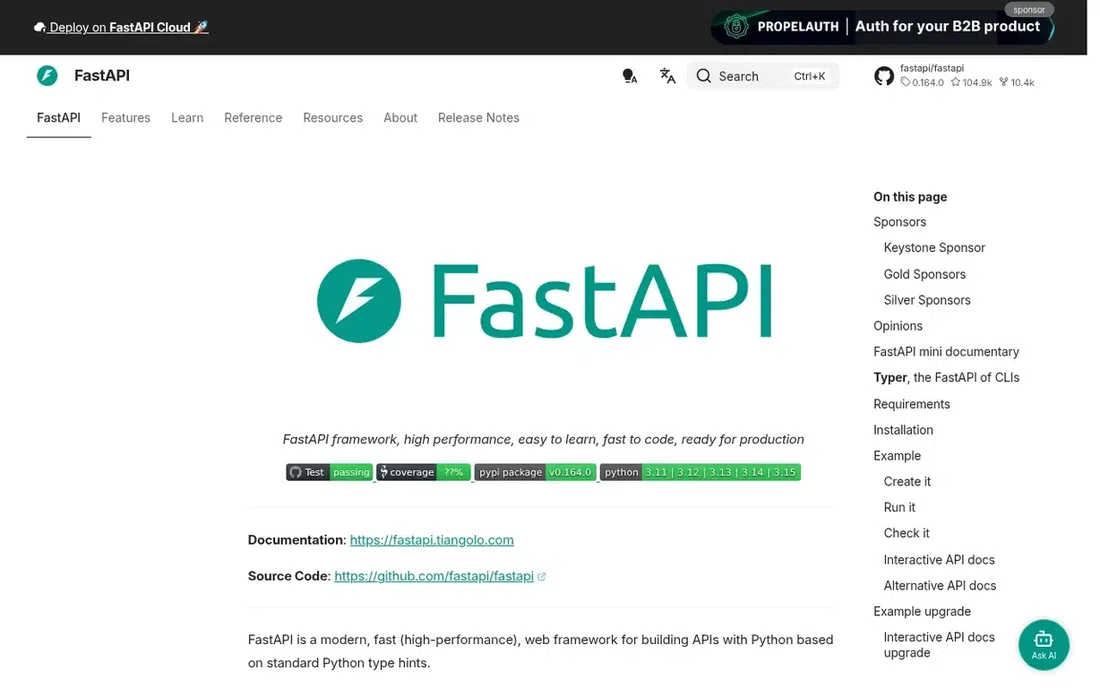
FastAPI targets high-performance APIs with type hints. FastAPI is a modern framework for building APIs, and its homepage describes it as high performance, simple to pick up, quick to code and ready for production. It leans on Python type hints to validate request and response data and produces interactive documentation from those definitions.
Trade-offs to know: Async patterns need some learning.
FastAPI is API-centric, so traditional server-rendered websites with templates and forms are not its primary focus. Its asynchronous style also needs some adjustment if your team is used to synchronous frameworks. FastAPI does not show a starting price in this comparison, so check the vendor site for current pricing. Free plan details: Not stated.
- Automatic interactive API documentation
- Made for high performance
- Less suited to server-rendered sites
Django
Best for: Full-featured, database-driven web applications
Django serves full-featured, database-driven web applications. Django is a full-stack framework aimed at developers working against deadlines. It ships with an object-relational mapper, an automatic admin interface, authentication and templating, so typical web application needs are covered without assembling separate libraries.
As for the details, the trade-off is weight. Django asks you to follow its conventions, and its defaults can feel like more than a small script or single endpoint needs. If your project is a light API or a minimal service, a micro-framework will get you moving with less overhead. Check the vendor site for Django pricing; none is listed in this comparison. Free access: Not stated.
Downsides: Heavier ramp-up time for beginners.
- Mature ecosystem of reusable apps
- Solid conventions and documentation
- Less adaptable for tiny services
Flask
Best for: Small services and adaptable custom applications
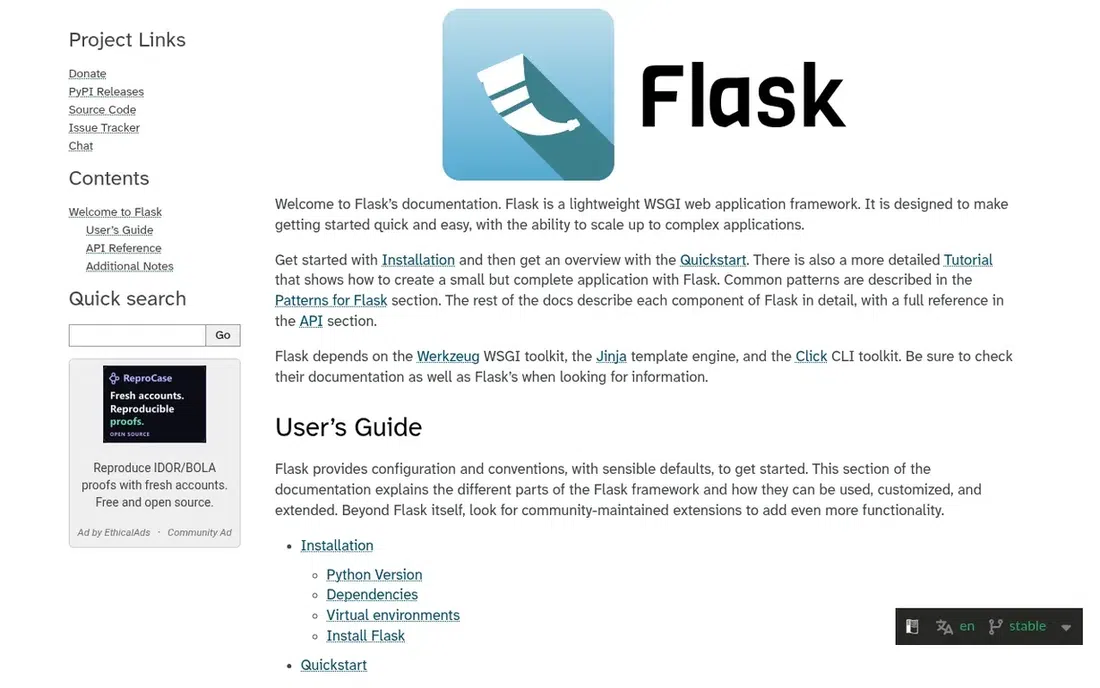
Choose Flask for small services and adaptable custom applications. That makes it a solid fit for small services, prototypes and applications where you want to pick each component instead of accept a full stack.
From a buyer's view, since so much is left to extensions, bigger Flask projects can drift in structure and consistency except when the team sets rules early. Pricing for Flask is not stated here, so ask the vendor for current figures. Free options: Not stated.
Drawbacks to consider: Fewer built-in conventions.
- Large extension ecosystem
- Minimal core that is simple to pick up
- You assemble numerous pieces yourself
Bottle
Best for: Tiny apps and single-file projects
In short, Bottle is for tiny apps and single-file projects. Developers who want routing and templating without a large stack commonly reach for it. From a buyer's view, Bottle is not designed for large, multi-team applications.
Its ecosystem of extensions is smaller than those of the major frameworks. As for the details, Bottle describes itself as a quick, straightforward and light WSGI micro web-framework for Python. It is distributed as a single file with no dependencies beyond the standard library, which makes it convenient for small web apps, prototypes, utilities and services that require to stay compact. Bottle does not show a starting price in this comparison, so check the vendor site for current pricing. As for free access: Not stated.
What to check first: Restricted for large applications.
- Straightforward routing and templating
- Single-file
- Small ecosystem of extras
How these tools were picked
LinkVetted looked at what each vendor publishes: pricing, plan limits, feature coverage for python web frameworks and stated drawbacks. No hands-on testing is claimed. Treat prices as a snapshot: vendors change plans often, so check the vendor site for the figure that applies today. Tools are placed by general fit for python web frameworks, with price clarity and free access as tie-breakers. A different team can reasonably rank them differently.
Questions to settle before buying
- Confirm the entry price with every vendor: no tool from Tornado to Bottle shows a fixed starting price.
- Before choosing Tornado, weigh its main limit: async model has a ramp-up time.
- Ask Django how an export works before you move any records in; an easy exit lowers the risk.
- Compare total cost, not headline price: for Tornado, add extra seats, add-ons and any usage-based charges.
- Look at the renewal terms for Bottle: auto-renewal, notice periods and price changes can matter more than the first-year price.
FAQ
Do these tools publish their prices?
No. None of the tools, from Tornado to Bottle, shows a fixed starting price here, so budget time for quotes.
Is Tornado the right pick for everyone comparing python web frameworks?
No single tool suits every team. Tornado comes first because it fits long-lived connections and real-time services, while FastAPI suits high-performance APIs with type hints and Django suits full-featured, database-driven web applications. Match the tool to your own size, budget and workflow before deciding.
Do I need async support in my Python framework?
Async helps when your application holds plenty of concurrent connections, for example live features or high-volume APIs. Tornado and FastAPI are built around asynchronous patterns. For traditional request-and-response websites, synchronous frameworks remain a practical choice.
How are the tools for python web frameworks ordered?
Tornado sits first and Bottle last because the order follows typical fit for python web frameworks, then price clarity and free access. It is a judgement call, so read each profile for fit and limits.
Does any tool for python web frameworks here have a free plan?
A permanent free plan is not offered by Tornado, Bottle or the other tools here. Plan a short evaluation period instead.
Sources
- https://www.tornadoweb.org
- https://fastapi.tiangolo.com
- https://www.djangoproject.com
- https://flask.palletsprojects.com
- https://bottlepy.org