Omnichannel Commerce Software in 2026: The 6 Best Options Side by Side
Shortlisting the best omnichannel commerce software? 6 products compared on cost, free access and ideal buyer. Short verdicts, no fluff. See which fits.
- Editor's choice
 commercetools
API-first composable enterprise commerce
Starts atSee websiteVisit commercetools.comFull review - Great alternative
 SAP Commerce Cloud
Enterprises with SAP systems in place
Starts atSee websiteVisit sap.comFull review - Also consider
 BigCommerce
Scalable selling across brands and regions
Starts atSee websiteVisit bigcommerce.comFull review
Direct answer
commercetools leads the list, best for API-first composable enterprise commerce. Listed starting prices: Shopify from $19 a month. For a different need, SAP Commerce Cloud covers enterprises with SAP systems in place and BigCommerce covers scalable selling across brands and regions. Details, prices and limits for the rest of the 6 tools are below.
TL;DR:
- Number one here is commercetools, a fit for API-first composable enterprise commerce.
- BigCommerce comes with a trade-off: advanced customization needs planning.
- The cheapest monthly starting price in the list is $19 per month, offered by Shopify.
- Only Shopware offers a free plan among these 6 tools.
Last checked November 2026. Prices and plan details were read from the vendors' own pages in November 2026; vendors change plans often, so confirm the current price on the vendor site before you buy.
Quick comparison
| Tool | Best for | Starts at | Free plan? | |
|---|---|---|---|---|
| commercetools | API-first composable enterprise commerce | See website | Free trial | Visit |
| SAP Commerce Cloud | Enterprises with SAP systems in place | See website | Not stated | Visit |
| BigCommerce | Scalable selling across brands and regions | See website | Not stated | Visit |
 Shopware | Configurable responsive storefronts | See website | Yes | Visit |
 Adobe Commerce | Enterprise B2B and B2C personalization | See website | Not stated | Visit |
 Shopify | Quick multi-channel selling for most firms | $19 a month | Free trial | Visit |
The full omnichannel commerce software list
Choosing omnichannel commerce software usually comes down to price, fit and limits. This LinkVetted guide sets 6 tools side by side on those three points, with the facts kept short and checkable.
Choose commercetools for API-first composable enterprise commerce. commercetools positions itself as enterprise commerce infrastructure for AI agents, letting teams build and operate commerce experiences across online, in-store, in-chat, and agent-to-agent channels from one unified engine.
Merchants without development teams, or those wanting to launch rapidly, should look at hosted systems instead. Worth adding: since it is infrastructure instead of a ready-made storefront, it demands engineering investment and a clear architecture plan. This comparison lists no price for commercetools; ask the vendor. Free access: Free trial.
Limits to weigh: No turnkey storefront from day one.
- Supports agent-to-agent commerce
- Unified engine across numerous channels
- Needs development resources
SAP Commerce Cloud serves enterprises with SAP systems in place. SAP Commerce Cloud is presented as AI-assisted ecommerce software from SAP that drives digital growth and demand whereas offering unified buying experiences to convert visitors into customers.
Teams without SAP foundations should weigh more straightforward or more composable alternatives before committing to this level of enterprise integration. Pricing for SAP Commerce Cloud is not stated here, so ask the vendor for current figures. Free options: Not stated.
What to check first: Implementation is resource intensive.
- AI-assisted ecommerce capabilities
- Unified buying experiences
- Tied closely to SAP environments
BigCommerce was built for scalable selling across brands and regions. BigCommerce describes itself as commerce made for momentum, powering modern buying experiences across brands, regions, and channels from one scalable foundation.
The main drawbacks: Advanced customization needs planning.
In daily use, customization beyond the system's native choices can need apps or development work, and very specialized B2B or composable requirements may push you elsewhere. Pricing for BigCommerce is not stated here, so ask the vendor for current figures. On free options: Not stated.
- Single foundation for several channels
- Made for growth across regions
- Feature depth varies by setup
Shopware is a good fit for customizable responsive storefronts. Shopware is described as an ecommerce product for building and customizing a completely responsive online store with a blend of design and functionality.
Points against: Advanced setups need developer help.
Deep customization and complex omnichannel setups usually call for developer involvement, and ecosystem support varies by region. Pricing for Shopware is not stated here, so ask the vendor for current figures. Shopware has a free plan.
- Flexible design and customization
- Responsive storefront foundation
- Smaller ecosystem in some regions
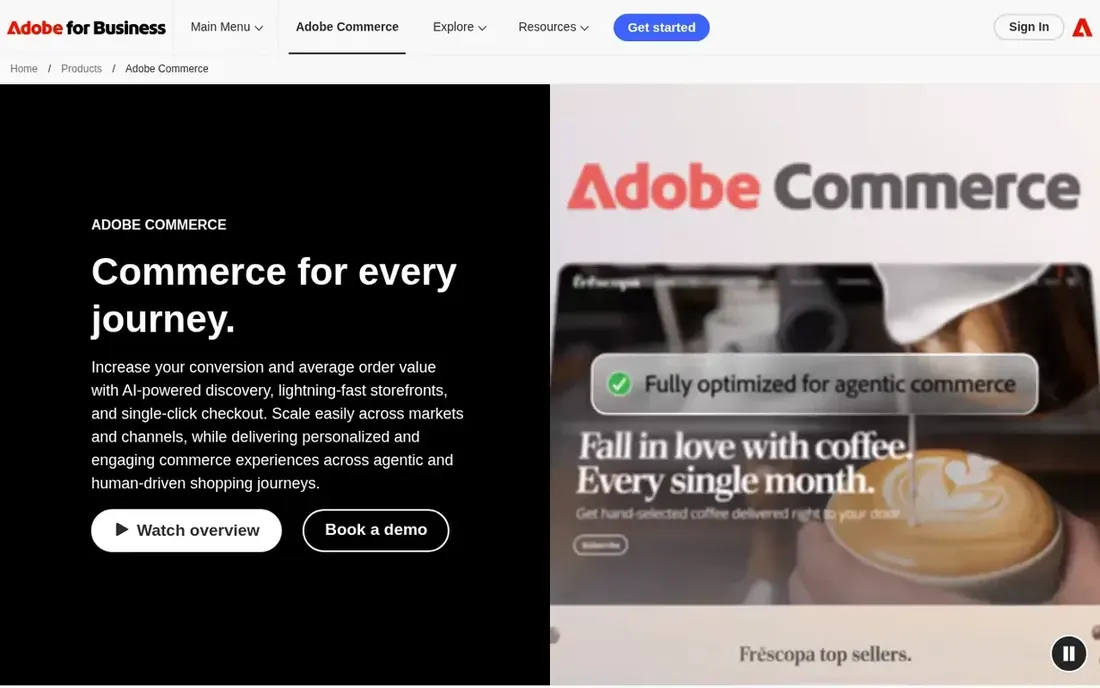
Adobe Commerce is built with enterprise B2B and B2C personalization in mind. Adobe Commerce, formerly Magento, is described as an AI-powered composable ecommerce system designed for B2B and B2C firms that want to drive growth and conversions through personalized experiences at global scale.
Consider a more managed choice when speed to launch and low maintenance matter more than deep customization and enterprise-scale personalization. Adobe Commerce does not show a starting price in this comparison, so check the vendor site for current pricing. On free options: Not stated.
Honest limits: Heavier operational overhead.
- AI-powered architecture
- Composable
- Implementation demands technical resources

Shopify is designed for quick multi-channel selling for most companies. Since it is a hosted, standardized system, teams with unusual data models or heavy custom logic may find it constraining compared to composable systems.
Limits to weigh: Deep customization can need extras.
Shopify starts at: $19 per month. Trial and free access: Free trial.
- All-in-one commerce toolset
- AI-assisted store building and growth
- Complicated enterprise needs may outgrow it
How these tools were picked
LinkVetted used vendor pricing pages and product documentation as the base, then compared plans, free access and documented limits for 6 tools. Seat minimums, billing terms and add-ons can move the real cost, so the starting prices here are a guide and not a quote. The order reflects how well each tool fits the most common buying scenario for omnichannel commerce software, then price clarity, then free plan access. It is a starting point, not a verdict.
Questions to settle before buying
- Ask commercetools, SAP Commerce Cloud, BigCommerce and others for a written quote, since no starting price is shown.
- Look at the free plan from Shopware closely: its caps decide whether it is usable for real work.
- Run a trial of commercetools and Shopify with real work before paying for a year; your own workflow is the best test.
- Before choosing commercetools, weigh its main limit: needs development resources.
- Verify that exporting from commercetools is possible on your plan and covers all your records.
- A short pilot of SAP Commerce Cloud with your real workflow tells you more than a feature table.
FAQ
How are the tools for omnichannel commerce software ordered?
commercetools sits first and Shopify last because the order follows typical fit for omnichannel commerce software, then price clarity and free access. It is a judgement call, so read each profile for fit and limits.
How long does implementation typically take?
Timelines depend heavily on catalog complexity, integrations, and customization depth, so ask each vendor for a scoped estimate based on your requirements.
What makes commerce software omnichannel?
Omnichannel software keeps product data, inventory, orders, and customer records consistent across web, marketplace, social, in-store, and other touchpoints. The key is a shared foundation instead of separate systems per channel, so updates and experiences stay coordinated.
Do these tools publish their prices?
Not all of them. commercetools, SAP Commerce Cloud, BigCommerce and others publish no starting price, so expect a quote request for those. The rest, Shopify included, show a starting price, though seats and billing terms still change the final cost.
Which options for omnichannel commerce software have a free plan?
Shopware is the only tool in this list with a free plan. Free plans usually cap users, projects or features, so check the limits on the vendor page. Several others offer a trial instead.
Should I choose hosted or composable commerce?
Hosted systems for example Shopify and BigCommerce cut operational overhead and accelerate launch, whereas composable systems like commercetools offer adaptability for custom touchpoints at the cost of engineering effort. Match the choice to your team's technical capacity and how unusual your requirements are.
Sources
- https://commercetools.com
- https://www.sap.com/products/crm/commerce-cloud.html
- https://www.bigcommerce.com
- https://www.shopware.com
- https://business.adobe.com/products/magento/magento-commerce.html
- https://www.shopify.com