Choosing Unified Commerce Platforms in 2026: 6 Options Compared
Best unified commerce platforms: 6 contenders ranked by fit, with entry costs and free tiers. We note where every tool falls short. Quick comparison inside.
- Editor's choice
 Adobe Commerce
B2B and B2C personalization at scale
Starts atPricing on requestVisit business.adobe.comFull review - Great alternative
 BigCommerce
Midmarket sellers expanding across channels
Starts atPricing on requestVisit bigcommerce.comFull review - Also consider
 Shopify Plus
Enterprise commerce on a managed foundation
Starts atPricing on requestVisit shopify.comFull review
Direct answer
If you need B2B and B2C personalization at scale, Adobe Commerce is the first tool to look at here. If your case is different, BigCommerce suits midmarket sellers expanding across channels and Shopify Plus suits enterprise commerce on a managed foundation. Free plan facts and limits for all 6 tools follow. None of these vendors publish plan prices, so pricing is on request for every option.
TL;DR:
- The list opens with Adobe Commerce, aimed at B2B and B2C personalization at scale.
- Commercetools suits Composable, API-first commerce builds.
- Adobe Commerce, commercetools and the 4 others all sell by quote; expect sales conversations before you see a price.
- Only Shopware offers a free plan among these 6 tools.
Last checked November 2026. Pricing on request: vendors did not publish plan prices when this guide was last checked (November 2026), so ask each vendor for a written quote.
Quick comparison
| Tool | Best for | Starts at | Free plan? | |
|---|---|---|---|---|
| Adobe Commerce | B2B and B2C personalization at scale | Pricing on request | Not stated | Visit |
| BigCommerce | Midmarket sellers expanding across channels | Pricing on request | Not stated | Visit |
| Shopify Plus | Enterprise commerce on a managed foundation | Pricing on request | Not stated | Visit |
 Shopware | Configurable storefronts with design control | Pricing on request | Yes | Visit |
 Salesforce Commerce Cloud | Teams already inside the Salesforce ecosystem | Pricing on request | Not stated | Visit |
 commercetools | Composable, API-first commerce builds | Pricing on request | Free trial | Visit |
Tool-by-tool breakdown
This LinkVetted guide covers 6 unified commerce platforms. Each profile lists a starting price, free plan details, strengths and drawbacks, so you can drop poor fits quickly.
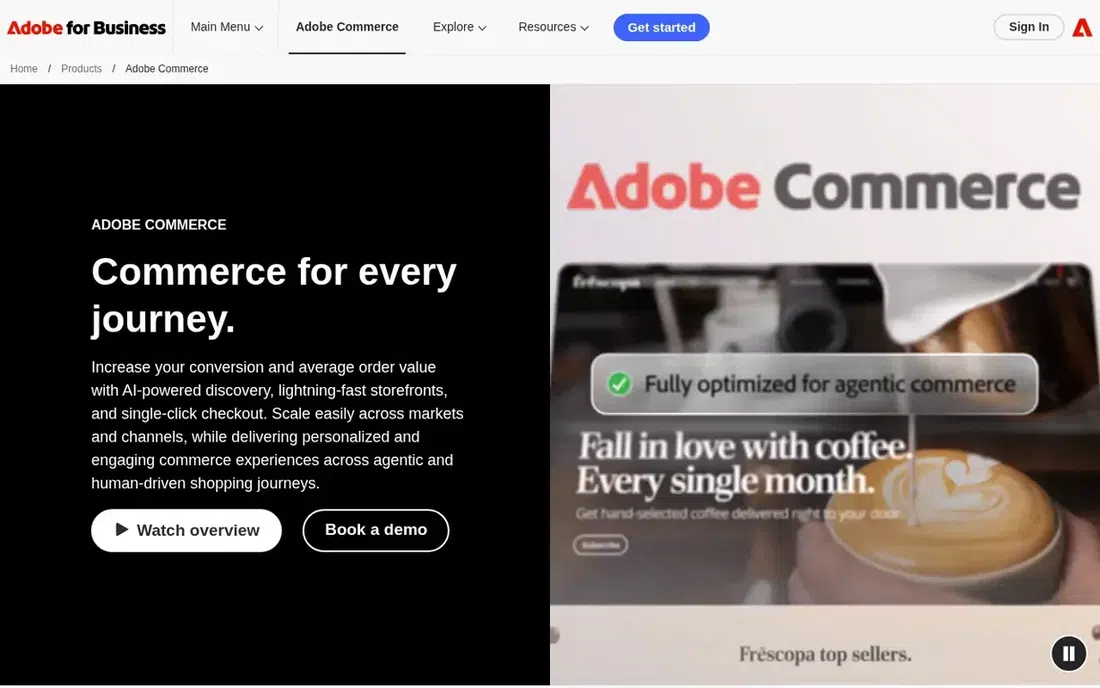
Adobe Commerce is designed for B2B and B2C personalization at scale. Merchants with complicated catalogs and content-driven journeys are a natural fit.
It fits bigger enterprises with existing Adobe ecosystem ties and the resources to run an adaptable, configurable stack. Adobe Commerce shows no starting price here, so confirm the cost on the vendor site. On free options: Not stated.
Drawbacks to consider: Needs specialist resources.
- Composable architecture
- B2B and B2C coverage
- Implementation complexity

BigCommerce was built for midmarket sellers expanding across channels. Very complicated B2B workflows or heavily customized composable architectures may need more than the product supplies from day one.
Trade-offs to know: Complicated customizations take effort.
Catalog-heavy merchants frequently find the model comfortable. For everyday use, pick BigCommerce when multi-channel expansion is the priority and you want a cohesive, manageable base. BigCommerce does not show a starting price in this comparison, so check the vendor site for current pricing. Free access: Not stated.
- Multi-channel selling
- Regional adaptability
- Enterprise depth varies by need

Where Shopify Plus fits: enterprise commerce on a managed foundation. Choose Shopify Plus when speed to market and operational simplicity outweigh fine-grained control.
If your requirements center on deep ERP orchestration or completely custom service layers, a composable choice may fit better. No starting price is listed for Shopify Plus here; confirm pricing on the vendor site. On free options: Not stated.
Watch-outs: Less deep backend control.
- Wide channel support
- Made for scale
- Customization has ceilings
Shopware makes the most sense for configurable storefronts with design control. Shopware presents itself as an ecommerce system for building and customizing a completely responsive online store with a blend of design and functionality.
Where it falls short: Smaller enterprise footprint.
For everyday use, pick Shopware when storefront adaptability and design fidelity are central to your commerce differentiation. As for the details, for very large global enterprises with deep composable requirements, other choices may offer broader infrastructure scope. Shopware does not show a starting price in this comparison, so check the vendor site for current pricing. Free access exists with Shopware.
- Responsive storefront focus
- Adaptable customization
- Custom work brings effort
Salesforce Commerce Cloud
Best for: Teams already inside the Salesforce ecosystem
Think of Salesforce Commerce Cloud for teams already inside the Salesforce ecosystem. Salesforce Commerce Cloud is Salesforce's commerce offering, targeted at enterprises that want buying experiences connected to their broader customer product.
Where it is weaker: Ecosystem lock-in risk.
Consider it when commerce is one piece of a wider customer product strategy instead of a standalone storefront decision. No starting price is listed for Salesforce Commerce Cloud here; confirm pricing on the vendor site. On free options: Not stated.
- Enterprise orientation
- Unified customer data potential
- Configuration-heavy projects
Choose commercetools for Composable, API-first commerce builds. commercetools calls itself the digital commerce AI company, offering enterprise commerce infrastructure for AI agents that runs experiences across online, in-store, in-chat and agent-to-agent channels from one unified engine.
For everyday use, teams without solid engineering capacity may prefer a more packaged system. As for the details, retailers planning conversational and agent-driven touchpoints should look closely. This comparison lists no price for commercetools; ask the vendor. Free options: Free trial.
Points against: You assemble the frontend.
- API-first engine
- Agent-ready positioning
- Needs engineering depth
How we compared the tools
For each of the 6 tools we noted price, free plan or trial, fit for unified commerce platforms and the main limit, using vendor pages and documentation. Treat prices as a snapshot: vendors change plans often, so check the vendor site for the figure that applies today. Position on the page reflects fit for a typical buyer first, with price clarity and free access breaking ties. Treat it as a guide, not a ruling.
Questions to settle before buying
- Confirm the entry price with every vendor: no tool from Adobe Commerce to commercetools shows a fixed starting price.
- Test the free plan from Shopware against your real workload before relying on it.
- Run a trial of commercetools with real work before paying for a year; your own workflow is the best test.
- Read the limits listed for Adobe Commerce first: implementation complexity.
- Ask the daily users to test Shopify Plus on a live task before you roll it out to everyone.
- Test the integrations you rely on with commercetools before committing; some connectors sit on upper tiers.
FAQ
Can I try these options before paying?
Often, yes. Shopware has a free plan and commercetools offers a free trial. Use your own data and a real task during the test, and check what the free tier or trial limits before you rely on it. Each of the 6 options in this unified commerce platforms guide has its own card above with the price, free plan and limits.
How are the tools for unified commerce platforms ordered?
Adobe Commerce sits first and commercetools last because the order follows typical fit for unified commerce platforms, then price clarity and free access. It is a judgement call, so read each profile for fit and limits.
Is Adobe Commerce the right pick for everyone comparing unified commerce platforms?
No single tool suits every team. Adobe Commerce comes first because it fits B2B and B2C personalization at scale, while BigCommerce suits midmarket sellers expanding across channels and Shopify Plus suits enterprise commerce on a managed foundation. Match the tool to your own size, budget and workflow before deciding.
Should I choose hosted or composable commerce?
The right answer relies on your in-house capacity and how unusual your requirements are. Numerous teams start hosted and move toward composable as complexity grows.
Do these tools publish their prices?
No. None of the tools, from Adobe Commerce to commercetools, shows a fixed starting price here, so budget time for quotes. All 6 picks in this unified commerce platforms comparison list a starting price, free plan details and the main limits on their cards above.
What makes a commerce system unified?
That typically means shared catalog, pricing and customer data instead of separate systems stitched together. Confirm how each vendor takes care of cross-channel data in practice.
Sources
- https://business.adobe.com/products/magento/magento-commerce.html
- https://www.bigcommerce.com
- https://www.shopify.com/plus
- https://www.shopware.com
- https://www.salesforce.com/commerce
- https://commercetools.com