Best Conversational Commerce Platforms for Enterprise in 2026: Prices, Free Plans and 6 Picks
6 tools for the best conversational commerce platforms for enterprise, compared on pricing, free plans and best-fit use. Details on cost, catches and fit.
- Editor's choice
 Adobe Commerce
Composable B2B and B2C commerce
Starts atSee websiteVisit business.adobe.comFull review - Great alternative
 Twilio
Custom messaging and voice engagement
Starts atSee websiteVisit twilio.comFull review - Also consider
 Salesforce Commerce Cloud
Unified commerce with CRM and service
Starts atSee websiteVisit salesforce.comFull review
Direct answer
Our first pick is Adobe Commerce, best for Composable B2B and B2C commerce. Listed starting prices: Zendesk from $19 agent/month premium yearly. For a different need, Twilio covers custom messaging and voice engagement and Salesforce Commerce Cloud covers unified commerce with CRM and service. Details, prices and limits for the rest of the 6 tools are below.
TL;DR:
- Adobe Commerce takes the first slot, best suited to Composable B2B and B2C commerce.
- The cheapest monthly starting price in the list is $19 agent/month premium yearly, offered by Zendesk.
- Before buying Zendesk, weigh this: Commerce features need integrations.
- Adobe Commerce, LivePerson and the 4 others all need a premium plan or a trial, since no free plan is listed.
Last checked November 2026. Prices and plan details were read from the vendors' own pages in November 2026; vendors change plans often, so confirm the current price on the vendor site before you buy.
Quick comparison
| Tool | Best for | Starts at | Free plan? | |
|---|---|---|---|---|
| Adobe Commerce | Composable B2B and B2C commerce | See website | Not stated | Visit |
| Twilio | Custom messaging and voice engagement | See website | Free trial | Visit |
| Salesforce Commerce Cloud | Unified commerce with CRM and service | See website | Not stated | Visit |
 Zendesk | AI-powered customer service at scale | $19 agent/month premium yearly | Free trial | Visit |
 Shopify Plus | Scalable commerce for high-volume brands | See website | Not stated | Visit |
| LivePerson | Conversational AI for personalized engagement | See website | Not stated | Visit |
Our 6 picks for conversational commerce platforms for enterprise
Short on time? The summary and table above give the quick view of 6 tools for conversational commerce platforms for enterprise, and the profiles that follow give the detail behind each entry.
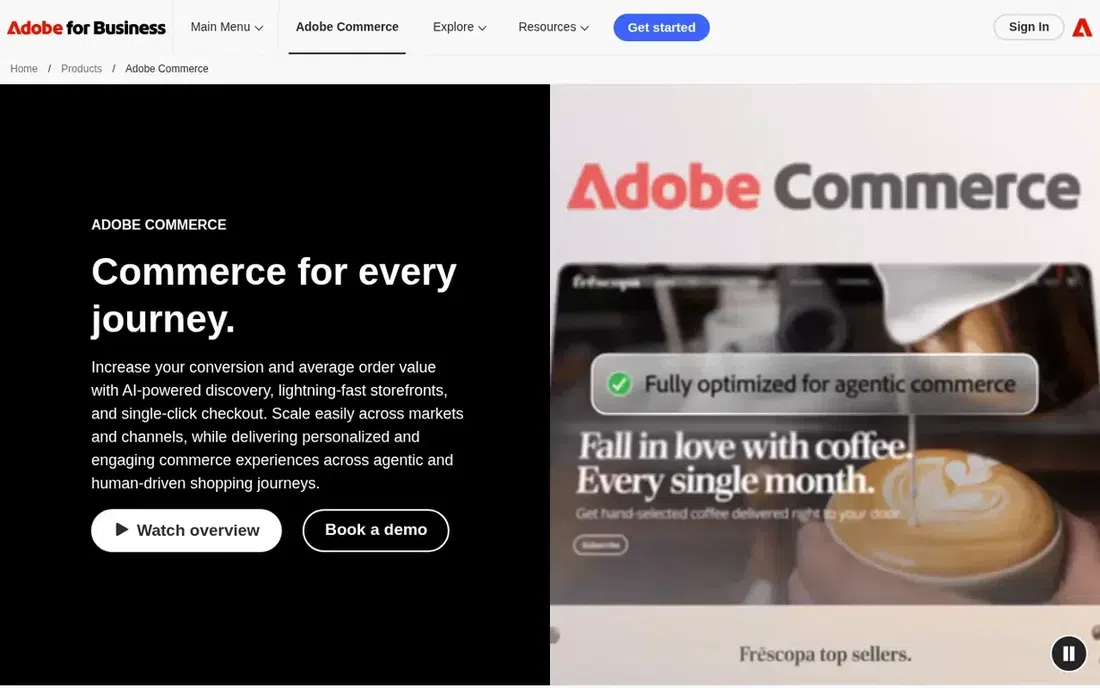
Pick Adobe Commerce if this describes you: Composable B2B and B2C commerce. It fits enterprises with complicated catalogs, multi-brand operations, or international requirements that require adaptable, API-driven commerce.
Implementation and continuing management can demand significant technical resources, and smaller teams may find the product heavy. Adobe Commerce shows no starting price here, so confirm the cost on the vendor site. On free options: Not stated.
Trade-offs to know: Resource-intensive setup.
- Composable architecture
- AI-powered personalization
- Steep ramp-up time
Twilio works best for custom messaging and voice engagement. It suits organizations with developer teams that want to produce tailored conversational commerce flows across channels.
What to check first: Needs development resources.
From a buyer's view, Twilio is not a ready-made commerce product, so firms must invest in development and integration work. Twilio does not show a starting price in this comparison, so check the vendor site for current pricing. On free options: Free trial.
- Conversational AI capabilities
- Adaptable developer system
- Not a turnkey commerce option
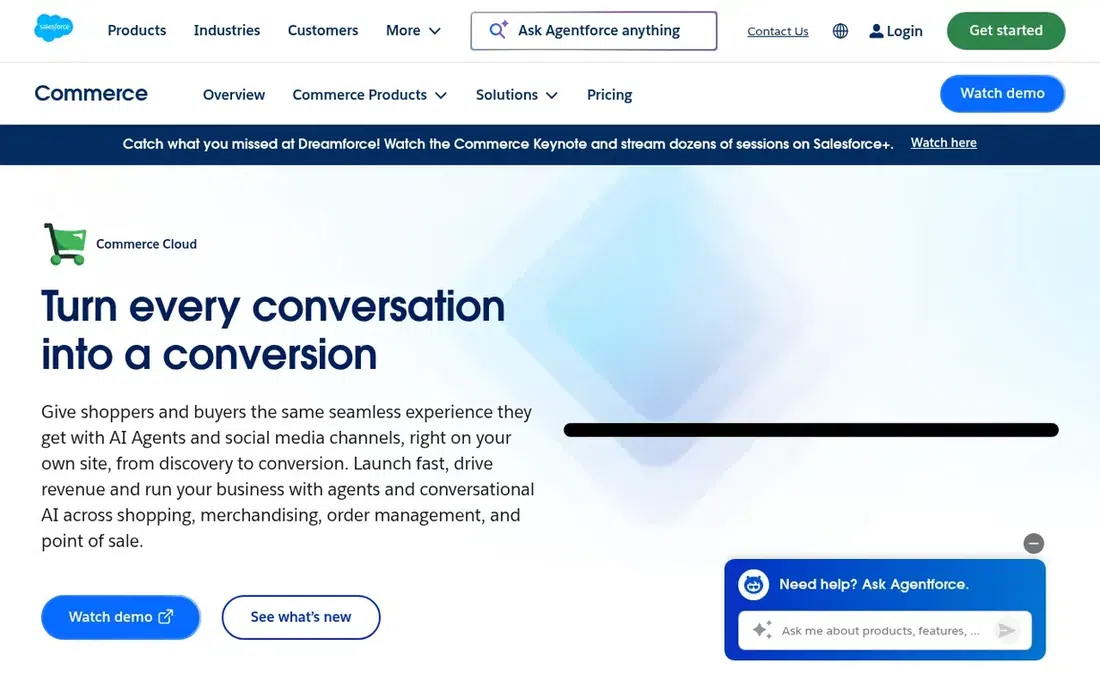
Salesforce Commerce Cloud makes the most sense for unified commerce with CRM and service. Organizations without Salesforce ecosystem experience may find more straightforward commerce platforms simpler to adopt, whereas those needing deep CRM integration will see capable alignment.
More specifically, the system can be complicated to implement and maintain, commonly requiring dedicated specialists. From a buyer's view, Salesforce Commerce Cloud is a commerce product that links with Salesforce CRM and service tools to support conversational journeys across sales and support. Check the vendor site for Salesforce Commerce Cloud pricing; none is listed in this comparison. As for free access: Not stated.
Points against: Requires specialized expertise.
- AI-powered personalization tools
- Deep integration with Salesforce CRM
- Complicated implementation
Zendesk makes the most sense for AI-powered customer service at scale. Zendesk concentrates on service instead of native commerce, so transactional capabilities rely on integrations with commerce platforms.
Where it falls short: Advanced AI may need extras.
Companies seeking a single system for both commerce and service may have to pair Zendesk with a commerce option, whereas service-centric teams will find it solid. Zendesk pricing: $19 agent/month premium yearly. Free options: Free trial.
- Scalable service workflows
- Omnichannel support
- Commerce features need integrations

Shopify Plus makes the most sense for scalable commerce for high-volume brands. Whereas highly scalable, Shopify Plus provides less deep code-level customization than some composable products, and advanced functionality frequently depends on external apps.
Drawbacks to consider: Extra costs for advanced apps.
Shopify Plus shows no starting price here, so confirm the cost on the vendor site. On free options: Not stated.
- Merchant-friendly administration
- Wide app ecosystem
- Less configurable at deep code level
LivePerson
Best for: Conversational AI for personalized engagement
LivePerson serves conversational AI for personalized engagement. LivePerson is not a full commerce system, so it generally connects with existing commerce and CRM systems.
LivePerson supplies a conversational AI product that helps brands engage with connected experiences and personalization at scale. Pricing for LivePerson is not stated here, so ask the vendor for current figures. Free access: Not stated.
Honest limits: Enterprise-focused complexity.
- Personalization at scale
- Connected experiences
- May require integration with commerce stack
How we built this list
The comparison looks at four things: starting price, free access, how well the feature set matches conversational commerce platforms for enterprise, and the main limit of each tool. Treat prices as a snapshot: vendors change plans often, so check the vendor site for the figure that applies today. Position on the page reflects fit for a typical buyer first, with price clarity and free access breaking ties. Treat it as a guide, not a ruling.
Questions to settle before buying
- Confirm the entry price on the vendor page. For Adobe Commerce, Twilio, Salesforce Commerce Cloud and others that means a quote rather than a fixed price.
- Run a trial of Twilio and Zendesk with real work before paying for a year; your own workflow is the best test.
- Before choosing Adobe Commerce, weigh its main limit: steep ramp-up time.
- Ask the daily users to test LivePerson on a live task before you roll it out to everyone.
- The entry price of Adobe Commerce is only the starting point; model the full cost with seats and extras.
FAQ
Do these tools publish their prices?
Not all of them. Adobe Commerce, Twilio, Salesforce Commerce Cloud and others publish no starting price, so expect a quote request for those. The rest, Zendesk included, show a starting price, though seats and billing terms still change the final cost.
What is conversational commerce for enterprises?
Conversational commerce refers to using messaging, chat, voice, and AI-driven interactions to support buying and service journeys. In practice, for enterprises, it frequently means integrating commerce products with customer service and messaging tools to build smooth experiences across channels.
Does any tool for conversational commerce platforms for enterprise here have a free plan?
A permanent free plan is not offered by Adobe Commerce, LivePerson or the other tools here. Twilio, Zendesk offer a trial. Plan a short evaluation period instead.
Is Adobe Commerce the right pick for everyone comparing conversational commerce platforms for enterprise?
No single tool suits every team. Adobe Commerce comes first because it fits Composable B2B and B2C commerce, while Twilio suits custom messaging and voice engagement and Salesforce Commerce Cloud suits unified commerce with CRM and service. Match the tool to your own size, budget and workflow before deciding.
Can I try these tools before paying?
Often, yes. Twilio and Zendesk offer a free trial. Use your own data and a real task during the test, and check what the free tier or trial limits before you rely on it.
Sources
- https://business.adobe.com/products/magento/magento-commerce.html
- https://www.twilio.com
- https://www.salesforce.com/products/commerce-cloud
- https://www.zendesk.com
- https://www.shopify.com/plus
- https://www.liveperson.com