6 Link Building Services for Photographers Worth Shortlisting in 2026
A practical guide to the best link building services for photographers in 2026, compared from vendor documentation and public sources.
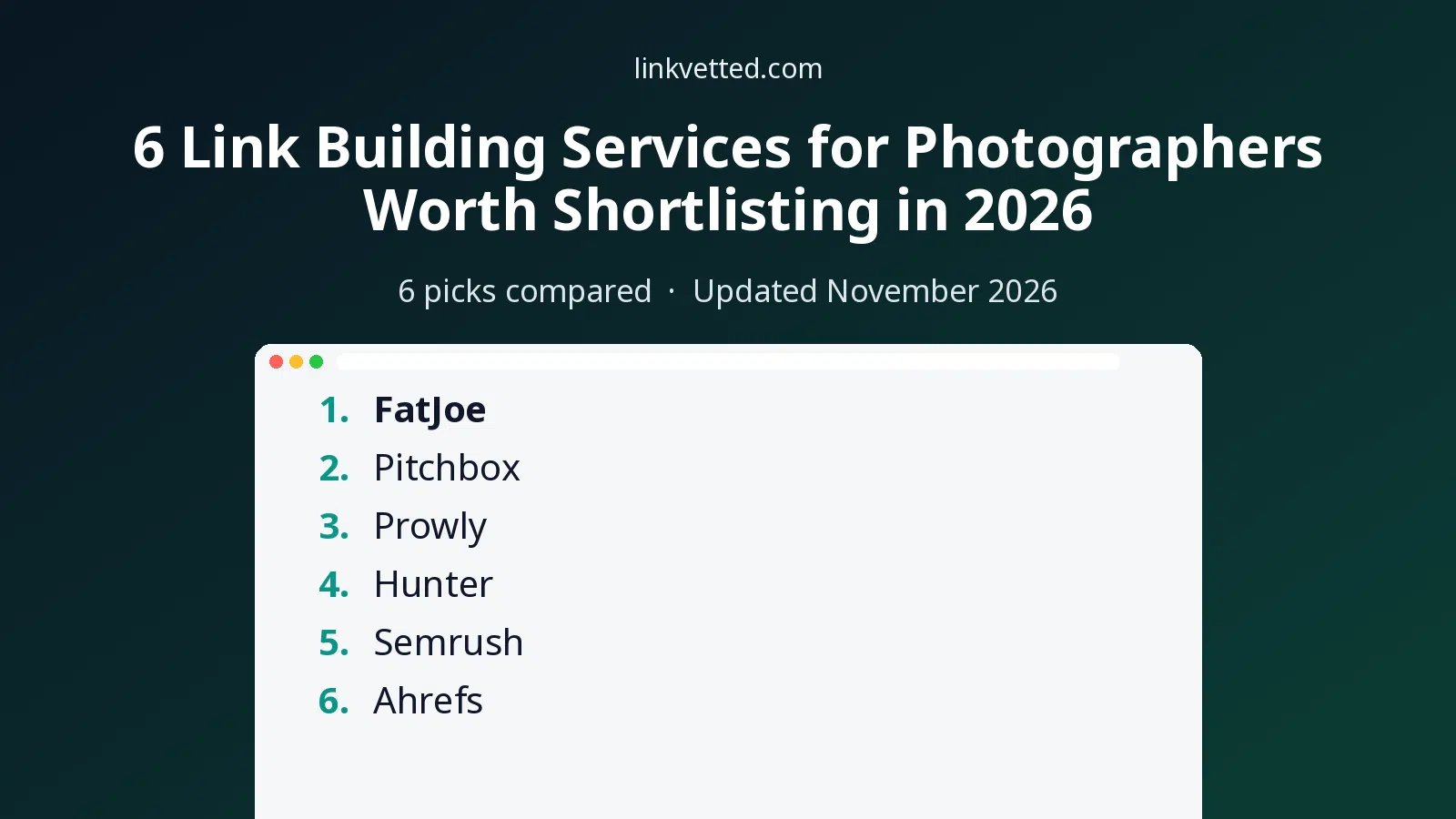
- Editor's choice
 FatJoe
Done-for-you blogger and editorial outreach
Starts atSee websiteVisit fatjoe.comFull review - Great alternative
 Pitchbox
Running your own outreach campaigns
Starts atSee websiteVisit pitchbox.comFull review - Also consider
 Prowly
Digital PR and media outreach
Starts atSee websiteVisit prowly.comFull review
Direct answer
My first pick is FatJoe, a UK link building agency that publishes its process and pricing model openly and offers blogger outreach and digital PR, which suits photographers who want editorial links rather than directory listings. For photographers who prefer to run outreach themselves, Pitchbox gives you the tools and database. For digital PR with a press angle, Prowly covers media contacts and campaigns. Each fits a different budget and level of involvement.
TL;DR:
- Photographers usually need editorial links from blogs, publications and local media more than bulk directory links.
- An agency service saves time but you still need to supply images, captions and story angles for outreach.
- Outreach software only works if you can commit to sending and following up on pitches consistently.
- Digital PR platforms help when you have a project, exhibition or series worth pitching to journalists.
- Check whether a service publishes its link sources and whether it accepts image-led niches like photography.
Last checked November 2026. Plan prices are not quoted in this guide because they change often; see each vendor's own pricing page for current figures before you buy.
Quick comparison
| Tool | Best for | Starts at | Free plan? | |
|---|---|---|---|---|
| FatJoe | Done-for-you blogger and editorial outreach | See website | Not stated | Visit |
| Pitchbox | Running your own outreach campaigns | See website | Not stated | Visit |
| Prowly | Digital PR and media outreach | See website | Free trial | Visit |
 Hunter | Finding editor and blogger emails | See website | Free plan | Visit |
 Semrush | Backlink research alongside SEO | See website | Not stated | Visit |
 Ahrefs | Auditing your backlink profile | See website | Not stated | Visit |
The best link building services for photographers compared
I compared these tools and services from vendor documentation and public sources, including their own help pages and published process descriptions. I did not run hands-on tests, so treat this as a starting point for your own evaluation. The picks below cover agency services, outreach software, PR platforms and research tools, because photographers tend to need a mix rather than one single product.
FatJoe is a link building agency that describes its services on its own site, including blogger outreach, digital PR and niche edits. For a photographer, the appeal is that someone else handles prospecting, pitching and placement while you supply the images and context. It fits solo photographers or small studios that do not have time to run outreach themselves and want links from blogs and publications rather than directories.
In practice, you would brief the team on your genre, such as wedding, portrait, landscape or commercial work, and provide a few image sets and story angles. The agency then pitches relevant sites. Because photography is a visual niche, expect to be involved in supplying assets and approving angles. Ask how they select targets and whether they share the full list before placement.
The main limit is control. You are buying a service, not a tool, so you see the outcome rather than every step. Photographers who want to approve each site personally, or who have a very narrow local market, may prefer to run outreach in-house with software instead.
- Publishes its outreach process
- offers blogger outreach and digital PR
- handles prospecting and placement
- Less control over individual targets
- not photography-specific
Pitchbox is outreach software for finding prospects, sending pitches and managing follow-ups. It suits photographers who are willing to do the work themselves but want a structured system instead of a spreadsheet. If you photograph a specific niche, such as food or architecture, you can build lists of relevant blogs and publications and pitch your work as a source or feature.
The workflow is straightforward in principle: build a prospect list, send a personalised pitch that references the site, attach a couple of images, and follow up. The tool helps you keep track of who replied and who did not. For photographers, the pitch quality matters more than the software, so budget time for writing and for choosing images that fit each site.
Skip it if you cannot commit to regular outreach. Software does not send pitches for you, and a neglected campaign produces nothing. It is also a poor fit if you want a fully managed service.
- Manages prospecting and follow-ups
- tracks outreach in one place
- supports team collaboration
- Needs your own target list
- requires consistent effort
Prowly is a PR platform with a media database, press release tools and campaign management. Photographers with a project, exhibition, book or series can use it to find journalists and editors and pitch the story. The link value comes from coverage in publications that cite your work, which is closer to digital PR than to traditional link building.
For photography, the strongest angles are usually news or human interest: a long-term documentary project, a community series, an award or an exhibition. Prowly helps you organise contacts and send a coherent pitch. You still need a press-ready set of images, captions and a short story.
Its limits are that it is built for PR rather than link metrics, and it works best when you have something genuinely newsworthy. Photographers without a current project may find it hard to justify the subscription.
- Media contact database
- press release and campaign tools
- built for PR workflow
- Not focused on SEO metrics
- needs a story worth pitching
Hunter is an email finding tool. You enter a domain and it returns publicly available email addresses associated with it, which helps when you want to pitch a photo editor or blog owner but cannot find a contact address on the site. It is a small utility rather than a full link building service.
For photographers, it fits a manual outreach approach: pick ten blogs that publish photography features, find the right contact, and send a short pitch with two or three images. It works well alongside a spreadsheet or a lightweight outreach tool. The free plan is useful for testing before you commit.
The limit is obvious: Hunter does not build links, track replies or manage campaigns. It is one step in a process you still have to run. Skip it if you already have contacts or use a platform that includes a database.
- Finds and verifies email addresses
- simple search by domain
- useful for small outreach lists
- Only finds contacts
- no outreach or tracking features
Semrush is an SEO platform with backlink analytics, competitor research and related tools. For a photographer, the useful part is seeing who links to similar photographers or photography blogs, then using that as a prospect list for your own outreach. It also helps you spot spammy or irrelevant links pointing at your site.
The workflow is research-led: enter a competitor or a photography publication, review referring domains, and shortlist sites that look like realistic targets. You then pitch them yourself or pass the list to an outreach service. This makes Semrush a planning tool rather than a link building service.
The drawback is cost and breadth. If you only need backlink data, a dedicated backlink checker may be cheaper. Photographers who already pay for an SEO platform may find the link tools a useful extra rather than the main reason to subscribe.
- Backlink analytics
- competitor research
- broad SEO toolkit
- Link features are part of a larger paid platform
- overkill for link building alone
Ahrefs is a backlink and SEO research platform. Photographers can use it to audit their own backlink profile, see which pages attract links and study competitors. If you are planning outreach, the referring domain lists for photography blogs and publications can inform your target list.
The practical use is diagnostic. Before you buy links or run a campaign, check what you already have and whether anything looks unnatural. After a campaign, check what actually landed. That makes it a useful companion to an agency or outreach tool rather than a replacement.
Its limits are price and scope. It is a research platform, not an outreach service, and it does not pitch anyone for you. Solo photographers on a tight budget may find a smaller backlink checker sufficient.
- Detailed backlink data
- site explorer for competitor research
- useful for spotting bad links
- Priced for teams
- no outreach features
How I chose
I chose these tools and services by reading vendor documentation, help pages and public descriptions of their processes, then matching them to how photographers actually get links. Photography is a visual niche, so I favoured options that support image-led pitches, editorial placements and PR-style stories over bulk directory submissions. I also looked at whether each vendor explains its methods publicly, because that makes it easier to judge fit before you pay.
I did not run hands-on tests, and I have not used every tool in a live campaign. The comparison is based on what the vendors publish and on public sources, not on measured results. Where a product's pricing or free plan was not clearly stated, I marked it as not stated rather than guessing. Use this guide to shortlist two or three options, then ask each vendor directly about photography experience, target selection and reporting before you commit.
What to check before you buy
- Ask whether the service has worked with photographers or other visual niches and can share example target types, not just generic samples.
- Confirm how targets are selected and whether you can approve or exclude sites before placement.
- Ask what assets they need from you, such as image sets, captions, credits and a short bio.
- Check whether they report the full list of placed links with live URLs so you can verify each one.
- Clarify what happens if a link is removed or a placement falls through.
- Read the contract for minimum terms and whether you can pause or cancel without penalty.
FAQ
Do photographers need link building at all?
Links help search engines and clients find your work, especially if you rely on organic search for enquiries. But photography is visual, so links from relevant blogs, publications and local media matter more than volume. A small number of editorial links from sites that actually feature photographers is usually more useful than hundreds of low-quality directory listings.
Can I build links myself instead of paying a service?
Yes. Many photographers run their own outreach by pitching blogs, publications and local media with a short email and a few strong images. It takes time and consistency, and most pitches will not get a reply. Software can help you organise the work, but the effort is still yours. Paying a service makes sense when your time is better spent shooting.
Are paid links safe?
Buying links that pass ranking signals can violate search engine guidelines, and the risk sits with your site. Editorial placements, digital PR coverage and genuine features are different because a journalist or editor chooses to cover your work. Ask any vendor how they source placements and avoid anything that promises guaranteed links on specific sites for a fee.
How many links do I need?
There is no fixed number. It depends on your niche, location and competition. A wedding photographer in a small town may need far fewer links than a commercial studio competing nationally. Focus on relevance and quality first, then add volume gradually. Track which links bring referral traffic and enquiries, not just rankings.
What should I send a blogger or editor?
Send a short pitch that explains why their audience would care, plus two or three high-resolution images with captions and credit information. Link to a relevant page on your site, such as a project or portfolio page. Keep it brief, personalise the first line, and make it easy for them to use your images without extra back-and-forth.
Sources
- https://fatjoe.com
- https://pitchbox.com
- https://prowly.com
- https://hunter.io
- https://semrush.com
- https://ahrefs.com
Related guides
- Best Building Information Modeling Software in 2026: 9 Tools Compared
- Top 5 Platforms for Building Clean Photo Galleries for 2026 (Prices and Free Plans)
- 5 Xnview Hover Play Thumbnail Building Alternatives Worth Switching To in 2026
- 6 Access Management Software for Photographers Worth Shortlisting in 2026