Best Link Building Services for Nutritionists for 2026: Our 5 Vetted Picks
A practical guide to the best link building services for nutritionists in 2026, compared from vendor documentation and public sources.
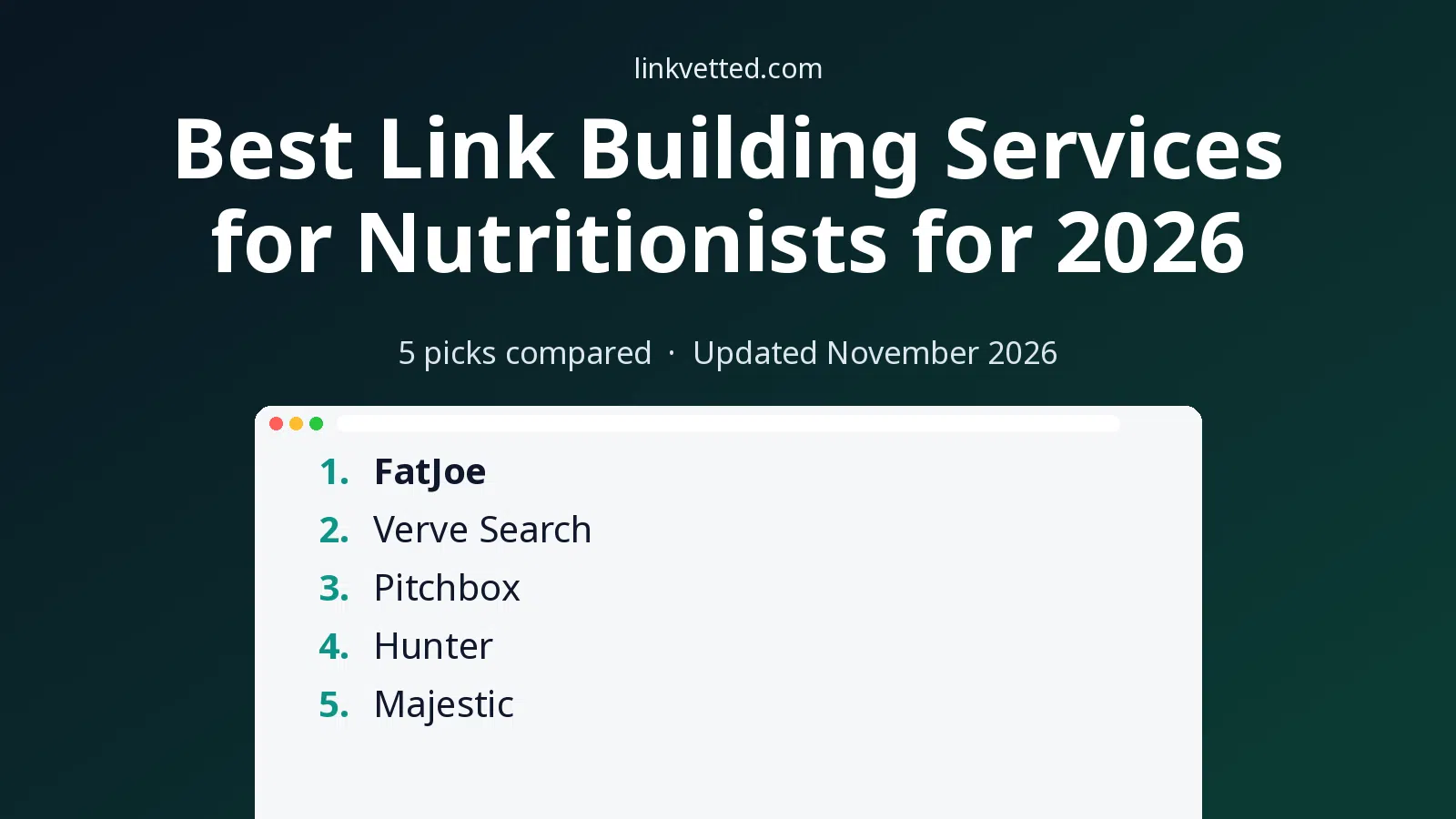
- Editor's choice
 FatJoe
Done-for-you blogger outreach
Starts atSee websiteVisit fatjoe.comFull review - Great alternativeVerve Search
Creative digital PR campaigns
Starts atSee websiteVisit vervesearch.comFull review - Also consider
 Pitchbox
Running your own outreach
Starts atSee websiteVisit pitchbox.comFull review
Direct answer
My top pick is FatJoe, a UK link building agency whose public materials describe blogger outreach and content-led placements, which suits nutritionists who want links from food and wellness blogs. For digital PR with a health and lifestyle angle, I suggest SMG or Verve Search. For a lower-effort, self-serve option where you keep control of outreach, Pitchbox is the tool I point people to. Each fits a different budget and level of involvement.
TL;DR:
- Nutrition is a sensitive topic, so the safest links come from sites that publish real editorial content about food, health and lifestyle.
- Agencies like FatJoe and Verve Search handle outreach for you, while tools like Pitchbox and Hunter support your own campaigns.
- Most providers do not publish prices, so you need to request a quote and ask what a typical nutrition campaign includes.
- Google's spam policies and the way it treats links mean paid link schemes and PBNs are a risk you should avoid entirely.
- Check that any provider can show you example placements in food, wellness or health publishing before you commit.
Last checked November 2026. Plan prices are not quoted in this guide because they change often; see each vendor's own pricing page for current figures before you buy.
Quick comparison
| Tool | Best for | Starts at | Free plan? | |
|---|---|---|---|---|
| FatJoe | Done-for-you blogger outreach | See website | Not stated | Visit |
| Verve Search | Creative digital PR campaigns | See website | Not stated | Visit |
| Pitchbox | Running your own outreach | See website | Free trial | Visit |
 Hunter | Finding editor email addresses | See website | Free plan | Visit |
 Majestic | Checking backlink profiles | See website | Not stated | Visit |
The best link building services for nutritionists compared
I put this list together from vendor documentation and public sources, not from hands-on tests. I looked at what each provider says it does, who it says it serves, and how that lines up with the needs of a nutrition practice. Where a provider does not publish details, I say so rather than guess.
FatJoe is a link building agency that, according to its website, runs blogger outreach and content placements. It presents itself as a service for businesses that want links without managing outreach themselves. For a nutritionist running a practice or a small clinic, that means someone else handles finding sites, pitching editors and placing content, which saves time if you would rather focus on clients.
In practice, a nutrition-focused campaign with FatJoe would start with you describing your topic areas, such as sports nutrition, gut health or family meals. The agency then sources sites and proposes placements. Because nutrition sits close to health claims, you should review every proposed site yourself and confirm the content is accurate and does not make claims you would not stand behind.
The main limit is transparency on price and on the exact sites used before you buy. If you need to approve every domain in advance or you have a very small budget, ask detailed questions first or consider a self-serve tool instead.
- Publicly describes blogger and content outreach
- offers link building as a standalone service
- has a blog with guidance on outreach
- Pricing not published
- placement quality varies by niche
Verve Search
Best for: Creative digital PR campaigns
Verve Search is a digital PR and content agency. Its public materials describe creative campaigns designed to earn coverage and links from publishers. That approach can work for nutritionists with a distinctive angle, such as a data-led piece on shopping habits or a survey on meal planning, because journalists respond to stories rather than to service pages.
For a nutritionist, the value is in the story. You would bring the subject knowledge and the angle, and the agency would shape it into something a health or lifestyle desk might cover. This is a different model from buying placements: you are pitching ideas and hoping for editorial pickup, which means results are less predictable but the links tend to be more natural.
Skip Verve if you want a fixed number of links at a set price, or if your budget is small. It suits practices and brands that can invest in a campaign and wait for coverage.
- Publicly describes creative digital PR and content campaigns
- works with consumer and lifestyle brands
- has published case studies on its site
- Aimed at larger campaigns
- not a low-cost option
Pitchbox is outreach software rather than a service. According to its website, it helps teams find prospects, manage email campaigns and track responses. For a nutritionist who is comfortable writing emails and wants to control exactly which sites are approached, this is a practical middle ground between doing everything by hand and paying an agency.
The workflow is straightforward in principle: you build a list of food, wellness and health sites, write a short pitch, and track replies. The hard part is the list and the pitch. Nutrition is a crowded topic, so you need a specific reason for a site to link to you, such as a genuinely useful resource on reading food labels or planning meals on a budget.
The limit is your own time. If you do not enjoy outreach or cannot commit a few hours a week, the software will not do the work for you. In that case, an agency is the better route.
- Publicly describes outreach and prospecting workflow
- supports campaign management
- has a free trial according to its site
- You do all the outreach
- needs time and a process
Hunter is an email discovery tool. Its website describes finding and verifying professional email addresses from company domains, which is useful when you have identified a food blog or health publication and need a contact. It is a supporting tool, not a link building service, and I include it because contact finding is where many small outreach efforts stall.
For a nutritionist, Hunter fits a simple routine: pick a publication, find the editor's address, send a short pitch about a resource you have created. It pairs well with Pitchbox or a plain spreadsheet. The free plan is enough to test whether the approach works for you before paying for anything.
Do not expect Hunter to tell you which sites are worth targeting or to write your pitch. It only solves the contact step, and some addresses it returns may be generic inboxes rather than the right editor.
- Publicly describes email discovery and verification
- has a free plan per its site
- integrates with common outreach tools
- Does not build links itself
- data accuracy varies by site
Majestic is a backlink data tool. Its website describes an index of links and metrics intended to help you judge the strength and relevance of a site's link profile. I include it because before you pay any agency, you should look at the sites they propose, and a data tool gives you a second opinion beyond the agency's own pitch.
For a nutritionist, the use case is due diligence. If a provider suggests a placement on a health or food site, you can check whether that site has a plausible link profile or looks like a link farm. You do not need to become an expert in metrics; you need to spot obvious problems, such as a site with unrelated topics and a strange link pattern.
The limit is that Majestic gives data, not judgement. It will not tell you whether a site is editorially credible or whether its health content is accurate. Treat it as one input, not a verdict.
- Publicly describes backlink data and trust metrics
- long-established link index
- useful for due diligence
- A data tool, not a service
- metrics need interpretation
How I chose
I built this list from vendor documentation and public sources. That means I read what each provider publishes about its services, looked at the type of clients and campaigns it describes, and checked whether its offering matches what a nutritionist actually needs: relevant placements, sensible claims, and a clear process. I did not run hands-on tests, and I have not used every service here on a live campaign.
The second filter was fit and limits. A nutritionist's site is usually small compared with a retail brand, so agencies built for large creative campaigns may not be the right first call. I also weighed transparency: providers that publish little about pricing or process get a note in the cons, because you should know what you are buying. Where I was unsure about a detail, such as free plan availability, I wrote "Not stated" rather than guess.
What to check before you buy
- Ask which specific sites or publication types the provider expects to target, and get examples in food, health or wellness.
- Confirm how health claims in placed content will be checked, since nutrition content can create regulatory and reputational risk.
- Ask whether links are editorial placements or paid placements, and make sure nothing violates Google's spam policies.
- Request a sample report so you can see what you get: domains, URLs, anchor text and dates.
- Check the provider's own backlink profile and public case studies before you commit.
- Clarify what happens if a placement is removed, and whether there is any replacement policy.
FAQ
Are paid link building services safe for a nutrition website?
Buying links that pass ranking signals is against Google's spam policies, so I would avoid any provider that sells guaranteed links. Editorial outreach, where a publisher chooses to link to something useful, is the safer model. Ask providers to describe their process in plain terms and walk away from anyone promising a set number of links for a fee.
Can I build links myself as a nutritionist?
Yes. A small practice can earn links by publishing genuinely useful resources, such as a guide to reading food labels or a meal planning template, then emailing relevant bloggers and journalists. Tools like Hunter and Pitchbox support that work. It takes time, but it keeps control in your hands and avoids the risk of a provider placing links you would not approve.
How long does link building take for a nutrition practice?
It depends on the method. Self-serve outreach can produce a few placements within weeks if your pitch is good. Agency campaigns usually run in cycles, and digital PR depends on whether journalists pick up the story. I would plan in months rather than weeks and judge providers on process and reporting, not on speed claims.
Do I need a nutrition-specific agency?
Not necessarily. A general agency with strong food and lifestyle contacts can do well if you supply the subject expertise and review the content. A specialist may understand the topic faster, but few exist. What matters more is whether the provider can show relevant placements and handles health claims carefully.
What should I budget for?
Providers rarely publish prices, so ask for a quote that covers strategy, outreach, content and reporting. Compare quotes on what is included rather than on the headline figure. For a small practice, a self-serve tool plus your own time is often the cheapest start, while an agency suits you if you would rather not run outreach yourself.
Sources
- https://fatjoe.com
- https://www.vervesearch.com
- https://pitchbox.com
- https://hunter.io
- https://majestic.com