Best Link Building Services for News Publishers for 2026: Our 6 Vetted Picks
A practical guide to link building services for news publishers in 2026, compared from vendor documentation and public sources, with fit and limits.
- Editor's choice
 Muck Rack
Press relationships and media monitoring
Starts atSee websiteVisit muckrack.comFull review - Great alternative
 Hunter
Finding contact emails for outreach
Starts atSee websiteVisit hunter.ioFull review - Also consider
 Pitchbox
Running structured outreach campaigns
Starts atSee websiteVisit pitchbox.comFull review
Direct answer
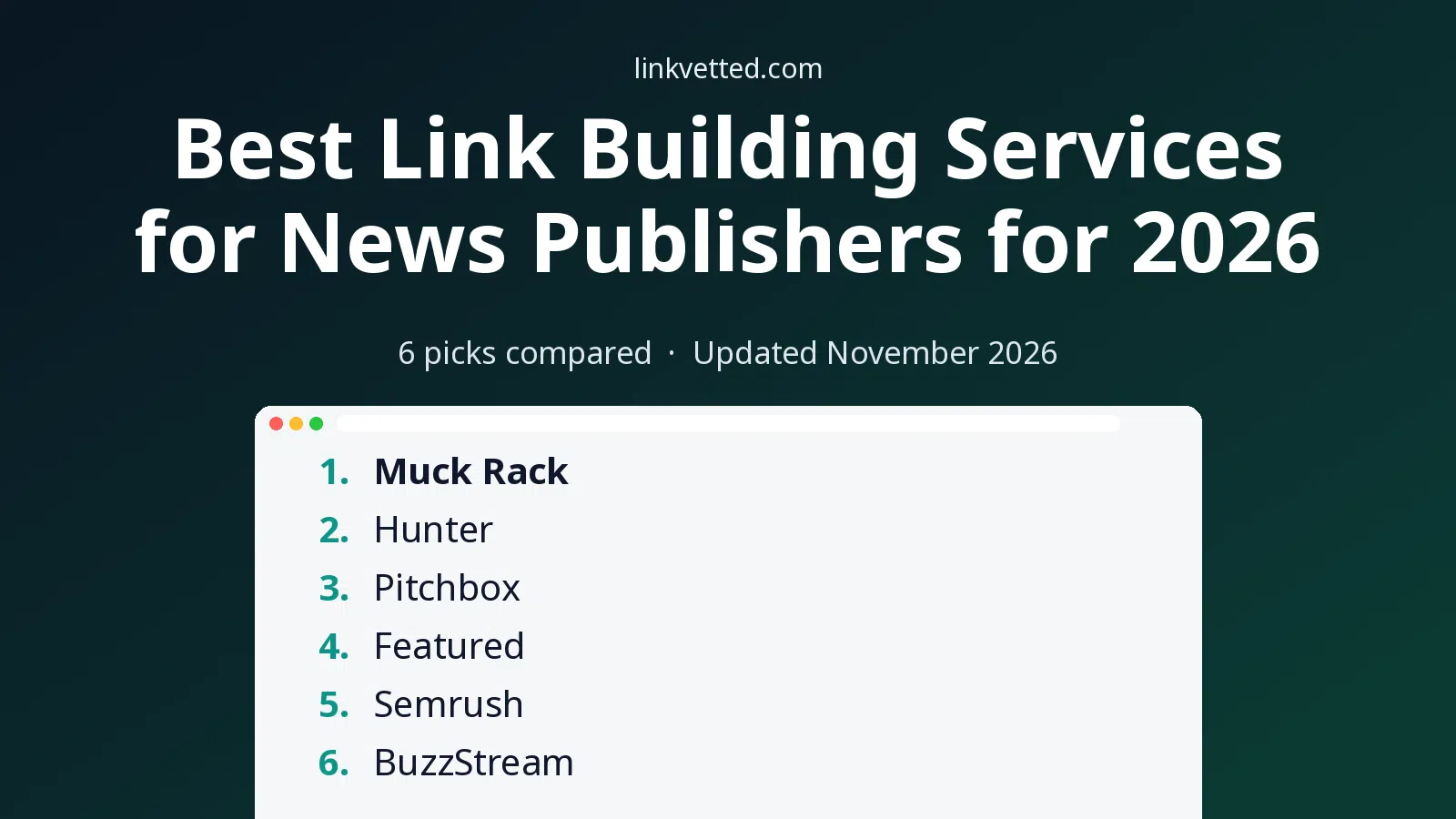
My first pick for most news publishers is Muck Rack, because it is built around journalist relationships and earned media rather than paid placements. For publishers who want a broader outreach database, Hunter and Pitchbox are worth a look, and Featured handles the editorial-placement side. The right choice depends on whether you need press relationships, prospecting, or managed outreach.
TL;DR:
- News publishers need links that come from real editorial coverage, not paid placements or private networks.
- A media database and a journalist outreach tool solve different problems, so many publishers end up using both.
- Managed services cost more but reduce the time your newsroom spends on prospecting and follow-up.
- Always check whether a vendor's links are earned, sponsored, or placed, because that changes how you should disclose them.
- Start with one channel, measure referral traffic and coverage quality, then add tools as the workflow proves itself.
Last checked November 2026. Plan prices are not quoted in this guide because they change often; see each vendor's own pricing page for current figures before you buy.
Quick comparison
| Tool | Best for | Starts at | Free plan? | |
|---|---|---|---|---|
| Muck Rack | Press relationships and media monitoring | See website | Not stated | Visit |
| Hunter | Finding contact emails for outreach | See website | Free plan | Visit |
| Pitchbox | Running structured outreach campaigns | See website | Not stated | Visit |
| Featured | Managed editorial link placements | See website | Not stated | Visit |
 Semrush | Research and competitor link analysis | See website | Free plan | Visit |
 BuzzStream | Small teams managing press outreach | See website | Free trial | Visit |
The best link building services for news publishers compared
I compared these tools from vendor documentation and public sources, not from hands-on testing. My focus was on how each one fits a newsroom's real workflow: finding journalists, pitching coverage, and tracking what gets published. I did not run trials or measure results, so treat this as a starting point for your own evaluation.
Muck Rack is a media relations platform built around a database of journalists and outlets. For a news publisher, the value is in knowing who covers your beat and building relationships that lead to mentions and links over time. It fits publishers with a communications or audience team rather than a single SEO person working alone.
In practice, you use it to build media lists, monitor coverage of your brand and topics, and report on earned mentions. Those mentions are the raw material for links: when another outlet covers your reporting, you can track it and follow up. The workflow is closer to PR than to classic link building, which is usually the right approach for news brands.
The limit is that it does not do outreach for you and does not report link authority. If you want a pure link prospecting tool, this is not it. Publishers without a PR function may find it hard to justify.
- Large journalist database
- media monitoring and alerts
- coverage reporting
- Pricing aimed at teams
- less focused on link metrics
Hunter is an email discovery tool. You enter a domain and it returns public email addresses associated with it, which helps when you want to reach an editor or reporter whose direct address is not listed. It is a small utility rather than a full link building service, but it fills a gap in many newsroom outreach workflows.
For news publishers, the common use is finding contacts at outlets that have covered similar stories, then pitching a follow-up or an exclusive. You can also use it to verify addresses before a campaign so fewer pitches bounce. It pairs well with a media database or a CRM, since it does not manage campaigns itself.
The limits are clear: it finds emails, it does not write pitches or track replies, and accuracy depends on what is public. Skip it if you already have a media database with verified contacts.
- Simple email discovery
- domain search
- works well alongside a CRM
- No outreach automation
- email accuracy varies by domain
Pitchbox is an outreach platform for managing prospecting and email campaigns at scale. You build lists, send pitches, and track replies in one place. For a news publisher, it suits teams that already know which sites and journalists they want to reach and need a system to run the process consistently.
The tool helps with the repetitive parts of outreach: sequencing follow-ups, tracking who replied, and keeping a record of conversations. That matters for publishers running regular data-story pitches or expert commentary offers. It does not guarantee coverage, and it does not replace a good story angle.
The main drawback is that it assumes you have a process and a list. Small publishers without dedicated outreach staff may find it heavy. Skip it if you only send a handful of pitches a month.
- Campaign management
- follow-up sequences
- prospecting workflow
- Needs a defined process
- setup takes time
Featured
Best for: Managed editorial link placements
Featured is a service that connects brands with publishers for editorial placements. For a news publisher, the angle is different: you may use it to place contributed content or expert pieces that earn mentions and links. It is a managed service, so you hand over the brief and the vendor handles matching.
The workflow is simple: you define the topic and the kind of outlet you want, and the service proposes placements. That saves time compared with cold outreach, and it can produce coverage on sites you might not reach alone. The trade-off is that placements are paid, so you should treat them as sponsored and disclose them where required.
The limits are control and fit. You cannot always choose the exact site, and editorial standards vary. Publishers with strict editorial policies should review each placement before publishing.
- Editorial placement focus
- managed process
- clear deliverables
- Paid placements need disclosure
- limited control over exact sites
Semrush is an SEO platform with a backlink analysis module. For news publishers, it is useful for seeing who links to competing outlets, which stories attract links, and where your own coverage is being cited. That research feeds outreach and content planning.
You can use it to find sites that link to similar stories, then pitch those sites with your own reporting. It also helps you spot unlinked mentions and broken links worth reclaiming. The link tools sit inside a larger platform, so you may pay for features you do not use.
The limit is that it is a research tool, not an outreach service. It tells you where links exist, not how to get them. Publishers who want done-for-you outreach should look elsewhere.
- Backlink data
- competitor analysis
- broad SEO toolkit
- Link building is one feature among many
- data needs interpretation
BuzzStream is a CRM for outreach. It stores contacts, tracks conversations, and helps you manage follow-ups. For a small news publisher, it is a practical way to keep press and blogger relationships organized without a large platform.
The tool helps by keeping a record of who you pitched, what they said, and when to follow up. That is useful when you are building relationships with reporters and editors over months. It also supports link tracking so you can see which outreach turned into coverage.
The limits are scale and data. It does not include a large media database, so you build lists yourself. Publishers with high outreach volume may outgrow it.
- Contact management
- outreach tracking
- affordable for small teams
- Smaller database
- manual list building
How I chose
I picked these tools by reading vendor documentation and public sources, then matching each one to the way a news publisher actually earns links: through coverage, relationships, and editorial placements. I did not run hands-on tests, so I cannot vouch for day-to-day usability or support quality. What I can do is explain what each tool is built for and where it stops.
I weighed four things: whether the tool fits a newsroom workflow, whether it supports earned coverage rather than paid links alone, how much manual work it leaves to you, and what it does not do. I left out vendors I could not confirm are operating, and I avoided any tool that depends on private networks or spam tactics.
What to check before you buy
- Confirm whether links are earned, sponsored, or placed, and plan disclosure accordingly.
- Ask for sample placements and check whether the outlets are relevant to your beat.
- Check whether the vendor provides reporting on coverage and referral traffic, not just link counts.
- Ask how contacts are sourced and whether they are verified.
- Confirm the contract terms, including cancellation and renewal.
- Test the workflow with a small campaign before committing to an annual plan.
FAQ
Do news publishers need link building services at all?
Not always. If your reporting already earns citations, a media monitoring tool may be enough. Services help when you want a repeatable outreach process or access to journalists you cannot reach alone.
Are paid editorial placements safe for a news brand?
They can be, if you disclose them as sponsored and keep them separate from editorial. The risk is mixing paid placements with earned coverage in a way that misleads readers or breaks publisher guidelines.
Can I use these tools without a PR team?
Yes, but you will do more of the work. Email finders and outreach CRMs are usable by one person. Media databases and managed placement services are easier with someone dedicated to outreach.
How do I measure whether link building is working?
Track coverage volume, referral traffic from new mentions, and whether your stories get cited by outlets you pitched. Link counts alone tell you little about whether the coverage reached the right audience.
What should I avoid when buying link building services?
Avoid anything that promises guaranteed links, sells links from private networks, or cannot tell you where placements will appear. Those tactics carry risk and rarely produce coverage that helps a news brand.
Sources
- https://muckrack.com
- https://hunter.io
- https://pitchbox.com
- https://featured.com
- https://semrush.com
- https://buzzstream.com