6 Best Link Building Services for Construction Companies for 2026, Vetted and Compared
A practical guide to link building services for construction companies in 2026, comparing outreach, digital PR and niche placement options.
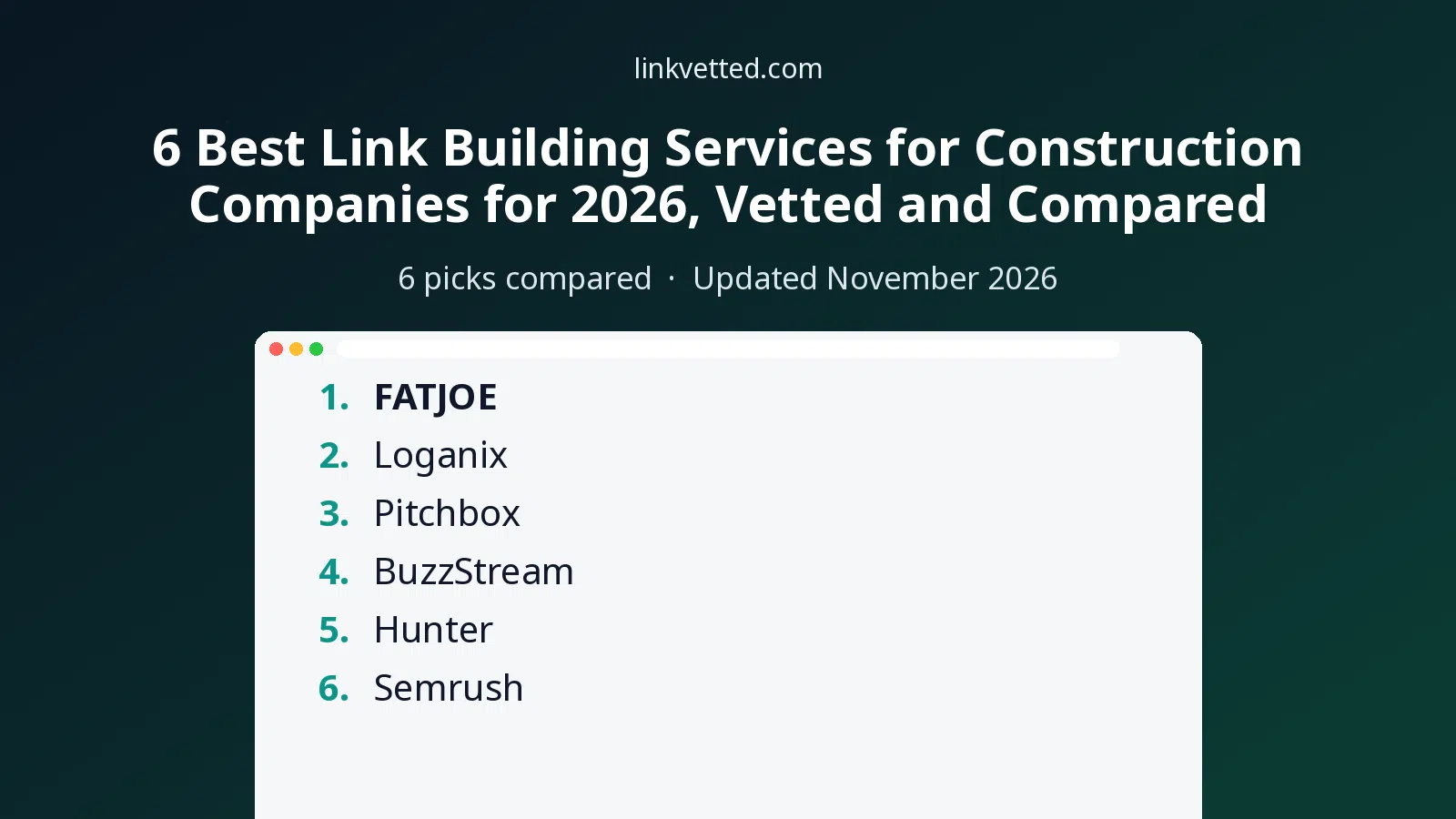
- Editor's choice
 FATJOE
Editorial blogger outreach links
Starts atSee websiteVisit fatjoe.comFull review - Great alternative
 Loganix
Managed link building and citations
Starts atSee websiteVisit loganix.comFull review - Also consider
 Pitchbox
Running your own outreach campaigns
Starts atSee websiteVisit pitchbox.comFull review
Direct answer
My top pick is FATJOE because it is built around blogger outreach and link placements, which suits construction firms that need relevant editorial links rather than generic directory listings. For teams that want managed link building with a clear process, I would also look at Loganix. For agencies that prefer to run outreach themselves in a shared workspace, Pitchbox is the third option worth comparing.
TL;DR:
- Construction companies usually need links from local news, trade publications and supplier or project-related sites, not from unrelated blogs.
- Managed services save internal time, but you still need to approve target lists and anchor text before anything goes live.
- Outreach platforms give you control and transparency, but they require someone on your team to run campaigns consistently.
- Always ask how a vendor defines a relevant site for construction and whether it publishes sample target lists.
- Treat link building as one part of a wider SEO plan that includes your service pages, location pages and project case studies.
Last checked November 2026. Plan prices are not quoted in this guide because they change often; see each vendor's own pricing page for current figures before you buy.
Quick comparison
| Tool | Best for | Starts at | Free plan? | |
|---|---|---|---|---|
| FATJOE | Editorial blogger outreach links | See website | Not stated | Visit |
| Loganix | Managed link building and citations | See website | Not stated | Visit |
| Pitchbox | Running your own outreach campaigns | See website | Not stated | Visit |
 BuzzStream | Small-team blogger and PR outreach | See website | Not stated | Visit |
 Hunter | Finding outreach email addresses | See website | Free plan | Visit |
 Semrush | Link research and competitor analysis | See website | Free plan | Visit |
The best link building services for construction companies compared
I compared these options from vendor documentation and public sources, including each vendor's own product pages and help content. I did not run hands-on tests, so treat this as a starting point for your own evaluation. The list mixes managed services, outreach platforms and research tools because construction companies often need more than one of these to build links consistently.
FATJOE is a link building marketplace and outreach service. You choose a category and describe your site, and the service works on placing links through its blogger network. For a construction company, the practical fit is editorial links from blogs and content sites rather than directory or profile links. It suits businesses that want to outsource outreach but still review what is being placed.
In a construction context, the workflow usually starts with defining the pages you want to support, such as service pages for commercial fit-out or groundworks, then agreeing anchor text and target site types. Because construction is a narrower niche than general consumer topics, you should ask for sample placements in your sector before ordering. The service is best treated as one source of links, not the whole strategy.
The main limit is relevance control. If your work depends on local press or trade association coverage, a general placement marketplace may not cover those outlets well. Skip it if you need guaranteed links from named construction publications.
- Outreach-focused placement model
- Publicly documented ordering process
- Useful for building editorial links at scale
- Placement inventory varies by niche
- Less control than running your own campaigns
Loganix is a managed SEO fulfillment company that offers link building and local citation services. You place an order and the team handles prospecting and placement according to the package. For construction companies that do not have an in-house SEO or outreach person, this removes the need to run campaigns yourself while still giving you a defined deliverable.
For construction SEO, the citation side is often as useful as the links. Local citations help with map and local pack visibility, and editorial links support service and location pages. The link building side is typically aimed at content pages, so you should map which URLs you want to support before ordering. Ask how they handle niche relevance for construction and what reporting you receive.
The drawback is control. Because fulfillment is managed, you may not see every prospect or email. If you want to approve each target site personally, a platform you run yourself will fit better.
- Managed fulfillment with defined deliverables
- Also offers local citation work
- Clear order-based workflow
- Less visibility into day-to-day outreach
- Managed model can feel like a black box
Pitchbox is an outreach platform for SEO teams and agencies. It helps you build prospect lists, send personalized pitches and manage follow-ups in one place. For a construction company with an in-house marketer or an agency partner, it gives you a repeatable process instead of ad hoc emails from a personal inbox.
The construction angle is in the prospecting. You can build lists of local news sites, trade publications, supplier blogs and project partners, then run separate campaigns for each. That structure matters because a pitch to a regional business journal is different from a pitch to a construction trade magazine. The platform supports that segmentation, but you still write the pitches and decide who to contact.
The limit is that Pitchbox is software, not a link service. If nobody on your team can run outreach weekly, the subscription will not produce links on its own. Skip it if you want a fully managed outcome.
- Campaign workflow for prospecting and follow-ups
- Shared workspace for teams
- Supports multiple outreach use cases
- Needs an operator to run campaigns
- Not a done-for-you link service
BuzzStream is a web-based outreach and relationship management tool. It is often used for blogger outreach and digital PR, with contact records, research tools and campaign tracking. For construction companies, it can support outreach to local journalists, trade editors and partner organizations in a structured way.
The value comes from keeping outreach organized. If your team contacts the same regional publications or supplier blogs over time, a contact database helps you avoid duplicate pitches and remember prior conversations. That is more useful for construction than blasting generic guest post requests, because local and trade relationships tend to produce better links.
The limitation is effort. BuzzStream does not find or place links for you, and it needs a consistent process to be worthwhile. If you only plan a few outreach emails a year, a simpler spreadsheet may be enough.
- Contact and relationship management
- Built for outreach research and tracking
- Works for PR and link campaigns
- Requires manual campaign work
- Less useful without a defined process
Hunter is an email discovery tool. You enter a domain and it returns publicly available email addresses associated with that domain, which you can use for outreach. For construction link building, it is a supporting tool rather than a service: you still need to choose target sites and write pitches.
In practice, Hunter fits early in the workflow. Once you have a list of trade publications, local news sites or supplier blogs, Hunter helps you find an editor or marketing contact. That saves time compared with hunting through contact pages. It works well alongside Pitchbox or BuzzStream, which handle the campaign side.
The clear limit is scope. Hunter does not evaluate sites, write outreach or secure placements. It is also worth verifying addresses before sending, since contact data changes. Skip it if you already have contact lists or use a managed service.
- Email discovery for prospecting
- Domain search for finding contacts
- Useful alongside any outreach tool
- Does not build or place links
- Contact data needs verification
Semrush is an SEO platform with backlink analysis and link building tools. You can review competitor backlink profiles, find sites that link to competitors but not to you, and research link prospects. For construction companies, this is useful for understanding which trade directories, local outlets and industry sites link to rival firms.
The practical use is planning. Before you buy links or run outreach, you can see which site types already link to construction businesses in your region. That helps you brief a managed service or build a target list for your own campaigns. It also helps you spot link gaps on service pages.
The drawback is that Semrush is a full SEO platform, not a link building service. It gives you data and tools, but you still need to act on them. Skip it if you only want links delivered and have no interest in research.
- Backlink data for competitor research
- Link building toolkit within a wider SEO platform
- Useful for finding link gaps
- Broad platform with a learning curve
- Link building is one part of the product
How I chose
I selected these options by reviewing vendor documentation and public sources, then matching each one to the way construction companies actually buy links. The main criteria were whether the vendor explains its process publicly, whether the model is managed or self-serve, and whether it can support niche or local link targets. I also looked at how each option fits alongside the others, since most construction firms need research, outreach and placement at different stages.
I did not run hands-on tests, and I have not included client results or performance claims. The comparison is based on what each vendor documents about its own product. Where a vendor does not state something clearly, such as free plan availability, I have marked it as not stated rather than guessing. Use this guide to shortlist options, then ask each vendor for sample targets and reporting before you commit.
What to check before you buy
- Ask for sample target sites in construction, local news or trade media, and check whether they are genuinely relevant to your services.
- Confirm who approves anchor text and landing pages, and make sure links point to pages you want to rank.
- Ask how the vendor handles local relevance if you serve specific cities or regions.
- Request reporting that shows live URLs, so you can verify placements yourself.
- Check whether the service covers digital PR and local citations, not just blog placements.
- Read the terms on link removal, replacements and what happens if a placement disappears.
FAQ
What kind of links do construction companies need?
Most construction companies benefit from a mix: local news coverage, trade publication mentions, supplier and partner links, and citations in relevant directories. Editorial links from sites your customers read carry more weight than generic blog placements. The right mix depends on whether you target commercial, residential or public sector work.
Can I build links without a managed service?
Yes. You can run outreach yourself using an email discovery tool and an outreach platform, or work with an agency. This takes time and a consistent process, but it gives you full control over target sites and messaging. Many small construction firms start with local PR and trade media relationships before paying for placements.
How do I judge relevance for a construction link?
Look at whether the site covers construction, property, local business or the sectors you serve. A link from a regional business publication or a trade magazine is usually more relevant than one from a general guest post blog. Check the site's recent content and whether it has real editorial standards.
Are paid links safe for construction SEO?
Paid placements are common, but the risk depends on how they are done. Links that look like advertising, are clearly disclosed, or come from unrelated sites are more likely to cause problems. Ask vendors how they select sites and avoid anything that promises guaranteed rankings or uses private blog networks.
How long before link building helps?
Link building is a long-term activity, and results depend on your site, competition and existing authority. Rather than expecting a fixed timeline, track changes in rankings, impressions and referral traffic over several months. Keep building links to pages that already attract traffic and enquiries.
Sources
- https://fatjoe.com
- https://loganix.com
- https://pitchbox.com
- https://www.buzzstream.com
- https://hunter.io
- https://www.semrush.com