Best AI Construction Estimating Software in 2026: 8 Tools Compared
Compare the best AI construction estimating software for takeoffs, pricing and bids, with current prices and strengths for each trade and team size here.

- Editor's choice
 Togal.AI
AI-automated commercial takeoffs
Starts at$299 per user per monthVisit togal.aiFull review - Great alternative
 STACK
Cloud takeoff and estimating for subcontractors
Starts atFreeVisit stackct.comFull review - Also consider
 Buildxact
Residential builders and remodelers
Starts at$169 per monthVisit buildxact.comFull review
TL;DR:
- Togal.AI and STACK lead on AI takeoff speed, while Buildxact and Clear Estimates suit smaller residential teams.
- Procore and ProEst fit large commercial firms that need estimating inside a wider project system.
- AI takeoff still needs a human review, especially on complex drawings and unusual scopes.
- Price varies widely, from a free STACK tier to quote-only enterprise platforms, so test on a real bid first.
Quick comparison
| Tool | Best for | Starts at | Free plan? | |
|---|---|---|---|---|
| Togal.AI | AI-automated commercial takeoffs | $299 per user per month | No | Visit |
| STACK | Cloud takeoff and estimating for subcontractors | Free | Yes | Visit |
| Buildxact | Residential builders and remodelers | $169 per month | Yes | Visit |
 PlanSwift | Desktop takeoff with assemblies and cost data | $2,000 per seat per year | Free trial | Visit |
 Procore Estimating | Large GCs already using Procore | See website | No | Visit |
 ProEst | Enterprise commercial estimating with BIM | See website | No | Visit |
 Kreo | Budget cloud takeoff with AI detection | $100 per user per month | Free trial | Visit |
 Clear Estimates | Fast residential quotes for small remodelers | $59 per month | No | Visit |
The best AI construction estimating software
AI estimating tools promise faster takeoffs and fewer missed items, but they differ a lot by trade, project type and price. We compared takeoff methods, cost data, export options and pricing for tools that are actively sold in October 2026.
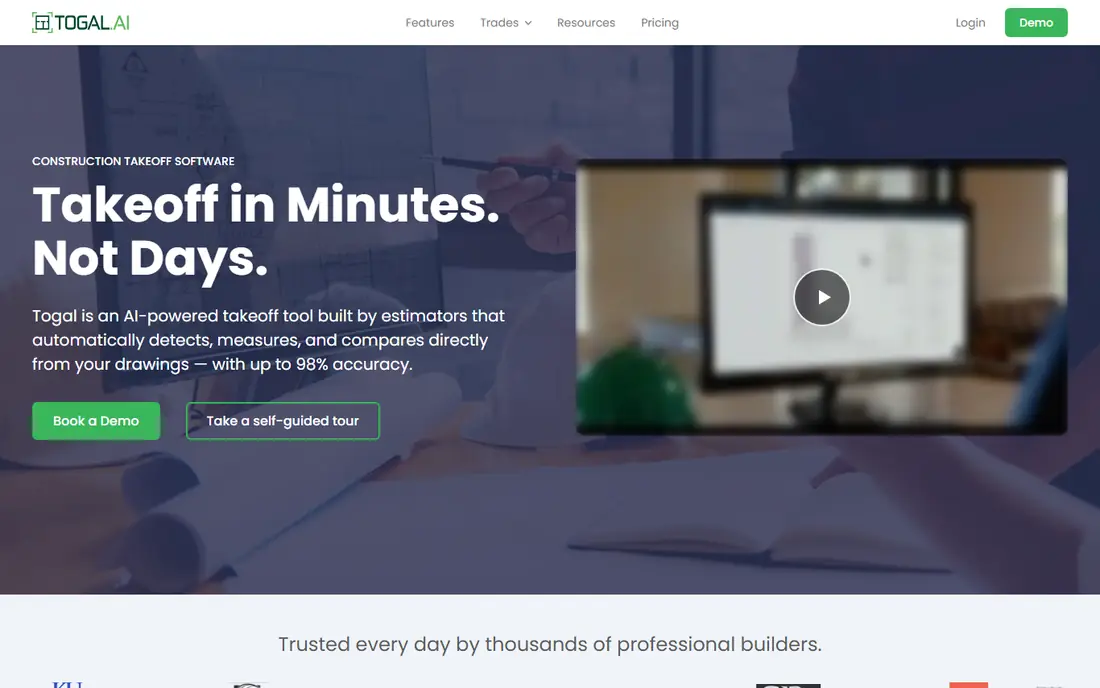
Togal.AI is the clearest example of AI-first takeoff. Upload drawings and the system detects rooms, areas and elements, then produces quantities you can review and export. For commercial general contractors and specialty subs bidding at volume, that speed matters: more bids in the same week, with less time spent clicking around plans by hand. A chat feature lets estimators ask questions about a plan, and 3D views help catch height and elevation issues early.
The price reflects that focus, at $299 per user per month on annual billing, and there is no free tier. Togal.AI is also primarily a takeoff tool, not a full estimating and job management suite, so many firms pair it with their existing pricing system. If your bottleneck is measurement, it is a strong buy. If your bottleneck is pricing, proposals and job tracking, look at an all-in-one option first.
- Automatic quantity detection from drawings
- Chat questions about plans
- 3D views for height checks
- No free plan
- Takeoff-focused, so you may still need a separate estimating system

STACK is a good starting point for subcontractors and general contractors who want cloud takeoff without a large upfront cost. The free tier lets a small team try plan-based measurement, and paid plans add estimating, cost data, proposals and bid management. Because it is cloud-based, several estimators can work on the same project and share plans without passing files back and forth.
Paid pricing is the catch. Entry paid plans run to $299 per user per month in some listings, with takeoff and estimating bundles higher, so a growing team should price the exact plan it needs before committing. AI-assisted takeoff helps, but it is one part of a broad platform rather than the whole product. For teams that want one vendor across preconstruction, STACK is a solid, if pricey, choice.
- Free tier to start
- Cloud collaboration
- Takeoff, estimating and bid tracking in one place
- Paid takeoff and estimating plans are costly
- AI features vary by plan

Buildxact is designed for the way residential builders actually work. Takeoff feeds into estimates, client quotes, purchase orders and schedules, so a small builder does not need four separate tools. Its AI suite, called Blu, assists with takeoff, estimate generation and review, and live supplier pricing helps keep quotes current. For remodelers and custom home builders, that end-to-end flow is the main selling point.
Large commercial firms will find it too residential in focus, and the Pro and Master tiers climb to $339 and $509 per month on annual billing. Those prices are per company rather than per seat in some listings, which helps small teams. If you build or remodel homes and want one system from takeoff to client approval, Buildxact is our pick for most residential teams.
- Built for residential work
- AI estimate tools
- Quotes, orders and scheduling in one system
- Less suited to large commercial work
- Higher tiers rise quickly in price
PlanSwift has been a staple for trade contractors for years, and its strength is still assembly-based takeoff on a desktop. Estimators who do repetitive work, such as flooring, drywall or electrical, can build assemblies once and reuse them across jobs, with regional material and labor cost data behind the numbers. A newer AI takeoff assistant speeds up measurement, and Excel export fits firms that price in spreadsheets.
The model is different from cloud tools: about $2,000 per seat per year in current listings, with a trial available. That suits a dedicated estimator with a fixed workstation, but it is less flexible for a distributed team. If your firm already runs on PlanSwift and Excel, staying put makes sense. If you need cloud collaboration, STACK or Togal.AI will feel more modern.
- Mature desktop takeoff
- Assembly-based estimating
- Strong Excel export
- Desktop-only feel
- High per-seat price
- AI features are newer than rivals
Procore Estimating makes most sense as part of Procore, the large project management platform used by many big general contractors. Estimating connects to budgets, contracts, scheduling and field tools, so numbers do not have to be retyped as a project moves from bid to build. For a large GC already committed to Procore, that continuity is worth a lot.
For anyone else, it is a heavy buy. Pricing is quote-based and tied to company volume, and a small builder would be paying for a platform far beyond its needs. Procore is also weaker as a standalone takeoff tool than Togal.AI or STACK. Choose it when you already use, or plan to adopt, Procore across the business, not when you only need a better takeoff tool.
- Estimating inside the wider Procore platform
- Financial and field links
- Strong for large projects
- Quote-only pricing
- Too much system for small firms
ProEst, from Autodesk, is built for mid-size and large commercial estimators who work with building models as well as drawings. It supports BIM-based takeoff, uses RSMeans cost data, and connects to the wider Autodesk construction platform. Multi-user cloud collaboration suits preconstruction teams that share large, complex bids across offices.
That depth brings cost and complexity. Pricing is custom, and teams should expect setup, templates and training before the system pays off. Smaller firms will find Buildxact or Clear Estimates faster to adopt. For enterprise teams that already use Autodesk tools and need credible cost data behind every bid, ProEst is one of the strongest options available.
- BIM takeoff
- RSMeans cost data
- Autodesk ecosystem links
- Multi-user cloud work
- Custom pricing
- Setup and training take time
Kreo is worth a look for firms that want AI takeoff without Togal.AI pricing. At around $100 per user per month on annual billing, it undercuts several rivals, and its AI tools detect common plan elements to speed up measurement. Being cloud-based, it suits teams that share plans and work from different locations, and a trial lets you test it on a real project.
The trade-off is scope. Kreo does not match the estimating depth, cost libraries or integrations of larger platforms, and its US presence is smaller, which can matter for support and local cost data. For a cost-conscious subcontractor whose main need is faster, accurate takeoff, Kreo is a sensible trial. For a firm that needs full estimating and job management, pair it with another system or choose an all-in-one tool.
- Lower price than most AI takeoff tools
- Cloud-based
- AI detection for common elements
- Smaller feature set than STACK or ProEst
- Less known in the US market
Clear Estimates is the simplest tool here, and for small remodelers that is the appeal. It focuses on fast, professional quotes using templates and parts pricing, with an AI plan upload feature on higher tiers. A team that currently quotes in spreadsheets can move to Clear Estimates in a day, and at $59 per month on annual billing, the cost is easy to justify on a single job.
It is not a commercial estimating platform. Complex assemblies, BIM work and large multi-trade bids are outside its focus, and there is no free plan to test it long-term. If you are a small remodeler or handyman business that needs clean quotes quickly, Clear Estimates is a good value. If you bid commercial work, start with Togal.AI, STACK or ProEst instead.
- Low price
- Quick quote templates
- Simple to learn
- No free plan
- Limited for commercial or complex projects
How we picked these
We compared official feature pages, pricing pages and public reviews for AI estimating tools that are actively sold in October 2026 and that genuinely use AI for takeoff, pricing or estimate review. We kept a mix of commercial, residential and budget tools, because a tool that fits a large GC rarely fits a two-person remodeling firm. We did not rank tools on vendor accuracy claims alone, since those claims are rarely tested on the same drawings.
What to check before you buy
Run the same live bid through your top two choices. Check how quantities export to Excel or your accounting system, how the tool handles drawing revisions, and how long a review takes. AI takeoff saves time only if checking its work is faster than measuring by hand. Also confirm cost data coverage for your region and trade, since a beautiful takeoff with wrong prices still produces a bad bid.
Ask about contract length and per-user minimums, and confirm who owns your project data if you cancel. Finally, talk to the estimators who will use the tool daily. A platform that fits management but frustrates estimators will not get used, and an unused estimating tool is the most expensive kind.
FAQ
What is the best AI estimating software for construction?
For commercial takeoff speed, Togal.AI leads, while STACK is the broader cloud platform for subcontractors. For residential builders, Buildxact is the better all-in-one pick. The right answer depends on your trade, project size and whether you need estimating alone or a full job system.
Can AI estimating replace a human estimator?
No. AI speeds up measurement and flags items a person might miss, but a human should still review quantities, check scope gaps and set final prices. Drawings have errors, notes and exceptions that software can misread. Treat AI as a fast assistant, not as a replacement for judgment.
How much does AI construction estimating software cost?
Prices range from a free STACK tier and $59 per month for Clear Estimates to $299 per user per month for Togal.AI and quote-only enterprise platforms such as Procore and ProEst. Always price the plan that includes the AI features you need, since some vendors sell AI as an add-on.
Is STACK or Togal.AI better for subcontractors?
Togal.AI is stronger for pure takeoff speed on commercial plans. STACK is stronger if you want takeoff, estimating, proposals and bid tracking in one cloud system. Subcontractors who bid at high volume often use Togal.AI for measurement and another system for pricing, while smaller subs may prefer STACK alone.
What is the best AI tool for construction estimating on a budget?
Kreo and Clear Estimates are the budget picks here, depending on your work. Kreo suits plan-based takeoff at around $100 per user per month, while Clear Estimates suits quick residential quotes at $59 per month. Both are worth a trial on a real bid before you commit.