5 Headless Ecommerce Software for Startups Worth Shortlisting in 2026
Best headless ecommerce software for startups in 2026: 5 tools with starting prices, free plans and limits. Compare costs and catches in one place. No hype.
- Editor's choice
 Fabric
Startups centred on AI-driven product discovery and merchandising
Starts atSee websiteVisit fabric.incFull review - Great alternative
 BigCommerce
Startups needing one scalable foundation across channels
Starts atSee websiteVisit bigcommerce.comFull review - Also consider
 Medusa
Developer-led startups wanting an open-source commerce core
Starts at$29 per monthVisit medusajs.comFull review
Direct answer
This list puts Fabric first for startups concentrated on AI-driven product discovery and merchandising. Listed starting prices: Medusa from $29 per month. BigCommerce fits startups needing one scalable foundation across channels; Medusa fits developer-led startups wanting an open-source commerce core. The full list of 5 tools follows, with prices and free plan facts.
TL;DR:
- Number one here is Fabric, a fit for startups concentrated on AI-driven product discovery and merchandising.
- Commercetools fits funded startups building enterprise-grade composable commerce.
- Medusa has the lowest monthly starting price in this list: $29 per month.
- Only Medusa offers a free plan among these 5 tools.
Last checked November 2026. Prices and plan details were read from the vendors' own pages in November 2026; vendors change plans often, so confirm the current price on the vendor site before you buy.
Quick comparison
| Tool | Best for | Starts at | Free plan? | |
|---|---|---|---|---|
| Fabric | Startups centred on AI-driven product discovery and merchandising | See website | Not stated | Visit |
| BigCommerce | Startups needing one scalable foundation across channels | See website | Not stated | Visit |
| Medusa | Developer-led startups wanting an open-source commerce core | $29 per month | Yes | Visit |
 Shopify Hydrogen | Startups building on Shopify with a custom framework storefront | See website | Not stated | Visit |
 commercetools | Funded startups building enterprise-grade composable commerce | See website | Free trial | Visit |
The full headless ecommerce software for startups list
LinkVetted compared 5 headless ecommerce software for startups. The goal is a practical shortlist: published prices, free plan facts, best-fit use cases and honest limits for every entry.
For startups centred on AI-driven product discovery and merchandising, Fabric is a natural candidate. Startups selling in discovery-driven categories may value this angle, since being surfaced in AI answers is becoming part of the buying journey.
Fabric shows no starting price here, so confirm the cost on the vendor site. Free plan details: Not stated.
What to check first: Narrower than full commerce suites.
- Merchandising-first positioning
- Tracks AI visibility
- Relies on AI channel shifts
BigCommerce
Best for: Startups needing one scalable foundation across channels
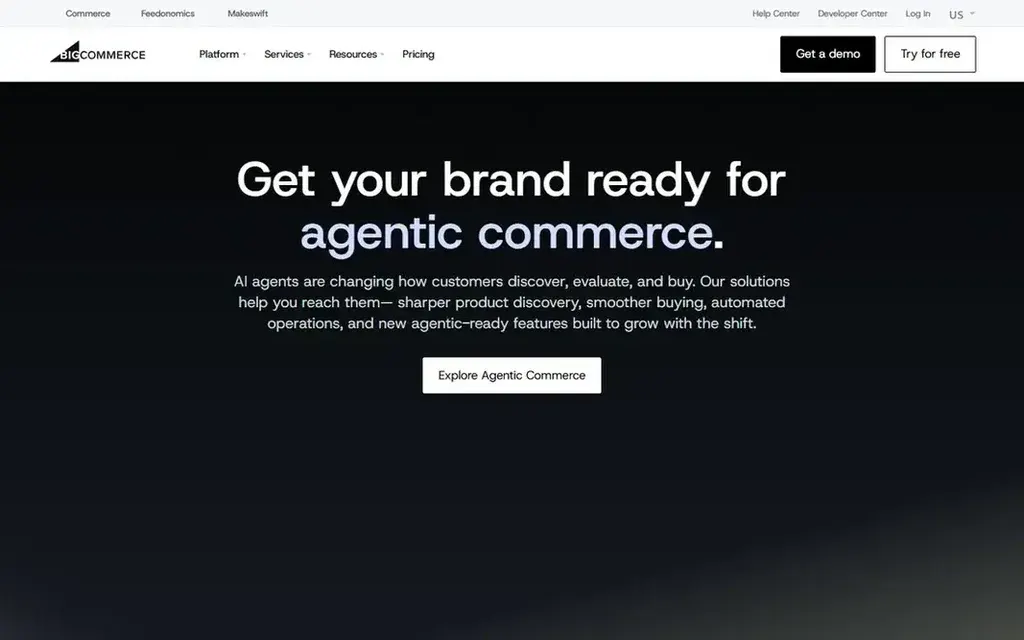
In short, BigCommerce is for startups needing one scalable foundation across channels. Since it is a full product, some startup teams may find more configuration than a lean API-first core needs.
BigCommerce shows no starting price here, so confirm the cost on the vendor site. Free options: Not stated.
Strengths: regions and channels.
Downsides: Less adaptable than pure headless cores.
- Positioned for modern buying experiences
- Supports brands
- Feature depth can add setup complexity
Where Medusa fits: developer-led startups wanting an open-source commerce core. Medusa bills itself as an open-source agentic commerce product and the most adaptable commerce system for agents and developers. Beyond that, startups with in-house engineers frequently like it since the open-source core can be extended and shaped around a custom storefront without locking into a single vendor's front-end conventions.
Watch-outs: You own more of the operations.
For everyday use, startups without dedicated developers may find a hosted system simpler, whereas engineering-heavy teams will get more control from Medusa. Adaptability shifts responsibility to your team: hosting, upgrades and integrations are mostly yours to run. On cost, Medusa starts like this: $29 per month. Medusa includes a free tier.
- Adaptable for agents and developers
- Open-source foundation
- Needs engineering resources
Shopify Hydrogen
Best for: Startups building on Shopify with a custom framework storefront
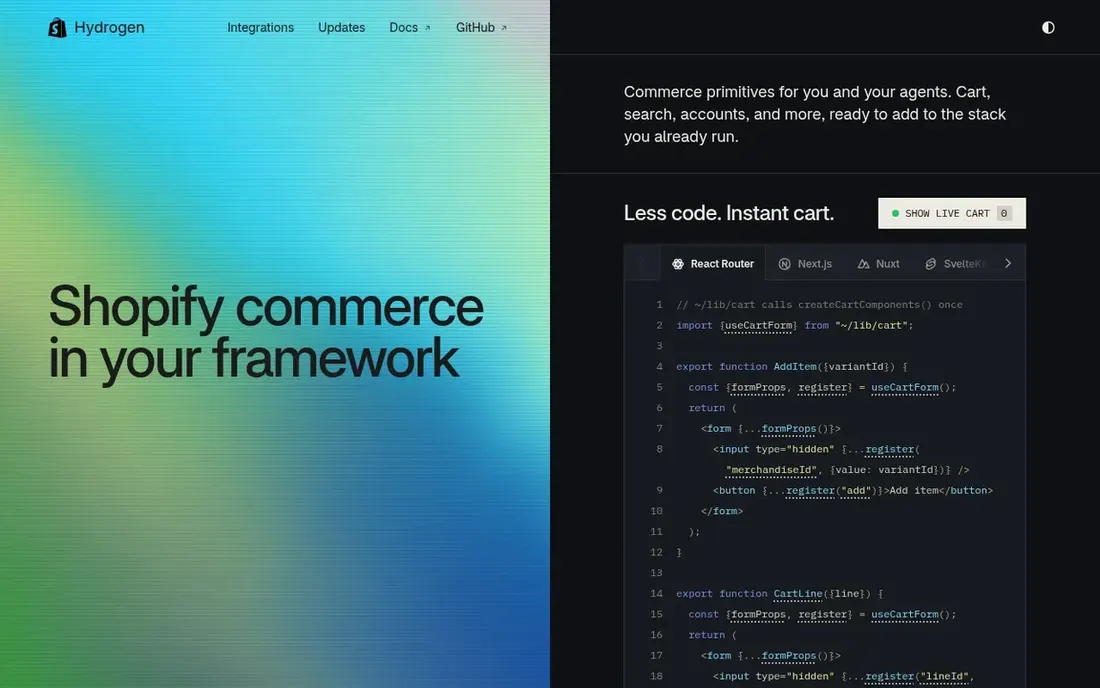
Shopify Hydrogen is built with startups building on Shopify with a custom framework storefront in mind. Teams with some React-style experience will find the model familiar.
Trade-offs to know: Needs front-end development skills.
Pricing for Shopify Hydrogen is not stated here, so ask the vendor for current figures. On free options: Not stated.
- Fits agent and custom front ends
- Commerce primitives for your framework
- Tied to the Shopify product
commercetools
Best for: Funded startups building enterprise-grade composable commerce
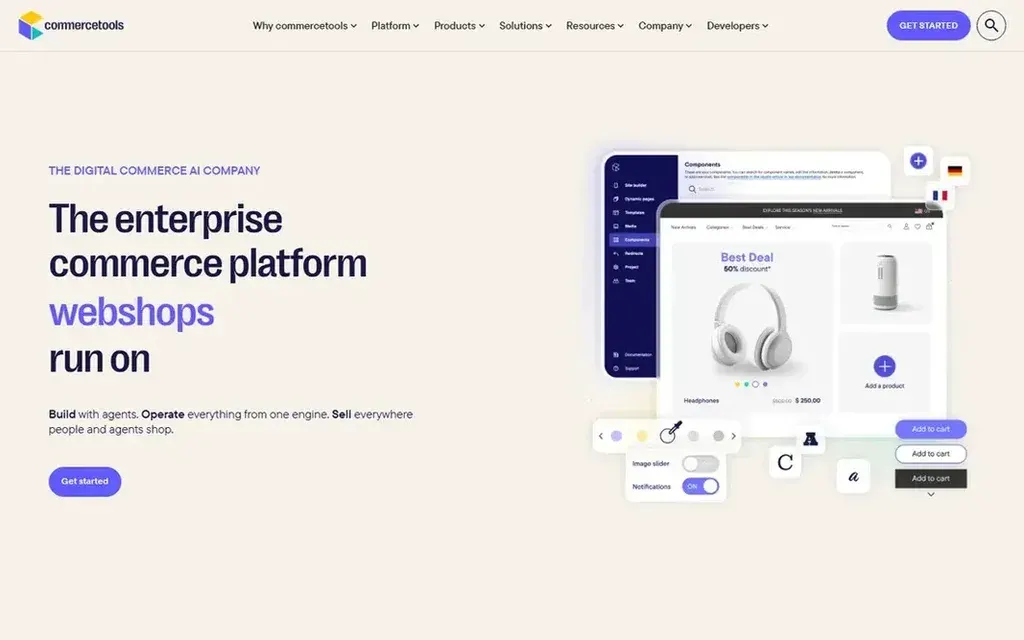
commercetools is built with funded startups building enterprise-grade composable commerce in mind. Startups with engineering capacity and ambitions for composable, multi-channel architecture may see it as a long-term core rather than a fast launch tool. commercetools describes itself as enterprise commerce infrastructure for AI agents, letting teams build and operate commerce across online, in-store, in-chat and agent-to-agent channels from one unified engine.
commercetools shows no starting price here, so confirm the cost on the vendor site. On free options: Free trial.
Where it is weaker: Heavier integration effort.
- Solid API-first positioning
- Unified engine across many channels
- Pitched at enterprise scale
Our selection method
For each of the 5 tools we noted price, free plan or trial, fit for headless ecommerce software for startups and the main limit, using vendor pages and documentation. Where a vendor does not publish a price, the entry says quote. Where a price depends on seats or billing term, the entry says so. We ordered the tools by general fit, then by how clearly pricing is shown, then by free access. A buyer with unusual needs may reorder them.
Pre-purchase checklist
- Get a written quote from Fabric, BigCommerce, Shopify Hydrogen and commercetools; the list shows no starting price for them.
- Test the free plan from Medusa against your real workload before relying on it.
- Take the trial from commercetools and push a live task through it before you pay.
- Read the limits listed for Fabric first: narrower than full commerce suites.
- Price Medusa for your actual team size; headline prices rarely include add-ons or overage.
- Ask BigCommerce whether prices are locked for the first term and what happens at renewal.
FAQ
Do these tools publish their prices?
Not all of them. Fabric, BigCommerce, Shopify Hydrogen and commercetools publish no starting price, so expect a quote request for those. The rest, Medusa included, show a starting price, though seats and billing terms still change the final cost.
How are the tools for headless ecommerce software for startups ordered?
The order follows typical fit for headless ecommerce software for startups, with Fabric first and commercetools last, then price clarity and free access. It is editorial judgement, not a score, so another team could rank the tools differently.
Which options for headless ecommerce software for startups have a free plan?
Medusa is the only tool in this list with a free plan. Free plans usually cap users, projects or features, so check the limits on the vendor page. One other tool offers a trial instead. For the full picture, the cards above cover all 5 entries of this headless ecommerce software for startups list, including price, free plan and limits.
What does headless ecommerce mean for a startup?
Headless ecommerce separates the customer-facing storefront from the commerce backend, which deals with catalog, cart and checkout through APIs. For startups, this lets a custom front end and quicker iteration without rebuilding core commerce logic each time the design changes.
Is Fabric the right pick for everyone comparing headless ecommerce software for startups?
No single tool suits every team. Fabric comes first because it fits startups focused on AI-driven product discovery and merchandising, while BigCommerce suits startups needing one scalable foundation across channels and Medusa suits developer-led startups wanting an open-source commerce core. Match the tool to your own size, budget and workflow before deciding.
Sources
- https://fabric.inc
- https://www.bigcommerce.com
- https://medusajs.com
- https://hydrogen.shopify.dev
- https://commercetools.com