Best Headless Ecommerce Software for Enterprise for 2026: Our 6 Vetted Picks
Best headless ecommerce software for enterprise, compared. 6 tools with published prices, free plans and limits. Verdicts stay brief and factual. Facts only.
- Editor's choice
 VTEX
AI-native unified commerce for large enterprises
Starts atPricing on requestVisit vtex.comFull review - Great alternative
 BigCommerce Enterprise
Open SaaS headless builds on a hosted base
Starts atPricing on requestVisit bigcommerce.comFull review - Also consider
 Shopify Plus
Managed commerce core with headless storefronts
Starts atPricing on requestVisit shopify.comFull review
Direct answer
If you need AI-native unified commerce for large enterprises, VTEX is the first tool to look at here. Look at BigCommerce Enterprise for open SaaS headless builds on a hosted base, and at Shopify Plus for managed commerce core with headless storefronts. Details and limits for the rest of the 6 tools are below. None of these vendors publish plan prices, so pricing is on request for every option.
TL;DR:
- VTEX takes the first slot, best suited to AI-native unified commerce for large enterprises.
- Fabric is the one to check for AI-driven merchandising and product catalog enrichment.
- Shopify Plus comes with a trade-off: less low-level control than pure API systems.
- No starting price is shown for any of the 6 tools, VTEX and Fabric included, so plan time for sales calls.
Last checked November 2026. Pricing on request: vendors did not publish plan prices when this guide was last checked (November 2026), so ask each vendor for a written quote.
Quick comparison
| Tool | Best for | Starts at | Free plan? | |
|---|---|---|---|---|
| VTEX | AI-native unified commerce for large enterprises | Pricing on request | Not stated | Visit |
| BigCommerce Enterprise | Open SaaS headless builds on a hosted base | Pricing on request | Not stated | Visit |
| Shopify Plus | Managed commerce core with headless storefronts | Pricing on request | Not stated | Visit |
 commercetools | API-first composable commerce infrastructure | Pricing on request | Free trial | Visit |
 Adobe Commerce | B2B and B2C composable enterprise commerce | Pricing on request | Not stated | Visit |
 Fabric | AI-driven merchandising and product catalog enrichment | Pricing on request | Not stated | Visit |
Headless Ecommerce Software for Enterprise, one by one
If you are comparing headless ecommerce software for enterprise, this page covers 6 tools in one place: what each is best for, what it costs to start, whether it has a free plan, and the main limit to know about.
VTEX is built with AI-native unified commerce for large enterprises in mind. VTEX presents itself as an AI-native unified commerce suite targeted at bold CIOs and CEOs, with a focus on modernizing the technology stack and driving operational results. It merges commerce capabilities in a single suite intended for large enterprises.
More specifically, as with any wide suite, the depth of specific features relies on configuration and integration planning, so teams should map requirements carefully. In daily use, consider VTEX when a unified, AI-native commerce suite aligns with your modernization goals. Pricing for VTEX is not stated here, so ask the vendor for current figures. On free options: Not stated.
Where it falls short: Feature depth varies by configuration.
- AI-native unified commerce suite
- Targets operational results for CIOs and CEOs
- May need integration planning
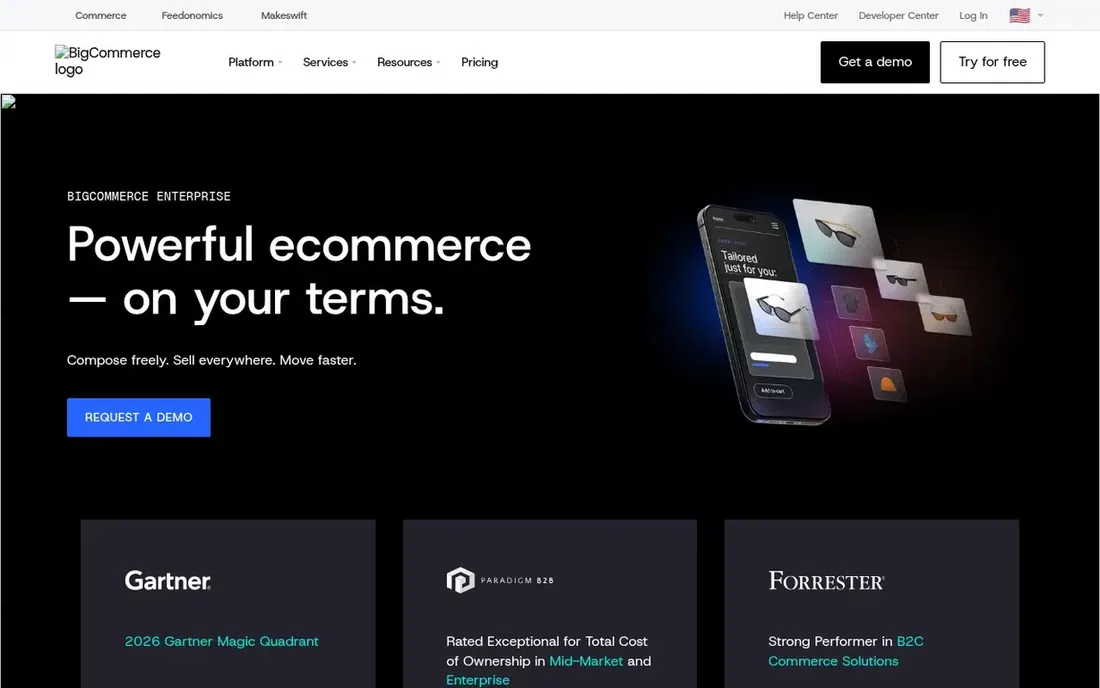
BigCommerce Enterprise targets open SaaS headless builds on a hosted base. Certain advanced capabilities can also need extra integrations.
It supports headless architectures through its APIs, letting teams pair custom storefronts with a hosted commerce backend. More specifically, choose BigCommerce Enterprise when a hosted, open SaaS base with headless choices matches your roadmap better than a completely decomposed stack. Check the vendor site for BigCommerce Enterprise pricing; none is listed in this comparison. As for free access: Not stated.
Drawbacks to consider: Less control than completely composable engines.
- Enterprise-focused system positioning
- Headless support for custom front ends
- Some advanced adaptability may need extras

Shopify Plus makes the most sense for managed commerce core with headless storefronts. Since the commerce core is managed, teams needing complete control over backend logic or highly bespoke data models may find it less adaptable than API-first products.
It pairs a managed commerce backend with headless storefront capabilities. So teams can build custom front ends whereas relying on Shopify for core commerce operations. No starting price is listed for Shopify Plus here; confirm pricing on the vendor site. Trial and free access: Not stated.
Drawbacks to consider: Deep customization can rely on the wider ecosystem.
- Managed infrastructure cuts operational load
- Headless storefront choices for custom builds
- Less low-level control than pure API products
commercetools targets API-first composable commerce infrastructure. Organizations wanting a managed, ready-made commerce core may prefer a hosted choice. Choose commercetools when composable control and multi-channel reach outweigh the build effort.
Beyond that, since the product offers infrastructure instead of a complete front end, teams must build and maintain storefronts and integrations themselves, which raises engineering overhead. Beyond that, commercetools positions itself as enterprise commerce infrastructure for AI agents, letting teams build and operate commerce experiences across online, in-store, in-chat and agent-to-agent channels from one unified engine. commercetools shows no starting price here, so confirm the cost on the vendor site. Free access: Free trial.
Trade-offs to know: Needs engineering effort to assemble.
- API-first architecture for custom builds
- In-store and in-chat channels
- No built-in storefront from day one
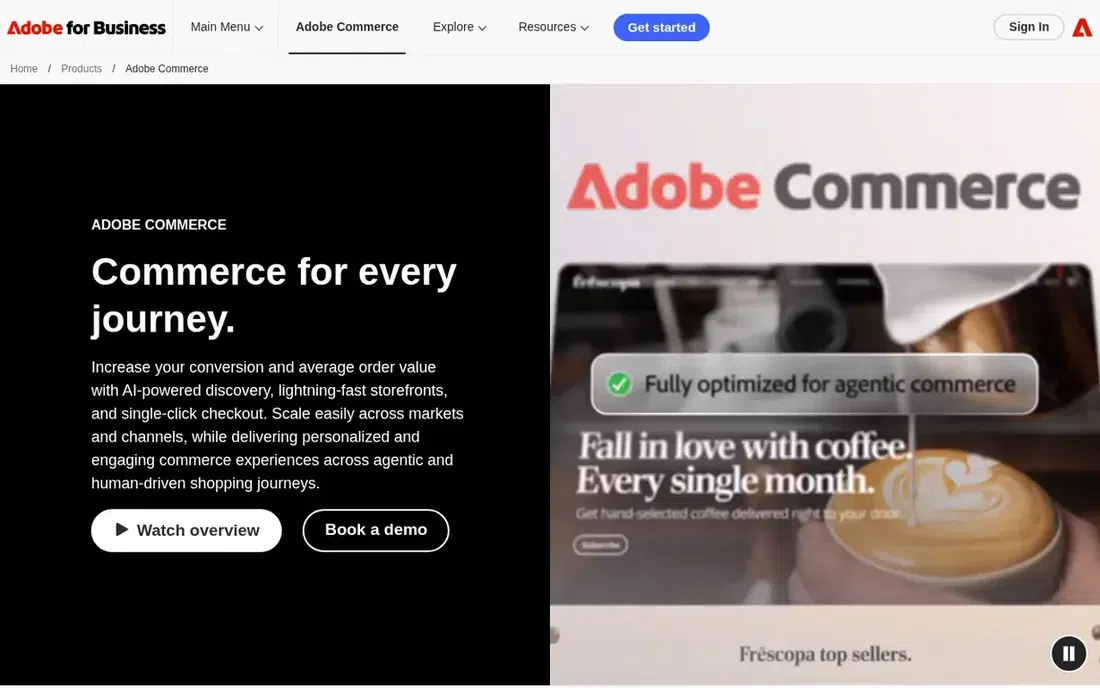
In short, Adobe Commerce is for B2B and B2C composable enterprise commerce. Adobe Commerce, formerly known as Magento, is an AI-powered composable ecommerce product geared toward B2B and B2C enterprises that want personalized experiences at global scale. It merges commerce with content and personalization capabilities across the Adobe ecosystem.
Downsides: Requires capable technical resources.
On top of that, smaller teams or those wanting a lighter managed core may prefer a more straightforward choice. As for the details, the product's breadth can translate into implementation complexity and continuing operational demands. Check the vendor site for Adobe Commerce pricing; none is listed in this comparison. Free plan details: Not stated.
- Supports both B2B and B2C models
- Personalized experiences
- Can be complicated to implement and operate
Fabric works best for AI-driven merchandising and product catalog enrichment. Fabric centres on reimagining merchandising for AI shopping, enriching product catalogs so answer engines can recommend a brand and helping teams track AI visibility.
Where it falls short: Value depends on AI shopping adoption.
It is targeted at merchants that want their products to surface when shoppers ask AI assistants for recommendations. Teams not yet prioritizing AI shopping channels may see less immediate benefit. This comparison lists no price for Fabric; ask the vendor. Free options: Not stated.
- Enriches product catalogs for AI shopping
- Focus on merchandising for AI-driven discovery
- Narrower than a full commerce product
How we compared the tools
The comparison looks at four things: starting price, free access, how well the feature set matches headless ecommerce software for enterprise, and the main limit of each tool. Figures are shown as the vendors publish them. Billing terms, seat minimums and add-ons can change the real cost. The sequence is a judgement call: typical use case first, then pricing transparency, then free access. Use the profiles to check fit.
Before you commit
- Ask each vendor, from VTEX to Fabric, for a written quote; none of them publishes a starting price.
- Take the trial from commercetools and push a live task through it before you pay.
- Before choosing VTEX, weigh its main limit: feature depth varies by configuration.
- Check the support hours and onboarding help Adobe Commerce offers; smaller vendors vary a lot here.
- Read the plan comparison for VTEX carefully; key features often start on a higher tier.
FAQ
Is VTEX the right pick for everyone comparing headless ecommerce software for enterprise?
No single tool suits every team. VTEX comes first because it fits AI-native unified commerce for large enterprises, while BigCommerce Enterprise suits open SaaS headless builds on a hosted base and Shopify Plus suits managed commerce core with headless storefronts. Match the tool to your own size, budget and workflow before deciding.
Can I try these tools before paying?
Often, yes. commercetools offers a free trial. Use your own data and a real task during the test, and check what the free tier or trial limits before you rely on it. For the full picture, the cards above cover all 6 entries of this headless ecommerce software for enterprise list, including price, free plan and limits.
Does any tool for headless ecommerce software for enterprise here have a free plan?
A permanent free plan is not offered by VTEX, Fabric or the other tools here. commercetools offer a trial. Plan a short evaluation period instead.
How are the tools for headless ecommerce software for enterprise ordered?
VTEX sits first and Fabric last because the order follows typical fit for headless ecommerce software for enterprise, then price clarity and free access. It is a judgement call, so read each profile for fit and limits.
How does AI fit into enterprise headless commerce?
Multiple systems now emphasize AI, from personalization in Adobe Commerce to AI-native positioning at VTEX and catalog enrichment for AI shopping at Fabric. Evaluate AI claims against your actual use cases and confirm capabilities with each vendor.
What makes ecommerce software headless?
Headless ecommerce separates the front-end storefront from the backend commerce engine, connecting them through APIs. Products differ in how much of the stack they run compared with leave to your team.
Sources
- https://vtex.com
- https://www.bigcommerce.com/enterprise
- https://www.shopify.com/plus
- https://commercetools.com
- https://business.adobe.com/products/magento/magento-commerce.html
- https://fabric.inc