Best Enterprise Ecommerce Platform in 2026: 8 Platforms Compared
Looking for the best enterprise ecommerce platform? We compare 8 enterprise platforms for large stores, covering pricing, scale, B2B and headless options.

- Editor's choice
 Shopify Plus
Fast-scaling DTC brands
Starts at$2,300 per monthVisit shopify.comFull review - Great alternative
 Adobe Commerce
Deep customization and B2B
Starts atSee websiteVisit business.adobe.comFull review - Also consider
 Salesforce Commerce Cloud
Salesforce ecosystems
Starts atSee websiteVisit salesforce.comFull review
TL;DR:
- Shopify Plus is the default enterprise choice for most large direct-to-consumer brands, thanks to its app ecosystem and speed to launch.
- Adobe Commerce suits firms with deep customization needs and a dedicated development team.
- Salesforce Commerce Cloud fits firms already committed to Salesforce, where shared data outweighs higher cost.
- Composable platforms such as commercetools suit firms with engineering teams that want full control over the storefront.
Quick comparison
| Tool | Best for | Starts at | Free plan? | |
|---|---|---|---|---|
| Shopify Plus | Fast-scaling DTC brands | $2,300 per month | No | Visit |
| Adobe Commerce | Deep customization and B2B | See website | No | Visit |
| Salesforce Commerce Cloud | Salesforce ecosystems | See website | No | Visit |
 BigCommerce Enterprise | Catalog-heavy B2B | See website | No | Visit |
 commercetools | Composable headless builds | See website | No | Visit |
 SAP Commerce Cloud | SAP-centered enterprises | See website | No | Visit |
 VTEX | Global brands and marketplaces | See website | No | Visit |
 Elastic Path | Composable commerce | See website | No | Visit |
The best enterprise ecommerce platforms
Enterprise ecommerce is not just a bigger version of a small store. It must handle high traffic, complex catalogs, B2B pricing, multiple storefronts and integrations with ERP and warehouse systems. We compared platforms built for that scale, not starter builders.

Shopify Plus is the enterprise tier of Shopify, with a starting price of $2,300 per month on a longer term, plus variable fees at higher volumes. Its strength is speed, since brands can launch, test and scale without building infrastructure. The app store covers subscriptions, loyalty, reviews, B2B pricing and international selling, which reduces custom development.
The trade-off is control. Highly custom checkout or catalog logic may hit platform limits, and using a third-party payment gateway adds a fee. For most large direct-to-consumer brands, the ecosystem and reliability outweigh those limits. Shopify Plus remains our default recommendation for enterprise teams that want to move fast.
- Large app ecosystem
- Fast launch
- B2B features and multi-storefront support
- Less flexible than open source
- Transaction fees without Shopify Payments
Adobe Commerce, formerly Magento, gives firms deep control over catalog, checkout and B2B workflows, including negotiated pricing, quotes and complex product rules. Its open source heritage means almost any requirement can be built, and a large agency ecosystem supports implementation. That flexibility suits firms with unusual catalogs or ERP needs.
Total cost is the catch. Licensing, hosting, implementation and ongoing maintenance add up, and the platform needs developers for updates and security. Adobe Commerce fits firms with a real engineering budget and requirements that SaaS platforms cannot meet. Smaller enterprise teams should weigh that cost carefully.
- Open source roots
- Deep B2B features
- Large agency ecosystem
- High total cost
- Needs a dedicated team
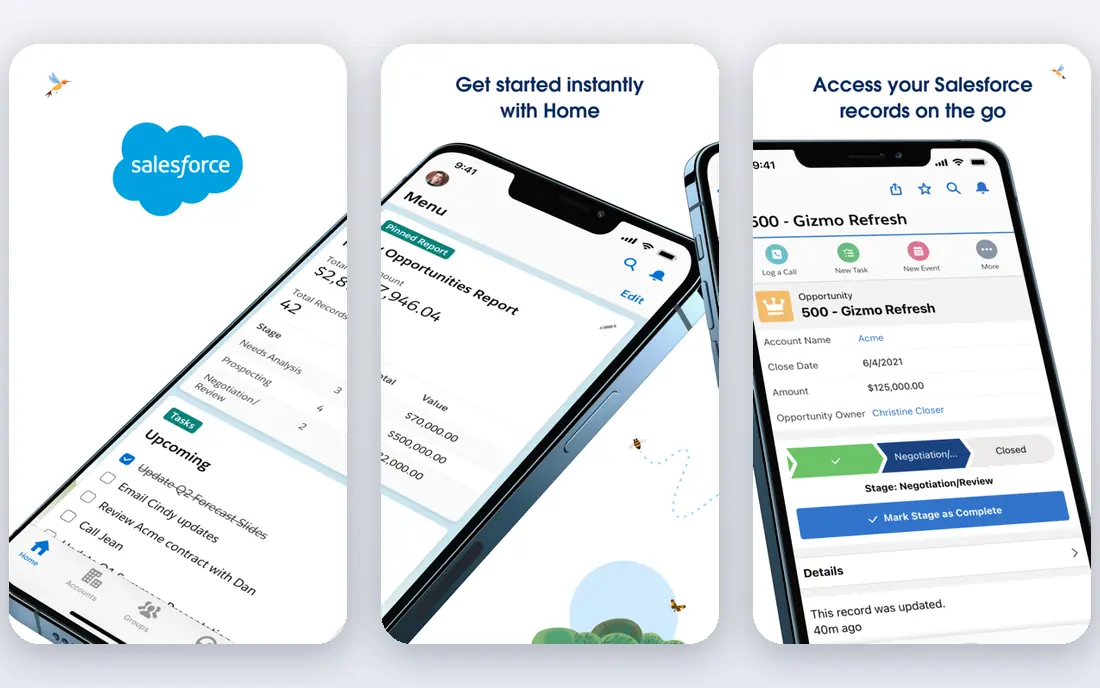
Salesforce Commerce Cloud offers B2C and B2B editions, with pricing often tied to gross merchandise value. Its strength is data, since customer, service and marketing data can sit in the same Salesforce ecosystem as commerce. Personalization and AI features benefit from that shared view, especially for firms already using Sales and Service Clouds.
Pricing can become expensive as revenue grows, because the revenue share scales with sales. Implementation is also complex and usually needs a specialist partner. Salesforce Commerce Cloud makes most sense for firms already committed to Salesforce, where integration value offsets the premium.
- Tight Salesforce integration
- Personalization tools
- B2C and B2B editions
- Revenue-share pricing
- Complex implementation
BigCommerce Enterprise, now sold under its Performance tier in some markets, offers a SaaS platform with no BigCommerce transaction fees and strong B2B support. It handles large catalogs, multi-storefront selling and headless builds through its Catalyst framework. That combination suits catalog-heavy brands and B2B sellers that want SaaS simplicity without Shopify fees.
Its app ecosystem is smaller than Shopify, so some niche features may need custom work. Enterprise pricing is custom and based on sales volume. For B2B and catalog-heavy firms that want a SaaS platform with headless flexibility, BigCommerce is a strong second choice.
- No platform transaction fees
- Strong B2B features
- Headless options
- Smaller app ecosystem than Shopify
- Enterprise pricing is custom
Commercetools is an API-first, composable platform, which means firms assemble their own storefront, search, payments and content tools around its commerce APIs. That flexibility suits large firms with distinct channels, regions and product models that a single SaaS template cannot serve. It scales globally and supports complex pricing and promotions through APIs.
The cost is engineering time. You must build and run the front end and integrations, so a dedicated team is essential. Time to launch is longer than Shopify Plus. Commercetools fits firms that treat commerce as a core engineering product, not just a storefront.
- API-first design
- Flexible composable stack
- Global scale
- Needs engineering resources
- Longer time to launch
SAP Commerce Cloud, formerly Hybris, is built for large enterprises already running SAP ERP, where order, inventory and customer data flow between systems. It supports complex B2B scenarios, global storefronts and marketplace models. For SAP-centered firms, that native integration reduces the middleware work that other platforms require.
Implementation is heavy and often needs a specialist partner, with high total cost. Firms without SAP gain little from choosing it over Shopify Plus or commercetools. For SAP enterprises, though, the integration case is strong, and migration planning should start early.
- Deep SAP ERP integration
- Complex B2B support
- Global enterprise scale
- Heavy implementation
- High total cost
VTEX offers ecommerce, marketplace and order management tools in one platform, with a strong presence in Latin America and growing global reach. Its modular design lets brands add marketplace selling, B2B and omnichannel fulfillment without a separate system. That breadth suits global brands and retailers that sell through multiple channels.
VTEX is less familiar to US agencies than Shopify or Adobe, so partner choice matters. Pricing is tied to GMV and modules, which needs careful modeling. For global and marketplace-led firms, VTEX deserves a place on the shortlist alongside the larger US platforms.
- Marketplace and OMS features
- Global reach
- Modular commerce tools
- Less familiar in the US
- Pricing tied to GMV and modules
Elastic Path provides composable commerce APIs for catalog, cart, pricing and promotions, letting firms build custom storefronts without a monolithic platform. It suits teams that want API flexibility but prefer a more guided product than a fully open stack. Headless builds, subscription models and complex product bundles are natural fits.
Like commercetools, it needs engineering resources and a longer launch timeline than SaaS. Its ecosystem is smaller, so partner and integration options need checking. For firms that want composable commerce with a focused vendor, Elastic Path is a credible alternative to commercetools.
- Composable APIs
- Flexible catalog and promotions
- Headless storefronts
- Needs engineering resources
- Smaller ecosystem than commercetools
How we picked these
We compared official product pages and 2026 enterprise ecommerce comparisons for platforms with proven large-store use, B2B support and integration options. We favored platforms with active development, enterprise support and a clear pricing model, even where pricing is quote-based. We excluded starter builders that cannot handle enterprise catalogs, traffic or B2B workflows.
How to choose an enterprise ecommerce platform
Start with total cost, not the headline license. SaaS platforms charge a subscription plus apps and payment fees, revenue-share platforms scale with sales, and composable platforms add engineering cost. Model your cost at current and doubled revenue, since a platform that looks cheap at $10 million in sales can become expensive at $50 million.
Next, test your hardest requirements first. B2B pricing, complex bundles, international taxes, marketplace selling and ERP links are where platforms differ most. A demo built around your real catalog and checkout will reveal limits faster than a generic sales presentation.
Finally, weigh team and timeline. SaaS platforms launch faster with smaller teams, while composable and open source platforms offer more control at higher cost. Pick the platform your team can run well for three years, not just the one with the longest feature list.
FAQ
What is the best enterprise ecommerce platform?
Shopify Plus is the best default for most large direct-to-consumer brands, thanks to speed, reliability and its app ecosystem. Adobe Commerce suits deep customization, Salesforce Commerce Cloud suits Salesforce firms, and commercetools suits engineering-led composable builds. The right platform depends on catalog complexity, B2B needs and team skills.
What are the best enterprise ecommerce platforms for B2B?
Adobe Commerce, BigCommerce Enterprise, Salesforce B2B Commerce and SAP Commerce Cloud all offer strong B2B features, including negotiated pricing, quotes and approval workflows. Shopify Plus also offers B2B tools for many firms. Test your exact B2B rules, such as price lists and payment terms, in a demo.
Is Shopify Plus good for enterprise?
Yes, Shopify Plus serves many large brands with high traffic, multi-storefront selling and B2B features. Its limits appear with highly custom checkout or catalog logic, where open source or composable platforms offer more control. For most enterprise DTC brands, its speed and ecosystem outweigh those limits.
How much does enterprise ecommerce software cost?
Enterprise pricing varies widely, from Shopify Plus at $2,300 per month on a longer term to quote-based platforms that scale with GMV or order volume. Implementation, apps and engineering add to the total. Get a total cost model for your revenue and order volume before comparing platforms.
What is headless ecommerce?
Headless ecommerce separates the storefront from the commerce back end, so teams can build a custom front end while using platform APIs for cart, checkout and catalog. Commercetools and Elastic Path are built for this model, while Shopify Plus and BigCommerce offer headless options too. Headless suits firms with distinct channels and strong engineering teams.