Best Enterprise E-Commerce Platforms in 2026: Prices, Free Plans and 6 Picks
Searching for the best enterprise E-Commerce platforms? Here are 6 options with prices and free plans. Details on cost, catches and fit. Pick with confidence.
- Editor's choice
 Adobe Commerce
Complicated B2B and B2C personalization
Starts atPricing on requestVisit business.adobe.comFull review - Great alternative
 BigCommerce Enterprise
Adaptable SaaS commerce on your terms
Starts atPricing on requestVisit bigcommerce.comFull review - Also consider
 Shopify Plus
Managed enterprise commerce at scale
Starts atPricing on requestVisit shopify.comFull review
Direct answer
Adobe Commerce leads the list, best for complicated B2B and B2C personalization. Look at BigCommerce Enterprise for adaptable SaaS commerce on your terms, and at Shopify Plus for managed enterprise commerce at scale. Details and limits for the rest of the 6 tools are below. None of these vendors publish plan prices, so pricing is on request for every option.
TL;DR:
- Adobe Commerce sits first on this list: complicated B2B and B2C personalization.
- Check the limits for Shopify Plus before you commit: less deep native B2B complexity than some rivals.
- Pricing across the list, from Adobe Commerce to commercetools, is by quote only.
- For Composable, API-first commerce infrastructure, commercetools is worth a look.
Last checked November 2026. Pricing on request: vendors did not publish plan prices when this guide was last checked (November 2026), so ask each vendor for a written quote.
Quick comparison
| Tool | Best for | Starts at | Free plan? | |
|---|---|---|---|---|
| Adobe Commerce | Complicated B2B and B2C personalization | Pricing on request | Not stated | Visit |
| BigCommerce Enterprise | Adaptable SaaS commerce on your terms | Pricing on request | Not stated | Visit |
| Shopify Plus | Managed enterprise commerce at scale | Pricing on request | Not stated | Visit |
 Salesforce Commerce Cloud | Commerce inside the Salesforce ecosystem | Pricing on request | Not stated | Visit |
 VTEX | AI-native unified commerce modernization | Pricing on request | Not stated | Visit |
 commercetools | Composable, API-first commerce infrastructure | Pricing on request | Free trial | Visit |
The full enterprise E-Commerce platforms list
LinkVetted put together this guide to enterprise E-Commerce platforms for readers who want a clear shortlist without reading every vendor page. It compares 6 tools on starting price, free plans, who each one suits and where each one falls short.
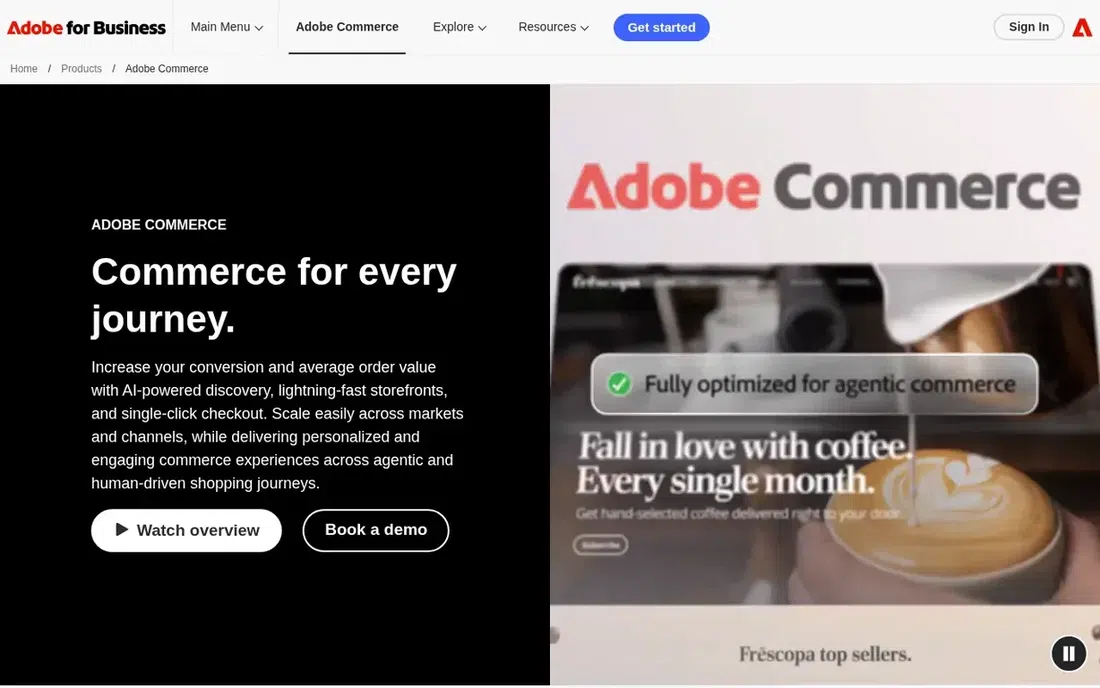
Adobe Commerce was built for complicated B2B and B2C personalization. The composable approach lets teams assemble services around a commerce core. Its adaptability includes operational weight: implementations generally demand specialist developers and continuing maintenance.
Strengths: Personalization at global scale.
Adobe Commerce, formerly Magento Commerce, is described by Adobe as an AI-powered composable e-commerce product for B2B and B2C that provides personalized experiences at global scale. Organizations without that capacity may prefer a more managed system for example Shopify Plus or BigCommerce Enterprise. No starting price is listed for Adobe Commerce here; confirm pricing on the vendor site. Free access: Not stated.
Limits to weigh: Needs significant technical resources.
- Composable
- AI-powered architecture
- Total ownership can be involved
BigCommerce Enterprise serves adaptable SaaS commerce on your terms. BigCommerce Enterprise is the enterprise edition of BigCommerce, which frames its system as feature-rich e-commerce on your terms and argues a modern SaaS system should fit the business instead of the reverse.
Watch-outs: Complicated needs may still need integrations.
For everyday use, BigCommerce Enterprise performs best when adaptability within a managed model is the priority. This comparison lists no price for BigCommerce Enterprise; ask the vendor. As for free access: Not stated.
- Supports B2B and B2C selling
- Adaptable positioning
- Less brand recognition than top-tier rivals

Shopify Plus is designed for managed enterprise commerce at scale. It suits merchants that want a managed core, fast storefront launches and a large partner and app ecosystem instead of building infrastructure themselves.
Teams moving up from standard Shopify frequently find the transition natural. No starting price is listed for Shopify Plus here; confirm pricing on the vendor site. Free plan details: Not stated.
Trade-offs to know: Heavy customization may need workarounds.
- Solid fit for direct-to-consumer growth
- Broad app and partner ecosystem
- Less deep native B2B complexity than some rivals
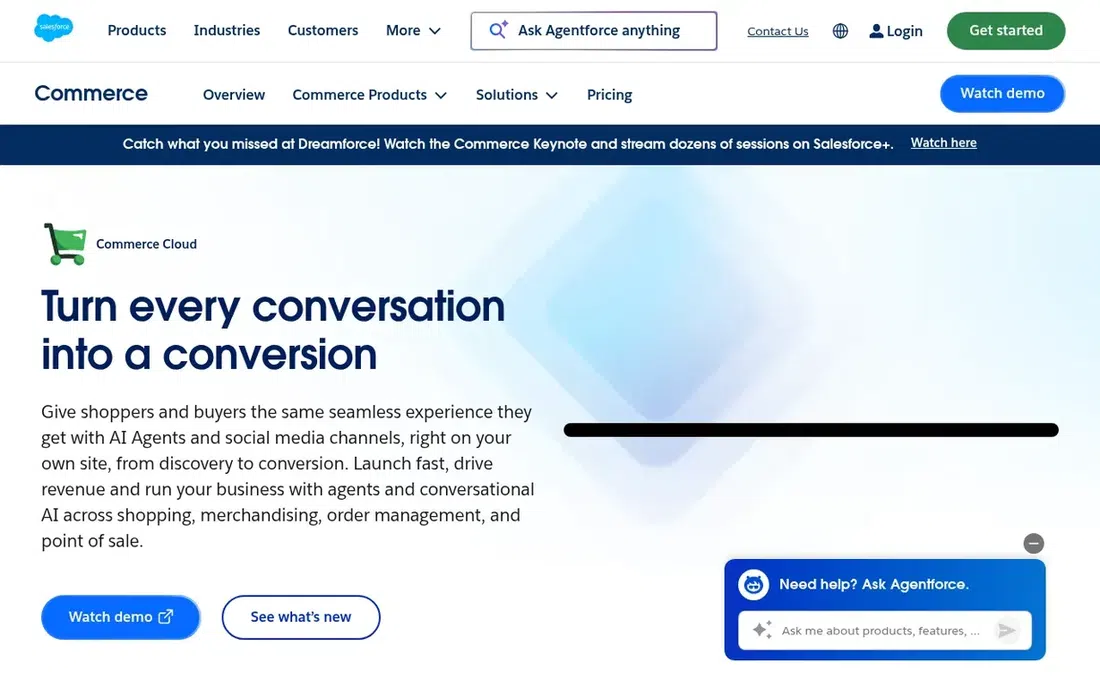
For Commerce inside the Salesforce ecosystem, Salesforce Commerce Cloud is a natural candidate. Commerce Cloud is Salesforce's commerce offering, pitched at organizations that want shopping experiences connected to customer data across sales, service and marketing.
Limits to weigh: Implementation can be involved.
The system is generally chosen as part of a broader customer system strategy. This comparison lists no price for Salesforce Commerce Cloud; ask the vendor. On free options: Not stated.
- Supports unified customer journeys
- Deep connection to Salesforce CRM data
- Best value primarily for Salesforce-centric stacks
VTEX targets AI-native unified commerce modernization. VTEX presents itself as the AI-native commerce suite of choice for bold technology and business leaders, promising stack modernization and operational results through a unified commerce option.
Check the vendor site for VTEX pricing; none is listed in this comparison. As for free access: Not stated.
Honest limits: Large catalogs still need planning.
- Unified commerce suite
- Geared toward stack modernization
- Regional familiarity varies
commercetools is a good fit for Composable, API-first commerce infrastructure. Its product is built to run commerce experiences across online, in-store, in-chat and agent-to-agent channels from one unified engine.
Where it shines: in-store and in-chat selling.
Since it is infrastructure instead of a finished storefront, teams need engineering capacity to build and operate experiences. Organizations wanting a managed, ready-to-launch product should look at Shopify Plus or BigCommerce Enterprise instead. commercetools does not show a starting price in this comparison, so check the vendor site for current pricing. As for free access: Free trial.
The main drawbacks: Not a turnkey storefront product.
- Aimed at multi-channel commerce
- Supports online
- Needs engineering to assemble experiences
Selection criteria
Selection started from tools commonly considered for enterprise E-Commerce platforms, then narrowed to 6 that have clear pricing information or a clear quote process. Figures are shown as the vendors publish them. Billing terms, seat minimums and add-ons can change the real cost. Tools are placed by general fit for enterprise E-Commerce platforms, with price clarity and free access as tie-breakers. A different team can reasonably rank them differently.
What to confirm before you sign up
- Ask each vendor, from Adobe Commerce to commercetools, for a written quote; none of them publishes a starting price.
- Run a trial of commercetools with real work before paying for a year; your own workflow is the best test.
- Before choosing Adobe Commerce, weigh its main limit: needs significant technical resources.
- Look at the renewal terms for Shopify Plus: auto-renewal, notice periods and price changes can matter more than the first-year price.
- Verify that exporting from BigCommerce Enterprise is possible on your plan and covers all your records.
FAQ
How are the tools for enterprise E-Commerce platforms ordered?
Adobe Commerce sits first and commercetools last because the order follows typical fit for enterprise E-Commerce platforms, then price clarity and free access. It is a judgement call, so read each profile for fit and limits.
Do these tools publish their prices?
No. None of the tools, from Adobe Commerce to commercetools, shows a fixed starting price here, so budget time for quotes.
What makes a platform enterprise-grade?
Enterprise products generally support large catalogs, several storefronts and channels, B2B and B2C models, and integration with business systems for example ERP and CRM.
Is Adobe Commerce the right pick for everyone comparing enterprise E-Commerce platforms?
No single tool suits every team. Adobe Commerce comes first because it fits complex B2B and B2C personalization, while BigCommerce Enterprise suits flexible SaaS commerce on your terms and Shopify Plus suits managed enterprise commerce at scale. Match the tool to your own size, budget and workflow before deciding.
Can I try these options before paying?
Often, yes. commercetools offers a free trial. Use your own data and a real task during the test, and check what the free tier or trial limits before you rely on it. Prices, free plan details and limits for all 6 tools in this enterprise E-Commerce platforms roundup sit on the individual cards above.
Sources
- https://business.adobe.com/products/magento/magento-commerce.html
- https://www.bigcommerce.com/enterprise
- https://www.shopify.com/plus
- https://www.salesforce.com/products/commerce-cloud
- https://vtex.com
- https://commercetools.com