Best B2B E-Commerce Platforms in 2026: 8 Platforms Compared
We compared the best b2b e-commerce platforms on contract pricing, buyer accounts, quoting and ERP links, so wholesale teams can shortlist with confidence.
- Editor's choice
 BigCommerce B2B Edition
Mid market distributors
Starts atSee websiteVisit bigcommerce.comFull review - Great alternative
 Shopify B2B
Brands selling B2B and direct to consumer
Starts at$2,300 per monthVisit shopify.comFull review - Also consider
 OroCommerce
Complex B2B workflows
Starts atSee websiteVisit oroinc.comFull review
TL;DR:
- BigCommerce B2B Edition and Shopify B2B suit mid market sellers who want a managed platform with a dedicated buyer portal, without building everything from scratch.
- OroCommerce and Adobe Commerce suit complex catalogs, multi organization accounts and custom workflows, but both need more implementation help and budget.
- Sana Commerce is a strong shortlist pick for companies already running SAP or Microsoft Dynamics, because the ERP link is the core of the product.
- Get pricing in writing for users, price lists and integrations, since most enterprise B2B pricing is quote based and totals vary widely.
Quick comparison
| Tool | Best for | Starts at | Free plan? | |
|---|---|---|---|---|
| BigCommerce B2B Edition | Mid market distributors | See website | No | Visit |
| Shopify B2B | Brands selling B2B and direct to consumer | $2,300 per month | No | Visit |
| OroCommerce | Complex B2B workflows | See website | Yes | Visit |
 Adobe Commerce | Large enterprise catalogs | See website | No | Visit |
 Sana Commerce | SAP and Dynamics ERP users | See website | No | Visit |
 Salesforce B2B Commerce | Salesforce centered enterprises | See website | No | Visit |
 WooCommerce B2B | Small wholesalers on WordPress | Free | Yes | Visit |
 SAP Commerce Cloud | SAP centered enterprises | See website | No | Visit |
The best b2b e-commerce platforms
Business buyers do not shop like retail shoppers. They buy on account, expect contract prices, order in bulk, and often need approval before an order is placed. The platforms below handle those needs in different ways, from simple wholesale price lists to full quote workflows and ERP sync. We ranked them by how much B2B logic is built in, rather than added on.
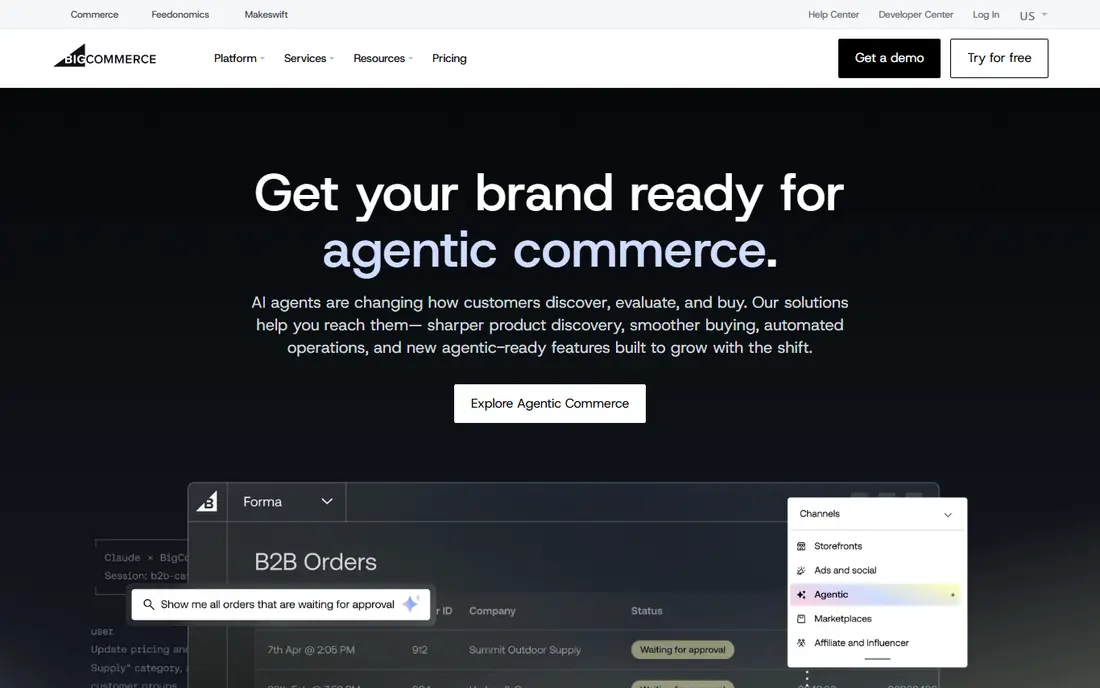
BigCommerce B2B Edition is a practical middle ground for distributors who want to move phone and email orders online without an enterprise rebuild. Buyers get a portal with their own price lists, order history and account users, while sellers can set customer groups, volume pricing and payment terms. The platform is managed SaaS, so hosting and updates are handled for you.
The catch is tiering. Full B2B Edition features are an add on to higher plans, so the total monthly cost is higher than the headline store price. Teams with simple wholesale needs may find the standard plans plus a B2B app enough, while larger distributors should price the full edition before committing. For mid market wholesale, it is one of the clearest value picks.
- Dedicated B2B buyer portal
- Price lists and customer groups
- Open integrations
- B2B features sit on higher tiers
- Some advanced workflows need apps or development

Shopify B2B, available on Shopify Plus, lets a brand run wholesale and retail from the same catalog and admin. You can create company profiles, assign buyers, set price lists and volume discounts, and offer payment terms such as net terms through supported options. For a brand that already sells direct to consumer on Shopify, that shared setup is a major time saver.
The barrier is price. Plus starts at $2,300 per month on a longer term, which is too much for a small wholesaler with a handful of accounts. Some complex needs, such as multi level approval chains, also need apps or custom work. If your wholesale channel is growing alongside a retail store, though, Shopify B2B keeps both channels in one place.
- One store for B2B and retail
- Large app ecosystem
- Familiar admin for staff
- High Plus entry price
- Some deep B2B workflows still need apps
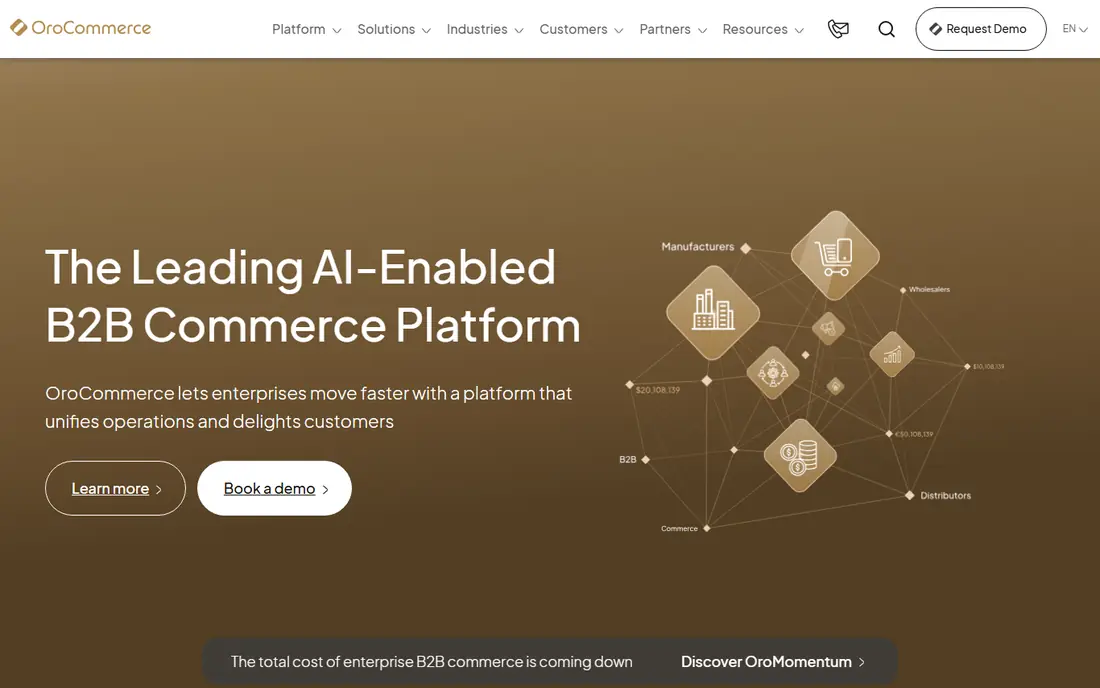
OroCommerce was built for B2B from the start, and that shows in the details. It models companies with multiple contacts, roles and locations, supports requests for quote, negotiated pricing and approval workflows, and handles large catalogs with complex product variants. For manufacturers and distributors with layered pricing, that native depth is hard to match with add on apps.
The trade is effort. Even with a Community Edition available free, a serious deployment needs Symfony skilled developers and a careful implementation plan. Enterprise licensing is quote based, so budget planning needs a vendor conversation early. If your B2B rules are genuinely complex, OroCommerce is worth that effort. If they are simple, a lighter SaaS option will launch faster.
- B2B first design
- Company accounts and workflows
- Open source Community Edition
- Implementation needs skilled developers
- Enterprise pricing is quote based
Adobe Commerce, formerly Magento Commerce, is the enterprise workhorse for large B2B and mixed B2C catalogs. Its B2B suite adds shared catalogs, negotiated pricing, quote requests, requisition lists and approval workflows, and the wider Adobe ecosystem covers content, analytics and personalization. Companies with huge catalogs and many storefronts can shape it to fit.
Cost and complexity are the honest downsides. Licensing, implementation and maintenance together often reach six figures per year for larger deployments, and finding experienced Adobe developers is not cheap. Smaller teams should not pick it for a simple wholesale portal. Large enterprises with dedicated commerce teams will get the most from its depth.
- Broad enterprise feature set
- B2B suite with quotes and shared catalogs
- Large partner network
- High total cost
- Needs specialist developers and ongoing maintenance
Sana Commerce takes a different approach: the web store reads prices, stock and customer data directly from your ERP, rather than syncing copies back and forth. For companies running SAP or Microsoft Dynamics, that means fewer mismatches between what the website shows and what the warehouse can ship. Orders flow back into the ERP, which keeps finance and operations on one record.
The limit is fit. If you are not on a supported ERP, Sana is not the right pick, and pricing is quote based, so you will need a sales conversation to budget. For ERP centered distributors and manufacturers, though, the integration depth often outweighs the narrower scope. It is best judged on how cleanly it connects to your current ERP, not on generic store features.
- Deep ERP integration
- Real time prices and stock
- Single data source for web orders
- Tied closely to supported ERPs
- Quote based pricing
Salesforce B2B Commerce suits companies that already run their sales, service and customer data in Salesforce. Buyers get account specific catalogs and pricing, reps can support online orders with the same customer record they use elsewhere, and quoting and order data stay in one system. That shared record is the main reason to choose it over a standalone store.
Outside Salesforce, the case weakens. Licensing and implementation are enterprise level, and the platform rewards teams already invested in the Salesforce stack. A company with no Salesforce footprint will find cheaper and faster options elsewhere. For Salesforce houses, it is a natural shortlist pick.
- Native link to Sales and Service Cloud
- Account based pricing
- Strong quoting tools
- Enterprise cost and implementation time
- Best value only inside Salesforce
WooCommerce B2B is the budget route for small wholesalers already on WordPress. The core software is free, and B2B plugins add wholesale pricing, customer groups, quote requests and registration approval. You keep full control over design, hosting and data, and the WordPress ecosystem means most content and SEO needs are covered.
Control brings responsibility. You pay for hosting, handle updates and security, and test plugins when WordPress updates. A small team with some WordPress skill can run a solid wholesale store at low cost. A team with no technical help may find a managed SaaS platform cheaper in staff time, even if the license looks higher.
- Free open source core
- Huge plugin range
- Full control over hosting and design
- B2B features need plugins
- Hosting, security and updates are your job
SAP Commerce Cloud is built for large enterprises already running SAP S/4HANA. It handles complex product configurations, multi country catalogs, contract pricing and order management at scale, and it shares data with the wider SAP estate. For a global manufacturer with SAP at the center, that fit is difficult to replace.
The downside is scale of effort. Implementation is a major project, licensing is quote based and high, and you need SAP skilled partners to run it well. Small and mid market sellers should look elsewhere. Large SAP enterprises with complex B2B scenarios should shortlist it alongside Adobe Commerce and Salesforce, and judge it on integration fit.
- Deep SAP S/4HANA integration
- Complex B2B scenarios
- Global enterprise scale
- Long implementation
- High cost
- Needs SAP expertise
How we picked these
We compared official product pages, B2B feature documentation, pricing models and ERP integration claims for platforms that serve business buyers in the US in 2026. We favored platforms with native company accounts, price lists, quoting or payment terms, and we noted where those features need a higher tier or an add on. We excluded retail only builders with no real B2B logic, and tools that no longer publish a current product page.
How to shortlist a B2B platform without a wasted pilot
Map your pricing rules first
Write down your price lists, volume tiers, customer groups and approval steps before you demo any platform. A demo looks good when the vendor shows a simple catalog, but the real test is your hardest pricing rule. Ask each vendor to build that rule live, with your data, during the trial.
Price the whole system, not the license
Add implementation, ERP integration, apps, payment terms handling and staff training to the license fee. A lower license with heavy custom work can cost more over three years than a higher license with native features. Ask for a three year total, including support, before you sign.
Test with real buyers
Invite two or three trusted wholesale customers to place test orders, request a quote and check their price list. Their feedback on checkout, account access and order history will tell you more than an internal demo. If buyers struggle to find their contract price, the platform is not ready, however good the admin looks.
FAQ
What is the difference between B2B and B2C e-commerce platforms?
B2C platforms sell to individual shoppers with one public price and instant payment. B2B platforms add company accounts with multiple users, contract and volume pricing, quote requests, approval workflows and payment terms such as net 30. Those features are the main reason B2B platforms cost more and take longer to set up.
Which B2B platform is best for small wholesalers?
WooCommerce B2B is the lowest cost route for small wholesalers on WordPress, while BigCommerce B2B Edition suits mid market sellers who want managed hosting and a buyer portal. Shopify B2B works well for brands that also sell retail, but Plus pricing puts it out of reach for very small wholesalers.
Do B2B platforms support payment terms like net 30?
Many do, but the method varies. Some offer native payment terms, others handle terms through invoicing, credit limits or a payment app. Confirm how terms, credit limits and overdue accounts are handled before you choose, and check whether terms apply per company or per buyer.
How long does a B2B platform implementation take?
A simple wholesale store on a SaaS platform can launch in weeks, while an enterprise deployment with ERP integration and custom workflows can take several months. The biggest drivers are catalog complexity, pricing rules and integration scope, so scope those early and keep the first launch to core ordering features.
Should we keep B2B and retail on one platform?
One platform saves admin time and keeps stock and product data in one place, which is why Shopify B2B and BigCommerce appeal to mixed sellers. Separate platforms can make sense when B2B pricing, catalogs or approval rules are so different that sharing a catalog creates more work than it saves.
Sources
- https://www.bigcommerce.com/b2b-ecommerce/
- https://www.shopify.com/plus/b2b
- https://oroinc.com/b2b-ecommerce/
- https://business.adobe.com/products/commerce.html
- https://www.sana-commerce.com
- https://www.salesforce.com/commerce/b2b/
- https://woocommerce.com
- https://www.sap.com/products/scm/commerce-cloud.html