Best Platform for Enterprise Level Ecommerce for 2026: Our 6 Vetted Picks
Best platform for enterprise level ecommerce in 2026: 6 contenders with entry costs and free tiers. Concise write-ups of every option. Jump to the table.
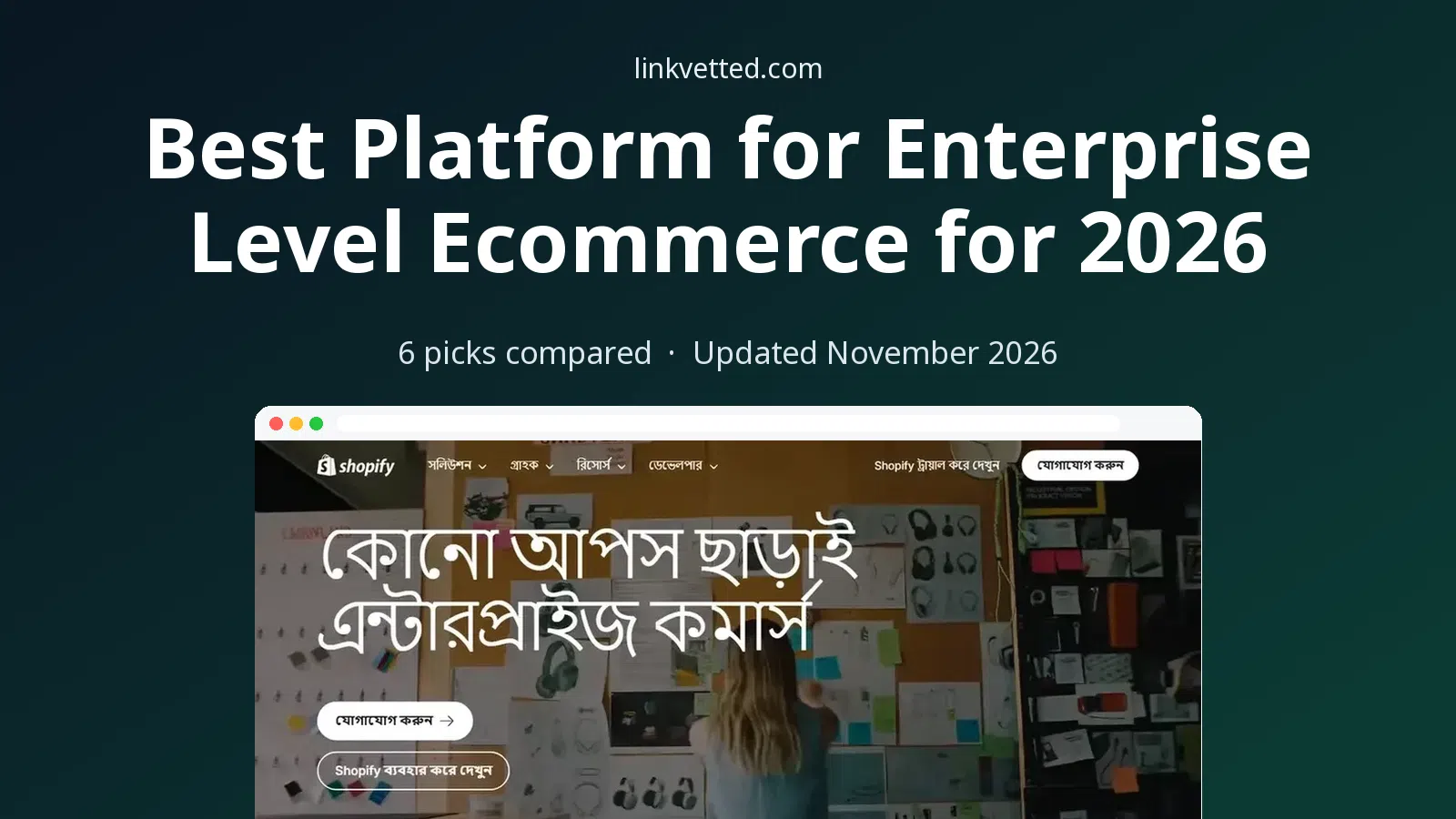
- Editor's choice
 Shopify Plus
High-growth brands seeking a managed commerce product
Starts atPricing on requestVisit shopify.comFull review - Great alternative
 SAP Commerce Cloud
Enterprises needing tight integration with SAP systems
Starts atPricing on requestVisit sap.comFull review - Also consider
 commercetools
API-first, composable commerce for omnichannel experiences
Starts atPricing on requestVisit commercetools.comFull review
Direct answer
Start with Shopify Plus if you need high-growth brands seeking a managed commerce product. Alternatives: SAP Commerce Cloud for enterprises needing tight integration with SAP systems, and commercetools for API-first, composable commerce for omnichannel experiences. The remaining 3 options are covered below with pricing notes and limits. None of these vendors publish plan prices, so pricing is on request for every option.
TL;DR:
- This list starts with Shopify Plus, which is built for high-growth brands seeking a managed commerce product.
- No starting price is shown for any of the 6 tools, Shopify Plus and Adobe Commerce included, so plan time for sales calls.
- Shopify Plus, Adobe Commerce and the 4 others all need a premium plan or a trial, since no free plan is listed.
- Check the limits for SAP Commerce Cloud before you commit: complicated and expensive implementation.
Last checked November 2026. Pricing on request: vendors did not publish plan prices when this guide was last checked (November 2026), so ask each vendor for a written quote.
Quick comparison
| Tool | Best for | Starts at | Free plan? | |
|---|---|---|---|---|
| Shopify Plus | High-growth brands seeking a managed commerce product | Pricing on request | Not stated | Visit |
| SAP Commerce Cloud | Enterprises needing tight integration with SAP systems | Pricing on request | Not stated | Visit |
| commercetools | API-first, composable commerce for omnichannel experiences | Pricing on request | Free trial | Visit |
 Salesforce Commerce Cloud | Companies deeply integrated with Salesforce CRM | Pricing on request | Not stated | Visit |
 BigCommerce Enterprise | B2B and B2C companies wanting SaaS adaptability | Pricing on request | Not stated | Visit |
 Adobe Commerce | B2B and B2C brands needing composable, AI-powered commerce | Pricing on request | Not stated | Visit |
Platform for Enterprise Level Ecommerce profiles
LinkVetted put together this guide to platform for enterprise level ecommerce for readers who want a clear shortlist without reading every vendor page. It compares 6 tools on starting price, free plans, who each one suits and where each one falls short.

Shopify Plus works best for high-growth brands seeking a managed commerce system. Consider alternatives if you need deep customization or complicated pricing models. Extra transaction fees can also impact costs.
It supports companies scaling rapidly, with features like multi-store management and automation. Worth adding: the deep app ecosystem permits merchants to extend functionality without heavy development. Shopify Plus shows no starting price here, so confirm the cost on the vendor site. As for free access: Not stated.
Where it falls short: Less adaptable for deep customization.
- Deep app ecosystem
- Steady uptime
- Transaction fees
Pick SAP Commerce Cloud if this describes you: enterprises needing tight integration with SAP systems. SAP Commerce Cloud is an AI-assisted ecommerce software that drives digital growth and demand by supplying unified buying experiences. It is especially well-suited for enterprises that already use SAP ERP or CRM, as it integrates smoothly to build a cohesive data and process environment.
The system supports B2B, B2C, and B2B2C models across several channels. Worth adding: consider alternatives if you seek a more standalone or lightweight option. SAP Commerce Cloud shows no starting price here, so confirm the cost on the vendor site. On free options: Not stated.
What to check first: Needs SAP expertise.
- Unified buying experiences
- Deep SAP integration
- Complicated and expensive implementation
commercetools
Best for: API-first, composable commerce for omnichannel experiences
commercetools serves API-first, composable commerce for omnichannel experiences. Its API-first, composable approach lets firms to produce highly customized and scalable options, making it well suited to enterprises with complicated, multi-channel strategies.
It is a good match for organizations with capable technical teams. This comparison lists no price for commercetools; ask the vendor. On free options: Free trial.
What to check first: No out-of-the-box storefront.
- Supports omnichannel and agent-to-agent commerce
- Highly scalable
- Needs development resources
Salesforce Commerce Cloud
Best for: Companies deeply integrated with Salesforce CRM
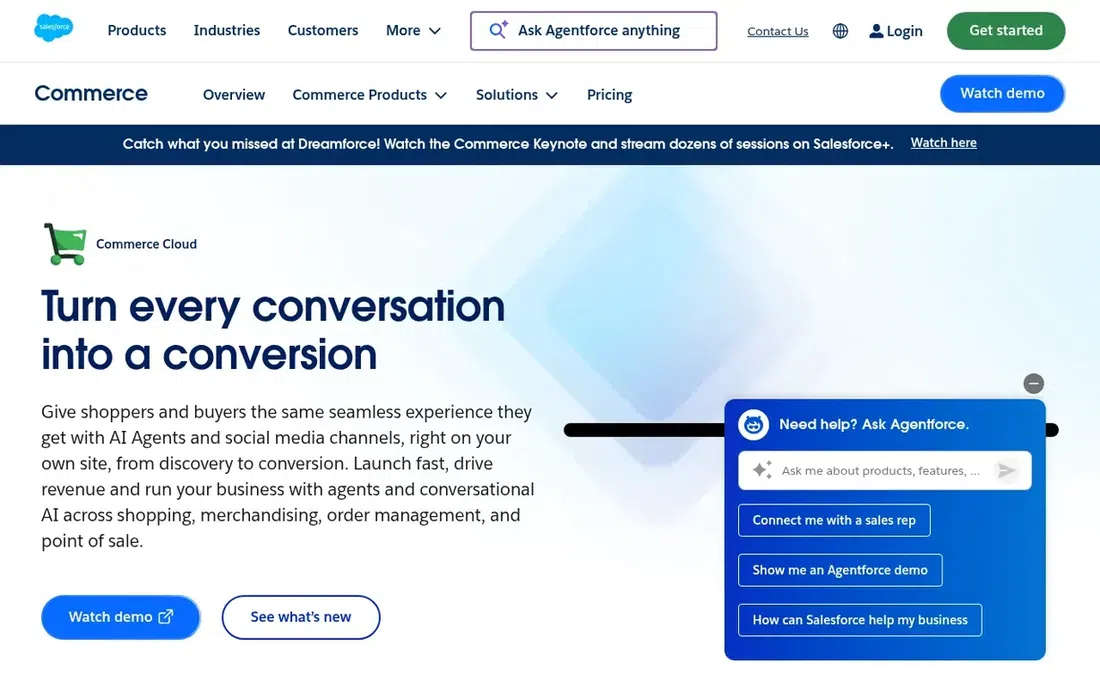
Salesforce Commerce Cloud is built with firms deeply integrated with Salesforce CRM in mind. The system's deep integration can result in higher costs and complexity, notably for companies not invested in the Salesforce ecosystem. Also, if you seek a standalone commerce option with more straightforward operations, other choices might be more suitable.
The system uses AI to deliver personalized shopping experiences and optimize conversions. It is well suited to enterprises already using Salesforce, as it makes it possible for a unified view of customer interactions across sales, service, and commerce. Salesforce Commerce Cloud shows no starting price here, so confirm the cost on the vendor site. As for free access: Not stated.
Drawbacks to consider: High total cost.
- Unified customer data
- AI-driven insights
- Complicated customization
BigCommerce Enterprise
Best for: B2B and B2C companies wanting SaaS adaptability
BigCommerce Enterprise makes the most sense for B2B and B2C firms wanting SaaS flexibility. Even so, BigCommerce may not offer the same level of customization as open-source products for highly complicated requirements.
Drawbacks to consider: Fewer apps than some competitors.
This comparison lists no price for BigCommerce Enterprise; ask the vendor. On free options: Not stated.
- Open SaaS architecture
- No transaction fees
- Restricted customization for complicated needs
Adobe Commerce
Best for: B2B and B2C brands needing composable, AI-powered commerce
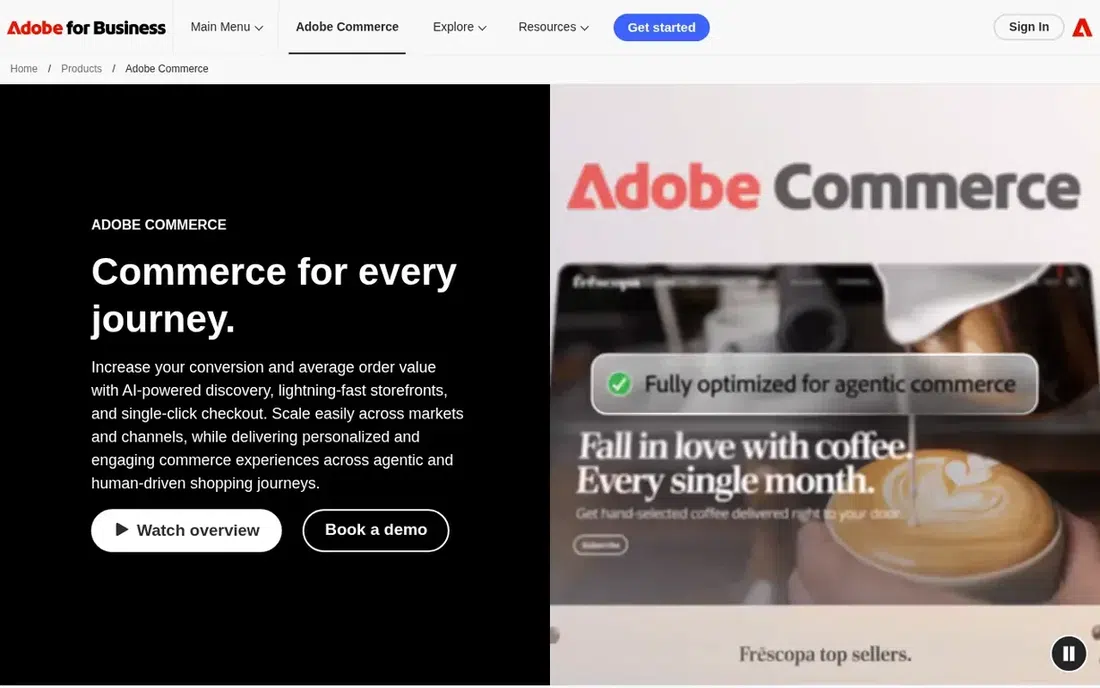
Think of Adobe Commerce for B2B and B2C brands needing composable, AI-powered commerce. Adobe Commerce is an AI-powered composable ecommerce system made for B2B and B2C firms. Consider alternatives if you need a more straightforward, managed option with less technical overhead.
Downsides: Needs technical expertise.
In practice, the product's composable nature permits companies to integrate best-of-breed services and adapt to changing market demands. Even so, Adobe Commerce can be complicated to implement and maintain, frequently requiring specialized development resources. No starting price is listed for Adobe Commerce here; confirm pricing on the vendor site. Free options: Not stated.
- Supports global scale
- AI-powered personalization
- Complicated implementation
How we built this list
What to confirm before you sign up
- Ask each vendor, from Shopify Plus to Adobe Commerce, for a written quote; none of them publishes a starting price.
- Use real work to test the free trial from commercetools, rather than a demo project.
- Read the limits listed for Shopify Plus first: less adaptable for deep customization.
- See whether BigCommerce Enterprise offers onboarding or training, and whether it is included in the price.
- Check whether the features you need in Adobe Commerce sit on the entry plan or only on higher tiers.
FAQ
Do these tools publish their prices?
No. None of the tools, from Shopify Plus to Adobe Commerce, shows a fixed starting price here, so budget time for quotes.
How are the tools for platform for enterprise level ecommerce ordered?
Shopify Plus sits first and Adobe Commerce last because the order follows typical fit for platform for enterprise level ecommerce, then price clarity and free access. It is a judgement call, so read each profile for fit and limits.
Can I migrate my existing store to an enterprise system without downtime?
Plenty of vendors offer tools and partner support to facilitate data transfer and minimize downtime. It is advisable to consult with implementation experts to ensure a smooth transition.
Does any tool for platform for enterprise level ecommerce here have a free plan?
No tool in this list, Shopify Plus and Adobe Commerce included, has a permanent free plan. commercetools offer a trial. Trials and quotes are the usual route, so plan a short evaluation period.
How does commercetools differ from traditional ecommerce systems?
Traditional products like Shopify Plus supply a managed front end and back end, offering quicker time to market but less adaptability for deep customization.
Is Shopify Plus the right pick for everyone comparing platform for enterprise level ecommerce?
No single tool suits every team. Shopify Plus comes first because it fits high-growth brands seeking a managed commerce platform, while SAP Commerce Cloud suits enterprises needing tight integration with SAP systems and commercetools suits API-first, composable commerce for omnichannel experiences. Match the tool to your own size, budget and workflow before deciding.
Sources
- https://www.shopify.com/plus
- https://www.sap.com/products/crm/commerce-cloud.html
- https://commercetools.com
- https://www.salesforce.com/commerce
- https://www.bigcommerce.com/enterprise
- https://business.adobe.com/products/magento/magento-commerce.html