Best Ecommerce Modernization Platforms in 2026: Prices, Free Plans and 5 Picks
Best ecommerce modernization platforms in 2026: 5 contenders with entry costs and free tiers. Every pick gets a straight assessment. Updated for 2026.
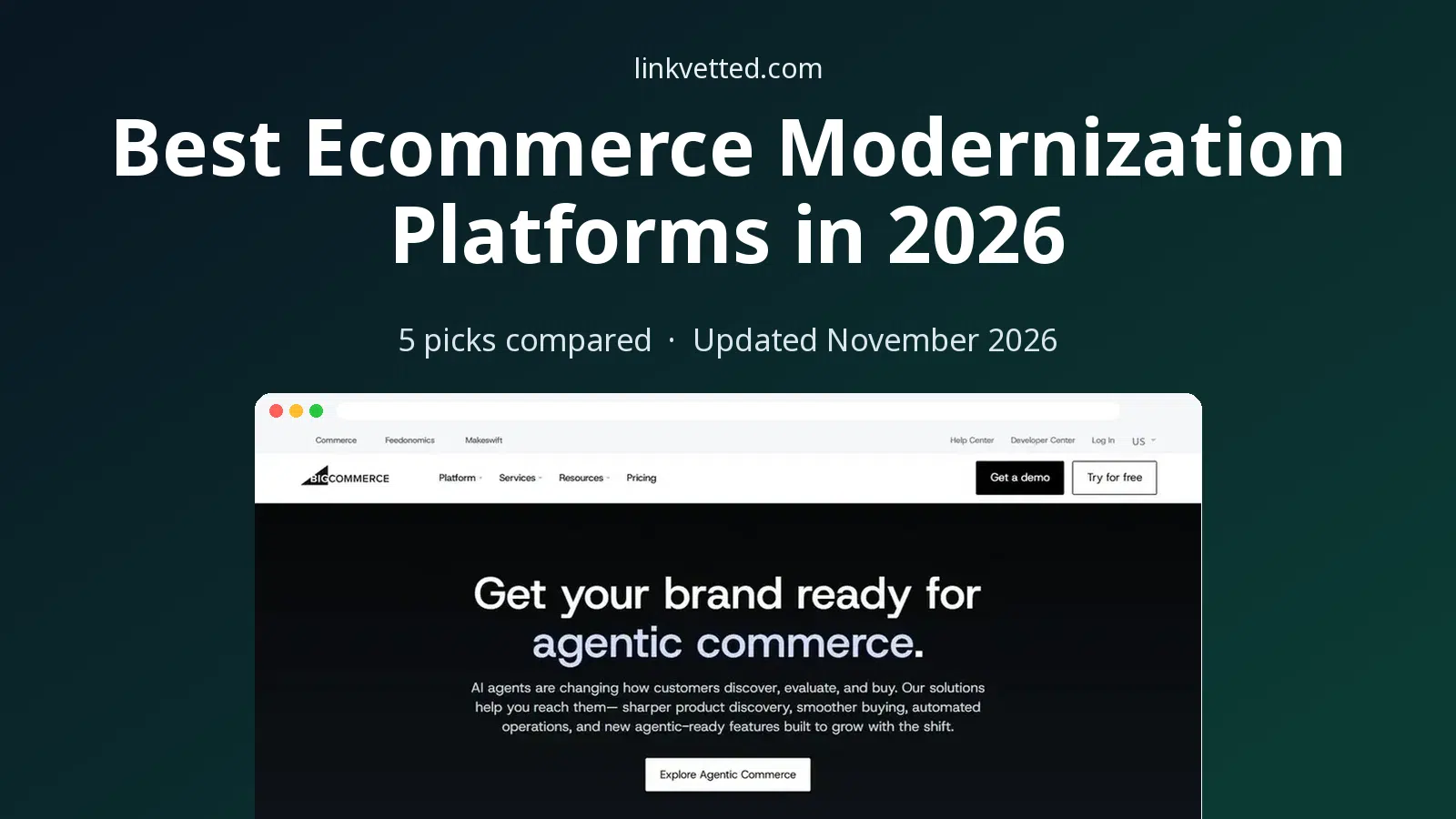
- Editor's choice
 BigCommerce
Multi-channel growth on one foundation
Starts atPricing on requestVisit bigcommerce.comFull review - Great alternative
 commercetools
Composable, API-first commerce infrastructure
Starts atPricing on requestVisit commercetools.comFull review - Also consider
 Shopware
Configurable responsive storefronts
Starts atPricing on requestVisit shopware.comFull review
Direct answer
Start with BigCommerce if you need multi-channel growth on one foundation. If your case is different, commercetools suits Composable, API-first commerce infrastructure and Shopware suits configurable responsive storefronts. The other 2 tools in the list cover narrower or pricier cases. None of these vendors publish plan prices, so pricing is on request for every option.
TL;DR:
- BigCommerce sits first on this list: multi-channel growth on one foundation.
- What to know about BigCommerce first: deep bespoke builds may need extra work.
- Every tool from BigCommerce to Salesforce Commerce Cloud works by quote, with no list price shown.
- Just one of the 5 tools, Shopware, has a free plan.
Last checked November 2026. Pricing on request: vendors did not publish plan prices when this guide was last checked (November 2026), so ask each vendor for a written quote.
Quick comparison
| Tool | Best for | Starts at | Free plan? | |
|---|---|---|---|---|
| BigCommerce | Multi-channel growth on one foundation | Pricing on request | Not stated | Visit |
| commercetools | Composable, API-first commerce infrastructure | Pricing on request | Free trial | Visit |
| Shopware | Configurable responsive storefronts | Pricing on request | Yes | Visit |
 Shopify Plus | Managed enterprise commerce at scale | Pricing on request | Not stated | Visit |
 Salesforce Commerce Cloud | Commerce inside the Salesforce ecosystem | Pricing on request | Free trial | Visit |
The full ecommerce modernization platforms list
LinkVetted put together this guide to ecommerce modernization platforms for readers who want a clear shortlist without reading every vendor page. It compares 5 tools on starting price, free plans, who each one suits and where each one falls short.

BigCommerce targets multi-channel growth on one foundation. Pick it when multi-channel expansion and a unified foundation are the priority instead of maximum architectural freedom.
More specifically, highly specialized requirements can call for custom development or integrations beyond the core product. From a buyer's view, BigCommerce markets itself as commerce made for momentum, powering buying experiences across brands, regions and channels from a single scalable foundation. Check the vendor site for BigCommerce pricing; none is listed in this comparison. Trial and free access: Not stated.
Upsides: Single scalable foundation.
Downsides: Feature depth varies by use case.
- Regions and channels
- Supports brands
- Deep bespoke builds may need additional work
commercetools is a good fit for Composable, API-first commerce infrastructure. It suits technically mature organizations building composable storefronts where the commerce engine is one modular layer among numerous.
What to check first: You assemble more of the stack.
More specifically, Composable architecture means you own more integration and front-end decisions, which raises engineering demands. commercetools shows no starting price here, so confirm the cost on the vendor site. Trial and free access: Free trial.
- Supports agent-to-agent commerce
- Composable enterprise positioning
- Needs engineering maturity
Choose Shopware for configurable responsive storefronts. Shopware presents itself as an ecommerce system for building and customizing a completely responsive online store with a blend of design and functionality.
On top of that, for very large global rollouts, teams should validate ecosystem support and integration depth against their requirements. It is a solid fit when design adaptability and customization are central instead of out-of-the-box enterprise breadth. Shopware shows no starting price here, so confirm the cost on the vendor site. Shopware has a free plan.
Points against: Smaller global ecosystem presence.
- Solid design and customization focus
- Responsive storefront building
- Enterprise scale needs careful planning

Shopify Plus is a good fit for managed enterprise commerce at scale. Teams that want a managed foundation, predictable operations and a large partner and app ecosystem commonly start here.
Shopify Plus shows no starting price here, so confirm the cost on the vendor site. As for free access: Not stated.
What to check first: Customization follows product conventions.
- Broad app and partner ecosystem
- Managed hosting and infrastructure
- Less low-level infrastructure control
Salesforce Commerce Cloud was built for Commerce inside the Salesforce ecosystem. Salesforce Commerce Cloud is Salesforce's commerce offering, geared toward enterprises that want shopping experiences connected to customer data and service processes across the Salesforce system.
Teams outside the Salesforce ecosystem may find the value proposition less compelling and the implementation resource-heavy. Beyond that, choose it when tight integration with existing Salesforce processes outweighs standalone system simplicity. This comparison lists no price for Salesforce Commerce Cloud; ask the vendor. Free access: Free trial.
Drawbacks to consider: Ecosystem lock-in considerations.
- Suited to unified customer data
- Part of the broader Salesforce product
- Implementation demands specialist skills
What went into this list
LinkVetted looked at what each vendor publishes: pricing, plan limits, feature coverage for ecommerce modernization platforms and stated drawbacks. No hands-on testing is claimed. Prices and plan limits come from vendor pages and can change, so confirm them on the vendor site before you buy. Order on the page follows fit for the typical buyer first, then price transparency and free access. Your own requirements should decide the final pick.
What to confirm before you sign up
- Confirm the entry price with every vendor: no tool from BigCommerce to Salesforce Commerce Cloud shows a fixed starting price.
- Test the free plan from Shopware against your real workload before relying on it.
- Use real work to test the free trial from commercetools and Salesforce Commerce Cloud, rather than a demo project.
- Before choosing BigCommerce, weigh its main limit: deep bespoke builds may need additional work.
- Before you load data into Shopify Plus, check what an export looks like and who can run it.
- Map your must-have features to a specific Shopware plan before you compare prices.
FAQ
Is BigCommerce the right pick for everyone comparing ecommerce modernization platforms?
No single tool suits every team. BigCommerce comes first because it fits multi-channel growth on one foundation, while commercetools suits Composable, API-first commerce infrastructure and Shopware suits customizable responsive storefronts. Match the tool to your own size, budget and workflow before deciding.
How are the tools for ecommerce modernization platforms ordered?
BigCommerce sits first and Salesforce Commerce Cloud last because the order follows typical fit for ecommerce modernization platforms, then price clarity and free access. It is a judgement call, so read each profile for fit and limits.
Can I try these options before paying?
Often, yes. Shopware has a free plan and commercetools and Salesforce Commerce Cloud offer a free trial. Use your own data and a real task during the test, and check what the free tier or trial limits before you rely on it.
Do these tools publish their prices?
No. None of the tools, from BigCommerce to Salesforce Commerce Cloud, shows a fixed starting price here, so budget time for quotes. For the full picture, the cards above cover all 5 entries of this ecommerce Modernization platforms list, including price, free plan and limits.
What makes a platform a modernization choice instead of a straightforward store builder?
Modernization systems usually support multi-storefront operations, integrations with business systems and either composable or enterprise-scale architecture. The right fit relies on whether you want a managed core or modular infrastructure you assemble yourself.
Sources
- https://www.bigcommerce.com
- https://commercetools.com
- https://www.shopware.com
- https://www.shopify.com/plus
- https://www.salesforce.com/products/commerce-cloud/overview