Best Ecommerce Order Management Software in 2026: 9 Tools Compared
Compare the best ecommerce order management software in 2026 for multichannel orders, inventory sync, shipping, and fulfillment workflows for growing brands.

- Editor's choice
 ShipStation
Multichannel shipping automation
Starts at$14.99 per monthVisit shipstation.comFull review - Great alternative
 Cin7 Core
Inventory plus order management
Starts at$349 per monthVisit cin7.comFull review - Also consider
 Linnworks
Marketplace sellers at scale
Starts atSee websiteVisit linnworks.comFull review
TL;DR:
- The best ecommerce order management software pulls orders from every sales channel into one queue, syncs inventory everywhere, and routes each order to the right warehouse or 3PL.
- ShipStation is the best starting point for shipping-focused sellers, while Cin7 Core suits multichannel brands that also need inventory and purchase orders.
- Zoho Inventory is the budget standout, with a free tier and paid plans from $29 per month billed annually, according to vendor pricing pages checked in 2026.
- Label tools and full order management systems are different products. Do not pay for warehouse workflows if you only need labels, and do not expect a label tool to run a warehouse.
- Our pick for most growing brands is Cin7 Core, because it combines order management, inventory, and multichannel sync in one system that scales.
Quick comparison
| Tool | Best for | Starts at | Free plan? | |
|---|---|---|---|---|
| ShipStation | Multichannel shipping automation | $14.99 per month | Free trial (30 days) | Visit |
| Cin7 Core | Inventory plus order management | $349 per month | Free trial (14 days) | Visit |
| Linnworks | Marketplace sellers at scale | See website | No | Visit |
 Veeqo | Amazon and multichannel sellers | Free | Yes | Visit |
 Zoho Inventory | Budget multichannel tracking | Free | Yes | Visit |
 Brightpearl by Sage | High-volume retail operations | See website | No | Visit |
 Ordoro | Sellers outgrowing label tools | $59 per month | Yes | Visit |
 ShipHero | Brands running their own warehouse | See website | No | Visit |
 Extensiv Order Manager | High-volume multichannel fulfillment | See website | No | Visit |
The best ecommerce order management software
Ecommerce order management software collects orders from your store, marketplaces, and other channels, keeps inventory accurate across all of them, and helps you pick, pack, ship, and track each order. We compared official pricing pages, feature pages, and public reviews to build this list.
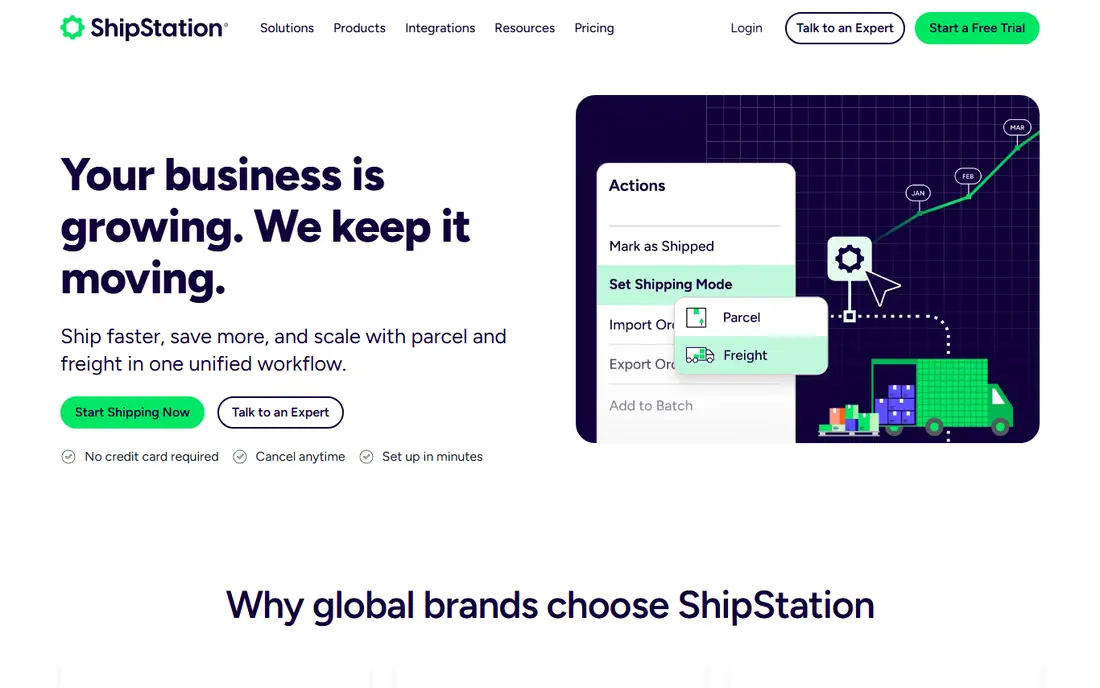
ShipStation is the default shipping tool for sellers on multiple channels, and its integration list is the reason. Shopify, Amazon, eBay, Etsy, WooCommerce, Walmart, and many more feed orders into one dashboard, where automation rules pick carriers by weight and destination, split orders across warehouses, and generate branded packing slips. For a seller shipping from a spare room or a small stockroom, that automation saves hours each week.
The limit is scope. ShipStation is excellent at getting orders out the door, but it is not a full inventory and warehouse system. Brands that hold stock across warehouses, manage purchase orders, and need picking workflows will outgrow it. If shipping is your main job, ShipStation is still the best place to start.
- Very broad channel and carrier integrations
- Strong automation rules
- Branded packing slips and tracking
- Inventory features are lighter than full OMS tools
- Costs rise with shipment volume
- Warehouse workflows are limited

Cin7 Core, formerly DEAR, is the step up when a label tool stops being enough. It combines inventory management, order management, purchase orders, and multichannel sales in one system, so stock levels, orders, and purchasing stay connected. That connection prevents oversells, which are the most expensive mistake a growing brand can make.
The price reflects that depth, at $349 per month for the entry tier, and setup needs real work around products, locations, and channels. Smaller sellers should not buy it before they need it. For growing multichannel brands, Cin7 Core is a coherent system that scales without constant workarounds.
- Combines inventory, orders, and multichannel sync
- Purchase orders and warehouse features
- Many integrations
- Price jump from label tools
- Setup takes time
- Smaller sellers may not need its depth

Linnworks is built for marketplace sellers who move serious volume across Amazon, eBay, and other channels, often across borders. Orders and inventory sync centrally, automation handles routing and listing updates, and reporting shows channel performance in one place. That marketplace depth is why larger sellers choose it over generic inventory tools.
Pricing is quoted and typically higher than budget tools, and smaller sellers may find setup heavy. If your business is marketplace-led and high volume, Linnworks is worth a quote. If you sell mainly through one Shopify store, a simpler tool will serve you better.
- Strong marketplace and cross-border sync
- Order and inventory automation
- Suited to high-volume sellers
- Pricing by quote and higher than budget tools
- Setup complexity for smaller sellers
- Support experience varies by plan
Veeqo, now part of Amazon, offers a free shipping plan that covers labels and order management for many sellers, which makes it an easy first step. Orders from multiple channels sync into one queue, and paid tiers add inventory management and deeper features for growing brands. Amazon sellers in particular get a smooth path from marketplace orders to labels.
The free plan has limits, and serious inventory work needs a paid tier, so check what is included before relying on it for a warehouse. For Amazon and multichannel sellers who want a low-cost start with a clear upgrade path, Veeqo is a practical choice.
- Free shipping plan for many sellers
- Multichannel order sync
- Inventory features on paid tiers
- Free plan has limits
- Advanced inventory sits in paid tiers
- Amazon sellers get the most value
Zoho Inventory is the budget standout in this category. The free plan covers a limited number of orders per month with real features, and paid plans start from $29 per month billed annually. It syncs orders and inventory across channels, handles purchase orders and shipments, and fits neatly into the wider Zoho suite for sellers already using Zoho Books or Zoho CRM.
At scale, Zoho Inventory is lighter than Cin7 or Brightpearl on warehouse depth and advanced automation. For early-stage and growing brands that need honest multichannel tracking without a large monthly bill, Zoho Inventory is hard to beat on value.
- Real free plan
- Paid plans from $29 per month billed annually
- Good marketplace and shipping integrations
- Depth is lighter than Cin7 at scale
- Warehouse features are basic
- Zoho ecosystem works best together
Brightpearl by Sage is built for high-volume retail and wholesale operations that need order management, inventory, accounting, and forecasting in one system. Demand forecasting helps buyers plan stock, while omnichannel tools keep online and offline sales in sync. For established retailers with complex operations, that depth matters.
Pricing is quoted and implementation needs planning, so Brightpearl suits companies that have outgrown mid-tier tools rather than startups. If your operation is high volume and you want retail depth with accounting included, Brightpearl deserves a demo.
- Strong retail operations depth
- Demand forecasting and omnichannel tools
- Accounting and inventory together
- Pricing by quote and higher than mid-tier tools
- Implementation effort
- Best for established retailers
Ordoro sits in the useful middle between a label tool and a full enterprise OMS. It combines order management, inventory tracking, and shipping, with dropshipping support for sellers that do not hold all their stock. Paid plans start at $59 per month, with a free plan available for very small sellers.
Ordoro will not match Cin7 or Brightpearl on warehouse depth or advanced automation, and some features sit in higher tiers. For sellers that have outgrown ShipStation for inventory reasons but are not ready for a $349 per month system, Ordoro is a sensible bridge.
- Order and inventory management with shipping
- Good step up from label-only tools
- Dropshipping support
- Depth is less than Cin7 at scale
- Some features sit in higher tiers
- Interface feels dated in places
ShipHero is for brands that run their own warehouse and need real warehouse management, not just order tracking. Pick and pack workflows, bin locations, purchase orders, and shipping sit in one system, and ShipHero also supports 3PL operations for brands that outsource fulfillment later. That warehouse focus is its clear advantage.
If you ship from a stockroom without formal picking workflows, ShipHero is more than you need, and pricing is quoted. For brands with a real warehouse team, ShipHero gives the operational control that label tools and light inventory tools cannot.
- Warehouse management with pick and pack workflows
- Order management for own-warehouse brands
- Good 3PL options
- Pricing by quote
- Overkill for sellers without a warehouse
- Setup needs warehouse process work
Extensiv Order Manager, formerly Skubana, is built for high-volume multichannel brands and 3PLs that need automated order routing, inventory allocation, and fulfillment workflows at scale. Orders flow from many channels into one system, routing rules send each order to the best fulfillment location, and reporting tracks performance across channels and warehouses.
That enterprise orientation means quoted pricing and a heavier setup than mid-tier tools. Smaller sellers should not start here. For high-volume brands and 3PLs that need serious fulfillment automation, Extensiv is a strong, specialist choice.
- Strong 3PL and high-volume order routing
- Multichannel automation
- Deep fulfillment workflows
- Pricing by quote
- Enterprise-oriented
- Smaller sellers will find it heavy and costly
How we picked these
We compared official pricing pages, feature pages, and public reviews, and we checked that each product is sold and supported in October 2026. We favored tools that truly manage ecommerce orders, meaning multichannel order intake, inventory sync, and fulfillment workflows, and we included both shipping-focused tools and full order management systems so sellers can see the price and scope jump clearly. Where pricing was not published, we wrote See website rather than guessing.
What to check before you buy ecommerce order management software
Start by counting channels, warehouses, and daily orders, and by naming your biggest pain. Oversells point to inventory sync, slow shipping points to automation and carrier rules, and warehouse errors point to pick and pack workflows. A tool that fixes the wrong pain will disappoint, however good its reviews are.
Test with your real channels and products
Connect your actual Shopify store, Amazon account, or other channels in a trial, and run real products with variants, bundles, and backorders through the system. Check how inventory updates propagate, how split shipments are handled, and how returns flow back into stock. Those edge cases decide whether a tool works in peak season.
Watch total cost, not just the monthly price
Check shipment caps, user limits, warehouse limits, and add-on fees, since those drive real cost more than the headline tier price. Ask what happens when you exceed a cap in a busy month, and whether integrations you need are included or paid extras. A cheap tool that charges per order can become expensive fast.
FAQ
What is ecommerce order management software?
Ecommerce order management software collects orders from all your sales channels into one system, syncs inventory across those channels, and helps you fulfill, ship, and track each order. It reduces oversells, manual entry, and shipping errors as volume grows.
What is the best order management software for ecommerce?
Cin7 Core is our pick for most growing brands, because it combines orders, inventory, and multichannel sync in one scalable system. ShipStation is better if shipping is your main job, while Zoho Inventory is better on a tight budget.
How much does ecommerce order management software cost?
Costs range from free tiers and $14.99 per month for shipping tools to $349 per month for Cin7 Core and quoted enterprise pricing for larger systems. Check shipment caps, user limits, and add-ons, since those affect total cost.
Do I need order management software if I only sell on Shopify?
Shopify handles basic orders well for a single store, but multichannel sellers, marketplace sellers, and brands with warehouses or 3PLs usually need dedicated order management. If oversells or manual order handling are costing time or sales, it is time to look.
What is the difference between ShipStation and Cin7 Core?
ShipStation focuses on shipping automation and labels across channels, while Cin7 Core adds full inventory, purchase orders, and warehouse workflows. ShipStation suits shipping-focused sellers, while Cin7 Core suits brands that need inventory control at scale.
Can order management software handle wholesale orders too?
Many tools on this list, including Cin7 Core, Brightpearl, and Zoho Inventory, handle wholesale and B2B orders alongside retail orders, with price lists and customer-specific pricing. Confirm wholesale features, including portals and EDI where needed, before you buy.