Best Data Cloud Platforms in 2026: Prices, Free Plans and 6 Picks
Best data cloud platforms: 6 tools compared on price, free plans and fit. Amazon Athena takes the lead for serverless interactive query service. Start here.
- Editor's choiceAmazon Athena
Serverless interactive query service
Starts atPricing on requestVisit aws.amazon.comFull review - Great alternative
 Amazon Redshift
Completely managed cloud data warehouse
Starts atPricing on requestVisit aws.amazon.comFull review - Also consider
 Google BigQuery
Autonomous data and AI analytics
Starts atPricing on requestVisit cloud.google.comFull review
Direct answer
Our first pick is Amazon Athena, best for serverless interactive query service. Amazon Redshift is the stronger choice for completely managed cloud data warehouse, while Google BigQuery suits autonomous data and AI analytics. Free plan facts and limits for all 6 tools follow. None of these vendors publish plan prices, so pricing is on request for every option.
TL;DR:
- The list opens with Amazon Athena, aimed at serverless interactive query service.
- Amazon Athena, Databricks and the 4 others all need a premium plan or a trial, since no free plan is listed.
- What to know about Google BigQuery first: costs can be unpredictable with heavy usage.
- Databricks is the one to check for unified data and AI platform.
Last checked November 2026. Pricing on request: vendors did not publish plan prices when this guide was last checked (November 2026), so ask each vendor for a written quote.
Quick comparison
| Tool | Best for | Starts at | Free plan? | |
|---|---|---|---|---|
| Amazon Athena | Serverless interactive query service | Pricing on request | Not stated | Visit |
| Amazon Redshift | Completely managed cloud data warehouse | Pricing on request | Not stated | Visit |
| Google BigQuery | Autonomous data and AI analytics | Pricing on request | Not stated | Visit |
 Google Cloud Dataflow | Streaming analytics and live processing | Pricing on request | Not stated | Visit |
 Microsoft Fabric | AI-powered analytics product | Pricing on request | Free trial | Visit |
 Databricks | Unified data and AI product | Pricing on request | Not stated | Visit |
6 data cloud platforms in detail
LinkVetted put together this guide to data cloud platforms for readers who want a clear shortlist without reading every vendor page. It compares 6 tools on starting price, free plans, who each one suits and where each one falls short.
Amazon Athena
Best for: Serverless interactive query service
For serverless interactive query service, Amazon Athena is a natural candidate. Amazon Athena is a serverless, interactive analytics service that gives you a simplified and adaptable way to analyze petabytes of data where it lives.
For more advanced data warehousing, consider Amazon Redshift or Google BigQuery. Amazon Athena does not show a starting price in this comparison, so check the vendor site for current pricing. On free options: Not stated.
Watch-outs: Limited to query-based use cases.
- No infrastructure to handle
- Interactive and adaptable
- Performance can vary with data size
Think of Amazon Redshift for completely managed cloud data warehouse. Redshift may need some tuning to achieve optimal performance, and it is less integrated with non-AWS services compared with multi-cloud choices. In practice, Redshift integrates well with other AWS services, making it a natural choice for teams already invested in the AWS ecosystem.
In practice, Amazon Redshift is a quick, completely managed cloud data warehouse that makes it straightforward and economical to analyze all your data. It is built for organizations that require a dependable, scalable warehouse for business intelligence and analytics. No starting price is listed for Amazon Redshift here; confirm pricing on the vendor site. On free options: Not stated.
Watch-outs: May need tuning for optimal performance.
- Optimized for analytics
- Straightforward and economical
- Less integrated with non-AWS services
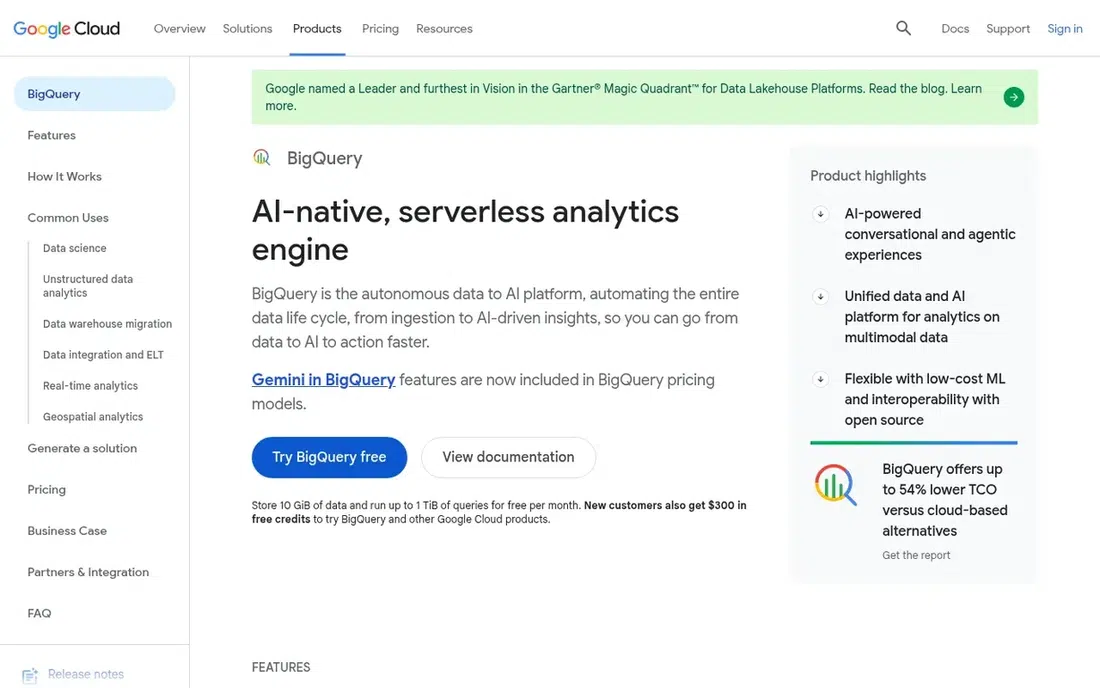
For autonomous data and AI analytics, Google BigQuery is a natural candidate. One potential downside is that costs can become unpredictable with heavy query usage, and users have limited control over the underlying infrastructure.
As for the details, Google BigQuery is described as an autonomous data and AI product that automates the whole data life cycle, enabling users to go from data to AI to action quicker. Google BigQuery shows no starting price here, so confirm the cost on the vendor site. Free options: Not stated.
Honest limits: Restricted control over infrastructure.
- Quick query performance
- Serverless architecture
- Costs can be unpredictable with heavy usage
Google Cloud Dataflow was built for streaming analytics and live processing. Google Cloud Dataflow is a completely managed streaming analytics service that cuts latency, processing time, and cost through autoscaling and live data processing.
What to check first: May need stream processing expertise.
It is aimed at organizations that require to process and analyze streaming data in live. Also, if you need a more general-purpose data warehouse, consider Google BigQuery or Amazon Redshift. Google Cloud Dataflow does not show a starting price in this comparison, so check the vendor site for current pricing. Free plan details: Not stated.
- Cuts latency and processing time
- Autoscaling capabilities
- Centred on streaming, less for warehousing
Microsoft Fabric is designed for AI-powered analytics platform. Fabric aims to ease analytics by offering a single system for several data workloads.
Limits to weigh: May need Microsoft ecosystem familiarity.
As a newer product, Fabric's features are still evolving, and it may need familiarity with Microsoft tools. Microsoft Fabric shows no starting price here, so confirm the cost on the vendor site. Free options: Free trial.
- AI-powered analytics
- Unites data and services
- Newer product, evolving features
In short, Databricks is for unified data and AI system. Databricks presents itself as a unified platform for data, analytics, and AI. It emphasizes a data-centric approach to building AI and aims to ease ETL, data warehousing, governance, and AI on a single system.
Watch-outs: May need expertise to completely use.
Even so, Databricks can be complicated to set up and may need specialized knowledge to completely utilize its capabilities. It might be overkill for small teams or straightforward use cases. For everyday use, consider alternatives like Google BigQuery if you need a more autonomous, hands-off analytics product with less configuration overhead. No starting price is listed for Databricks here; confirm pricing on the vendor site. Free options: Not stated.
- Unified system for data, analytics, AI
- Eases ETL and data warehousing
- Can be complicated for small teams
How these tools were picked
The comparison looks at four things: starting price, free access, how well the feature set matches data cloud platforms, and the main limit of each tool. Prices and plan limits come from vendor pages and can change, so confirm them on the vendor site before you buy. Tools are placed by general fit for data cloud platforms, with price clarity and free access as tie-breakers. A different team can reasonably rank them differently.
What to confirm before you sign up
- Request quotes from Amazon Athena, Databricks and the others; the list shows no fixed prices.
- Run a trial of Microsoft Fabric with real work before paying for a year; your own workflow is the best test.
- Read the limits listed for Amazon Athena first: performance can vary with data size.
- See whether Amazon Athena offers onboarding or training, and whether it is included in the price.
- Find out whether the entry plan of Amazon Redshift covers your must-haves or only a trimmed-down version.
FAQ
Can I try these options before paying?
Often, yes. Microsoft Fabric offers a free trial. Use your own data and a real task during the test, and check what the free tier or trial limits before you rely on it. All 6 picks in this data cloud platforms comparison list a starting price, free plan details and the main limits on their cards above.
What is a data cloud product?
A data cloud system is a cloud-based service that integrates data warehousing, analytics, and frequently AI capabilities to help organizations handle and analyze data at scale. It typically supplies tools for data ingestion, storage, processing, and visualization.
How are the tools for data cloud platforms ordered?
The order follows typical fit for data cloud platforms, with Amazon Athena first and Databricks last, then price clarity and free access. It is editorial judgement, not a score, so another team could rank the tools differently.
Do these tools publish their prices?
No. None of the tools, from Amazon Athena to Databricks, shows a fixed starting price here, so budget time for quotes.
Does any tool for data cloud platforms here have a free plan?
No tool in this list, Amazon Athena and Databricks included, has a permanent free plan. Microsoft Fabric offer a trial. Trials and quotes are the usual route, so plan a short evaluation period.
Sources
- https://aws.amazon.com/athena
- https://aws.amazon.com/redshift
- https://cloud.google.com/bigquery
- https://cloud.google.com/dataflow
- https://www.microsoft.com/en-us/microsoft-fabric
- https://www.databricks.com