Best Cloud-Native Data Platforms for 2026: Our 5 Vetted Picks
Searching for the best Cloud-Native data platforms? Here are 5 options with prices and free plans. Fit and flaws are laid out for each entry. Clear verdicts.
- Editor's choice
 Starburst
Governed data access without movement
Starts at$0.50 /creditVisit starburst.ioFull review - Great alternative
 Databricks
Unified data, analytics, and AI work
Starts atSee websiteVisit databricks.comFull review - Also considerMicrosoft Azure Synapse Analytics
Enterprise SQL warehousing plus big data
Starts atSee websiteVisit azure.microsoft.comFull review
Direct answer
Our first pick is Starburst, best for governed data access without movement. Listed starting prices: Starburst from $0.50 /credit. Databricks is better for unified data, analytics, and AI work, and Microsoft Azure Synapse Analytics is better for enterprise SQL warehousing plus big data. The remaining 2 options are covered below with prices and limits.
TL;DR:
- Starburst is the opening pick, best for governed data access without movement.
- Starburst stands alone as the one tool in this list with a free plan.
- Expect to ask for a quote from Databricks, Microsoft Azure Synapse Analytics, Google BigQuery and Amazon Athena; the other tools show a starting price.
- Amazon Athena fits serverless SQL queries on data in place.
- Google BigQuery comes with a trade-off: deep feature set can overwhelm newcomers.
Last checked November 2026. Prices and plan details were read from the vendors' own pages in November 2026; vendors change plans often, so confirm the current price on the vendor site before you buy.
Quick comparison
| Tool | Best for | Starts at | Free plan? | |
|---|---|---|---|---|
| Starburst | Governed data access without movement | $0.50 /credit | Yes | Visit |
| Databricks | Unified data, analytics, and AI work | See website | Not stated | Visit |
| Microsoft Azure Synapse Analytics | Enterprise SQL warehousing plus big data | See website | Not stated | Visit |
 Google BigQuery | Autonomous analytics and AI-ready warehousing | See website | Not stated | Visit |
| Amazon Athena | Serverless SQL queries on data in place | See website | Not stated | Visit |
Our 5 Cloud-Native data platforms
If you are comparing Cloud-Native data platforms, this page covers 5 tools in one place: what each is best for, what it costs to start, whether it has a free plan, and the main limit to know about.
Starburst works best for governed data access without movement. It suits organizations with data spread across plenty of systems that want a governed query layer instead of consolidating everything into one warehouse.
Where it falls short: Value relies on existing data sources.
In daily use, choose Starburst when cross-source access and governance matter more than consolidation. Starburst cost at the entry level: $0.50 /credit. Starburst includes a free tier.
- Avoids unnecessary data movement
- Links governed enterprise data to AI
- Query layer instead of a full warehouse
Databricks makes the most sense for unified data, analytics, and AI work. If you only need a straightforward SQL warehouse, a narrower service may be simpler. In practice, the breadth of the system means setup and governance decisions take real planning.
Teams without data engineering skills may find it heavy. More specifically, Databricks supplies a unified product for data, analytics, and AI, letting teams ease ETL, data warehousing, governance, and AI on a single data and AI system. This comparison lists no price for Databricks; ask the vendor. Trial and free access: Not stated.
Trade-offs to know: Overlap across features can confuse planning.
- Unified product for data and AI
- Data-centric approach to building AI
- Wide scope needs configuration effort
Microsoft Azure Synapse Analytics
Best for: Enterprise SQL warehousing plus big data
In short, Microsoft Azure Synapse Analytics is for enterprise SQL warehousing plus big data. Synapse spans multiple integrated components, so design and cost management need care, and teams outside Azure will feel friction.
Organizations wanting a single more straightforward warehouse or a multi-cloud query layer may look elsewhere. This comparison lists no price for Microsoft Azure Synapse Analytics; ask the vendor. Free options: Not stated.
The main drawbacks: Most natural inside the Azure ecosystem.
- Geared toward accelerating time to insight
- Merges SQL warehousing and big data analytics
- Several integrated components add complexity
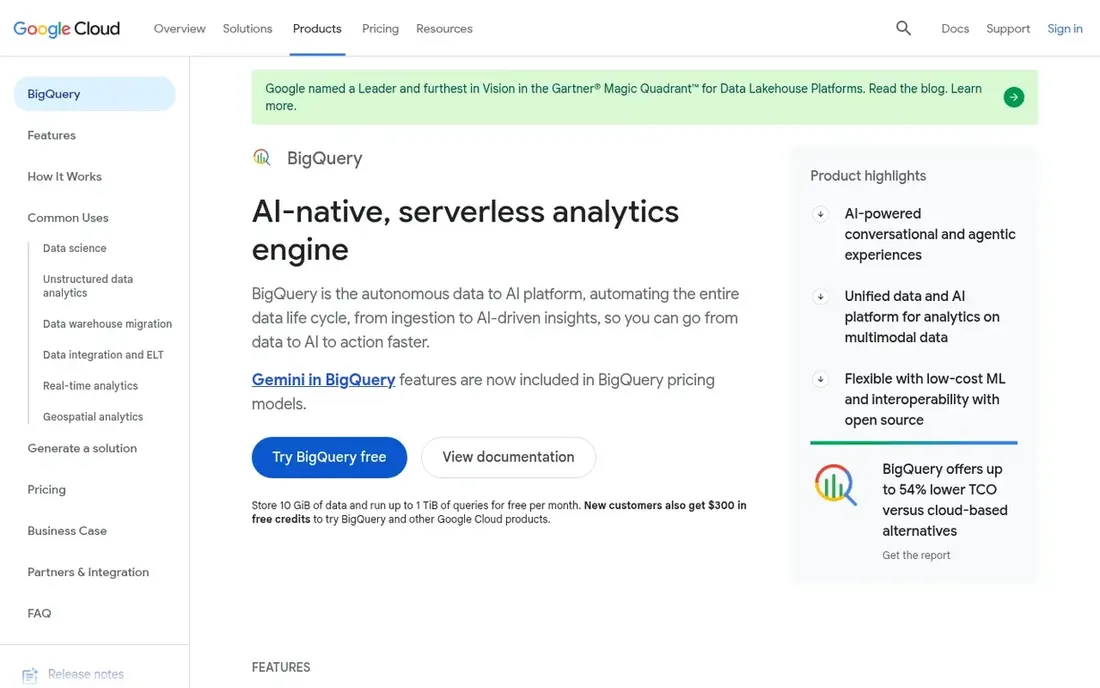
Google BigQuery targets autonomous analytics and AI-ready warehousing. Since BigQuery is deeply tied to Google Cloud, teams standardized on other clouds may find integration and cost management less natural.
Trade-offs to know: Best value inside the Google Cloud ecosystem.
What users get: Aimed at analytics and AI together. It also provides a wide surface of features that smaller teams may not need. Google BigQuery does not show a starting price in this comparison, so check the vendor site for current pricing. Free plan details: Not stated.
- Automates much of the data life cycle
- Completely managed architecture
- Deep feature set can overwhelm newcomers
Amazon Athena
Best for: Serverless SQL queries on data in place
Amazon Athena is aimed squarely at serverless SQL queries on data in place. Amazon Athena is a serverless, interactive analytics service that offers a simplified and adaptable way to analyze large volumes of data where it lives.
Watch-outs: Performance relies on how data is organized.
For everyday use, choose Athena for adaptable serverless querying instead of as your primary warehouse. Athena is a query service, not a complete warehousing platform, so persistent modeling, governance, and heavy transformation usually need other tools. Amazon Athena shows no starting price here, so confirm the cost on the vendor site. Trial and free access: Not stated.
- Interactive SQL for large datasets
- Serverless with no infrastructure to run
- Query-focused instead of a full warehouse
Selection criteria
Each tool was reviewed on what its vendor publishes: price, plan limits, core features and stated drawbacks. We did not run hands-on tests. Where a vendor does not publish a price, the entry says quote. Where a price depends on seats or billing term, the entry says so. Tools are placed by general fit for Cloud-Native data platforms, with price clarity and free access as tie-breakers. A different team can reasonably rank them differently.
What to confirm before you sign up
- Get a written quote from Databricks, Microsoft Azure Synapse Analytics, Google BigQuery and Amazon Athena; the list shows no starting price for them.
- Look at the free plan from Starburst closely: its caps decide whether it is usable for real work.
- Before choosing Starburst, weigh its main limit: query layer instead of a full warehouse.
- Involve the people who will use Starburst daily; a short pilot beats a long feature checklist.
- Work out what Databricks costs with your real seat count, add-ons and usage, not just the entry price.
FAQ
How are the tools for Cloud-Native data platforms ordered?
The order follows typical fit for Cloud-Native data platforms, with Starburst first and Amazon Athena last, then price clarity and free access. It is editorial judgement, not a score, so another team could rank the tools differently.
What makes a data system cloud-native?
Cloud-native products are meant to run in the cloud with managed infrastructure, elastic scaling, and services that separate storage from compute. This lets teams avoid provisioning servers and scale analytics work as demand changes.
Is Starburst the right pick for everyone comparing Cloud-Native data platforms?
No single tool suits every team. Starburst comes first because it fits governed data access without movement, while Databricks suits unified data, analytics, and AI work and Microsoft Azure Synapse Analytics suits enterprise SQL warehousing plus big data. Match the tool to your own size, budget and workflow before deciding.
Do these tools publish their prices?
Not all of them. Databricks, Microsoft Azure Synapse Analytics, Google BigQuery and Amazon Athena publish no starting price, so expect a quote request for those. The rest, Starburst included, show a starting price, though seats and billing terms still change the final cost.
Can I try these options before paying?
Often, yes. Starburst has a free plan. Use your own data and a real task during the test, and check what the free tier or trial limits before you rely on it.
Sources
- https://www.starburst.io
- https://www.databricks.com
- https://azure.microsoft.com/en-us/products/synapse-analytics
- https://cloud.google.com/bigquery
- https://aws.amazon.com/athena