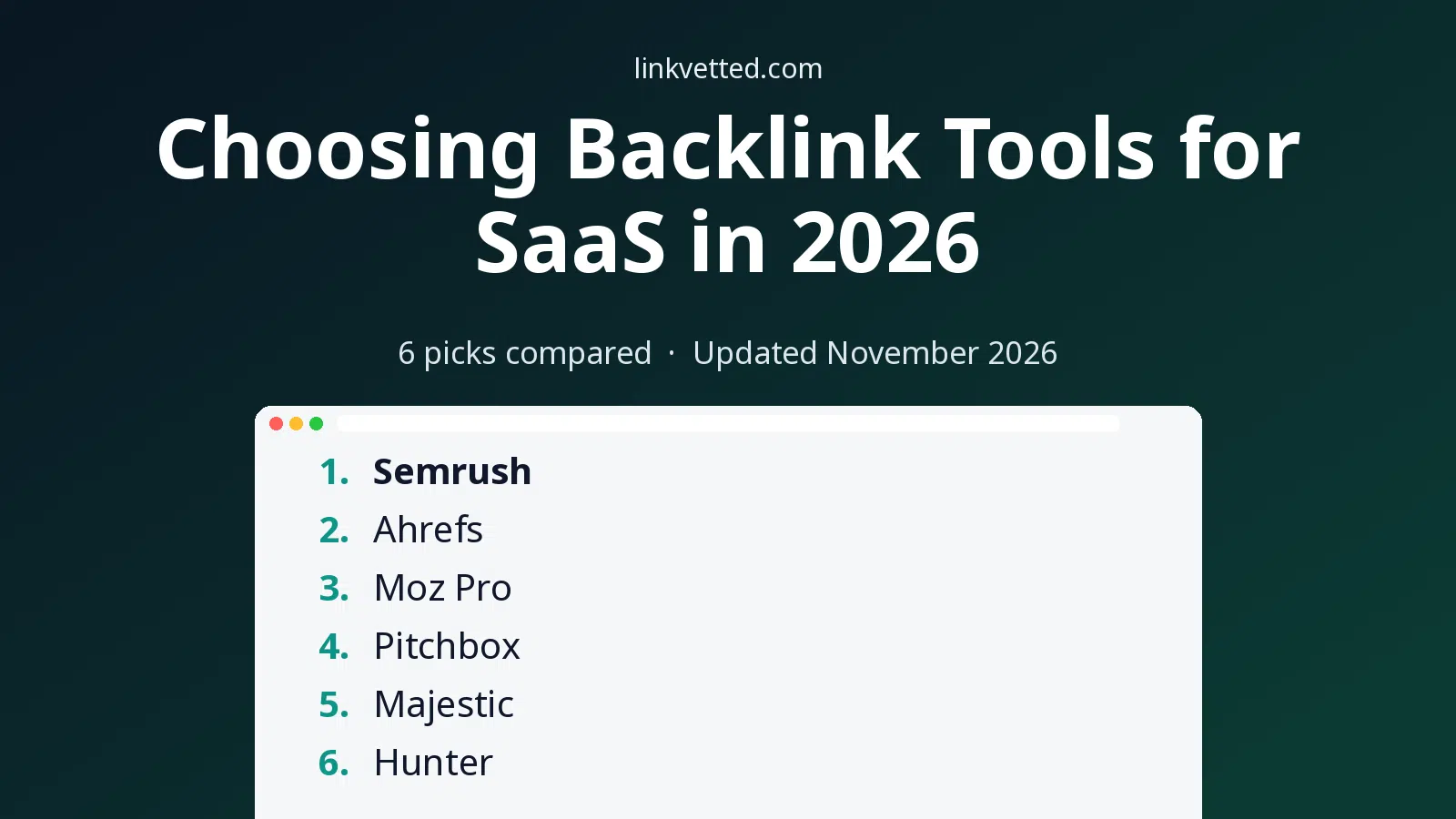
Choosing Backlink Tools for SaaS in 2026: 6 Options Compared
A practical guide to the best backlink tools for SaaS, compared from vendor documentation and public sources to help you pick the right fit.
- Editor's choice
 Semrush
All-in-one SEO and backlink work
Starts atSee websiteVisit semrush.comFull review - Great alternative
 Ahrefs
Link data depth and reporting
Starts atSee websiteVisit ahrefs.comFull review - Also consider
 Moz Pro
Beginners and simpler workflows
Starts atSee websiteVisit moz.comFull review
Direct answer
My top pick for most SaaS teams is Semrush, because its backlink index, competitor gap views and outreach-friendly exports cover the whole workflow in one place. If budget is the main constraint, Ahrefs is the stronger choice for link data depth and reporting. For teams that mainly need to find and manage prospects, Pitchbox is the better fit for outreach at scale.
TL;DR:
- SaaS link building usually mixes product-led content, comparison pages and digital PR, so a tool needs both data and prospect management.
- Backlink indexes differ between vendors, so cross-check important links in at least two sources before you report on them.
- Most SaaS teams get more value from a smaller set of tools used consistently than from a large stack nobody maintains.
- Outreach tools save time on follow-ups, but the quality of your target list still decides the outcome.
- Always confirm current pricing, seat limits and export rules on the vendor site before you commit.
Last checked November 2026. Plan prices are not quoted in this guide because they change often; see each vendor's own pricing page for current figures before you buy.
Quick comparison
| Tool | Best for | Starts at | Free plan? | |
|---|---|---|---|---|
| Semrush | All-in-one SEO and backlink work | See website | Free plan | Visit |
| Ahrefs | Link data depth and reporting | See website | Free plan | Visit |
| Moz Pro | Beginners and simpler workflows | See website | Free trial | Visit |
 Pitchbox | Outreach prospecting and follow-ups | See website | No free plan | Visit |
 Majestic | Focused backlink analysis | See website | No free plan | Visit |
 Hunter | Finding contact emails for outreach | See website | Free plan | Visit |
The best backlink tools for SaaS compared
I compared these tools from vendor documentation, public help pages and published feature lists. I did not run hands-on tests, so treat this as a starting point for your own trial, not a lab result. The picks below reflect how each tool fits common SaaS link building work.
Semrush is a broad SEO platform where backlink analysis sits alongside keyword research, site audits and rank tracking. For a SaaS team, that means one login covers the content research that usually comes before link building. It suits marketing teams that want a shared workspace rather than a single-purpose link checker.
For backlink work, the backlink audit and competitor gap views help you see who links to rival SaaS products and which pages attract links. You can filter by authority and export prospect lists for outreach. Many teams pair this with comparison and alternatives pages, then track new referring domains over time.
The limits are mostly about learning time and cost at higher usage. Solo founders or very small teams may find a lighter tool enough. Skip it if you only need a quick link lookup now and then.
- Large backlink index
- Competitor backlink gap views
- Exports that feed outreach lists
- Dense interface for new users
- Feature breadth can distract from link work
Ahrefs is known for its backlink index and site explorer, and it is a common choice for SaaS teams that report on link growth to stakeholders. The data is detailed enough to review anchor text, referring pages and link history, which helps when you audit a competitor's profile or check your own.
The link intersect view is useful for SaaS because it shows sites that link to several competitors but not to you, which makes a natural outreach shortlist. You can also monitor new and lost links and pull reports for monthly updates. Combined with content planning, it supports a steady link acquisition process.
Watch the credit system and plan limits if you run frequent large exports. Teams on tight budgets should compare tiers carefully. Skip it if you mainly need contact finding rather than link data.
- Detailed referring domain data
- Strong crawler and site explorer
- Useful link intersect reports
- Credit limits on some plans
- Premium pricing at scale
Moz Pro bundles link research with rank tracking, site audits and keyword tools. It is often the first paid SEO tool for smaller SaaS teams because the interface is approachable and the documentation is thorough. If your link building is still informal, it gives you a structured place to start.
For backlink work, Link Explorer shows referring domains, top pages and spam indicators. You can compare your profile with competitors and spot link opportunities from pages that already cite similar products. The spam score signal is a useful sanity check before you add a site to an outreach list.
The trade-off is index size and depth compared with larger rivals. Teams doing heavy link analysis may outgrow it. Skip it if you need very large exports or advanced link intersect work.
- Clear interface for newcomers
- Link explorer with spam signals
- Helpful learning resources
- Smaller link index than larger rivals
- Less depth for advanced analysis
Pitchbox is an outreach platform rather than a link index. It helps you build prospect lists, send personalized pitches and manage follow-ups in one place. SaaS teams that run regular link building campaigns, such as resource page outreach or digital PR, use it to keep track of who was contacted and when.
The workflow starts with importing prospects from a research tool, then segmenting them by campaign. You can set follow-up sequences, assign owners and track replies. For SaaS, this fits campaigns around comparison content, original data studies and expert commentary, where many contacts need consistent handling.
It does not tell you who links to whom, so you still need a data source. Small teams may find the pricing hard to justify. Skip it if your outreach volume is low or you prefer a simple spreadsheet.
- Prospect and campaign management
- Automated follow-up sequences
- Team collaboration features
- Not a backlink database
- Priced for teams rather than solo users
Majestic is a dedicated link intelligence tool. It has tracked backlinks for a long time and offers its own trust and citation metrics, which some SEOs use as a secondary quality signal. For SaaS teams that want a second opinion on a link profile, it is a useful cross-check against other indexes.
The tool is good for reviewing a competitor's link history, spotting topical clusters of referring sites and checking whether a prospect site looks trustworthy. You can export data for your own analysis. It works well alongside a broader SEO platform rather than replacing one.
It does not cover keyword research or content planning, so it is a complement, not a full stack. Some users find the interface less modern. Skip it if you want one tool for everything.
- Long-running link index
- Trust Flow and Citation Flow metrics
- Useful historical link data
- Narrower than full SEO suites
- Interface feels dated to some users
Hunter is an email finding and verification tool. It is not a backlink database, but it fills a practical gap in link building: once you have a list of target sites, you need a way to reach the right person. SaaS teams often use it to find editor or marketing contacts at publications and blogs.
The domain search shows email patterns and public addresses associated with a site, and verification helps reduce bounces before you send. In a link building workflow, this sits between prospect research and the outreach send. It pairs well with a CRM or outreach platform.
Accuracy varies by site, and some organizations hide contact details. It will not replace a data source for link discovery. Skip it if your outreach targets are already in a managed database.
- Simple email lookup
- Domain search for contact lists
- Verification features
- Not a backlink tool
- Results depend on public data
How I chose
I selected these tools by reading vendor documentation, public help centers and published feature descriptions, then matching each one to the way SaaS teams actually build links. That means looking for backlink data, competitor comparison features, export options and outreach support. I did not run hands-on tests, benchmark indexes or measure results, so my notes describe documented capabilities and typical use cases rather than verified performance.
I also weighed limits: pricing structure, plan restrictions, learning curve and whether a tool is a full platform or a single-purpose utility. A SaaS team with one marketer needs different things from a team with a dedicated link building function. Where a tool is narrow, I say so, and where a broader platform may be more than you need, I flag that too. Use this guide to shortlist, then trial the tools against your own workflow.
What to check before you buy
- Confirm how many projects, seats and exports each plan allows, since SaaS teams often share one account across content and SEO.
- Check whether the backlink index covers the sites you care about, and cross-check a few known links before trusting reports.
- Look at how competitor comparison and link gap features work, because these drive most SaaS link prospecting.
- Review export formats and API access if you plan to feed data into a CRM or outreach tool.
- Ask about link history retention if you report on lost links or profile changes over time.
- Read the cancellation and refund terms, and confirm current pricing on the vendor site before you commit.
FAQ
Do I need more than one backlink tool for a SaaS site?
Not always, but many teams use two. One tool provides link data and competitor research, while another handles outreach or contact finding. If your link building is occasional, a single platform with export options is usually enough. Add tools only when a specific step, like follow-ups or email finding, becomes a bottleneck.
Are free plans enough for SaaS link building?
Free plans are useful for learning an interface and checking a handful of links, but they usually limit projects, rows or exports. For regular competitor research and reporting, a paid tier is typically needed. Check the exact limits on the vendor site, since free plan terms change and may not cover commercial use.
How do I judge whether a backlink is worth pursuing?
Look at whether the page is relevant to your product category, whether it is edited and maintained, and whether it links to similar tools. A link from a page that genuinely lists SaaS options is more useful than a random mention. Avoid paid link schemes and private networks, which put your site at risk.
Can these tools help with digital PR for SaaS?
They help with the research and tracking side: finding sites that cover your topic, checking their link profiles and monitoring new links after a campaign. The pitching and story still come from you. Pair a backlink tool with an outreach platform and a clear angle, such as original data or expert commentary.
How often should I review my backlink profile?
A monthly review fits most SaaS teams. Check new and lost referring domains, look for unusual spikes and confirm that important campaign links are live. Quarterly, compare your profile with two or three competitors to spot gaps. Frequent checks are only useful if you act on what you find.
Sources
- https://www.semrush.com
- https://ahrefs.com
- https://moz.com
- https://pitchbox.com
- https://majestic.com
- https://hunter.io