6 Backlink Tools for Shopify Stores Worth Shortlisting in 2026
A practical guide to the best backlink tools for Shopify stores in 2026, compared from vendor documentation and public sources for outreach and link tracking.
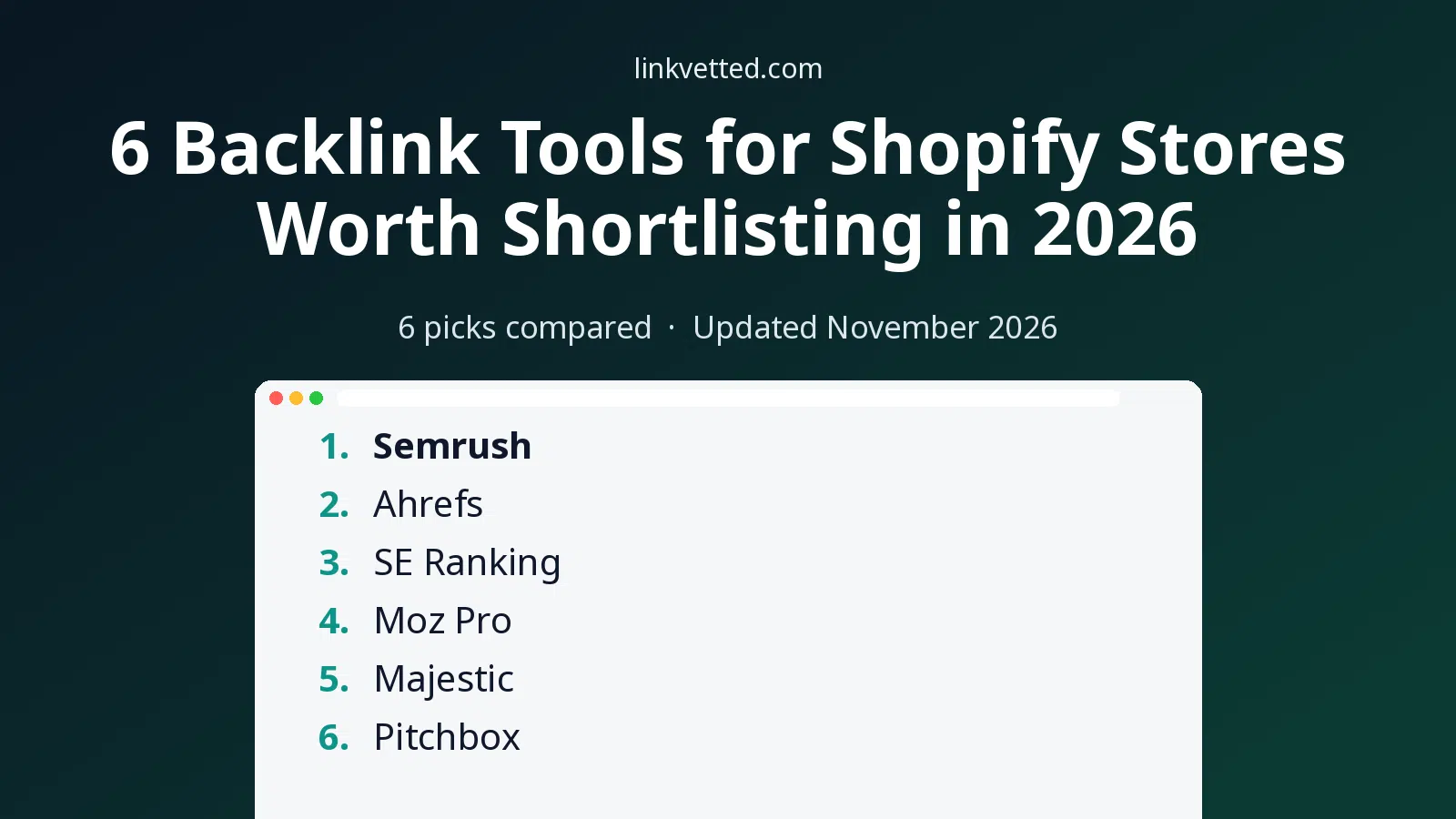
- Editor's choice
 Semrush
All-round backlink and competitor research
Starts atSee websiteVisit semrush.comFull review - Great alternative
 Ahrefs
Deep link profile analysis and audits
Starts atSee websiteVisit ahrefs.comFull review - Also consider
 SE Ranking
Budget-friendly link monitoring and research
Starts atSee websiteVisit seranking.comFull review
Direct answer
My first pick is Semrush for most Shopify stores, because its backlink index, competitor gap views and outreach-friendly prospect lists sit in one place. If you mainly need link tracking and cleanup, Ahrefs is the stronger analyzer. If your budget is tight and you want a lighter workflow, SE Ranking covers link monitoring and competitor research at a lower entry point. I compared these from vendor documentation and public sources, not hands-on tests.
TL;DR:
- A backlink tool only helps a Shopify store if it fits the way you actually earn links, whether that is product PR, supplier pages or blogger outreach.
- Backlink indexes differ between vendors, so cross-checking a prospect's link profile in a second tool avoids wasted outreach.
- Shopify stores usually need prospect discovery and competitor gap analysis more than raw link counts.
- Disavow and toxic-link features matter less for most small stores than clean prospecting and follow-up tracking.
- Every tool here lists pricing on its own site, so confirm the current plan and limits before you commit.
Last checked November 2026. Plan prices are not quoted in this guide because they change often; see each vendor's own pricing page for current figures before you buy.
Quick comparison
| Tool | Best for | Starts at | Free plan? | |
|---|---|---|---|---|
| Semrush | All-round backlink and competitor research | See website | Free plan | Visit |
| Ahrefs | Deep link profile analysis and audits | See website | No free plan | Visit |
| SE Ranking | Budget-friendly link monitoring and research | See website | Free trial | Visit |
 Moz Pro | Simple authority and spam checks | See website | Free trial | Visit |
 Majestic | Trust and citation flow review | See website | No free plan | Visit |
 Pitchbox | Managing outreach campaigns at scale | See website | No free plan | Visit |
The best backlink tools for Shopify stores compared
I put this list together by reading each vendor's documentation and public help pages, then matching features to the way small Shopify teams work. I did not run hands-on tests, so treat the notes as a starting point for your own trial. The order reflects fit for a typical store, not a scored ranking.
Semrush is a broad SEO platform with a backlink analytics section that covers referring domains, anchor text, new and lost links, and a link gap view against competitors. For a Shopify store selling physical products, the competitor gap report is often the most useful part, because it shows which blogs and review sites link to rival shops and not to yours.
In practice, you would pull a competitor's referring domains, filter for pages that look like gift guides, reviews or category roundups, and build an outreach list from there. The tool also tracks your own new and lost links over time, which helps when a product launch earns coverage and you want to see which pages picked it up.
The limits are practical: the interface takes time to learn, and the most useful competitor and outreach features sit in paid tiers. A solo store owner who only wants a monthly link check may find it more than they need.
- Large backlink index
- competitor gap tools
- built-in prospect lists
- Dense interface
- many features behind higher tiers
Ahrefs is known for its backlink data and site audit tools. For Shopify stores, the referring domain report and the anchor text breakdown help you see whether links point at product pages, collections or the homepage, which matters when you want category pages to rank.
The workflow I would suggest is to audit your own profile first, then look at two or three competitors in the same niche. You can export referring domains, check which ones look like genuine editorial coverage, and note the page type that earned the link. That gives you a realistic target list rather than a random set of domains.
The main drawback is cost, since there is no free plan and the entry tier is aimed at people who will use it regularly. A store that only checks links once a quarter may not get enough value.
- Strong link index
- clear anchor and referring domain reports
- useful site audit
- No free plan
- higher entry cost
SE Ranking is an SEO platform with rank tracking, competitor research and a backlink checker. It suits smaller Shopify stores that want a single dashboard for rankings and links without paying for an enterprise suite.
For link work, you can review your own referring domains, compare against competitors, and monitor new and lost links. The reporting side is useful if you work with a freelancer or agency and want a simple monthly summary of what changed.
Its link index is smaller than Semrush or Ahrefs, so some smaller blogs may not appear. If you need the deepest possible data set, look elsewhere; if you need a workable list at a lower cost, it is worth a trial.
- Lower entry point
- competitor backlink research
- clear reporting
- Smaller index than the leaders
- fewer advanced link filters
Moz Pro includes Link Explorer, which shows referring domains, anchor text and a spam score for domains. Store owners who find other tools overwhelming often prefer Moz because the reports are simpler to read.
For a Shopify store, the practical use is checking whether a blog or directory that wants to link to you looks legitimate. You can look at the domain's link profile and spam score before agreeing to a collaboration or a product review. It is a screening tool as much as a research tool.
The trade-off is freshness: Moz's link index is generally updated less frequently than some competitors, so very recent links may take longer to appear. Stores that need up-to-the-minute link alerts should compare with another tool.
- Understandable authority metrics
- spam score checks
- clean reports
- Link index refreshed less often
- fewer prospecting features
Majestic focuses almost entirely on links, with its Trust Flow and Citation Flow metrics and a large historical index. It is a specialist tool rather than an all-in-one SEO platform.
For Shopify stores, it is most useful when you want a second opinion on a prospect's link quality. If a blogger or review site asks for a product in exchange for coverage, checking their Trust Flow and top linking domains in Majestic gives you a quick sense of whether the site has real editorial links.
The limits are clear: it does not do rank tracking, content or outreach management, and the interface feels older than newer platforms. It works best as a companion to a broader tool, not a standalone purchase for a small store.
- Long-standing link index
- trust and citation metrics
- useful historical data
- Narrow feature set
- dated interface
Pitchbox is an outreach and blogger relationship platform. It helps you build prospect lists, send and track email sequences, and manage follow-ups in one place. It does not provide its own backlink index, so you pair it with a research tool.
A Shopify store running regular product PR or blogger collaborations can use it to keep track of who was contacted, who replied and which placements went live. That structure matters once you move past a handful of manual emails.
The drawback is fit: it is designed for teams running ongoing campaigns, and the pricing reflects that. A solo owner sending a few pitches a month will likely do better with a spreadsheet and a research tool.
- Prospect management
- outreach sequences
- campaign reporting
- Built for teams
- no backlink index of its own
How I chose
I built this list from vendor documentation, public help pages and product descriptions, then matched each tool to common Shopify store tasks: finding competitor links, screening prospects, tracking new and lost links, and managing outreach. I did not run hands-on tests, so the notes describe documented features and typical workflows rather than measured results. Where a vendor's public material was unclear, I left the detail out rather than guess.
I also weighed limits, not just features. A tool that is excellent for an agency may be overkill for a store owner who checks links monthly, and a cheaper tool with a smaller index may still be the right call for a small catalogue. The order reflects general fit for a Shopify store doing its own link building, and you should treat it as a shortlist to trial rather than a final verdict. Pricing and plan details change, so always confirm on the vendor's own site.
What to check before you buy
- Confirm the tool indexes the kind of sites that link to your niche, such as gift guides, review blogs or supplier directories, not just news sites.
- Check whether you can export referring domains and filter by page type, since product and collection pages need different targets than the homepage.
- Look at how often the link index updates if you need to report new coverage after a launch.
- Decide whether you need outreach management built in or will handle email separately.
- Check the plan limits on projects, rows exported and historical data before committing.
- Confirm the tool supports the markets you sell in, since link data for smaller countries can be thinner.
FAQ
Do Shopify stores need a paid backlink tool?
Not always. If you only want to see who links to you, the free tiers of some tools and Shopify's own analytics give a basic view. A paid tool earns its place when you are actively prospecting, comparing against competitors or reporting link growth over time.
Can I use these tools without an SEO background?
Yes, most have guided reports and help documentation. Start with one competitor's referring domains, filter for pages that look like genuine editorial coverage, and build a short outreach list. Avoid bulk emailing and focus on a handful of relevant sites.
Is a big backlink index always better?
No. A large index helps you find more prospects, but relevance matters more than volume. A smaller index that covers your niche well can be more useful than a huge one full of sites that would never link to a Shopify store.
How do I judge whether a linking site is worth pursuing?
Look at whether the site publishes real content for real readers, whether it links to other stores in your category, and whether its links come from editorial pages rather than directories. Use a second tool to cross-check the domain's profile before you invest time in a pitch.
Do these tools guarantee rankings?
No tool can promise rankings. They help you find prospects, screen sites and track links, but results depend on your content, relevance and how competitive your category is. Treat link building as one part of a wider store marketing plan.
Sources
- https://www.semrush.com
- https://ahrefs.com
- https://seranking.com
- https://moz.com
- https://majestic.com
- https://pitchbox.com
Related guides
- Best Abandoned Cart Recovery Software for Shopify Stores for 2026: Our 5 Vetted Picks
- Best AI Shopify Designers Software in 2026: Prices, Free Plans and 5 Picks
- The 5 Best AI Shopify Photographers Software in 2026, Ranked
- 5 Best Conversion Rate Optimization Tools for Shopify for 2026, Vetted and Compared