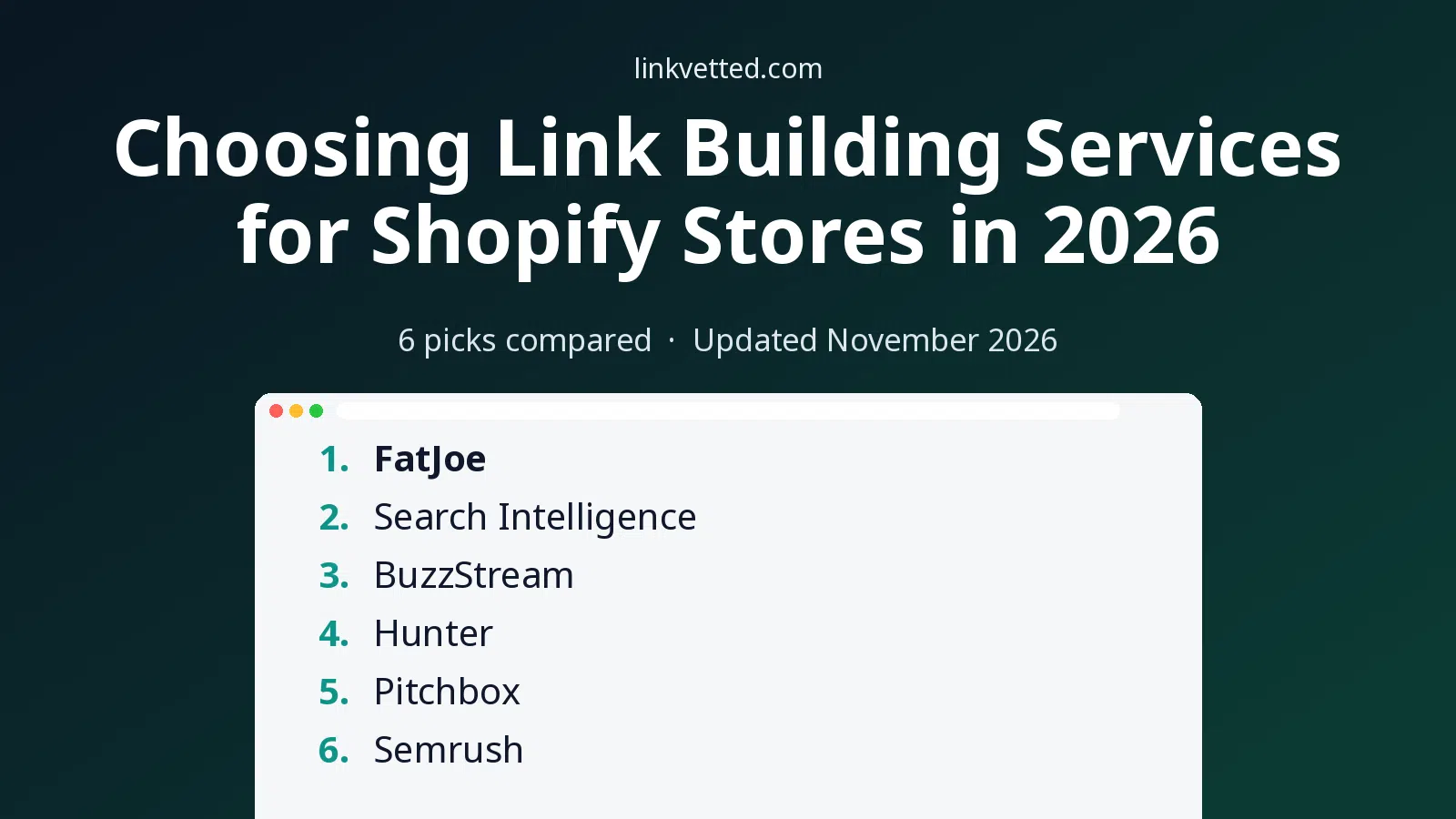
Choosing Link Building Services for Shopify Stores in 2026: 6 Options Compared
A practical guide to the best link building services for Shopify stores in 2026, compared from vendor documentation and public sources.
- Editor's choice
 FatJoe
Managed link packages for store owners
Starts atSee websiteVisit fatjoe.comFull review - Great alternativeSearch Intelligence
Editorial links at scale
Starts atSee websiteVisit searchintelligence.comFull review - Also consider
 BuzzStream
Digital PR outreach you run yourself
Starts atSee websiteVisit buzzstream.comFull review
Direct answer
My top pick is FatJoe because it publishes clear link packages and outreach details that suit store owners who want a managed service. For editorial placements at scale, I point people to Search Intelligence, and for digital PR with journalist outreach, I suggest BuzzStream. Each one fits a different budget and workload, so the right choice depends on whether you want done-for-you links, content-led PR, or outreach software you run yourself.
TL;DR:
- Managed link services save time, but you still need to check every placement before it goes live.
- Shopify stores often compete with product pages, so category and collection URLs deserve links too.
- Digital PR works best when you have a story, data, or a product angle journalists can use.
- Outreach software only pays off if you can commit to sending and following up on emails.
- Always ask for sample placements and confirm links are live, indexed, and relevant before you pay.
Last checked November 2026. Plan prices are not quoted in this guide because they change often; see each vendor's own pricing page for current figures before you buy.
Quick comparison
| Tool | Best for | Starts at | Free plan? | |
|---|---|---|---|---|
| FatJoe | Managed link packages for store owners | See website | Not stated | Visit |
| Search Intelligence | Editorial links at scale | See website | Not stated | Visit |
| BuzzStream | Digital PR outreach you run yourself | See website | Free trial | Visit |
 Hunter | Finding contact emails for outreach | See website | Free plan | Visit |
 Pitchbox | Outreach campaigns for agencies and teams | See website | Not stated | Visit |
 Semrush | SEO data plus link outreach tools | See website | Free plan | Visit |
The best link building services for Shopify stores compared
I put this list together from vendor documentation and public sources, not from hands-on tests. I looked at what each service says it delivers, how the workflow fits a Shopify store, and where the limits sit. Treat it as a starting point for your own checks and conversations with each vendor.
FatJoe is a link building service that sells placements in packages, often with content included. It suits Shopify owners who do not want to run outreach themselves and prefer to order a set number of links and let the vendor handle prospecting and placement. The model is straightforward: you pick a package, share your target URLs and topics, and the team works through its publisher network.
For a Shopify store, the useful part is that you can point links at collection pages as well as blog posts. Product and category pages often need authority to rank, and a managed service can spread links across those URLs if you ask. I would give clear instructions on anchor text and target pages rather than letting the vendor choose everything.
The limit is control. You are trusting the vendor's publisher list, and you may not get to approve every site in advance. If you want to vet each domain yourself, skip this and run your own outreach instead.
- Simple package ordering
- Clear outreach and placement process
- Options for content-led links
- Less control over individual sites
- Placement quality varies by package
Search Intelligence
Best for: Editorial links at scale
Search Intelligence is a digital PR and link building agency that works on editorial placements. It fits Shopify brands that have a story to tell, such as a product launch, a survey, or a seasonal angle, and want coverage in online publications. The team plans campaigns and pitches them to journalists and editors on your behalf.
For ecommerce, this works well when you can supply data or a strong hook. A store selling outdoor gear, for example, might run a small survey and pitch the results. The agency handles the pitching and placement, which saves you from building media lists. I would ask how they report on placements and whether you see the full list of target publications.
The main drawback is that pricing is quote-based, so you need a call before you know the budget. Smaller stores with no story angle may find it hard to get traction. Skip it if you want cheap, fast links and nothing else.
- Focus on editorial placements
- Campaign planning support
- Suits brands wanting volume
- Quote-based pricing
- Less suited to very small budgets
BuzzStream is outreach software rather than a done-for-you link service. It helps you build prospect lists, track conversations, and manage follow-ups with bloggers, journalists, and site owners. It suits Shopify stores with someone who can spend a few hours a week on outreach and wants a organised system instead of a spreadsheet.
The workflow is practical: you find prospects, log their details, send personalised pitches, and track replies. For a store, that could mean pitching product-focused gift guides, review sites, or niche blogs in your category. Because it is software, the quality of the links depends on the list you build and the pitches you write.
The limit is obvious: you still do the work. If nobody on your team can commit to outreach, the tool will sit unused. Skip it if you want links delivered without your involvement.
- Built for blogger and journalist outreach
- Contact and conversation tracking
- Team-friendly workflow
- You do the prospecting and pitching
- Needs consistent time each week
Hunter is an email finding tool. You enter a domain and it returns public email addresses and patterns, which you can use to build an outreach list. For Shopify stores doing their own link building, it removes the tedious step of hunting for editor or blogger contacts one by one.
It fits early-stage outreach: you have a list of target sites, and Hunter helps you find the right person to email. It pairs well with outreach software or a simple CRM. I would still verify addresses before sending, since public data can be out of date.
The limit is scope. Hunter does not place links, write pitches, or track replies. It is one step in a longer process. Skip it if you already have contact data or you are buying managed links.
- Finds and verifies email addresses
- Works with domain searches
- Simple to use alongside a CRM
- Email finding only
- No link placement or outreach tracking
Pitchbox is outreach and blogger relationship software aimed at agencies and in-house teams. It manages prospect lists, sequences, and reporting in one place. For a Shopify store with a marketing team or an agency partner, it can keep link campaigns organised and measurable.
The useful part for ecommerce is repeatable campaigns. You can build a list of niche blogs and review sites, run a sequence, and track which pitches lead to placements. That structure helps when you want to pitch seasonal campaigns, such as holiday gift guides, more than once a year.
The drawback is setup. You need to learn the tool and keep prospect lists clean. Small stores sending a handful of emails a month will not get much from it. Skip it unless you have regular outreach volume.
- Prospect management and email automation
- Campaign reporting
- Suits teams with steady volume
- Setup takes time
- Overkill for occasional outreach
Semrush is an SEO platform with backlink analysis, keyword research, and content and outreach tools. For a Shopify store, it helps you see who links to competitors, find gaps, and plan which pages need links. It is not a managed link service, but it supports the work if you run campaigns in-house.
The backlink data is the main draw. You can study competitor link profiles, spot relevant blogs and publications, and build a target list. Combined with outreach tools, that gives you a workflow from research to contact. I would use it to decide which collection and product pages deserve links first.
The limit is breadth. You pay for a large suite, and link building is only one part. Stores that just want links placed may find it indirect. Skip it if you have no one to act on the data.
- Backlink and competitor data
- Outreach and content tools in one suite
- Useful for planning target pages
- Link building is one part of a large suite
- Can be more than a small store needs
How I chose
I compared these services from vendor documentation and public sources. I did not run hands-on tests, and I have not used every tool on a live Shopify store. Instead, I read what each vendor says it offers, checked how the workflow fits an ecommerce site, and noted where the limits sit. That means the list reflects fit and transparency more than measured results.
My method was to separate managed services from software. FatJoe and Search Intelligence deliver placements, while BuzzStream, Hunter, Pitchbox, and Semrush support work you do yourself. I also looked at whether each option can target collection pages, not just blog content, because Shopify stores often need links to commercial URLs. Where pricing is quote-based or unclear, I say so rather than guess. Use this guide to shortlist vendors, then ask each one for samples and references before you commit.
What to check before you buy
- Ask for sample placements and confirm the links are live and indexed.
- Check whether the vendor can link to collection and product pages, not only blog posts.
- Confirm you can approve target sites or at least see the full list before placement.
- Ask how they handle anchor text and whether you can set the wording.
- Check the reporting: do you get a placement list with URLs and dates?
- Confirm the contract terms, including replacement policy if a link is removed.
FAQ
Are paid links safe for Shopify stores?
Paid placements carry risk if they look like link schemes. Links that are clearly disclosed as sponsored or advertising should use the right attributes. Editorial links earned through PR are safer. I would avoid any vendor promising guaranteed rankings or selling links from unrelated sites. Check each placement and keep records of what you paid for.
How many links does a new Shopify store need?
There is no fixed number. A new store usually benefits from a small set of relevant links to its homepage and key collections before scaling up. Quality and relevance matter more than volume. I would start with a handful of placements from sites in your niche, then review rankings and traffic before ordering more.
Can I build links to collection pages?
Yes, and for many stores it is worth doing. Collection pages often target commercial keywords, so links to those URLs can support rankings. Mix them with links to the homepage and useful blog content. Avoid pointing every link at the same page, and keep anchor text natural.
Do I need an agency or can I do outreach myself?
It depends on time and skills. If you can spend a few hours a week finding prospects and writing pitches, software like BuzzStream or Pitchbox can support you. If not, a managed service like FatJoe saves time but gives you less control. Many stores start in-house and move to an agency as volume grows.
How do I judge link quality?
Look at relevance, traffic, and whether the site publishes real content for readers. A link from a niche blog with an engaged audience is usually better than one from a general directory. Check that the page is indexed, the link is not buried in a sponsored block, and the site is not part of a link network.
Sources
- https://fatjoe.com
- https://searchintelligence.com
- https://www.buzzstream.com
- https://hunter.io
- https://pitchbox.com
- https://www.semrush.com
Related guides
- Best Abandoned Cart Recovery Software for Shopify Stores for 2026: Our 5 Vetted Picks
- Best AI Shopify Designers Software in 2026: Prices, Free Plans and 5 Picks
- The 5 Best AI Shopify Photographers Software in 2026, Ranked
- 5 Best Conversion Rate Optimization Tools for Shopify for 2026, Vetted and Compared