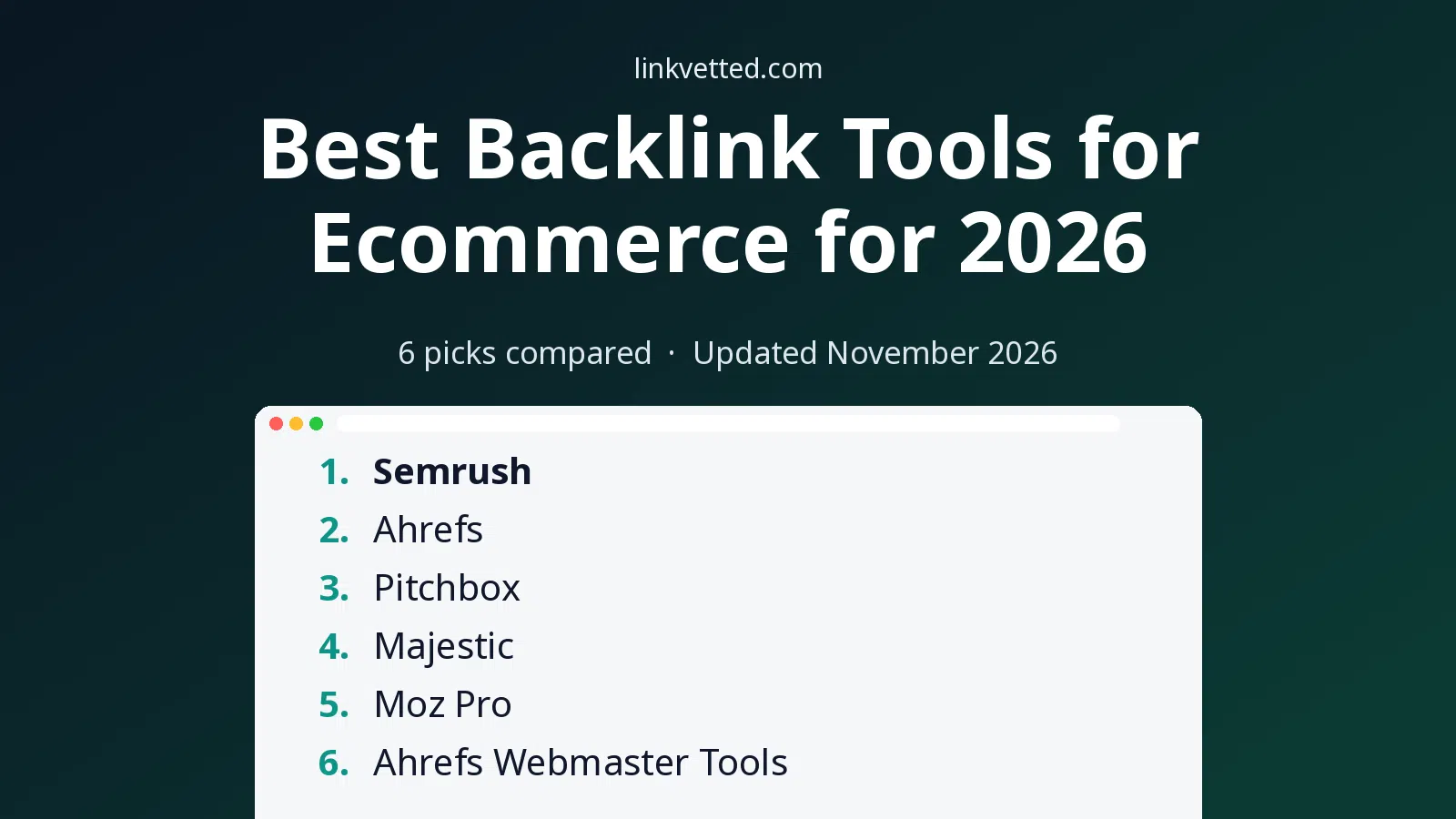
Best Backlink Tools for Ecommerce for 2026: Our 6 Vetted Picks
A practical look at the best backlink tools for ecommerce stores, compared from vendor documentation and public sources, with limits and buying checks.
- Editor's choice
 Semrush
Competitor and link gap research
Starts atSee websiteVisit semrush.comFull review - Great alternative
 Ahrefs
Deep backlink index analysis
Starts atSee websiteVisit ahrefs.comFull review - Also consider
 Pitchbox
Running outreach campaigns at scale
Starts atSee websiteVisit pitchbox.comFull review
Direct answer
My first pick is Semrush, because its backlink index, competitor research and link gap views fit the way ecommerce teams compare product and category pages. For outreach at volume, Pitchbox is the stronger fit. If budget is tight and you mainly need to check and monitor links, Ahrefs Webmaster Tools covers the basics. I compared these from vendor documentation and public sources, not hands-on tests.
TL;DR:
- Ecommerce link work is mostly about category and product pages, so tools that show link gaps by URL folder are more useful than generic domain scores.
- A backlink checker tells you what exists; an outreach tool manages the emails and follow-ups that create new links.
- Free tiers are useful for monitoring your own site but rarely enough for competitive link research across a large catalogue.
- No tool guarantees rankings, and link quality still depends on relevance, placement and editorial context.
- Check how each vendor handles large sites, since ecommerce stores often have thousands of indexable URLs.
Last checked November 2026. Plan prices are not quoted in this guide because they change often; see each vendor's own pricing page for current figures before you buy.
Quick comparison
| Tool | Best for | Starts at | Free plan? | |
|---|---|---|---|---|
| Semrush | Competitor and link gap research | See website | No free plan | Visit |
| Ahrefs | Deep backlink index analysis | See website | No free plan | Visit |
| Pitchbox | Running outreach campaigns at scale | See website | No free plan | Visit |
 Majestic | Trust and citation flow analysis | See website | No free plan | Visit |
 Moz Pro | Learning core link metrics | See website | Free trial | Visit |
 Ahrefs Webmaster Tools | Free monitoring of your own store | See website | Free plan | Visit |
The best backlink tools for ecommerce compared
I put this list together from vendor documentation, public product pages and published help material. I did not run hands-on tests, and I have not measured results for any store. The notes below describe what each tool says it does and where it tends to fit an ecommerce workflow.
Semrush is an all-in-one SEO platform with a backlink analytics section. For an ecommerce store, the useful part is comparing your domain against competitors and filtering referring domains by page type, so you can see whether rivals earn links to category pages, buying guides or product launches. It suits in-house marketers and agencies managing several stores.
The link gap view is where ecommerce work usually starts. You enter a few competitor domains, then look for sites that link to them but not to you. From there you can filter by authority and traffic, export the list, and pass it to whoever runs outreach. Semrush also tracks new and lost links, which matters when a supplier page or press mention disappears.
The main limit is cost and complexity. A small store with one site and a modest link budget may find the interface heavier than needed. Skip it if you only want a quick check of who links to you.
- Large backlink index
- competitor comparison views
- built-in outreach support
- Dense interface
- plan limits on projects
Ahrefs is known for its backlink index and site explorer. Ecommerce teams use it to review link history, spot which pages attract links, and study how competitors structure internal links toward money pages. It pairs well with a technical audit when you are cleaning up a large catalogue.
For link building, the referring domains report and the link intersect feature help you find sites that link to several competitors. You can filter by language, traffic and whether the link is dofollow. The history view is handy for spotting links that were removed, which happens often with product roundups and gift guides.
The trade-off is plan limits. Heavy research across many competitors can use up credits quickly. Skip it if your link work is light or you mainly need outreach management rather than data.
- Detailed referring domain data
- strong crawl and site audit tools
- useful anchor and link history views
- Credit-based limits on some plans
- premium pricing
Pitchbox is an outreach platform rather than a backlink checker. You import prospect lists, build email sequences, and track replies and follow-ups in one place. For ecommerce stores that pitch product roundups, gift guides and category features, it removes the spreadsheet work that slows campaigns down.
The typical workflow is to pull prospect URLs from a research tool, enrich contact details, then run a sequence with a first email and two or three follow-ups. Pitchbox keeps the status of each prospect visible, which helps when several people pitch the same sites. It also helps you avoid contacting the same editor twice.
The limit is that it does not find prospects for you. You still need a data source and a reason for each pitch. Skip it if you send a handful of emails a month.
- Manages prospecting and follow-ups
- campaign templates
- team workflow features
- Not a link database
- needs a separate research source
Majestic has built its reputation on link data and its trust and citation flow metrics. Ecommerce SEOs use it to judge whether a linking site looks reputable, and to compare link profiles across competitors. The historical index is useful when you want to see how a domain's links changed over time.
In practice, you might use Majestic to screen a prospect list before outreach, checking whether a site's link profile looks natural. The bulk backlink checker lets you paste several domains and compare them side by side, which is quicker than opening each one.
The interface is less polished than newer tools, and it does not manage outreach. Skip it if you want one platform for research, auditing and email.
- Long-running link history
- topical trust flow metrics
- bulk comparison tools
- Dated interface
- fewer workflow features
Moz Pro includes link research alongside keyword and site tools. Its domain authority metric is widely used as a rough comparison point, and the link explorer shows referring domains, anchor text and spam signals. It suits smaller ecommerce teams that are new to link work and want plain explanations.
For a store, the useful views are the linking domains report and the comparison against a competitor. You can sort by authority and spot sites that look worth a pitch. Moz also flags potentially spammy links, which helps when you are reviewing an old profile.
The main limit is index size, so some smaller or newer sites may show fewer links than they have. Skip it if you need the largest possible dataset or advanced outreach features.
- Clear explanations of metrics
- approachable interface
- combines link and on-page data
- Smaller link index than some rivals
- fewer ecommerce-specific views
Ahrefs Webmaster Tools is a free product for site owners who verify ownership. It shows backlinks pointing to your domain, site audit issues and some performance data. For a small ecommerce store, it is a sensible starting point before paying for a full platform.
The practical use is monitoring. You can see new links as they appear, catch links that drop off, and check whether a page you care about has earned anything. It also surfaces technical issues that affect how crawlers see your pages, which matters on large catalogues.
The limit is clear: it covers only sites you verify, so you cannot research competitors. Skip it if you need prospect lists or outreach management.
- Free for verified sites
- shows backlinks and site health
- alerts on new and lost links
- Only your own verified sites
- limited competitor research
How I chose
I started from vendor documentation and public product pages, then looked at how each tool describes its backlink data, filtering options and outreach features. I focused on what matters for ecommerce: whether you can compare category and product URLs, filter referring domains, and move from research into a pitch. I also noted plan limits and free tiers where the vendor states them.
I did not run hands-on tests, and I have not measured outcomes for any store. Where a tool's documentation was unclear, I left the claim out rather than guess. The list favours tools with a public, verifiable homepage and a clear use case, and I have noted the main drawback for each so you can rule options out quickly.
What to check before you buy
- Whether the tool lets you filter backlinks by URL path, so you can separate category pages from blog posts.
- How many projects or domains your plan allows, since ecommerce teams often track several stores or regional sites.
- Whether link data is refreshed often enough for your reporting cycle, and how the vendor describes its crawl.
- If you need outreach, check whether the tool sends email itself or only exports lists.
- Export limits and API access, which matter if you feed data into a spreadsheet or dashboard.
- Trial terms and cancellation rules, so you can test the workflow before committing.
FAQ
Do ecommerce stores need a paid backlink tool?
Not always. If you only want to monitor links to your own store, a free verified-site tool covers the basics. Paid tools become useful when you need competitor research, prospect lists or outreach management across a large catalogue.
Can a backlink tool guarantee rankings?
No. These tools report link data and help you manage outreach. Rankings depend on many factors, and no vendor can promise a position. Treat link data as one input, not a result.
What is the difference between a backlink checker and an outreach tool?
A checker shows links that already exist, including referring domains and anchor text. An outreach tool manages the emails and follow-ups that ask for new links. Many teams use both, pulling prospects from one and pitching through the other.
How do I judge link quality for a product page?
Look at whether the linking page is relevant to your product, whether the link sits in editorial content, and whether the site looks maintained. Avoid judging on a single metric. A relevant niche page can be more useful than a high-authority general site.
Can I use these tools for multiple storefronts?
Most paid plans support several projects or domains, but limits vary. Check the vendor's plan details before you commit, especially if you run regional stores with separate domains or subfolders.
Sources
- https://www.semrush.com
- https://ahrefs.com
- https://pitchbox.com
- https://majestic.com
- https://moz.com
- https://ahrefs.com/webmaster-tools