Best Blog Platform for Monetization in 2026: 7 Tools Compared
7 options for the best blog platform for monetization, with entry costs, free tiers and the buyer each one serves. Pros and cons for every tool. Start here.

- Editor's choice
 Ghost
Teams comparing choices in this category
Starts at$15 per month (billed yearly)Visit ghost.orgFull review - Great alternative
 beehiiv
Newsletters that stack ads, subscriptions and boosts
Starts at$49 a month (billed yearly)Visit beehiiv.comFull review - Also consider
 Vocal.Media
Per-read payouts with no audience required
Starts at$9.99 per month (Vocal+ optional)Visit vocal.mediaFull review
Direct answer
For teams comparing choices in this category, Ghost is where this list starts. If your case is different, beehiiv suits newsletters that stack ads, subscriptions and boosts and Vocal.Media suits per-read payouts with no audience required. The full list of 7 tools follows, with prices and free plan facts.
TL;DR:
- The list opens with Ghost, aimed at teams comparing choices in this category.
- One limit worth knowing about Ghost: managed hosting begins at $15 per month with no permanent free level.
- Wix is the one to check for straightforward blogs with built-in marketing tools.
- The lowest published monthly entry price here is $5 per month, from Medium.
- 6 out of 7 tools include a free plan, among them beehiiv, Vocal.Media, Kit and Substack.
Quick comparison
| Tool | Best for | Starts at | Free plan? | |
|---|---|---|---|---|
| Ghost | Teams comparing choices in this category | $15 per month (billed yearly) | Free trial (14 days) | Visit |
| beehiiv | Newsletters that stack ads, subscriptions and boosts | $49 a month (billed yearly) | Yes | Visit |
| Vocal.Media | Per-read payouts with no audience required | $9.99 per month (Vocal+ optional) | Yes | Visit |
 Kit | Creators monetizing through email funnels and digital products | $39 per month (billed monthly) | Yes | Visit |
 Substack | Premium newsletters with zero upfront cost | $0 (10% fee on premium subscriptions) | Yes | Visit |
 Medium | Writers earning from an existing reader pool | $5 a month (membership) | Yes | Visit |
 Wix | Straightforward blogs with built-in marketing tools | $17 a month (billed annually) | Yes | Visit |
Blog Platform for Monetization, one by one
Short on time? The summary and table above give the quick view of 7 tools for blog platform for monetization, and the profiles that follow give the detail behind each entry.
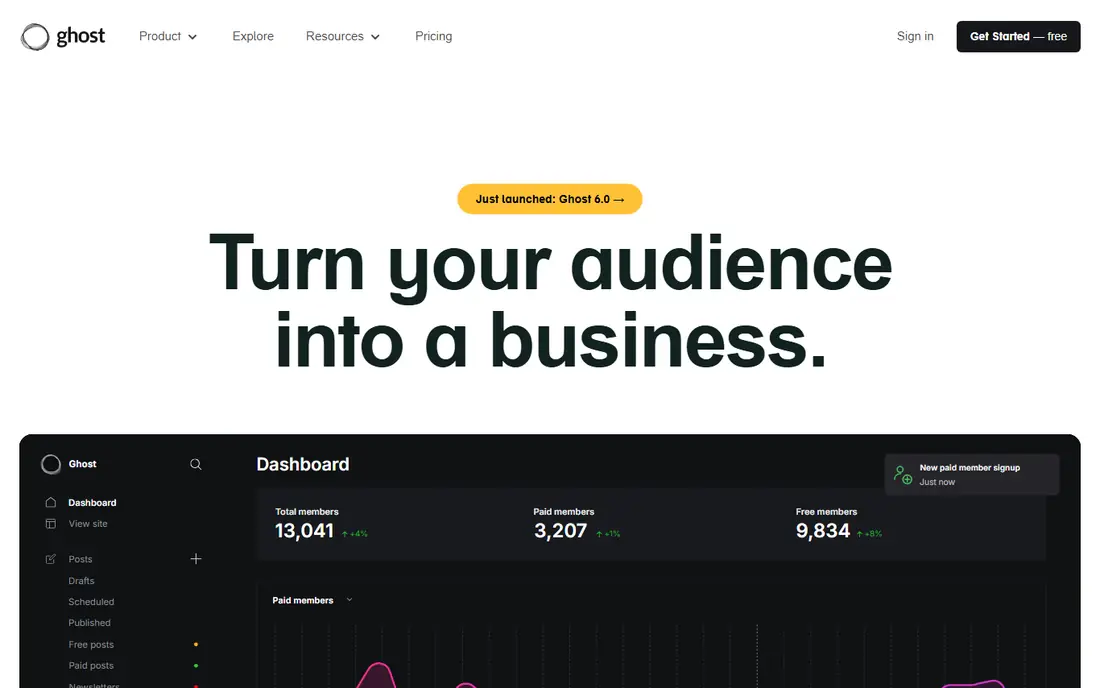
Ghost is a good fit for teams comparing choices in this category. Support runs on documentation and forums instead of phone lines. Also, pricing changed in 2026.
The Starter plan is now $15 per month billed annually (up from $9), handling up to 500 members. That is still cheap compared with a percentage cut once revenue grows. It performs best for subscription firms where the flat fee stays small next to income, and for technically comfortable users who may self-host to cut costs further. Ghost cost at the entry level: $15 per month. Free plan details: Free trial (14 days).
Points against: Smaller theme and plugin ecosystem than WordPress.
- Clean editor with memberships and newsletters built in
- Open source with a free self-hosted choice
- Premium member features need Stripe
Pick beehiiv if this describes you: newsletters that stack ads, subscriptions and boosts. beehiiv was built as a direct answer to Substack's revenue cut. In daily use, the pricing math favors beehiiv once you earn real money.
Beyond that, at 1,000 subscribers the Lite plan is $49 a month billed yearly, and Pro is $95, and that stays flat whereas revenue grows. Worth adding: past 50,000 subscribers the monthly price climbs steeply, so large lists should model costs against expected income. Also, the built-in website is serviceable for a newsletter home but not a replacement for a full content site. Pick beehiiv if you run a newsletter-first business and want subscriptions plus ad revenue without giving up a percentage. On cost, beehiiv starts like this: $49 per month. beehiiv offers a free plan.
Honest limits: Pricing jumps sharply as the list grows past 50,000.
- Built-in ad network for fund revenue
- Free plan includes up to 2,500 subscribers
- Premium plans needed for real monetization features

Vocal.Media makes the most sense for per-read payouts with no audience required. Vocal.Media pays writers straight for reads: $3.80 per 1,000 reads on the free plan, or $6.00 per 1,000 reads with the Vocal+ membership at $9.99 per month. As for the details, the honest math is sobering.
There is no audience threshold to start earning, and readers can tip stories. In practice, Vocal lacks Medium's domain authority and built-in readership, so most writers must promote their own work to get reads at all. Themed writing challenges with cash prizes provide active writers another way to earn. Price to start with Vocal.Media: $9.99 per month. Vocal.Media has a free plan.
Honest limits: Traffic depends heavily on your own promotion.
- Writing challenges offer additional prize money
- Free to publish
- Low per-read rates
Kit is a good fit for creators monetizing through email funnels and digital products. Kit, formerly ConvertKit, is an email product instead of a blogging tool. But it earns its place since email is where plenty of creators actually make money.
Where it is weaker: Free plan limits automations; premium plans scale with subscriber count.
Kit Commerce lets you sell digital products, premium newsletters and subscriptions at a 0.6% transaction fee plus card processing, far below Substack's 10%. As for the details, you pair it with a site on WordPress, Ghost or similar, and premium pricing rises with list size. Beyond that, the free Newsletter plan handles up to 10,000 subscribers with unlimited broadcasts, landing pages and forms. Worth adding: pick Kit if your monetization plan centers on email: selling courses, ebooks or premium newsletters to a list you own. The main limit is that Kit is not a place to publish a blog. Price to start with Kit: $39 per month. Kit has a free plan.
- Visual automation builder for sales funnels
- Commerce features with a low 0.6% transaction fee
- Needs a separate site
Substack is a good fit for premium newsletters with zero upfront cost. Substack lets you publish a newsletter in minutes and turn on premium subscriptions whenever you are ready. Choose Substack if you want the lowest possible barrier to a premium newsletter and you value its built-in readership.
Honest limits: You rent the audience relationship.
Strengths: Built-in discovery through recommendations.
In practice, once premium revenue passes a handful of hundred dollars per month, compare the 10% cut against flat-fee systems, since the fee scales with your success. Substack also owns the reading experience, so branding choices are thin and moving your publication elsewhere later takes real effort. From a buyer's view, on a $5,000 month that is $500 to Substack plus roughly $175 to Stripe, whereas flat-fee systems cost a fraction of that. For everyday use, Substack also recommends publications to readers, which provides writers with no existing list a genuine head start. Substack starts at: $0. Substack has a free plan.
- Takes care of payments
- Email delivery and archives
- 10% system fee on premium revenue is steep at scale
Medium is built with writers earning from an existing reader pool in mind. Eligibility now asks for an active membership ($5 per month or $50 per year) and a track record of published stories, a response to low-quality content flooding the system. The program tightened in 2026.
Honest limits: You cannot export the audience.
In daily use, there is no site to maintain and no plugins to update. From a buyer's view, Medium pays writers through its Partner Program, which shares membership revenue based on how much paying members read and engage with paywalled stories. Payouts are not a fixed rate per view. More specifically, Medium fits writers who want to earn from writing alone, with no interest in running a publication business. The starting price for Medium: $5 per month. You can start on Medium without paying.
- Free to publish with a large built-in audience
- Partner Program pays for member reading time
- Payouts rely on an opaque engagement formula
Wix is designed for straightforward blogs with built-in marketing tools. Higher levels add ecommerce, subscriptions, bookings and email marketing.
Highlights: bookings and payments.
Drawbacks to consider: Free plan displays Wix ads and uses a Wix subdomain. It is weaker for ad-driven blogs: placing and managing display ads is clunkier than on WordPress, and the product's SEO ceiling sits below self-hosted alternatives. On top of that, Wix suits beginners who want a blog plus straightforward premium offerings, like coaching, bookings or a small digital store, without touching code or hosting. Wix cost at the entry level: $17 per month. Free access exists with Wix.
- Genuine free plan for getting started
- Built-in email marketing
- Display-ad monetization is awkward
What went into this list
We compared the tools on published pricing, free plan or trial availability, feature coverage for blog platform for monetization, and the limits each vendor documents. Treat prices as a snapshot: vendors change plans often, so check the vendor site for the figure that applies today. We ordered the tools by general fit, then by how clearly pricing is shown, then by free access. A buyer with unusual needs may reorder them.
Before you commit
- Prices are a starting point; Medium shows $5 per month to start, so verify what your seat count would cost.
- Look at free plan limits closely: beehiiv, Vocal.Media, Kit and others have one, and the caps decide whether it is usable for real work.
- Take the trial from Ghost and push a live task through it before you pay.
- Before choosing Ghost, weigh its main limit: managed hosting opens at $15 per month with no permanent free level.
- Total up the real monthly cost of Medium, including add-ons, extra users and usage-based fees.
- Ask whether Wix integrates with your current software, and whether that comes standard or as an add-on.
FAQ
Is Ghost the right pick for everyone comparing blog platform for monetization?
No single tool suits every team. Ghost comes first because it fits teams comparing options in this category, while beehiiv suits newsletters that stack ads, subscriptions and boosts and Vocal.Media suits per-read payouts with no audience required. Match the tool to your own size, budget and workflow before deciding.
Which options for blog platform for monetization have a free plan?
On this list, 6 of 7 tools include a free plan, among them beehiiv, Vocal.Media, Kit and Substack. Caps on seats, usage or features are common, so test the free plan against your real workload. One other tool offers a trial instead.
What is the cheapest option for blog platform for monetization in this list?
On published monthly entry prices, Medium is the lowest here at $5 per month. Entry price is only part of the cost, because seats, add-ons and billing terms can change the total.
How are the tools for blog platform for monetization ordered?
Ghost sits first and Wix last because the order follows typical fit for blog platform for monetization, then price clarity and free access. It is a judgement call, so read each profile for fit and limits.
Do I need an existing audience to monetize a blog?
No, but the product choice changes. WordPress, Ghost and beehiiv provide you more control and better margins but expect you to drive your own traffic.