Best Backlink Gap Analysis Tools for 2026: Our 6 Vetted Picks
Compare the best backlink gap analysis tools for 2026. I review six platforms from vendor documentation and public sources, with pros, cons and who each fits.
- Editor's choice
 Semrush
Multi-competitor gap comparison
Starts atSee websiteVisit semrush.comFull review - Great alternative
 Ahrefs
Deep link index and detail
Starts atSee websiteVisit ahrefs.comFull review - Also consider
 Majestic
Link-flow and trust metrics
Starts atSee websiteVisit majestic.comFull review
Direct answer
Semrush is my top pick for most agencies because its backlink analytics and competitor comparison views let you line up several domains and see which referring sites link to rivals but not to you. Ahrefs fits teams that want deep link index detail, and Majestic suits anyone who works mainly from link-flow metrics. I based this on vendor documentation and public sources, not hands-on testing.
TL;DR:
- A backlink gap analysis compares the referring domains of your competitors against your own to find link opportunities you are missing.
- The strongest tools let you compare several domains side by side rather than one competitor at a time.
- Export options matter, because most gap work ends up in a spreadsheet for outreach planning.
- Link index size and refresh frequency differ between vendors, so check how often each one updates its data.
- No tool guarantees links or rankings; gap analysis only shows where competitors have links and you do not.
Last checked November 2026. Plan prices are not quoted in this guide because they change often; see each vendor's own pricing page for current figures before you buy.
Quick comparison
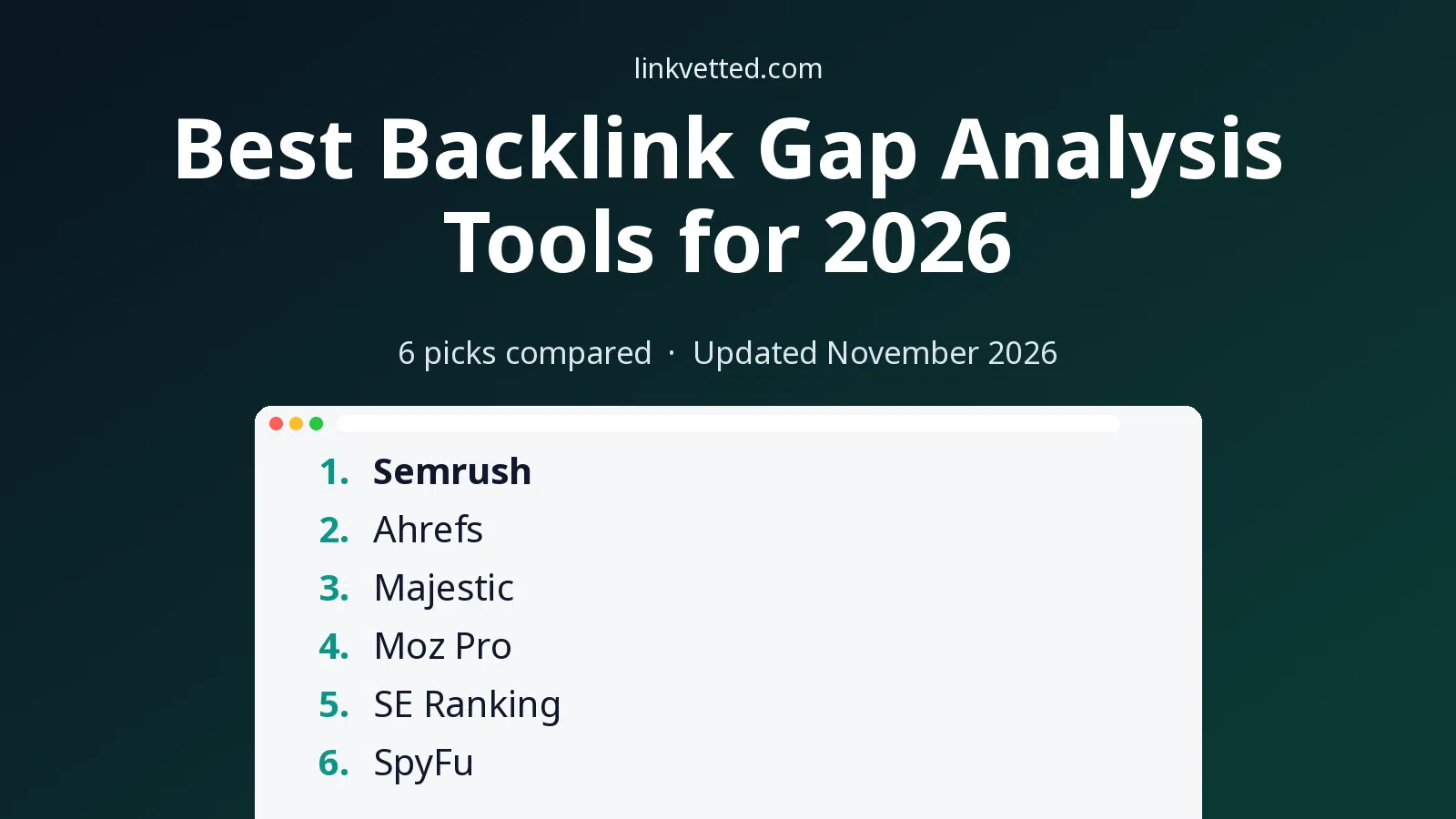
| Tool | Best for | Starts at | Free plan? | |
|---|---|---|---|---|
| Semrush | Multi-competitor gap comparison | See website | Free plan | Visit |
| Ahrefs | Deep link index and detail | See website | No free plan | Visit |
| Majestic | Link-flow and trust metrics | See website | No free plan | Visit |
 Moz Pro | Teams already using Moz | See website | Free trial | Visit |
 SE Ranking | Budget-conscious agencies | See website | Free trial | Visit |
 SpyFu | Quick competitor link checks | See website | No free plan | Visit |
The best backlink gap analysis tools compared
I put this list together from vendor documentation, public help pages and product descriptions, and I did not run hands-on tests of each platform. My aim was to match each tool to the gap-analysis job it handles best, and to be clear about where each one falls short.
Semrush is an all-in-one SEO platform with a backlink analytics section and a dedicated backlink gap tool. You enter your domain and up to several competitors, and it shows referring domains that link to the competitors but not to you. That makes it a natural fit for agencies that pitch against several rivals and need a shared view of the opportunities.
For gap analysis, the workflow is straightforward: add your domain and competitors, filter by authority or traffic, then export the list for outreach. Because the same platform also holds keyword and site audit data, you can cross-check whether a linking site is relevant before you spend time on a pitch. That saves switching between tools.
The main limit is cost and complexity. If you only need an occasional link check, the free plan will not cover heavy gap work, and smaller teams may find the paid tiers more than they need. Skip it if you want a single-purpose link tool.
- Compare several domains at once
- Broad backlink and competitor data
- Useful export and reporting options
- Full access needs a paid plan
- Interface can feel dense for new users
Ahrefs is a well-known SEO toolkit built around a large backlink index. Its backlink and referring domain reports are detailed, and you can compare your profile with competitors to spot domains that link to them but not to you. It suits teams that care about the quality and freshness of link data.
The gap workflow usually runs through the site explorer and link intersection views: pull competitor referring domains, filter out domains that already link to you, then sort by relevance. Exports are clean enough to hand to an outreach team. The depth is the draw, but it also means a learning curve.
The drawback is access. There is no free plan, and the paid tiers are a commitment for a solo operator. Skip Ahrefs if you mainly need competitor PPC data or a light monthly check rather than deep link research.
- Large, frequently updated link index
- Strong referring domain detail
- Good filtering and export
- No free plan
- Paid plans are a real commitment for small teams
Majestic is a link-focused platform that has built its reputation on link metrics such as Trust Flow and Citation Flow. It lets you compare link profiles across domains, which is the core of a gap analysis, and it presents the data in a way that suits people who think in terms of link quality rather than raw counts.
For gap work, you pull competitor backlinks, compare them with your own, and filter by trust metrics to prioritise the domains worth pursuing. The site comparison view is useful when you want to see several rivals at once. It is a practical choice for link builders who already know what they are looking for.
The trade-off is breadth. Majestic does not try to be a full SEO suite, so if you want keyword, content and technical tools in one place, you will need something else alongside it. There is also no free plan, so budget for a paid subscription.
- Long-standing link index
- Trust Flow and Citation Flow metrics
- Comparison views for multiple sites
- Fewer surrounding SEO features
- No free plan
Moz Pro is a long-running SEO platform with a link explorer that covers backlink and referring domain data. It includes comparison features that let you see links pointing to competitors, which you can then check against your own profile. It is a sensible pick if your team already uses Moz for other SEO work.
In practice, you use the link explorer to pull competitor backlinks, export them, and remove any domains that already link to you. The metrics are well known and easy to explain to clients, which helps when you present a gap report. The interface is approachable for people who are new to link analysis.
The main limitation is index depth compared with dedicated link tools. If your gap analysis depends on finding every possible linking domain, Moz may leave some gaps of its own. The free tier is a trial rather than an ongoing free plan, so treat it as an evaluation window.
- Familiar link metrics and interface
- Link explorer with competitor comparison
- Fits with other Moz SEO tools
- Link index smaller than some specialists
- Free access is limited to a trial
SE Ranking is an SEO platform aimed at agencies and smaller teams, with competitor and backlink research modules. It lets you compare your backlink profile with competitors and find referring domains you are missing, which is the gap-analysis job in a nutshell. It is a practical option when budget is a deciding factor.
The workflow is similar to other suites: enter your domain and rivals, review the domains that link to them but not to you, and export the list. Reports are clear enough to share with clients, and the platform covers rank tracking and audits as well, so you are not buying a single-purpose tool.
The limit is depth. SE Ranking's link data is not as extensive as the dedicated link platforms, so for very competitive niches you may want a specialist alongside it. The free tier is a trial, so plan for a paid plan if you use it regularly.
- Competitive and backlink research in one place
- Clear competitor comparison reports
- Reasonable fit for smaller teams
- Link data less deep than specialist tools
- Free access is a trial
SpyFu is best known for competitor research across paid and organic search, and it also includes backlink data. You can look at a competitor's links and compare them with your own to spot domains you are missing. It is a reasonable choice if you already use it for PPC research and want a quick link check in the same place.
For gap analysis, the backlink views are simpler than those in dedicated link tools. You can pull competitor links, compare them with your profile, and export for review. It works best as a first pass rather than a deep link audit, and it pairs well with a specialist tool when you need more detail.
The limitation is focus. SpyFu is built around competitor and PPC research, so its link data is not as deep as the dedicated platforms. There is no free plan, and if backlink gap analysis is your main job, a specialist tool will serve you better.
- Competitor research in one dashboard
- Backlink data alongside PPC data
- Simple comparison views
- Link data is not the core focus
- No free plan
How I chose
I built this list from vendor documentation, public help pages and product descriptions rather than from hands-on testing. For each tool I looked at whether it actually supports comparing several domains, how it presents referring domains that link to competitors but not to you, and whether the export and filtering options suit an outreach workflow. I also checked what each vendor says about its link index and how often it updates.
I then weighed fit and limits. A tool that is excellent for a large agency may be overkill for a solo consultant, and a budget platform may not have the link depth a competitive niche needs. I noted where each tool is weaker, such as smaller link indexes or the absence of a free plan, so you can match the choice to your situation. Where I was unsure about a detail, I left it out rather than guess.
What to check before you buy
- Confirm the tool lets you compare your domain against more than one competitor at the same time.
- Check whether you can filter out domains that already link to you, so the gap list is clean.
- Look at export formats and limits, since gap lists usually end up in a spreadsheet.
- Ask how often the vendor refreshes its link index, because stale data wastes outreach time.
- Check whether link metrics such as trust or authority scores are included and how they are calculated.
- Confirm the plan covers the number of domains and competitors you actually need each month.
FAQ
What is a backlink gap analysis?
A backlink gap analysis compares the sites linking to your competitors with the sites linking to you. The difference is your gap: referring domains that link to rivals but not to your site. You then review those domains for relevance and decide which are worth approaching. It is a planning exercise, not a guarantee that those links can be won.
Can I do backlink gap analysis for free?
Some tools offer a free plan or trial that covers a limited number of checks, which can be enough for a first look at one or two competitors. For regular work across several domains, most platforms require a paid plan. Check each vendor's current free offering before you rely on it, since terms change.
How many competitors should I compare?
Two to five competitors is a practical range for most gap analyses. Fewer gives a narrow view, while too many produces a long list that is hard to prioritise. Pick rivals that rank for the same terms and serve a similar audience, so the links you find are relevant to your own outreach.
Is a bigger link index always better?
Not always. A larger index can surface more opportunities, but relevance and freshness matter as much as size. A smaller index that updates often and covers your niche well may be more useful than a huge one full of irrelevant domains. Match the tool to the markets you actually work in.
Do these tools guarantee links or rankings?
No. Gap analysis shows where competitors have links and you do not, which helps you plan outreach. Whether a site links to you depends on your pitch, your content and the site owner's decision. No tool can promise links or rankings, and you should be sceptical of anyone who says otherwise.
Sources
- https://www.semrush.com
- https://ahrefs.com
- https://majestic.com
- https://moz.com
- https://seranking.com
- https://www.spyfu.com