Best AEO Analysis Tools in 2026: 8 Products Compared
Compare the best AEO analysis tools for tracking AI citations and brand mentions. We review 8 platforms for ChatGPT, Perplexity, and Google AI Overviews.
- Editor's choice
 Profound
Enterprise AI visibility programs
Starts atSee websiteVisit tryprofound.comFull review - Great alternative
 Peec AI
Prompt-level citation analytics
Starts atSee websiteVisit peec.aiFull review - Also consider
 Otterly.AI
Low-cost starting point
Starts at$29 per monthVisit otterly.aiFull review
TL;DR:
- AEO tools track whether AI answer engines mention or cite your brand, which a classic rank tracker does not show.
- Start with the engines your buyers actually use, such as ChatGPT, Perplexity, Gemini, or Google AI Overviews, and pick a tool that covers those engines.
- Otterly.AI is the lowest-cost entry point in this list, while Profound and Scrunch suit larger teams with more prompts and reporting needs.
- Prompt quality matters more than prompt volume. A small set of real buyer questions gives clearer answers than a large set of generic phrases.
- Check whether a plan limits prompts, brands, or seats before you sign up, since those limits drive the real monthly cost.
Quick comparison
| Tool | Best for | Starts at | Free plan? | |
|---|---|---|---|---|
| Profound | Enterprise AI visibility programs | See website | No | Visit |
| Peec AI | Prompt-level citation analytics | See website | No | Visit |
| Otterly.AI | Low-cost starting point | $29 per month | No | Visit |
 Scrunch AI | Monitoring plus content delivery | See website | No | Visit |
 Semrush | Teams already using an SEO suite | See website | No | Visit |
 Ahrefs | SEO teams adding brand tracking | See website | No | Visit |
 Writesonic | Tracking plus content help | See website | No | Visit |
 AthenaHQ | Prescriptive next steps | See website | No | Visit |
The best AEO analysis tools
Search is changing fast. Buyers now ask ChatGPT or Perplexity a question and read a short answer, often without clicking through to a website. The tools below help you see when your brand appears in those answers, when a competitor appears instead, and which pages earn citations.
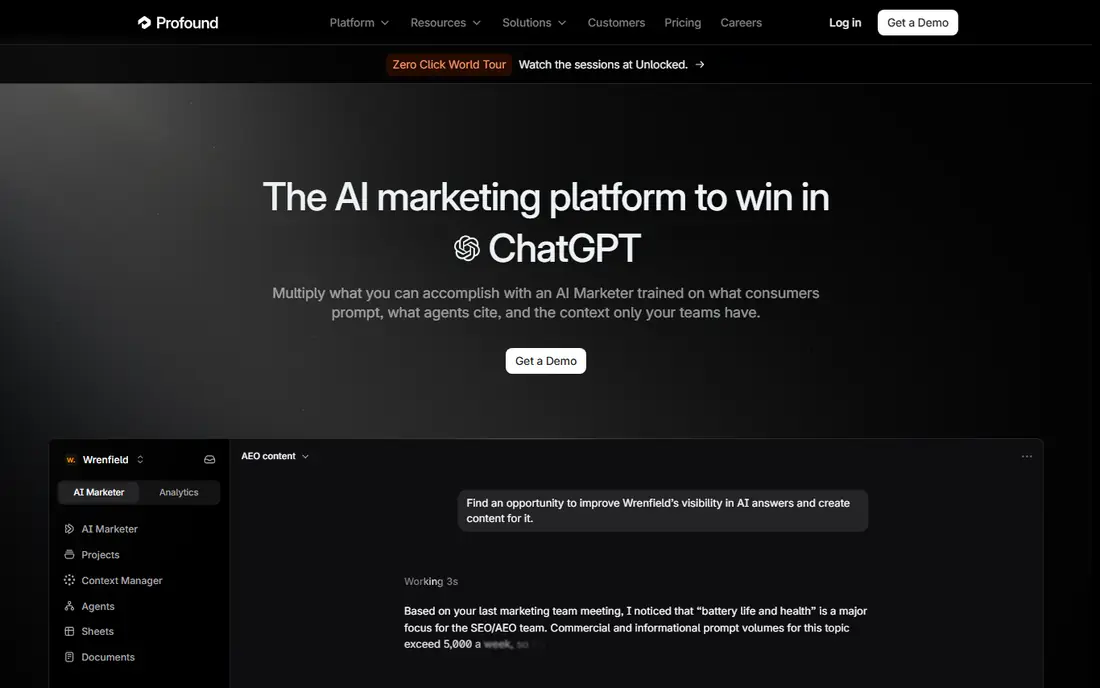
Profound is the enterprise pick in this list. It runs prompts across major AI engines, shows where your brand is cited, and compares your visibility with named competitors. For a large brand team, that daily view is the core value. You can see a change, trace it to specific prompts, and decide what to publish or fix next.
The platform also adds content creation and crawler analytics, which helps teams that want tracking and action in one place. The catch is scope and cost. A solo marketer or a small site will find the setup heavy, and entry pricing can rise quickly with prompt volume. Choose Profound when AI visibility is a formal program with an owner, not a side project.
- Tracks major AI engines daily
- Covers prompts, citations, and competitors
- Content and crawler tools in the same platform
- More tool than a small team needs
- Pricing is not simple to compare at a glance
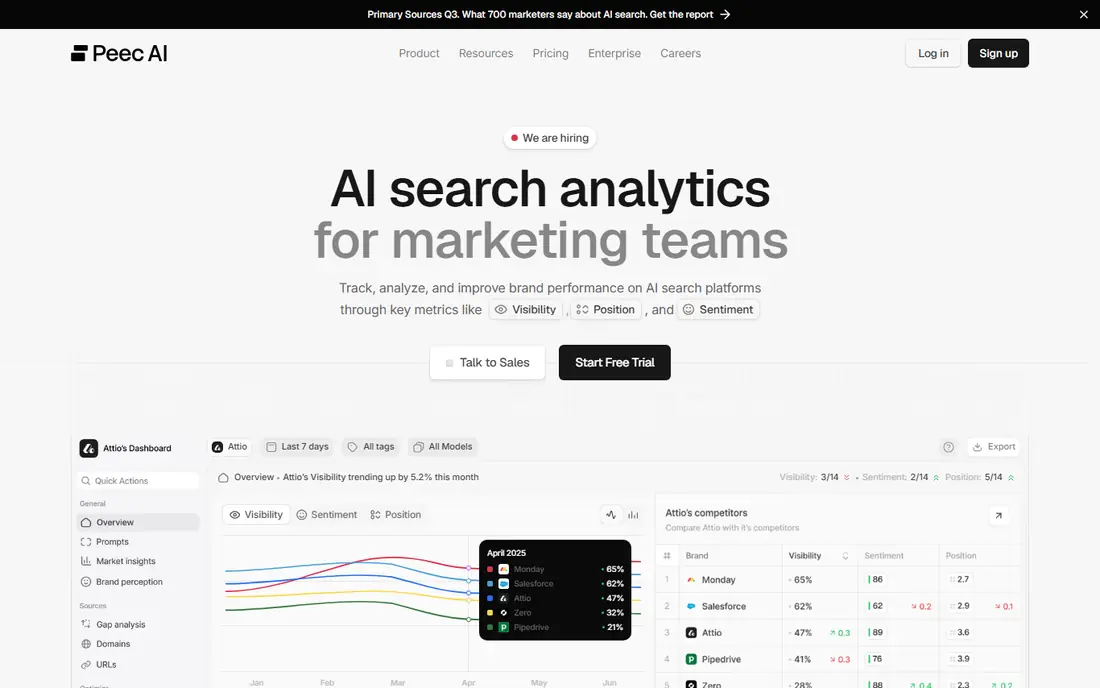
Peec AI appeals to teams that want clear numbers they can show to a client or a manager. Its dashboard breaks results down by prompt, engine, and citation, so you can see exactly which questions surface your brand and which ones do not. Screenshot audit trails help when a report needs proof, not just a score.
The limit is that Peec AI is mainly a monitoring tool. It tells you what is happening, but you still need a separate plan for fixing pages and creating new content. That is fine for agencies that already have a content workflow. It is less helpful if you want one tool to track, write, and publish.
- Clean dashboard for prompt-level results
- Daily tracking with audit trails
- Useful for agencies and multi-brand teams
- Focused on monitoring rather than content creation
- Higher cost than entry-level trackers
Otterly.AI is the sensible first step for a small team. Setup is quick, the entry price is low, and the reports focus on the basics: which prompts mention you, which cite you, and how you compare with competitors. That is enough to learn whether AI search matters for your niche before you spend more.
The base plan covers fewer engines, and some engines are add-ons, so check coverage for the tools your buyers use. Otterly.AI also does not generate content for you. Think of it as a measuring tool. If the measurements show a real gap, you can upgrade later or pair it with your existing content process.
- Lowest entry price in this list
- Fast setup
- Clear share-of-voice reporting
- Fewer engines on the base plan
- No in-platform content generation
Scrunch AI goes a step beyond tracking. It monitors how AI engines treat your brand, and it can serve pages shaped for AI crawlers without changing the pages people see. That second feature is the reason to consider Scrunch over a basic tracker, since it turns a report into a live change.
That depth comes with a higher price and a longer setup. Small teams may not need crawler delivery yet, and they may find the platform more complex than a simple dashboard. Scrunch fits teams that already track AI visibility and want to act on it at scale.
- Tracks many AI surfaces
- Serves AI-optimized pages to crawlers
- Persona and journey views included
- Higher entry price than basic trackers
- Setup takes more time
Semrush is the practical pick if you already pay for an SEO suite. Its AI visibility toolkit tracks citations in ChatGPT, Google AI features, Gemini, and Perplexity, and it sits next to the keyword and content tools your team already uses. That keeps reporting in one place instead of spreading it across vendors.
The drawback is that you are buying into a suite, not a single-purpose tracker. If you do not use the rest of Semrush, a focused AEO tool may cost less for the same tracking. Check whether the AI toolkit is included in your plan or priced as an add-on before you compare totals.
- AI visibility tools sit beside keyword, backlink, and content tools
- Large prompt database
- Familiar reporting
- AI features are an add-on to a larger suite
- Per-domain pricing can add up
Ahrefs Brand Radar tracks brand mentions across AI engines and the web, which suits SEO teams that already live in Ahrefs. You can pair a mention with backlink and content data, and you can research which competitor pages AI engines cite most often. That context helps when you need to explain why a page wins a citation.
Ahrefs is still, at heart, an SEO suite. Teams that want deep AEO workflows, such as prompt-level action plans and crawler delivery, will find more in a dedicated tool. Pick Ahrefs when brand tracking is one part of a wider SEO job, not the whole job.
- Strong backlink and content data behind brand tracking
- Trusted SEO reporting
- Good for competitor research
- AI visibility is newer than its core SEO tools
- Not a dedicated AEO platform
Writesonic suits content teams that want tracking and writing help together. You can see which prompts miss your brand, then work on pages that are easier for AI engines to quote. That loop is valuable for blogs, guides, and product pages that need regular updates.
The breadth is also the risk. Writesonic covers many marketing jobs, so the AEO features may not feel as deep as a dedicated tracker. It is a good pick when one vendor for tracking and content help matters more than the deepest possible AEO reporting.
- Combines AI visibility tracking with content optimization
- Useful for teams that publish often
- Clear FAQ and guide content
- Broad feature set can feel scattered
- Pricing depends on the modules you choose
AthenaHQ stands out for teams that ask, what do we do next. Its Action Center turns tracking data into suggested steps, such as pages to update or topics to cover. That helps a small marketing team that does not have a specialist to read raw prompt data all day.
The suggestions are a starting point, not a finished plan. You still need to check whether a recommendation fits your brand, your facts, and your audience. AthenaHQ works best when someone owns the follow-through, even if that person is not an AEO expert.
- Turns visibility data into clear action steps
- Tracks many AI engines
- Useful for teams without a dedicated AEO specialist
- Recommendations still need human review
- Pricing is not the cheapest entry point
How we picked these
We reviewed vendor feature pages, pricing pages, and public comparisons of AEO and GEO tools published in 2026. We favored tools that track citations or mentions in live AI answer engines, not tools that only optimize page copy. We checked engine coverage, prompt and brand limits, reporting depth, and whether content help was included or sold separately. We did not claim hands-on testing, and we listed pricing as shown on vendor sites or as See website where a plan price depends on volume or modules.
How to choose an AEO tool without overspending
Start with your buyers, not with a vendor demo. List the ten to twenty questions your buyers actually ask before they buy, then check which tools track those questions on the engines they use. A tool that covers ChatGPT but not Perplexity may still be right for you, or it may miss half your traffic. Engine coverage is a buying decision, not a detail.
Check the limits that drive cost
Prompt counts, brand counts, seat counts, and reporting history all affect price. A low headline price can rise quickly if you track many prompts or many client brands. Ask for a quote based on your real prompt list, not a demo list, and check whether unused prompts roll over or expire.
Judge the report, not the score
A single visibility score looks neat in a slide, but it hides the useful detail. Look for prompt-level results, cited URLs, competitor comparisons, and a history view that shows change over time. If you cannot trace a score back to a specific prompt and a specific answer, the score will not help you fix anything.
Keep content work separate at first
Tracking alone will not earn citations. Pages that answer a question directly, with clear facts and sources, tend to be easier for AI engines to quote. Before you buy a content module, test whether simple page updates based on tracker reports move your results. That test tells you whether you need a bigger platform or just better pages.
FAQ
What is the best AEO analysis tool?
There is no single best tool for every team. Profound suits enterprise programs, Peec AI suits prompt-level reporting, and Otterly.AI suits a low-cost start. Pick based on the engines you need, the number of prompts you will track, and whether you also need content help.
How is AEO different from SEO?
SEO tracks rankings and clicks in classic search results. AEO tracks mentions and citations inside AI-generated answers from tools such as ChatGPT, Perplexity, and Google AI Overviews. A page can rank well in Google and still never appear in an AI answer, which is why the two need different measurements.
Are AEO and GEO the same thing?
In practice, yes for most buyers. Answer engine optimization and generative engine optimization both describe work to earn mentions and citations in AI answers. Vendors use the terms in different ways, so judge a tool by its engine coverage and reporting, not by the acronym in its headline.
Is there a free AEO analysis tool?
Some vendors offer a free scan or a limited trial, but ongoing tracking is usually paid because each prompt run costs the vendor money. A free scan can be useful to test whether AI search matters for your brand, but it will not replace daily tracking over time.
How many prompts should I track?
Start with a small set of real buyer questions, usually ten to fifty, and expand only when you act on the results. A large prompt list that no one reviews gives noise, not insight. Add prompts when you launch a product, enter a market, or see a competitor appear in answers you used to win.