Best Uptime Monitoring for SaaS Platforms in 2026: Prices, Free Plans and 6 Picks
6 best uptime monitoring for SaaS platforms, compared on pricing, free plans and best-fit use. Trade-offs are spelled out for each entry. Straight answers.
- Editor's choice
 Checkly
Developer-led active reliability and scripted checks
Starts at$24 a monthVisit checklyhq.comFull review - Great alternative
 UptimeRobot
Quick, straightforward endpoint and keyword monitoring
Starts at$9 a monthVisit uptimerobot.comFull review - Also consider
 New Relic
Correlating telemetry to cut mean time to repair
Starts at$10 per user a monthVisit newrelic.comFull review
Direct answer
Start with Checkly if you need developer-led active reliability and scripted checks. Listed starting prices: Checkly from $24 a month, UptimeRobot from $9 a month and New Relic from $10 per user a month. If your case is different, UptimeRobot suits quick, straightforward endpoint and keyword monitoring and New Relic suits correlating telemetry to cut mean time to repair. The other 3 tools in the list cover narrower or pricier cases.
TL;DR:
- Top of the list is Checkly, which targets developer-led active reliability and scripted checks.
- For the cheapest start, look at UptimeRobot: $9 per month.
- Datadog Synthetic Monitoring suits user journey checks inside a bigger observability stack.
- A free plan is available from 4 of the 6 tools: Checkly, UptimeRobot, New Relic, Better Stack Uptime.
- What to know about New Relic first: wide product can overwhelm new users.
Last checked November 2026. Prices and plan details were read from the vendors' own pages in November 2026; vendors change plans often, so confirm the current price on the vendor site before you buy.
Quick comparison
| Tool | Best for | Starts at | Free plan? | |
|---|---|---|---|---|
| Checkly | Developer-led active reliability and scripted checks | $24 a month | Yes | Visit |
| UptimeRobot | Quick, straightforward endpoint and keyword monitoring | $9 a month | Yes | Visit |
| New Relic | Correlating telemetry to cut mean time to repair | $10 per user a month | Yes | Visit |
| Better Stack Uptime | Watches, heartbeats and status pages together | $9 per responder license a month | Yes | Visit |
| Dynatrace Synthetic Monitoring | Service levels and business transaction visibility | See website | Not stated | Visit |
| Datadog Synthetic Monitoring | User journey checks inside a bigger observability stack | See website | Not stated | Visit |
Our 6 uptime monitoring for SaaS platforms
LinkVetted compared 6 uptime monitoring for SaaS platforms. The goal is a practical shortlist: published prices, free plan facts, best-fit use cases and honest limits for every entry.
Checkly targets developer-led active reliability and scripted checks. Since it is developer-oriented, teams without scripting comfort may face a steeper ramp-up time. Consider alternatives when non-technical staff must run monitoring day to day.
Drawbacks to consider: Assumes scripting comfort.
In practice, Checkly describes itself as the active reliability layer for developers and agents, built from the ground up to be operated by technical teams and to provide a clear signal of application health. It is a natural fit where developers own reliability straight instead of handing it to a separate operations function. The starting price for Checkly: $24 per month. Free access exists with Checkly.
- Made for developer and agent operation
- Clear signal of application health
- Narrower than full observability suites
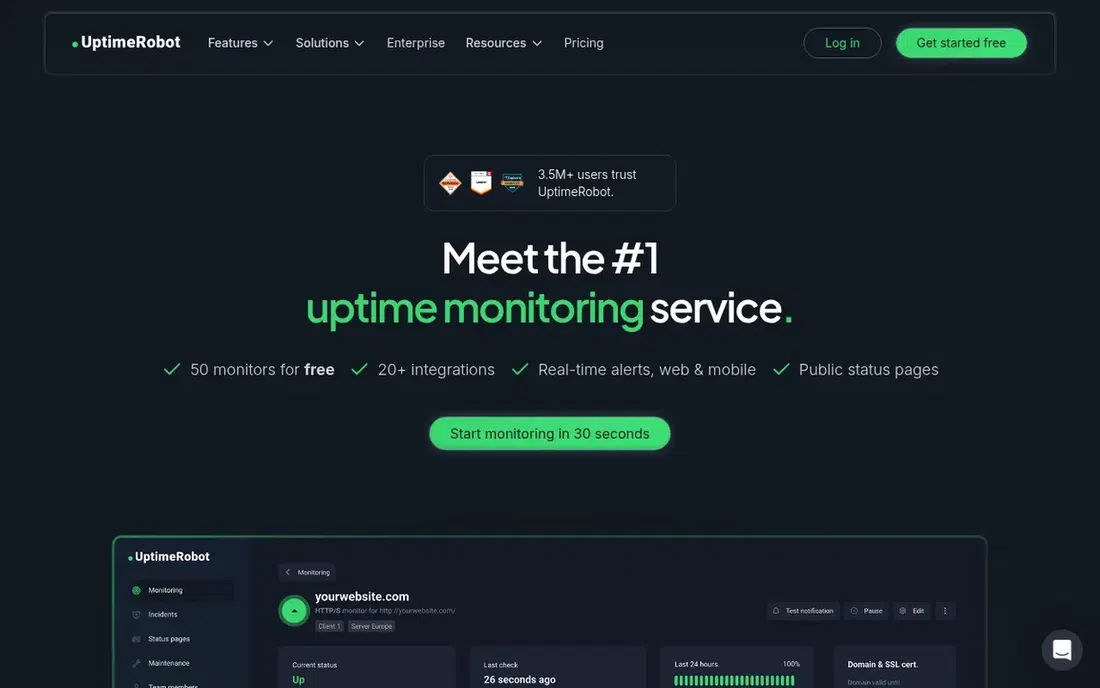
UptimeRobot serves quick, straightforward endpoint and keyword monitoring. It is a reasonable starting point for smaller engineering groups establishing entry-level alerting discipline. Its strength is simplicity, so teams needing scripted multi-step browser journeys or deep telemetry correlation will likely want a more specialized system.
Upsides: Fast start with minimal setup.
Downsides: Advanced needs may outgrow entry-level checks.
In practice, keyword and cron checks include numerous typical cases but are not a substitute for full journey testing. Choose something else when reliability requirements extend well beyond reachability and content assertions. The starting price for UptimeRobot: $9 per month. UptimeRobot includes a free tier.
- SSL
- Keyword and cron monitoring
- Less depth for complicated user journeys
New Relic works best for correlating telemetry to reduce mean time to repair. New Relic is an AI-powered observability system that correlates telemetry across a whole stack so teams can isolate root cause and cut mean time to repair.
Downsides: Uptime checks are one part of a bigger suite.
If your need is a light availability alarm with minimal setup, a dedicated uptime service may be the more practical starting point. The breadth that makes it capable can also make it complicated for teams seeking only straightforward uptime checks. New Relic starts at: $10 per user per month. New Relic includes a free tier.
- Correlates telemetry across the stack
- AI-powered observability framing
- Wide platform can overwhelm new users
Better Stack Uptime
Best for: Watches, heartbeats and status pages together
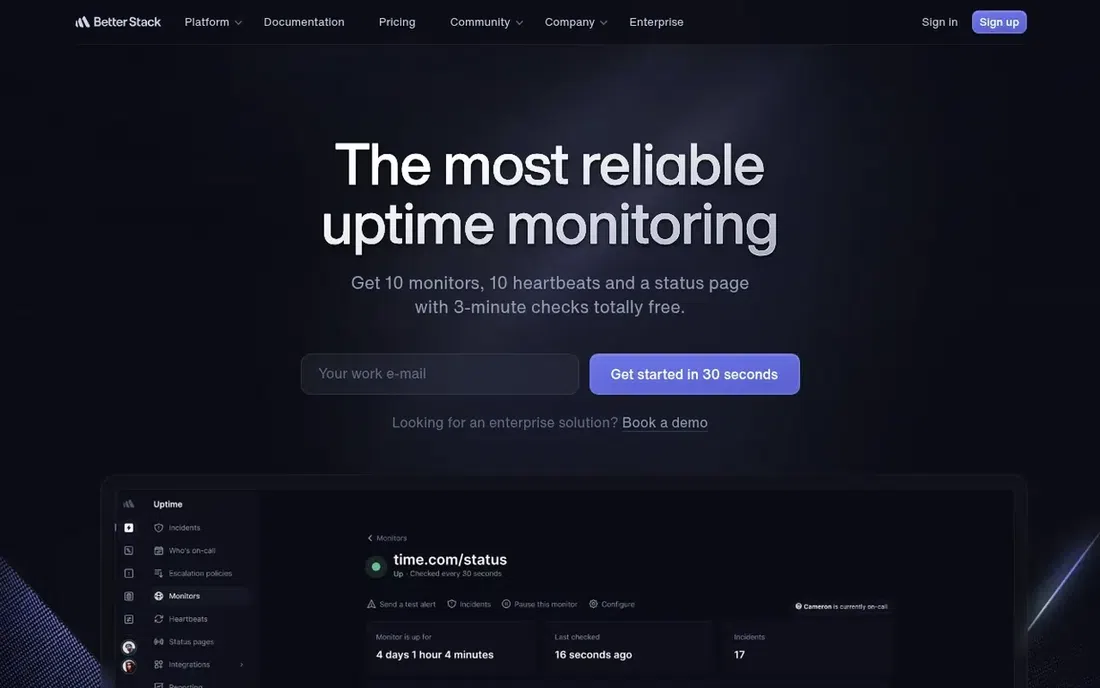
Pick Better Stack Uptime if this describes you: Watches, heartbeats and status pages together. Better Stack Uptime presents itself as dependable uptime monitoring that bundles watches, heartbeats and a status page in one offering.
Limits to weigh: Fewer deep synthetic journey features.
As for the details, organizations with deep synthetic testing or full-stack telemetry needs may find it complements instead of replaces a broader system. The bundle leans toward core uptime and communication instead of complex scripted browser journeys. Better Stack Uptime pricing: $9 per responder license per month. A free plan is available with Better Stack Uptime.
- Straightforward reliability bundle
- Merges uptime checks with heartbeats
- May be entry-level for large observability programs
Dynatrace Synthetic Monitoring
Best for: Service levels and business transaction visibility
Dynatrace Synthetic Monitoring is designed for service levels and business transaction visibility. SaaS teams that must report on service commitments and watch revenue-critical transactions can use it to link availability with business impact.
Watch-outs: Enterprise-oriented configuration.
Smaller teams may find the depth unnecessary for straightforward endpoint alerting. The product orientation means more configuration and governance than an entry-level uptime checker. Check the vendor site for Dynatrace Synthetic Monitoring pricing; none is listed in this comparison. As for free access: Not stated.
- Handles key business transactions
- Insight into service levels and availability
- More than straightforward uptime needs need
Datadog Synthetic Monitoring
Best for: User journey checks inside a bigger observability stack
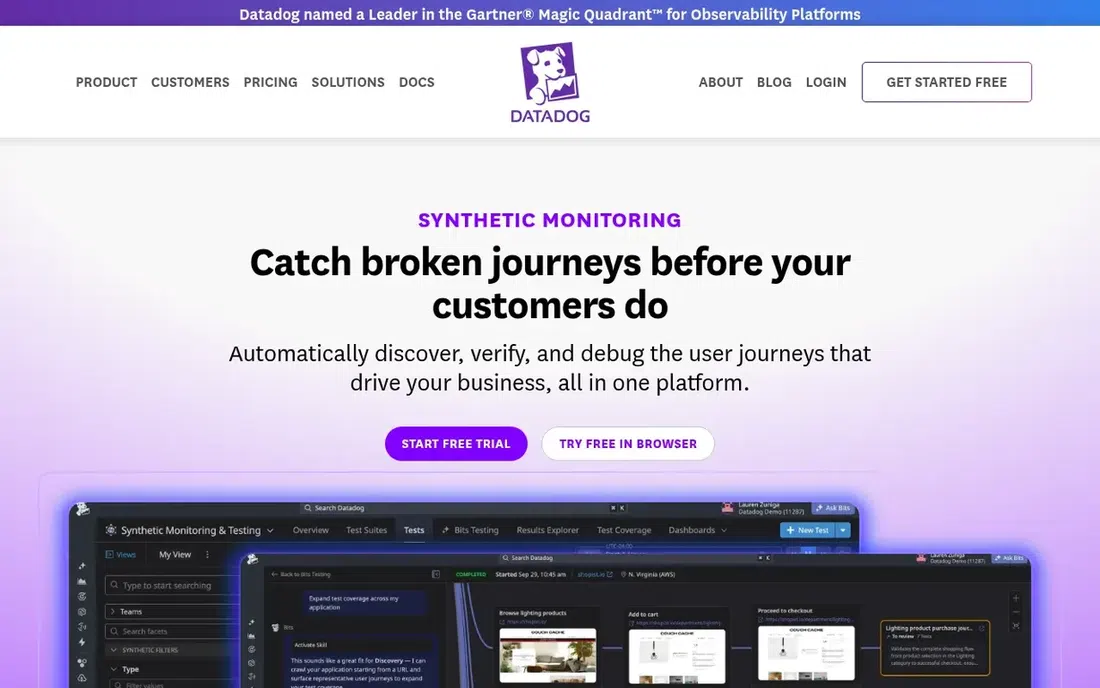
Datadog Synthetic Monitoring is designed for user journey checks inside a bigger observability stack. For SaaS teams, that means testing the flows customers actually rely on, like sign-in and core app paths, instead of only pinging a homepage.
The system orientation is also its primary limitation: teams wanting only a light uptime ping may find it more than they need. In daily use, if your priority is the fastest possible path to entry-level alerts, a more straightforward dedicated uptime service is worth considering instead. Check the vendor site for Datadog Synthetic Monitoring pricing; none is listed in this comparison. Free plan details: Not stated.
Watch-outs: Can be heavy for straightforward endpoint checks.
- Verification and debugging in one system
- Suits teams already using wide telemetry
- Best value comes from deeper product use
What went into this list
We compared the tools on published pricing, free plan or trial availability, feature coverage for uptime monitoring for SaaS platforms, and the limits each vendor documents. Plan names, prices and limits change often. Treat the figures here as a starting point and verify them with the vendor. Tools are placed by general fit for uptime monitoring for SaaS platforms, with price clarity and free access as tie-breakers. A different team can reasonably rank them differently.
A buyer's checklist
- Ask Dynatrace Synthetic Monitoring and Datadog Synthetic Monitoring for a written quote, since no starting price is shown.
- Read the fine print on the free plans from Checkly, UptimeRobot, New Relic and Better Stack Uptime; seat, project and feature caps differ.
- Read the limits listed for Checkly first: assumes scripting comfort.
- Test the integrations you rely on with Dynatrace Synthetic Monitoring before committing; some connectors sit on upper tiers.
- Price Checkly for your actual team size; headline prices rarely include add-ons or overage.
FAQ
How are the tools for uptime monitoring for SaaS platforms ordered?
The order follows typical fit for uptime monitoring for SaaS platforms, with Checkly first and Datadog Synthetic Monitoring last, then price clarity and free access. It is editorial judgement, not a score, so another team could rank the tools differently.
When is a dedicated uptime tool better than a full observability product?
If you chiefly need quick alerts when endpoints fail, a dedicated uptime service is quicker to set up and simpler to operate. Plenty of teams use both, with straightforward checks feeding into deeper analysis.
Should monitoring be owned by developers or operations?
It relies on how your team is structured. Developer-oriented tools like Checkly suit teams that maintain checks alongside application code. Broader products fit organizations with dedicated operations or site reliability functions.
Which options for uptime monitoring for SaaS platforms have a free plan?
Checkly, UptimeRobot, New Relic and Better Stack Uptime offer a free plan in this list. Free plans usually cap users, projects or features, so check the limits on the vendor page.
How do status pages fit into SaaS uptime monitoring?
A status page lets you communicate incidents to customers without ad hoc messages. Confirm whether the status page can be branded and updated rapidly during an incident.
Is Checkly the right pick for everyone comparing uptime monitoring for SaaS platforms?
No single tool suits every team. Checkly comes first because it fits developer-led active reliability and scripted checks, while UptimeRobot suits fast, simple endpoint and keyword monitoring and New Relic suits correlating telemetry to reduce mean time to repair. Match the tool to your own size, budget and workflow before deciding.
Sources
- https://www.checklyhq.com
- https://uptimerobot.com
- https://newrelic.com
- https://betterstack.com/uptime
- https://www.dynatrace.com/platform/synthetic-monitoring
- https://www.datadoghq.com/product/synthetic-monitoring