The 5 Best Optical Design Software in 2026, Ranked
Comparing the best optical design software? 5 contenders, each with entry cost, free tier and best-fit buyer. Concise write-ups of every option. Start here.
- Editor's choiceAnsys Speos
Optical system design and validation
Starts atPricing on requestVisit ansys.comFull review - Great alternative
 COMSOL Multiphysics
Multiphysics simulation including optics
Starts atPricing on requestVisit comsol.comFull review - Also considerTracePro
Illumination and stray light analysis
Starts atPricing on requestVisit lambdares.comFull review
Direct answer
If you need optical system design and validation, Ansys Speos is the first tool to look at here. Look at COMSOL Multiphysics for Multiphysics simulation including optics, and at TracePro for illumination and stray light analysis. The other 2 tools in the list cover narrower or pricier cases. None of these vendors publish plan prices, so pricing is on request for every option.
TL;DR:
- This list starts with Ansys Speos, which is built for optical system design and validation.
- For lens design and optimization, OSLO is worth a look.
- One limit worth knowing about TracePro: narrower focus than full lens design suites.
- No starting price is shown for any of the 5 tools, Ansys Speos and OSLO included, so plan time for sales calls.
Last checked November 2026. Pricing on request: vendors did not publish plan prices when this guide was last checked (November 2026), so ask each vendor for a written quote.
Quick comparison
| Tool | Best for | Starts at | Free plan? | |
|---|---|---|---|---|
| Ansys Speos | Optical system design and validation | Pricing on request | Not stated | Visit |
| COMSOL Multiphysics | Multiphysics simulation including optics | Pricing on request | Not stated | Visit |
| TracePro | Illumination and stray light analysis | Pricing on request | Not stated | Visit |
| Zemax OpticStudio | General optical, illumination, and laser design | Pricing on request | Not stated | Visit |
| OSLO | Lens design and optimization | Pricing on request | Free trial | Visit |
Every option for optical design software explained
This LinkVetted guide covers 5 options for optical design software. Each profile lists a starting price, free plan details, strengths and drawbacks, so you can drop poor fits quickly.
Ansys Speos
Best for: Optical system design and validation
Ansys Speos is designed for optical system design and validation. Ansys Speos is optical system design software for the design, optimization, visualization, and validation of optical systems.
Honest limits: Not a dedicated lens design tool.
It fits projects where optical design links to broader system validation and where a visual result helps communicate design intent. No starting price is listed for Ansys Speos here; confirm pricing on the vendor site. Free plan details: Not stated.
- Design, optimization, visualization, validation
- Handles complete optical systems
- Wide scope may need training
COMSOL Multiphysics works best for Multiphysics simulation including optics. COMSOL Multiphysics is software for multiphysics simulation, used by engineers and researchers to model real-world designs, devices, and processes across industries.
Points against: General system, not optics-specific.
Choose COMSOL when coupling optics with other physics is the priority and you can invest in learning the system. From a buyer's view, for optical work, it suits teams that require to couple optical effects with thermal, structural, or other physics in one model. No starting price is listed for COMSOL Multiphysics here; confirm pricing on the vendor site. Trial and free access: Not stated.
- Multiphysics simulation across physics areas
- Used by engineers and researchers
- Optical design may need add-on modules
TracePro
Best for: Illumination and stray light analysis
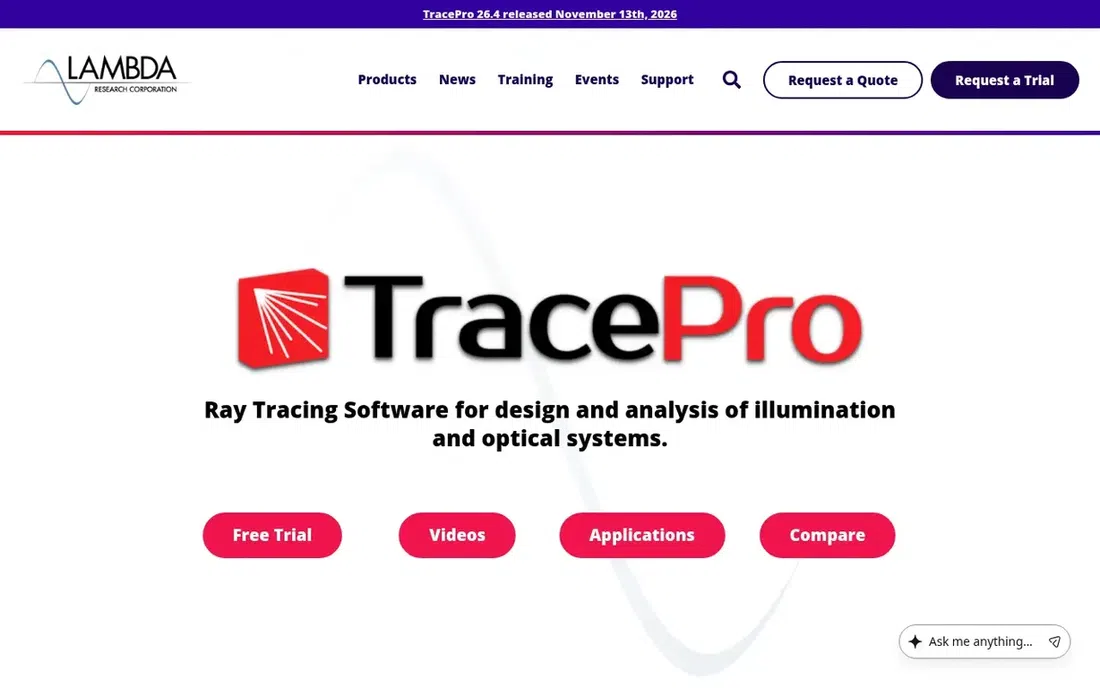
TracePro was built for illumination and stray light analysis. It supports CAD import and BSDF data, which helps when you have to bring in mechanical geometry or surface scattering information.
It suits engineers whose primary task is understanding how light propagates in illumination systems or how stray light reaches detectors. No starting price is listed for TracePro here; confirm pricing on the vendor site. Free plan details: Not stated.
What to check first: May not replace a dedicated lens design tool.
- Monte Carlo ray tracing for illumination and stray light
- CAD import supported
- Narrower focus than full lens design suites
Zemax OpticStudio
Best for: General optical, illumination, and laser design
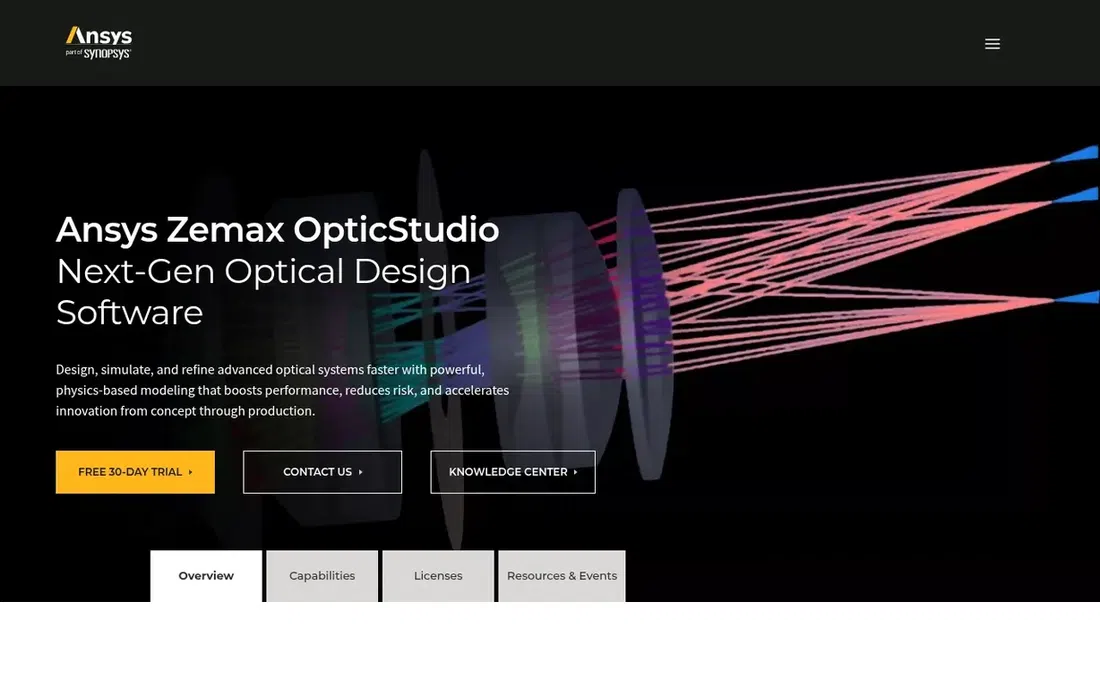
For general optical, illumination, and laser design, Zemax OpticStudio is a natural candidate. Ansys Zemax OpticStudio is described as the standard software for optical, illumination, and laser system design.
It lets you simulate, optimize, and tolerance designs within a single environment. On top of that, since it spans numerous design tasks, new users may need time to learn its workflow. Pricing for Zemax OpticStudio is not stated here, so ask the vendor for current figures. As for free access: Not stated.
The main drawbacks: Not centred on multiphysics beyond optics.
- Tolerancing in one tool
- Widely used as a standard for optical design
- Wide feature set may take time to learn
OSLO
Best for: Lens design and optimization
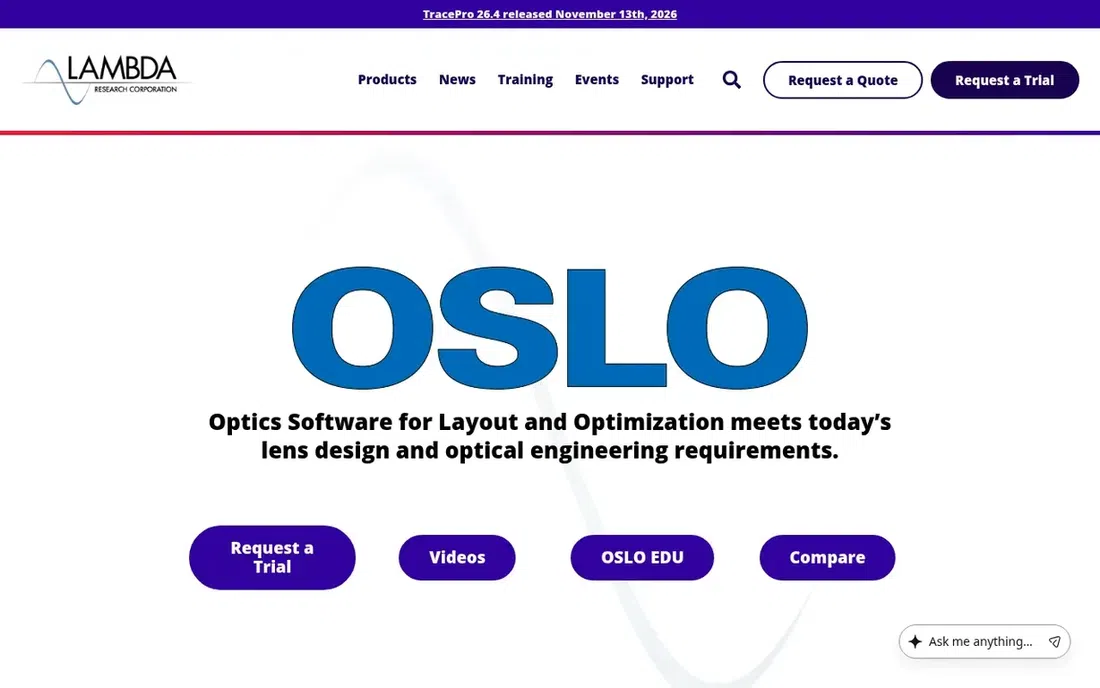
OSLO targets lens design and optimization. OSLO is lens design software for optical layout and optimization. Its vendor describes it as an established industry standard that is easy-to-learn and straightforward to use, helping move an optical project from conception through to prototype.
In daily use, if you need multiphysics coupling, a general simulation system may be a better fit. From a buyer's view, choose OSLO when lens layout and optimization are the primary tasks and you want a direct path from concept to prototype. OSLO is oriented toward lens design, so illumination and stray light studies may call for a different tool. No starting price is listed for OSLO here; confirm pricing on the vendor site. Free plan details: Free trial.
Where it is weaker: Less emphasis on illumination and stray light.
- Described as easy-to-learn and straightforward to use
- Optical layout and optimization
- Restricted multiphysics scope
How we compared the tools
LinkVetted used vendor pricing pages and product documentation as the base, then compared plans, free access and documented limits for 5 tools. Where a price is missing, the vendor does not list one publicly or ties it to a quote. Always confirm before budgeting. The order reflects how well each tool fits the most common buying scenario for optical design software, then price clarity, then free plan access. It is a starting point, not a verdict.
Questions to settle before buying
- Ask each vendor, from Ansys Speos to OSLO, for a written quote; none of them publishes a starting price.
- Take the trial from OSLO and push a live task through it before you pay.
- Read the limits listed for Ansys Speos first: wide scope may need training.
- Ask COMSOL Multiphysics how an export works before you move any records in; an easy exit lowers the risk.
- Map your must-have features to a specific Ansys Speos plan before you compare prices.
FAQ
How are the tools for optical design software ordered?
Ansys Speos sits first and OSLO last because the order follows typical fit for optical design software, then price clarity and free access. It is a judgement call, so read each profile for fit and limits.
What is the best optical design software overall?
Ansys Speos comes first here and is built for optical system design and validation. Buyers with other needs may prefer COMSOL Multiphysics (for Multiphysics simulation including optics) or TracePro (for illumination and stray light analysis). Compare costs and limits first.
Does any tool for optical design software here have a free plan?
No tool in this list, Ansys Speos and OSLO included, has a permanent free plan. OSLO offer a trial. Trials and quotes are the usual route, so plan a short evaluation period.
Can I try these options before paying?
Often, yes. OSLO offers a free trial. Use your own data and a real task during the test, and check what the free tier or trial limits before you rely on it.
Is Ansys Speos the right pick for everyone comparing optical design software?
No single tool suits every team. Ansys Speos comes first because it fits optical system design and validation, while COMSOL Multiphysics suits Multiphysics simulation including optics and TracePro suits illumination and stray light analysis. Match the tool to your own size, budget and workflow before deciding.
Sources
- https://www.ansys.com/products/optics/ansys-speos
- https://www.comsol.com
- https://www.lambdares.com/tracepro
- https://www.ansys.com/products/optics/ansys-zemax-opticstudio
- https://www.lambdares.com/oslo