Observability Pipeline Software for Remote Teams in 2026: The 6 Best Options Side by Side
6 best observability pipeline software for remote teams, compared on pricing, free plans and best-fit use. Every pick gets a straight assessment. No filler.
- Editor's choiceSumo Logic
Cloud log management with SIEM insight
Starts atSee websiteVisit sumologic.comFull review - Great alternative
 Dynatrace
AI-driven observability with automation and security
Starts at$7 per host a monthVisit dynatrace.comFull review - Also consider
 Splunk Observability Cloud
Large security and observability workloads
Starts at$6 a month, per CPU core, billed annuallyVisit splunk.comFull review
Direct answer
If you need Cloud log management with SIEM insight, Sumo Logic is the first tool to look at here. Listed starting prices: Dynatrace from $7 per host a month, Splunk Observability Cloud from $6 a month, per CPU core, billed annually and Grafana Cloud from $19 per month. Alternatives: Dynatrace for AI-driven observability with automation and security, and Splunk Observability Cloud for large security and observability workloads. The full list of 6 tools follows, with prices and free plan facts.
TL;DR:
- Top of the list is Sumo Logic, which targets Cloud log management with SIEM insight.
- What to know about Sumo Logic first: log-centric focus may limit some metrics depth.
- Splunk Observability Cloud, Grafana Cloud: these are the 2 tools out of 6 that offer a free plan.
- Splunk Observability Cloud has the lowest monthly starting price in this list: $6 per month, per CPU core, billed annually.
Last checked November 2026. Prices and plan details were read from the vendors' own pages in November 2026; vendors change plans often, so confirm the current price on the vendor site before you buy.
Quick comparison
| Tool | Best for | Starts at | Free plan? | |
|---|---|---|---|---|
| Sumo Logic | Cloud log management with SIEM insight | See website | Free trial | Visit |
| Dynatrace | AI-driven observability with automation and security | $7 per host a month | Free trial | Visit |
| Splunk Observability Cloud | Large security and observability workloads | $6 a month, per CPU core, billed annually | Yes | Visit |
 Elastic Observability | Search-driven observability on Elasticsearch | See website | Free trial | Visit |
 Grafana Cloud | Open-standards observability without lock-in | $19 per month | Yes | Visit |
 Datadog | Unified cloud monitoring across distributed stacks | $8 per committer a month | Free trial | Visit |
Our 6 observability pipeline software for remote teams
LinkVetted compared 6 observability pipeline software for remote teams. The goal is a practical shortlist: published prices, free plan facts, best-fit use cases and honest limits for every entry.
Sumo Logic
Best for: Cloud log management with SIEM insight
Sumo Logic targets Cloud log management with SIEM insight. Remote teams running SaaS-heavy environments can centralize logs and security signals in one place, which helps distributed responders investigate incidents with consistent data rather than hopping between vendor consoles.
The system leans toward log management and security analytics, so teams needing deep distributed tracing or profiling should confirm coverage suits their stack. Sumo Logic shows no starting price here, so confirm the cost on the vendor site. As for free access: Free trial.
Drawbacks to consider: Log-centric focus may limit some metrics depth.
- Cloud monitoring and log management
- Live insights for SaaS apps
- Security and ops data need shared governance
Dynatrace is aimed squarely at AI-driven observability with automation and security. Remote teams that want automation to carry routine analysis and remediation work can benefit from that consolidated approach, notably when operations and security responsibilities overlap.
The combined scope means teams should roll out capabilities in stages and confirm which modules match their workflows. In practice, organizations seeking a narrow monitoring tool may find the platform bigger than necessary. Dynatrace cost at the entry level: $7 per host per month. Free options: Free trial.
Where Dynatrace stands out: AI and automation. Limits to weigh: Adoption needs structured rollout.
- Bundles application security
- Concentrated on business outcomes
- Wide scope can feel complicated
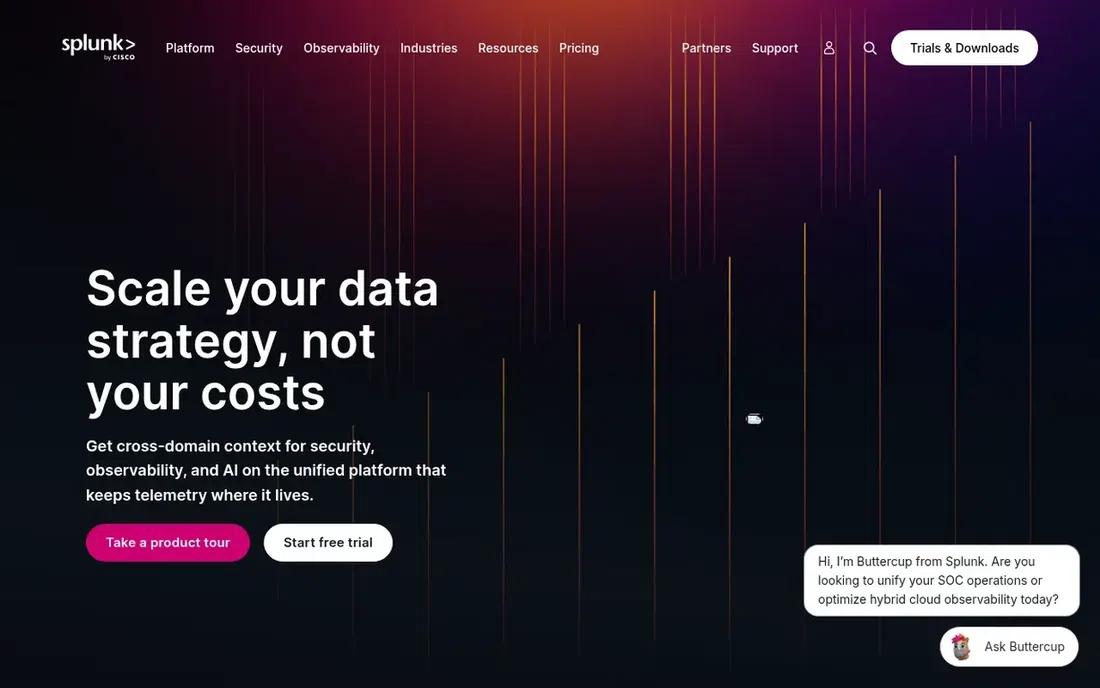
Choose Splunk Observability Cloud for large security and observability workloads. Splunk positions its data system around unifying security and observability at petabyte scale, with trusted AI and machine-speed threat and downtime response.
What to check first: System breadth needs planning.
The product is wide, so teams should plan onboarding and data governance carefully instead of switching everything on at once. Starting cost for Splunk Observability Cloud: $6 per month, per CPU core, billed annually. You can start on Splunk Observability Cloud without paying.
- Trusted AI positioning
- Brings together security and observability
- Heavier for small teams
Elastic Observability is aimed squarely at search-driven observability on Elasticsearch. Teams that already depend on Elasticsearch for search or log analysis can extend that foundation into observability, giving remote engineers a familiar query model and a shared index of telemetry that supports quick investigation across distributed services.
In practice, deployment choices affect how much operational work stays with your team. Pricing for Elastic Observability is not stated here, so ask the vendor for current figures. Free access: Free trial.
Limits to weigh: Operational ownership varies by deployment.
- Deployable data product
- Powered by Elasticsearch
- Search-first model needs tuning
Think of Grafana Cloud for open-standards observability without lock-in. Grafana Cloud is presented as a full-stack observability system built on open standards that brings together metrics, logs, traces, profiles and business data whereas helping teams avoid lock-in.
For remote teams, open standards mean dashboards and queries stay portable and engineers familiar with Grafana tooling can contribute rapidly, which eases onboarding across distributed squads. Entry price for Grafana Cloud: $19 per month. Grafana Cloud offers a free plan.
Best features of Grafana Cloud: Built on open standards. Honest limits: Assembly of sources takes planning.
- Traces and profiles
- Avoids lock-in
- Several data types can complicate governance
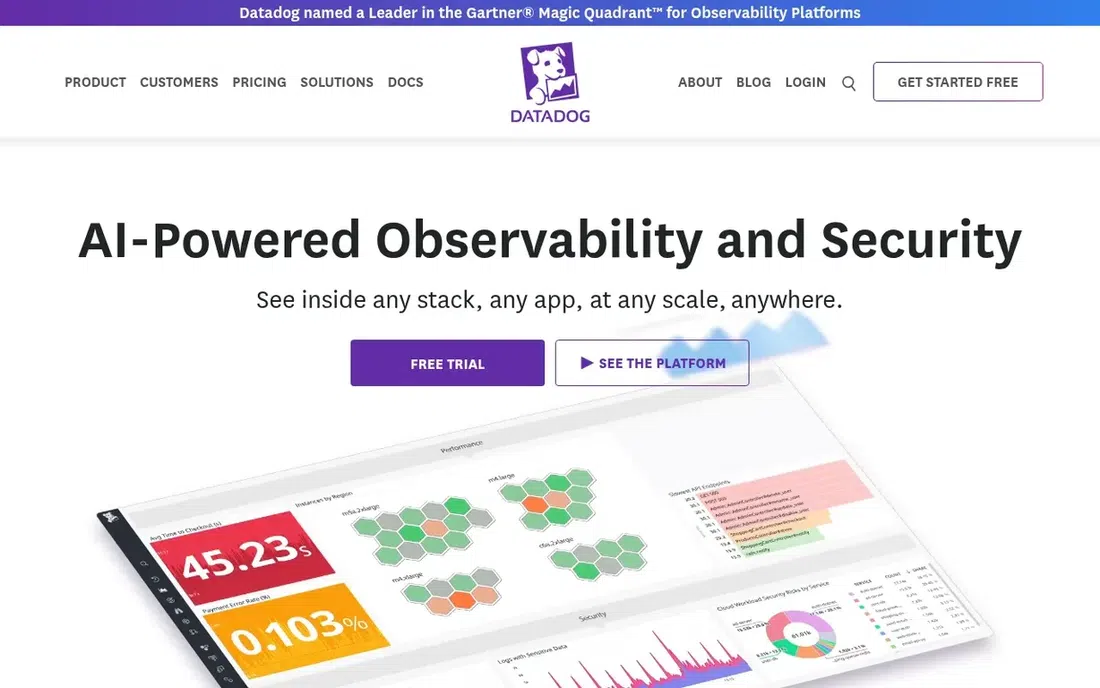
Datadog makes the most sense for unified cloud monitoring across distributed stacks. The breadth that makes Datadog useful can also make initial setup and navigation busy for smaller teams without dedicated product staff. For everyday use, consider alternatives if you chiefly need open-standards tooling or deep security analytics in the same system.
For everyday use, telemetry volumes drive how much work the pipeline carries. So teams with tight budgets may want to scope which metrics and logs they send first. Worth adding: for remote teams, that central view matters since engineers across locations can share the same dashboards and alerts instead of reconciling separate tools. Entry price for Datadog: $8 per committer per month. Free options: Free trial.
Watch-outs: Costs scale with telemetry volume.
- Cloud monitoring as a service
- Single place for metrics from apps and services
- Feature depth can overwhelm new teams
What went into this list
The comparison looks at four things: starting price, free access, how well the feature set matches observability pipeline software for remote teams, and the main limit of each tool. Where a price is missing, the vendor does not list one publicly or ties it to a quote. Always confirm before budgeting. Order on the page follows fit for the typical buyer first, then price transparency and free access. Your own requirements should decide the final pick.
A buyer's checklist
- Get a written quote from Sumo Logic and Elastic Observability; the list shows no starting price for them.
- Look at free plan limits closely: Splunk Observability Cloud and Grafana Cloud have one, and the caps decide whether it is usable for real work.
- Use real work to test the free trial from Sumo Logic, Dynatrace, Elastic Observability and Datadog, rather than a demo project.
- Read the limits listed for Sumo Logic first: log-centric focus may limit some metrics depth.
- The entry price of Splunk Observability Cloud is only the starting point; model the full cost with seats and extras.
- Pick one real project and run it in Sumo Logic first; a small pilot shows fit faster than a checklist.
FAQ
Do these products replace existing monitoring tools?
Commonly they consolidate multiple tools instead of replace everything at once. Teams usually migrate sources in stages, starting with the telemetry that causes the most incident friction. Confirm integration and data governance plans before retiring existing tooling.
How do log-focused products differ from full observability suites?
Log-focused products for example Sumo Logic centralize logs and security signals, which fits SaaS-heavy environments. Match the choice to whether your incidents are typically log-driven or span the entire stack.
Is Sumo Logic the right pick for everyone comparing observability pipeline software for remote teams?
No single tool suits every team. Sumo Logic comes first because it fits Cloud log management with SIEM insight, while Dynatrace suits AI-driven observability with automation and security and Splunk Observability Cloud suits large security and observability workloads. Match the tool to your own size, budget and workflow before deciding.
Do these tools publish their prices?
Not all of them. Sumo Logic and Elastic Observability publish no starting price, so expect a quote request for those. The rest, Dynatrace included, show a starting price, though seats and billing terms still change the final cost.
What is the cheapest option for observability pipeline software for remote teams in this list?
On published monthly entry prices, Splunk Observability Cloud is the lowest here at $6 per month, per CPU core, billed annually. Entry price is only part of the cost, because seats, add-ons and billing terms can change the total. For the full picture, the cards above cover all 6 entries of this observability pipeline software for remote teams list, including price, free plan and limits.
How are the tools for observability pipeline software for remote teams ordered?
Sumo Logic sits first and Datadog last because the order follows typical fit for observability pipeline software for remote teams, then price clarity and free access. It is a judgement call, so read each profile for fit and limits.
Sources
- https://www.sumologic.com
- https://www.dynatrace.com
- https://www.splunk.com
- https://www.elastic.co
- https://grafana.com
- https://www.datadoghq.com