Best Data Observability Tools in 2026: 8 Platforms Compared
Compare the best data observability tools in 2026, from Monte Carlo and Bigeye to Soda, Acceldata, Databand, Metaplane, Elementary, and Sifflet for data teams.
- Editor's choice
 Monte Carlo
Data quality at scale
Starts atSee websiteVisit montecarlodata.comFull review - Great alternative
 Bigeye
Developer-led monitoring
Starts atSee websiteVisit bigeye.comFull review - Also consider
 Soda
Data quality checks in pipelines
Starts atSee websiteVisit soda.ioFull review
TL;DR:
- Monte Carlo is the most complete choice for data quality, lineage, and incident management at scale.
- Bigeye suits developer-led teams that want code-based monitoring and API control.
- Soda and Elementary suit teams that want data quality checks inside dbt and existing pipelines.
- Databand suits pipeline-heavy teams that run Airflow, Prefect, or Dagster.
- Most tools are quote-based, so run a proof of concept on your own data before committing.
Quick comparison
| Tool | Best for | Starts at | Free plan? | |
|---|---|---|---|---|
| Monte Carlo | Data quality at scale | See website | Free trial | Visit |
| Bigeye | Developer-led monitoring | See website | Free trial | Visit |
| Soda | Data quality checks in pipelines | See website | Free trial | Visit |
 Acceldata | Enterprise data observability | See website | No | Visit |
 Databand | Pipeline observability | See website | Free trial | Visit |
 Metaplane | Small data teams | See website | Free trial | Visit |
 Elementary | dbt-native monitoring | Free | Yes | Visit |
 Sifflet | Unified data observability | See website | Free trial | Visit |
The best data observability tools
Data observability tools watch data freshness, volume, schema, distribution, and lineage, then alert the right owner before a broken dashboard reaches executives. These eight platforms cover that job for teams from a single dbt project to a large enterprise warehouse.
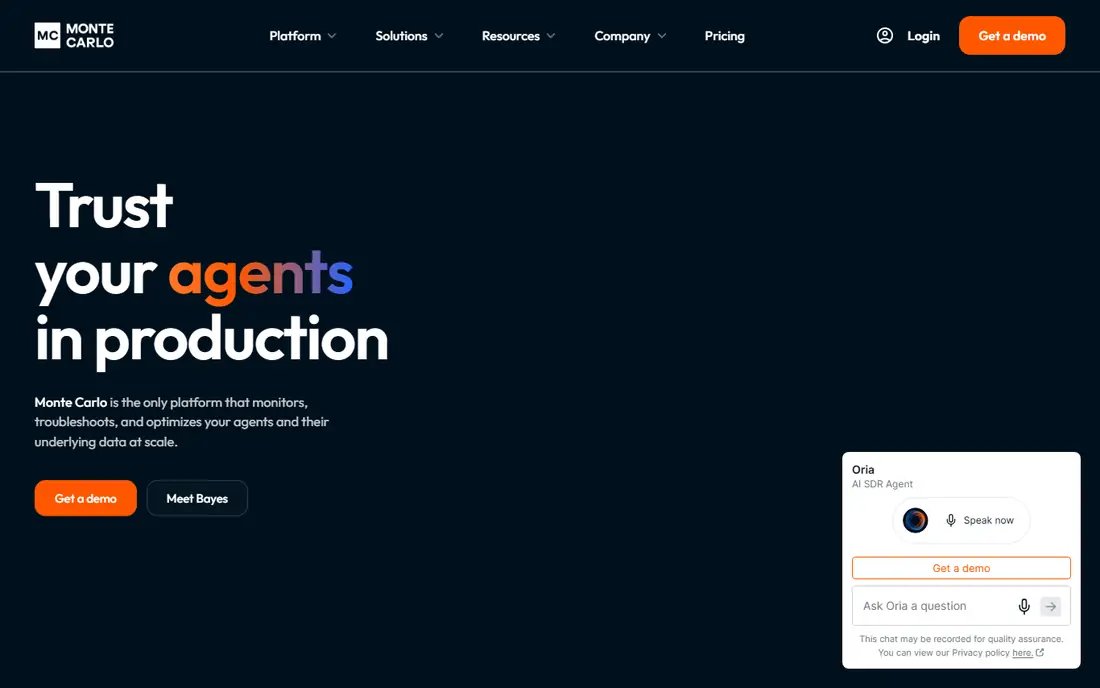
Monte Carlo is the category leader for a reason. It learns what normal looks like for each table, then alerts on freshness delays, volume drops, schema changes, and distribution shifts, with lineage to show which dashboards and downstream tables are affected. Incident workflows help data teams triage, assign, and resolve issues in one place.
The main barrier is price and scope. Monte Carlo is quote-based and aimed at mid-size to large data teams, so a small team with one warehouse may find it more than it needs. For a team where bad data regularly reaches stakeholders, the combination of monitoring, lineage, and incident management justifies a proof of concept first.
- Machine learning monitors for freshness, volume, and schema
- Lineage and incident workflows
- Broad warehouse support
- Pricing is quote-based and can be high
- Smaller teams may use only part of the platform
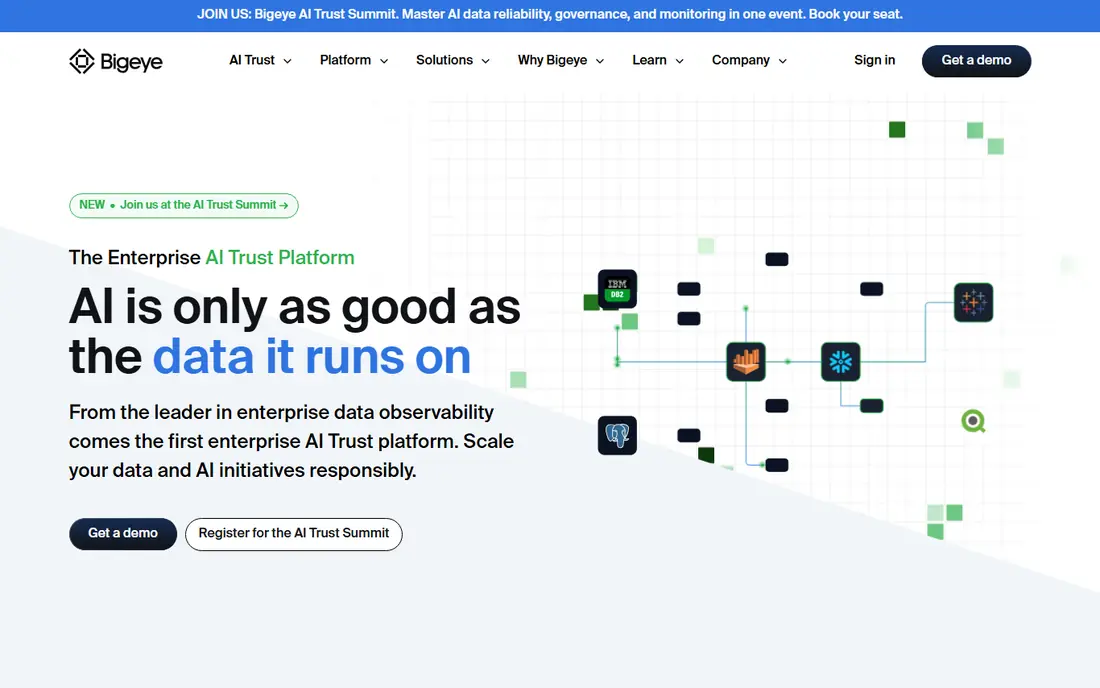
Bigeye suits data teams that prefer code to clicks. Metrics, thresholds, and anomaly detection can be defined in code, managed in version control, and deployed through CI, while an API-first design lets platform teams extend monitoring into their own workflows. An Airflow operator brings monitoring into pipeline jobs without switching tools.
Bigeye setup is more developer-led than guided, so a team without data engineering time may prefer a more opinionated tool. Pricing is also quote-based. For a platform team that already treats data pipelines as code, Bigeye gives control and consistency that dashboard-only tools cannot match.
- Code-based metrics and deltas
- API-first design
- Airflow operator and CI integration
- Pricing is quote-based
- Less guided setup than some rivals
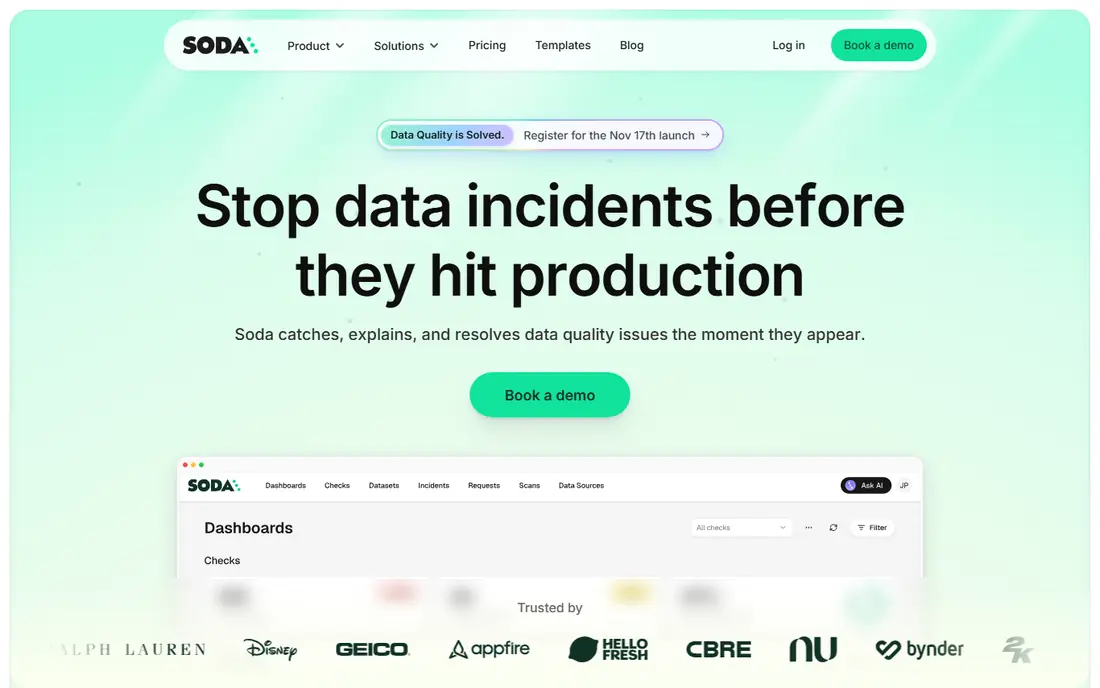
Soda focuses on data quality as code. Teams write checks in SodaCL, a readable language for freshness, completeness, validity, and custom rules, then run those checks in pipelines or on a schedule. Soda Library adds Python-native checks, and anomaly detection flags unusual patterns without a hand-written threshold for every column.
Soda works best when checks live inside pipelines, not as an afterthought dashboard. Teams that only want alerts without writing checks may prefer Monte Carlo or Metaplane. For data engineers who already use dbt or Airflow and want testable quality rules, Soda is a practical and focused choice.
- SodaCL checks in code
- Soda Library for Python
- Anomaly detection and data contracts
- Pricing is quote-based
- Best value comes with pipeline integration, not standalone use
Acceldata targets large enterprises with complex data estates. It combines data quality monitoring, pipeline observability, and cost insight in one platform, with governance features that suit regulated industries. That breadth helps a central data platform team manage many warehouses, lakes, and pipelines from one view.
Acceldata is not a small-team tool. Pricing and implementation are enterprise-scale, and a team with a single warehouse will not use most of the platform. For a large organisation that needs reliability, cost, and governance together, Acceldata is a strong shortlist candidate alongside Monte Carlo.
- Broad enterprise coverage
- Data quality, pipeline, and cost views
- Governance and reliability focus
- Enterprise pricing and implementation
- Heavier than small teams need
Databand answers a different question from Monte Carlo: how are pipelines running, not just what does the data look like. It tracks pipeline runs, task status, and lineage across Airflow, Prefect, and Dagster, so engineers can spot a failed or slow run before downstream tables go stale. An open source option gives teams a low-cost way to start.
Databand data quality checks are lighter than those in Monte Carlo or Soda, so many teams pair Databand for pipelines with a quality tool for tables. If your main pain is pipeline failures and slow runs, Databand is the right first pick. If bad values inside a successful run are the main pain, start with a quality-focused tool.
- Strong Airflow, Prefect, and Dagster support
- Pipeline lineage
- Open source option
- Data quality depth is lighter than Monte Carlo
- UI feels less polished than rivals
Metaplane is a good middle ground for small to mid-size data teams. Setup on a warehouse is fast, monitors cover freshness, volume, and schema changes, and lineage shows which dashboards depend on a broken table. Slack alerts keep the team informed without a separate incident tool for most cases.
Metaplane does not match Monte Carlo or Acceldata on enterprise governance or scale, but most small teams do not need that depth. If you run a modern warehouse, use dbt, and want alerts within days rather than a long implementation, Metaplane is an efficient choice and a useful Monte Carlo alternative.
- Fast setup on warehouses
- Anomaly monitors
- Lineage and Slack alerts
- Smaller scale than Monte Carlo
- Enterprise governance features are lighter
Elementary is the best starting point for a team already running dbt. It is open source and dbt-native, so it monitors dbt models, tests, and runs, sends Slack alerts when a model fails or data looks off, and shows lineage from dbt project files. Because it lives inside the dbt workflow, setup feels natural for dbt users.
Elementary is narrower than a full observability platform. It assumes dbt, and its coverage outside dbt pipelines is limited. Support on the free tier is community-led, with paid options for larger teams. For a dbt team that wants monitoring without a large vendor contract, Elementary is the lowest-cost credible start.
- Open source and dbt-native
- Monitors dbt tests and models
- Slack alerts and lineage
- Requires dbt
- Narrower warehouse scope than full platforms
- Support is community-led on free tier
Sifflet brings data quality, lineage, and incident management into one view, with both rule-based checks and machine learning monitors. Broad source support covers warehouses, lakes, and common BI tools, so a team can trace an issue from a dashboard back to a source table. Incident workflows help assign and track fixes.
Sifflet has a smaller market presence than Monte Carlo, so reference customers and ecosystem depth should be checked during a trial. Pricing is quote-based, as with most tools here. For a team that wants a unified platform but prefers an alternative to the largest vendor, Sifflet is a solid proof-of-concept candidate.
- Unified quality, lineage, and incident views
- Broad source support
- Rule-based and ML monitors
- Smaller market presence than Monte Carlo
- Pricing is quote-based
How we picked these
We compared official docs, pricing pages, and public reviews for data observability platforms available in 2026. We kept tools that monitor freshness, volume, schema, or distribution, offer lineage or incident workflows, and support common warehouses or orchestrators. We noted where pricing is quote-based and where an open source or free tier exists, because that changes the trial path for small teams.
How to choose a data observability tool
Start with your biggest data pain. If dashboards go stale because pipelines fail, start with Databand or a pipeline view inside your chosen platform. If values inside successful runs are wrong, start with Monte Carlo, Soda, or Elementary. If both pains exist, shortlist a unified platform and test it on your worst tables first.
Next, check coverage and alert quality. Confirm support for your warehouse, lake, orchestrator, and BI tool, then run monitors on a few tables for two weeks. A tool that alerts on every minor shift will be ignored, while a tool that misses a real break will lose trust. Tune thresholds with the team that owns each table, not in isolation.
Plan ownership and response
Assign an owner to each monitored table and a clear response path: who gets the alert, where the incident is tracked, and how downstream users are told. Without ownership, alerts become noise. With ownership, a monitor becomes a service-level agreement for data, and stakeholders learn to trust dashboards again.
Start small, then expand
Monitor your most important tables first, such as revenue, finance, and customer tables, then expand to the next tier. A proof of concept on 20 critical tables teaches more about alert quality, lineage accuracy, and team workflow than a broad rollout on 2,000 tables. Expand only when alerts are accurate and owners respond promptly.
FAQ
What is data observability?
Data observability is the practice of monitoring data health, including freshness, volume, schema, distribution, and lineage, so teams can detect, triage, and fix data issues before they affect decisions. It is similar to application observability, but for data pipelines and tables.
What is the best data observability tool?
Monte Carlo is the best overall choice for scale and completeness, while Bigeye suits developer-led teams and Soda or Elementary suit dbt-based teams. The best tool depends on whether your main pain is pipeline failures, data quality, or both.
Is there a free data observability tool?
Yes. Elementary is open source and free for dbt teams, and Trivy-style scanning is not a substitute, but for data, Databand offers an open source option. Most full platforms offer a free trial, not a lasting free tier, so check trial terms before a proof of concept.
How is data observability different from data quality?
Data quality checks test whether data meets rules, such as completeness or validity. Data observability adds freshness, volume, schema, lineage, and incident workflows, so teams can see when data breaks, where it breaks, and what it affects downstream.
Do I need data observability if I already use dbt tests?
dbt tests catch known issues in models, but they do not always catch freshness delays, volume drops, schema changes in sources, or pipeline failures outside dbt. Observability tools add those monitors and lineage, which is why many dbt teams add Elementary, Soda, or Monte Carlo alongside tests.
How long does it take to set up a data observability tool?
Small tools such as Metaplane or Elementary can monitor key tables within days. Enterprise platforms such as Monte Carlo or Acceldata take longer, because they need warehouse access, lineage mapping, alert tuning, and owner assignments across many tables.