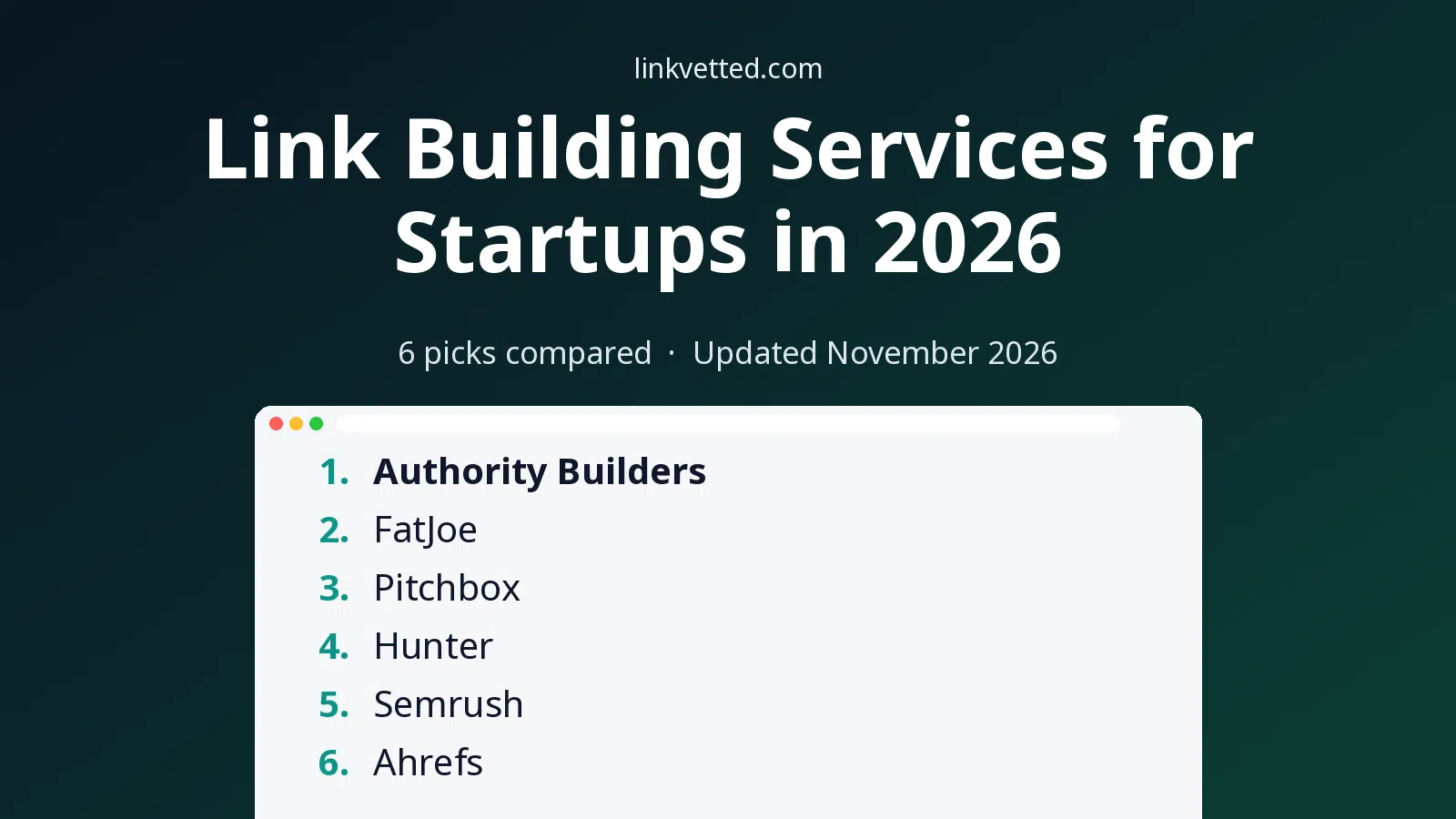
Link Building Services for Startups in 2026: The 6 Best Options Side by Side
A practical guide to the best link building services for startups in 2026, compared from vendor documentation and public sources by Shihab Mia.
- Editor's choice
 Authority Builders
Startups that want to approve each link
Starts atSee websiteVisit authority.buildersFull review - Great alternative
 FatJoe
Founders who want outreach handled
Starts atSee websiteVisit fatjoe.comFull review - Also consider
 Pitchbox
Teams running their own outreach
Starts atSee websiteVisit pitchbox.comFull review
Direct answer
My top pick for most startups is Authority Builders, because it lets you choose individual placements and review metrics before you commit, which suits a small budget and a young site. For startups that want done-for-you outreach, FatJoe is a sensible second option, and for teams that prefer to run outreach themselves with software, Pitchbox is the stronger fit.
TL;DR:
- Startups usually need a small number of relevant, editorially placed links rather than a large volume of cheap ones.
- Managed services save time but give you less control over which sites you appear on.
- Self-serve marketplaces let you approve each placement, which matters when your domain is new.
- Outreach software only works if you have the time to run campaigns and write pitches yourself.
- Always ask a vendor how they source sites and whether you can see the full list before paying.
Last checked November 2026. Plan prices are not quoted in this guide because they change often; see each vendor's own pricing page for current figures before you buy.
Quick comparison
| Tool | Best for | Starts at | Free plan? | |
|---|---|---|---|---|
| Authority Builders | Startups that want to approve each link | See website | Not stated | Visit |
| FatJoe | Founders who want outreach handled | See website | Not stated | Visit |
| Pitchbox | Teams running their own outreach | See website | Not stated | Visit |
 Hunter | Finding contact emails for outreach | See website | Free plan | Visit |
 Semrush | Startups already doing SEO in-house | See website | Free plan | Visit |
 Ahrefs | Research and prospecting before outreach | See website | Not stated | Visit |
The best link building services for startups compared
I put this comparison together from vendor documentation and public sources, including each company's own product pages and help content. I did not run hands-on tests of these services, so treat this as a starting point for your own checks rather than a lab result. The focus is on what fits a startup with a limited budget and a site that is still building authority.
Authority Builders is a marketplace where you browse a list of sites and choose the placements you want. Each listing shows details about the site so you can judge relevance before committing. For a startup, that control is useful because you can start with a handful of links to pages that genuinely relate to your product, rather than accepting a bulk package.
The workflow is straightforward: you filter the inventory, review the sites, and order the placements you approve. That fits a founder who wants to stay involved in link decisions without learning outreach from scratch. Because you see the site list first, you can avoid placements that look off-topic or thin.
The limit is that you are paying per placement, so a larger campaign adds up quickly. Skip it if you want a single fixed package with no review step, or if you would rather hand the whole process to an agency.
- You pick individual sites
- metrics are shown before you buy
- placements are editorial rather than automated
- Per-site pricing makes budgeting harder
- you need to spend time reviewing options
FatJoe is a link building service that handles blogger and publisher outreach on your behalf. You describe what you need, and the team sources placements and manages the conversation with site owners. It suits a startup founder who is stretched across product, sales and marketing and cannot run outreach personally.
For startups, the appeal is speed of setup. You do not need to build a prospect list or write pitches, which are the two tasks that stall most in-house link campaigns. The service is aimed at getting placements live without you managing the back-and-forth.
The trade-off is visibility. You get less say over which specific sites are used compared with a marketplace model. Skip it if you want to approve every domain before a link goes live.
- Managed outreach
- simple ordering process
- blog content explains link building basics
- Less control over individual sites
- you rely on the vendor's vetting
Pitchbox is outreach software rather than a link placement service. It helps you find prospects, send pitches and manage follow-ups from one place. For a startup with one person who can own link building, it turns a messy spreadsheet process into something repeatable.
The startup use case is control on a budget: you decide which sites to contact and what to say. You can run small, targeted campaigns around a product launch or a piece of original research, then track replies in the tool. That keeps your links relevant to your niche.
One limit: the work is still yours. If nobody has time to write pitches and follow up, the software will not produce links. Skip it if you want a done-for-you service.
- Manages prospecting and follow-ups
- works with your own email
- campaign reporting
- Requires your time to run campaigns
- you supply the prospect lists
Hunter is an email finding tool, not a link building service. You give it a domain, and it returns publicly available email addresses associated with that site. For startups, it fills a specific gap: once you have a list of sites you want links from, you need a way to reach the right person.
Used alongside outreach software or a spreadsheet, Hunter speeds up the prospecting stage. You can search by domain, check the addresses, and then send your pitch from your own inbox. It is a supporting tool in a link building workflow rather than the whole workflow.
Do not buy it expecting placements. It also will not write your pitches or manage replies. Skip it if you have already outsourced outreach entirely.
- Email finding
- domain search
- verification features
- Not a link building service
- results still need manual checking
Semrush is an SEO platform with a backlink analysis section. You can look at your own link profile, study competitors' backlinks, and find sites that link to similar businesses. For a startup, that research is often the first step before any outreach begins.
The practical use is prospecting. You identify domains that already link to competitors or to useful resources in your space, then build a target list. Combined with an email tool and some writing time, that gives you a low-cost link building process run in-house.
It is not a link building service, so do not expect placements. The subscription also covers many features you may not need yet. Skip it if you only want links delivered and have no interest in SEO data.
- Backlink analysis
- competitor link research
- broad SEO toolkit
- Link building is one feature among many
- no managed placements
Ahrefs is another SEO toolset with strong backlink data. You can inspect which sites link to a competitor, check the context of those links, and build a prospect list for your own outreach. For startups, it is a research tool that supports a manual link building effort.
The workflow is similar to Semrush: find linking domains, filter for relevance, then contact the site owners yourself or pass the list to a writer. The data helps you avoid wasting pitches on sites that look irrelevant or low quality.
It does not place links or run campaigns. The cost is also hard to justify if link building is your only task. Skip it if you want a managed service rather than a data subscription.
- Detailed backlink data
- site explorer
- useful for competitor research
- No outreach or placement service
- requires interpretation
How I chose
I selected these tools by reading vendor documentation, product pages and public help content, then matching each one to the realities of a startup: small budgets, limited staff time, and a domain that is still earning trust. I looked at whether a tool lets you see and approve sites, whether it handles outreach for you, and whether it supports an in-house process. I did not run hands-on tests, and I have not used every feature described here.
I also weighed the limits honestly. A marketplace gives control but needs your review time. A managed service saves time but reduces visibility. Software assumes you have hours to spend. Research tools assume you will act on the data. None of these is universally best, so the right pick depends on whether your constraint is money, time or control. Check current details on each vendor's site before you buy, since features and terms change.
What to check before you buy
- Ask whether you can see the full list of sites before any placement goes live.
- Confirm how the vendor sources sites and whether they accept paid or sponsored placements, and how those are disclosed.
- Check that placements are editorial and relevant to your niche, not generic directories.
- Ask what happens if a link is removed, and whether there is any replacement policy.
- Confirm you are not paying for links that violate search engine guidelines.
- Start with a small order or trial so you can judge quality before scaling spend.
FAQ
Are paid link building services safe for a startup?
It depends on how the links are sourced. Editorial placements on relevant sites, where the publisher chooses to link, are the safer route. Bulk packages of low-quality links carry risk. Ask each vendor how they source sites and whether placements are disclosed, then decide if the approach fits your risk tolerance.
How many links does a new startup site need?
There is no fixed number, and I would not trust anyone who gives you one. A new site usually benefits more from a small set of relevant links from sites in your industry than from a large volume of unrelated ones. Focus on relevance and a natural pace rather than a target count.
Should I use a service or do outreach myself?
Do it yourself if you have a writer and a few hours a week, because you keep control and spend less. Use a managed service if your time is better spent on product and sales. A marketplace sits in between: you approve placements but someone else handles the logistics.
Can I combine these tools?
Yes, and many startups do. A common setup is a research tool for prospecting, an email finder for contacts, and either outreach software or a managed service to run the campaign. Combining tools lets you cover research, contact and placement without relying on one vendor for everything.
What should I avoid when buying link building for a startup?
Avoid vendors who will not show you the sites, promise specific rankings, or sell large packages of unrelated links. Also be wary of anyone who cannot explain how placements are sourced. Start small, check the first batch of links, and only scale if the quality holds up.
Sources
- https://authority.builders
- https://fatjoe.com
- https://pitchbox.com
- https://hunter.io
- https://semrush.com
- https://ahrefs.com