Best Cap Table Management Software for Startups in 2026: 9 Tools Compared
Compare the best cap table management software for startups, from Carta and Eqvista to Ledgy and Cake Equity. See pricing, 409A, and fit for 2026 buyers.

- Editor's choice
 Carta
US Series A and beyond
Starts atFreeVisit carta.comFull review - Great alternative
 Eqvista
Early-stage value
Starts atFreeVisit eqvista.comFull review - Also consider
 Ledgy
European startups
Starts atSee websiteVisit ledgy.comFull review
TL;DR:
- Carta is our pick for US startups at Series A and beyond, thanks to law-firm acceptance and broad equity tools.
- Eqvista is the best value pick for early-stage firms, with a free tier to 20 stakeholders and clear per-stakeholder pricing.
- Ledgy suits European and cross-border startups that need EU compliance and multi-currency equity.
- Check 409A valuation cost, stakeholder caps, and migration help before choosing, since those drive total cost.
- Keep the cap table clean from day one, because errors compound with every round, grant, and transfer.
Quick comparison
| Tool | Best for | Starts at | Free plan? | |
|---|---|---|---|---|
| Carta | US Series A and beyond | Free | Yes | Visit |
| Eqvista | Early-stage value | Free | Yes | Visit |
| Ledgy | European startups | See website | Yes | Visit |
 Cake Equity | Pre-seed and APAC startups | $1,000 per year | Yes | Visit |
 Fidelity Private Shares | Bank-backed growth firms | Free | Yes | Visit |
 Capboard | Low-cost EU cap tables | $30 per month | Free trial | Visit |
 Qapita | Cross-border equity | See website | No | Visit |
 Morgan Stanley Shareworks | Public and late-stage firms | See website | No | Visit |
 Vestd | UK share schemes | See website | Free trial | Visit |
The best cap table management software for startups
A cap table records who owns a company, including founders, investors, employees with options, and holders of SAFEs and convertible notes. Good software keeps that record accurate, models future rounds, handles 409A valuations, and produces documents investors and lawyers trust. This guide is general information, not legal or tax advice.
Carta is the default cap table platform for many US startups, covering cap tables, option grants, SAFEs, 409A valuations, board consents, and liquidity tools. Its free Launch tier suits very early firms under set stakeholder and funding limits, while paid tiers scale to growth and pre-IPO companies. Law firms and investors know its reports, which speeds due diligence.
Paid pricing is not published as a simple list, and total cost depends on stage, stakeholders, and modules such as 409A and fund administration. Firms should get a written quote and ask about overage charges. For a US startup planning a Series A and beyond, Carta is our pick for acceptance and breadth.
- Widely accepted by US law firms and VCs
- Broad equity and fund tools
- Transfer agent services
- Paid pricing is quote-based
- Costs rise with stakeholders
- Add-ons add up
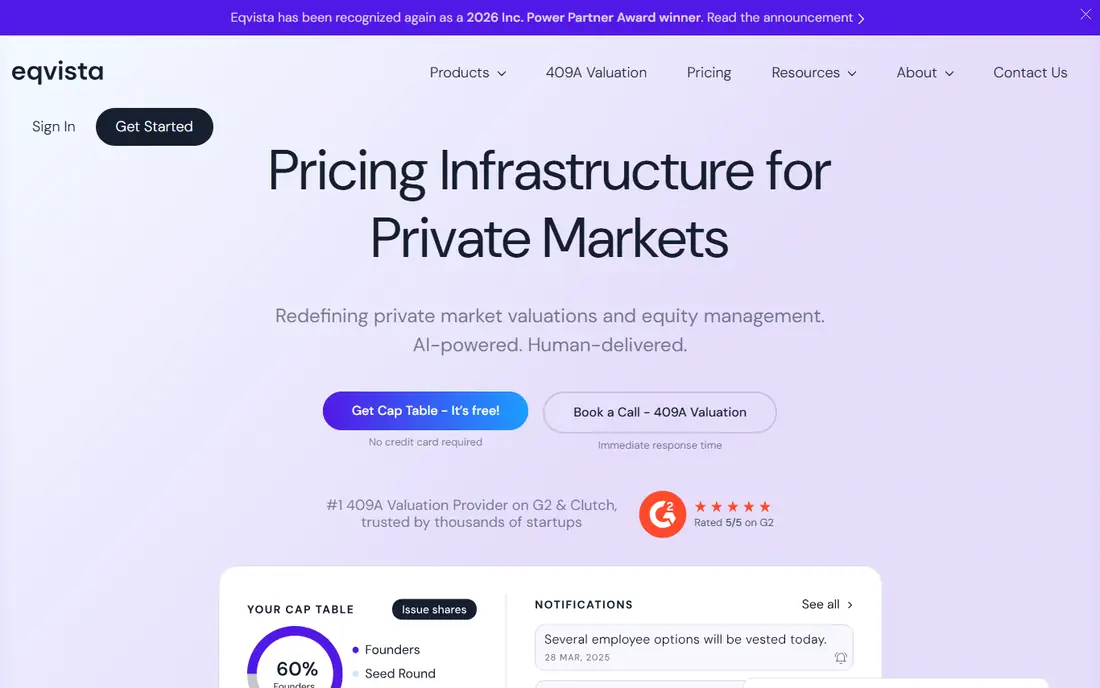
Eqvista offers cap table management, option plans, SAFEs, convertible notes, and 409A valuations, with a free tier for up to 20 stakeholders. Paid pricing is per stakeholder, which makes costs easier to predict as a firm grows, without sudden tier jumps. White-glove migration help is a practical plus for firms moving from spreadsheets.
Its ecosystem is smaller than Carta's, and some advanced compliance or liquidity features sit in higher plans. Firms that need deep US fund administration may still prefer Carta. For an early-stage startup that wants a clean cap table at a predictable price, Eqvista is the best value pick.
- Free to 20 stakeholders
- Clear per-stakeholder pricing
- Bundled 409A options
- Smaller ecosystem than Carta
- Some advanced features cost extra
- Support varies by plan
Ledgy is built for European and cross-border equity, with support for EMI, VSOP, BSPCE, and other local schemes, plus multi-currency and IFRS 2 reporting. It suits startups with teams and investors in several countries, where a US-only tool would struggle with local rules. Employee portals help staff understand their options and exercises.
Paid pricing is quote-based, and US-specific workflows are lighter than in Carta. Complex schemes still need legal review, since software does not replace counsel. For a European startup or a firm with EU investors and staff, Ledgy is a strong, focused choice.
- EU and cross-border compliance
- IFRS reporting
- Employee portals
- Quote-based paid pricing
- US features are lighter
- Setup needs care for complex schemes
Cake Equity, formerly Cake, offers cap table management and employee share plans for startups in Australia, Asia-Pacific, and beyond. A free tier for up to 5 stakeholders suits a tiny founding team, while paid annual tiers add stakeholders, reporting, and 409A-related help. The interface is simple, which helps founders who are setting up equity for the first time.
The free cap is low, and firms with many early angels or staff may move to paid tiers quickly. US-specific features are lighter than in Carta or Eqvista. For a pre-seed or APAC startup that wants a simple, affordable start, Cake Equity is a good pick.
- Simple for pre-seed firms
- APAC compliance focus
- Clear annual tiers
- Free tier caps at 5 stakeholders
- Advanced features cost more
- US depth is lighter
Fidelity Private Shares, formerly Shoobx, is a cap table and equity platform backed by Fidelity Stock Plan Services. It offers cap tables, option management, and compliance tools, with a free tier for early firms under stakeholder and funding limits. Its bank backing appeals to firms planning growth toward IPO, where stock plan continuity matters.
Pricing for larger firms is quote-based, and onboarding can feel more formal than in founder-led tools. The ecosystem is narrower than Carta's. For a startup that values a bank-backed platform and a path from early stage to public markets, Fidelity Private Shares is worth a look.
- Backed by Fidelity
- Free for early firms under limits
- Growth to IPO support
- Pricing for larger firms is quote-based
- Setup can be formal
- Ecosystem is narrower
Capboard is a low-cost cap table tool for early-stage European teams, with per-stakeholder pricing and a low monthly entry point. It covers cap tables, option pools, and basic fundraising modeling, which is enough for many pre-seed and seed firms. The simple pricing helps founders budget without a sales process.
It is a smaller vendor, so advanced compliance, secondary, and fund features are lighter than in Ledgy or Carta. Support resources are more limited. For a cost-conscious EU startup that needs a clean, simple cap table, Capboard is a practical budget pick.
- Low entry price
- EU focus
- Simple cap table and modeling
- Smaller vendor
- Advanced compliance features are lighter
- Support is more limited
Qapita offers cap table management, ESOP administration, valuations, and reporting for startups across Asia, the Middle East, and other cross-border markets. It suits firms with investors and staff in several countries, where local compliance and currency handling matter. Its tools link equity grants to valuations and board reporting.
Pricing is quote-based, and US-specific workflows may be lighter than in Carta. Firms should confirm local scheme support for each country where they have staff. For a cross-border startup outside the US and EU core, Qapita is a strong specialist option.
- Cross-border cap tables
- ESOP management
- Valuation and reporting tools
- Quote-based pricing
- Best in Asia and Middle East markets
- US depth varies
Morgan Stanley Shareworks, formerly Solium Shareworks, is an equity platform for late-stage and public companies, with global equity administration, payroll, and settlement tools. It handles complex, multi-country plans at scale, which suits firms approaching IPO or already public. Its backing and scale appeal to finance teams managing large participant counts.
Pricing is quote-based and high for startups, and setup is a major project. Pre-seed and seed firms will find cheaper, simpler tools. For a late-stage firm planning a public listing, Shareworks is a proven enterprise choice.
- Strong for public and late-stage equity
- Global payroll and settlement
- Morgan Stanley backing
- Quote-based and costly
- Complex setup
- Overkill for pre-seed firms
Vestd is a UK equity platform focused on share schemes, including EMI options, growth shares, and founder equity. It helps UK startups set up schemes, issue shares, and manage leavers and exercises, with legal document templates and guidance. That UK focus makes it easier for British founders than a generic US tool.
Global and US features are lighter, and pricing is quote-based. Complex cross-border schemes may need another platform or legal help. For a UK startup that wants a clear, local share scheme platform, Vestd is a smart choice.
- UK EMI and share scheme focus
- Founder-friendly setup
- Legal document help
- UK focus limits global use
- Pricing is quote-based
- Advanced modeling is lighter
How we picked these
We compared vendor feature pages, pricing transparency, stakeholder caps, 409A options, and geographic fit, plus public comparisons. We favored tools that are actively sold to startups in 2026, that handle SAFEs, options, and future rounds, and that cover US, EU, APAC, and UK needs. We left out tools that have closed to new customers or are winding down, since a cap table platform must be stable for years.
We did not test live cap tables with real equity data, and pricing for quote-based vendors varies by stakeholders, modules, and stage. Confirm a written quote and migration terms before moving a live cap table.
How to choose cap table software for startups
Start with stage, geography, and valuation needs, then check migration and legal fit.
Match the tool to your stage
Pre-seed firms with few stakeholders suit free tiers from Carta, Eqvista, Cake Equity, or Fidelity Private Shares. Seed and Series A firms need modeling, SAFE handling, and 409A support. Late-stage firms need fund, liquidity, and public-market tools. Buying a late-stage platform too early wastes money, while outgrowing a simple tool mid-round creates migration pain.
Check 409A and stakeholder costs
Ask what a 409A valuation costs, how often you will need one, and what happens when you pass a stakeholder cap. Some tools bundle valuations, while others charge per valuation. Model total cost at your next round size, not just today, since stakeholder counts jump after a priced round.
Confirm legal and investor acceptance
Ask your lawyer and lead investors which platforms they accept and what reports they expect. A tool that produces clean, lawyer-ready reports will save time in due diligence. Also confirm data export and migration terms, so you are not locked in if you outgrow the tool.
Keep the record clean from day one
Enter every grant, SAFE, note, transfer, and exercise promptly, with documents attached. Reconcile the cap table after each round and each option grant cycle. A clean record is the best defense against costly corrections later, no matter which software you choose.
FAQ
What is cap table management software?
Cap table management software records and manages company ownership, including founder shares, investor shares, employee options, SAFEs, and convertible notes. It models future rounds, tracks vesting and exercises, and produces reports for investors, lawyers, and boards. Good tools keep one accurate record instead of scattered spreadsheets.
What is the best cap table software for startups?
Carta is best for US startups at Series A and beyond, thanks to acceptance and breadth. Eqvista is best for early-stage value. Ledgy suits European startups, while Cake Equity suits pre-seed and APAC firms. The right pick depends on stage, geography, and valuation needs.
How much does cap table software cost?
Many tools offer free tiers for small stakeholder counts, with paid plans from about $30 per month to $1,000 per year at entry level. Larger firms pay quote-based annual fees that rise with stakeholders and modules. Always add 409A valuation costs and migration fees to the total.
Do I need a 409A valuation?
US startups that issue stock options generally need a 409A valuation to set a fair strike price and meet tax rules. Valuations are usually needed after funding rounds and at least annually. Some cap table tools bundle valuations, while others charge separately, so check this cost early.
Can I move my cap table from a spreadsheet?
Yes, most tools offer migration help, including white-glove imports from spreadsheets. Clean the spreadsheet first, reconcile share counts, and check every grant and SAFE before import. Ask the vendor how long migration takes and who checks the imported record.
Should my lawyer review my cap table software choice?
Yes, for any priced round, option plan, or cross-border scheme, legal review is wise. Software records ownership, but it does not replace legal advice on share classes, vesting, tax, and compliance. Share your shortlist with counsel before signing a long contract.